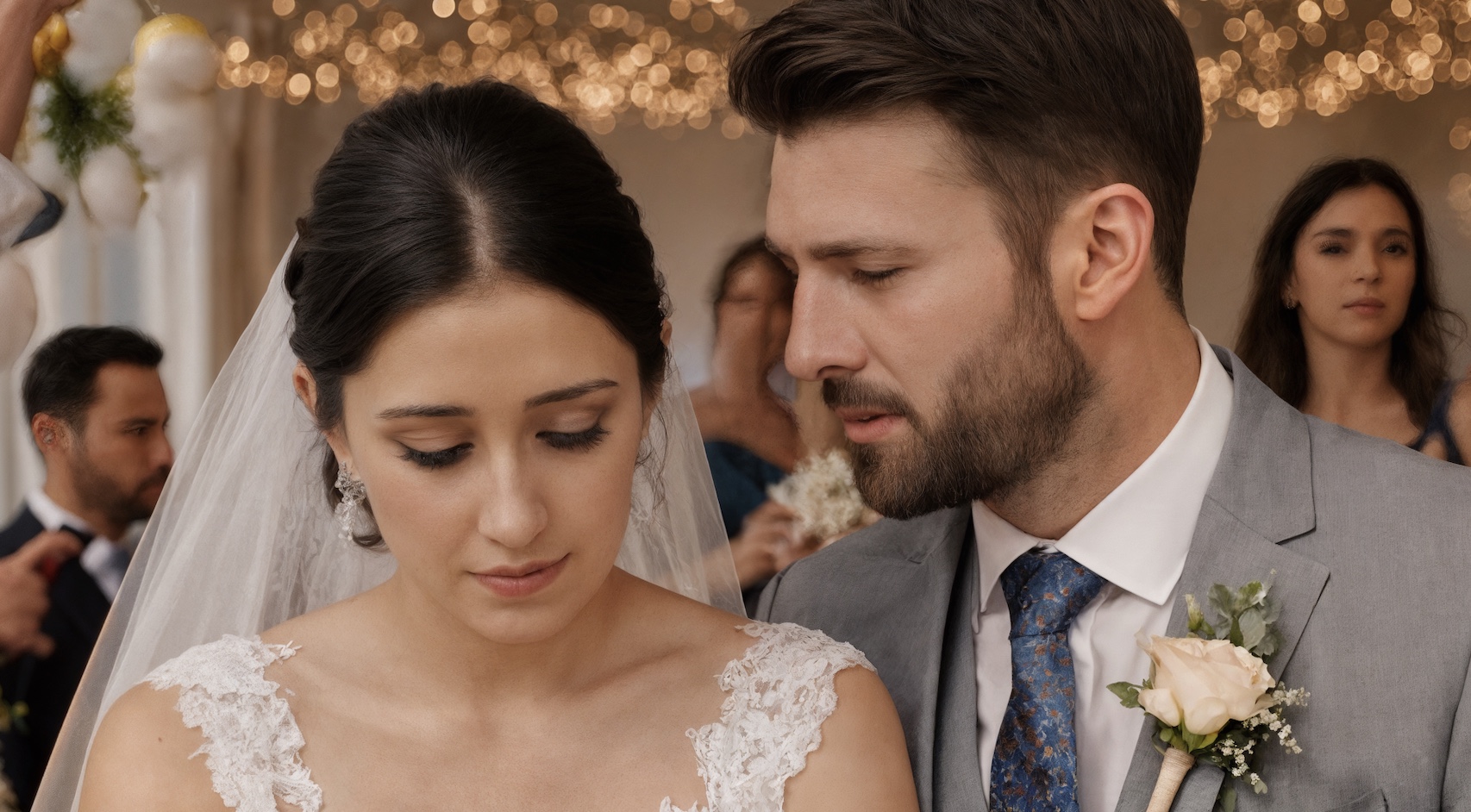
Svetlana stood in front of the mirror, staring at her own reflection. The white dress hugged her figure perfectly, the veil fell in a soft cascade over her shoulders, and her makeup looked flawless. It should have been the dream day—the exact moment she’d been working toward for so long.
But inside, she felt strangely hollow.
She smoothed a palm over the fabric, fixed a curl by her temple, and drifted back to the beginning. A year ago, she’d met Denis at a corporate party. Tall, handsome, with an easy smile and confident manners. A manager at a big company, a decent car, polished words—he knew exactly what to say.
He courted her beautifully: bouquets, dinners out, compliments that sounded sincere. Svetlana was moved. After a few failed relationships, she craved stability, dependability, simple warmth. Denis seemed like that kind of man—steady.
Six months later he proposed, romantically—ring, one knee, a practiced tenderness. Svetlana said yes without a second thought. Her parents were thrilled, her friends congratulated her, everything rolled forward like it was meant to.
Wedding preparations took months. Svetlana managed it all herself: selecting the restaurant, ordering the dress, choosing the menu, sending invitations. Denis “helped,” but mostly on paper—agreeing with whatever she chose, nodding, repeating that everything was perfect.
And three months before the wedding, Svetlana made a major decision.
She sold her old one-bedroom on the outskirts. She’d lived there for five years after college, saving every spare coin, setting aside part of every paycheck. She lived modestly, denied herself entertainment, dressed simply—everything for one goal: to buy a larger place.
And then she found the ideal option.
A bright two-bedroom in a new development, renovated, in a good neighborhood. A park nearby, a school, shops—everything she’d imagined. She paid, finalized the paperwork, received the keys.
It felt like triumph. Like she’d won something honestly earned.
Her parents were proud. Her friends were jealous—in a friendly way. Denis told her she was amazing, that they now had a home, that he was happy.
Everything seemed to be falling into place.
Except for one thing.
Nina Sergeyevna—Denis’s mother.
They met for the first time two months earlier. Denis brought Svetlana to his mother’s place to introduce them. Nina Sergeyevna lived alone in an old three-bedroom on the edge of town. The apartment was clean, but oppressive—heavy furniture, dark tones, and walls crowded with old photographs.
She greeted Svetlana without smiling, looked her up and down with a hard, measuring gaze, and simply nodded.
“Well, hello. Come in.”
They sat at the table. Nina Sergeyevna poured tea, set out cookies, and began asking questions—about Svetlana’s job, her parents, her plans. Svetlana answered calmly, doing her best to be polite.
“I heard you bought an apartment,” Nina Sergeyevna said suddenly, pouring herself a second cup. “A two-bedroom in a new building.”
“Yes,” Svetlana nodded. “It’s a good area. I searched for a long time.”
Nina Sergeyevna gave a quiet, skeptical little sound and looked at her with a strange half-smile.
“Well, well. Here’s what I’ll tell you, girl. After the wedding, everything becomes shared. Family property. So don’t get too full of yourself thinking it’s only yours.”
Svetlana stayed silent back then. She decided it was just an older generation with its own mindset. She didn’t want conflict before the wedding. Denis didn’t say anything either—he simply changed the subject.
But now, remembering that conversation, she realized it hadn’t been a random remark.
It had been a warning.
And then the wedding day arrived.
Svetlana breathed out and stepped into the hall. Guests had already gathered. Music played, servers hurried between tables, everything was arranged down to the last detail. She’d done her best—she wanted this day to be unforgettable.
Denis stood by the entrance, smiling at guests. When he saw his bride, he walked over and wrapped an arm around her waist.
“Gorgeous,” he whispered. “My wife.”
Svetlana smiled, though something inside her flinched. She didn’t know why—just a faint, barely-there feeling.
The ceremony passed quickly: vows, a kiss, applause. Then the banquet began. Guests ate, drank, danced. Svetlana sat smiling, responding to toasts and congratulations.
Nina Sergeyevna sat across the table, watching her with a particular expression—not openly hostile, but not warm either. It was the look someone gives an item in a store, assessing its value.
Denis slid into the seat beside Svetlana and put an arm around her shoulders. His face was slightly flushed—he’d clearly had too much champagne. His eyes sparkled, his grin widened, his movements loosened. He laughed louder than usual, slapped friends on the back, told jokes.
“Best day of my life!” he declared loudly so the neighboring tables could hear. “I’m the luckiest man alive! Now we’ll have everything!”
Svetlana nodded, but something in his voice unsettled her. He sounded too satisfied—not like a man in love, but like someone who’d just closed a profitable deal.
Denis leaned closer, almost brushing her ear with his lips. The smell of alcohol hit her. He raised his glass, then whispered with an almost pleased smile:
“You know, I talked everything over with Mom. Your whole apartment is going to her. She’s alone—she needs support. And you and I will rent something modest. That’s the right way.”
Svetlana went still.
Her heart thudded so loudly she felt sure everyone could hear it. Heat rushed into her face, her ears burned. Slowly she turned to look at her husband.
He was smiling. Just smiling—like he’d said something completely ordinary.
“What?” she asked quietly, hoping she’d misheard.
Denis winked and patted her shoulder.
“You got it. Mom’s already in the loop. We’ll do the paperwork later. Now’s not the time. It’s a celebration!”
He stood and went back to his friends, who were calling him over for another round. Svetlana remained seated, staring at the empty plate in front of her. Guests laughed, clinked glasses, music pounded—but she heard none of it. A low roar filled her ears, as if she’d plunged underwater.
The apartment. Her apartment. The one she’d bought herself. With her own money. After selling the old one-bedroom where she’d spent five years saving every last bit. The bright two-bedroom in the new building—the dream she’d planned, furnished with love, imagined raising a family in.
And he’d just said he was giving it to his mother.
Svetlana rose from the table. Her legs felt unsteady, but she forced herself forward. She walked past the guests, past the dancing couples, and into the corridor. She leaned against the wall, closed her eyes, and tried to breathe evenly.
Her friend Ksenia noticed and hurried over.
“Svet—what’s wrong? Are you feeling sick?”
“I’m fine,” Svetlana forced out. “It’s just stuffy. It’ll pass.”
“Okay… want some fresh air? Let’s go outside.”
“No. I’ll be back in a minute.”
Ksenia nodded and left. Svetlana stayed alone. She pulled out her phone, lit the screen, and stared at the wallpaper—a photo of her and Denis, both smiling, arms around each other. It looked like it belonged to another life.
She replayed every small detail that hadn’t added up before. How Denis always dodged real conversations about the future. How he’d joked whenever she asked where they would live after the wedding. How his mother kept hinting about “shared property.” How Denis never once offered to put his name on the apartment documents, yet constantly repeated that they were “one family.”
And Svetlana had mistaken it for romantic purity—as if he cared about feelings more than papers.
How naïve she’d been.
She returned to the hall and sat down again. Denis was at another table now, arm around his friends, drinking, laughing. Nina Sergeyevna watched Svetlana and let a small, satisfied smile slip onto her face—confident, pleased.
And Svetlana understood: they had planned it. In advance. Long before the wedding.
The banquet ended late. Guests left, and the newlyweds were finally alone. Denis could barely stand. Svetlana helped him to the car, driven by a sober friend.
At home, Denis collapsed onto the bed and fell asleep instantly. Svetlana stood beside him, looking down. He snored, arms spread wide. A blissful smile sat on his face.
She undressed, took off the wedding gown, hung it carefully in the closet. Then she lay down beside him—but sleep wouldn’t come. She stared into the darkness until morning, turning over every word, every moment.
By dawn, she had made a decision.
Denis woke around noon with a pounding head and bleary eyes. Svetlana was already dressed and ready to go.
“Where are you going?” he mumbled, squinting against the daylight.
“Out,” she said shortly.
“Out where? We’re newlyweds. Come back to bed. Let’s rest.”
“Later,” Svetlana replied, and walked out.
She went straight to the public service office. Took a number. Waited. Approached the window.
“Hello,” she told the employee. “I need to place a restriction on my apartment—no transactions of any kind without my personal presence and notarized consent.”
The young woman nodded.
“Your passport and your property documents, please.”
Svetlana handed everything over, filled out the form, signed her name. Twenty minutes later it was done. Now no one—absolutely no one—could sell it, gift it, or do anything with it without her personally showing up and agreeing.
When she returned home, she made copies of all the documents. The originals she hid in a safe at her parents’ house. The copies she kept with her—just in case. One more set she entrusted to Ksenia.
“What happened?” Ksenia asked, taking the envelope.
“I’ll tell you later,” Svetlana said. “Just keep it. If anything happens, these papers prove the apartment is mine.”
Denis was still asleep when she came back. Svetlana sat in the kitchen, brewed strong tea, and waited.
He emerged toward evening, messy-haired, eyes red.
“My head is killing me,” he complained. “Do we have anything for a hangover?”
Without a word, Svetlana slid pills and water across the table. He swallowed them and sat down opposite her.
“Listen,” she said, meeting his eyes. “What did you say yesterday about the apartment?”
Denis winced.
“Me? I didn’t say anything.”
“You did,” Svetlana said. “At the wedding. You said my apartment would go to your mother, and we’d rent a place.”
He hesitated, looked away, rubbed the bridge of his nose.
“Oh… that. I was joking. Come on, you took that seriously?”
“It didn’t sound like a joke.”
“Svet, you know I say stupid things when I drink. Don’t make it a big deal. It’s nothing.”
Svetlana said nothing. She just watched him. Denis shifted in his chair, drumming his fingers on the table.
“Fine—forget it,” he said quickly. “Let’s talk about the honeymoon instead. Turkey? Sochi?”
But Svetlana didn’t forget.
Three days passed. Denis called his mother and talked for a long time. Svetlana caught fragments: apartment, registration, documents, notary. When he hung up, he said casually:
“Mom wants to meet. To discuss a few things.”
“What things?” Svetlana asked, even though she already knew.
“Family stuff. Housing, responsibilities—like normal people. It’s fine.”
“Okay,” Svetlana nodded. “Let’s meet.”
They met on Saturday in a café. Svetlana arrived on time. Denis and his mother were already seated by the window.
Nina Sergeyevna looked pleased and confident—hair done, makeup perfect, a strict suit. She wore a condescending smile, like someone who had already won.
“Svetochka, sit,” she said, gesturing to the chair. “Let’s talk like adults about important matters.”
Svetlana sat down, placed her bag on her lap, folded her hands on the table, and straightened her back.
“I’m listening.”
“Right,” Nina Sergeyevna began, not waiting for questions. “Now that you’re family, everything needs to be arranged properly. You have a two-bedroom. Big, bright. And I’m alone in my old three-bedroom on the outskirts—it’s hard for me. I’m not young anymore, my health isn’t what it used to be. And that neighborhood isn’t safe. So it would be fair if you transferred your apartment to me. And you and Denis can rent something simpler, closer to the center. You’re young—easy for you. And it’s even more convenient: no need to take on a mortgage.”
Svetlana listened in silence. Denis sat beside his mother and didn’t look at his wife. He stared into his coffee, stirring with a spoon even though the sugar had long dissolved.
Nina Sergeyevna continued, gaining momentum.
“This is normal practice, by the way. In good families, that’s how it’s done. The older generation should be provided for and protected. You’re young—you’ll earn more. You have your whole life ahead of you. And later, when I’m gone, it’ll all come back to you anyway. So it’s just a formality. Temporary.”
She spoke calmly and confidently, as if the decision had already been made—like Svetlana’s role was to nod, sign, and say thank you for the honor of helping.
Svetlana paused. Then lifted her eyes and looked straight at Nina Sergeyevna—no smile, no emotion.
“No,” she said, flat and clear.
Her mother-in-law blinked, startled.
“What do you mean, no?”
“I’m not transferring the apartment to you,” Svetlana said evenly. “It’s my property. I bought it with my money, earned by me. I put my work, my time, my strength into it. And it will remain mine. Period.”
Nina Sergeyevna’s face hardened.
“Are you mocking me? We agreed!”
“We didn’t agree on anything,” Svetlana replied calmly. “You decided it all yourselves—without me. But I’m not an object and I’m not a child. I’m an adult, and I make my own decisions.”
“Denis!” Nina Sergeyevna snapped, turning to her son. “Tell her! Explain how this works!”
Denis finally raised his eyes. His face looked pale; sweat had appeared on his forehead.
“Svet, come on. Let’s be reasonable,” he said. “Mom’s right. She really needs support. We’re family. We’re supposed to help each other.”
“I got married,” Svetlana said, staring him down, “not to hand over my property. And if those are the same thing to you, then you and I have completely different definitions of marriage.”
Nina Sergeyevna shot up from her chair, nearly knocking over her cup.
“Oh, so that’s how it is? You don’t care about family? You’re selfish! You only think about yourself! Denis, do you hear what she’s saying? Do you hear who you married?”
“I’m not selfish,” Svetlana answered without raising her voice. “I’m just not stupid. You want me to give away what I earned and end up with nothing. That’s not ‘helping family.’ That’s daylight robbery.”
“How dare you!” Nina Sergeyevna grabbed her handbag, her face flushed. “Denis, are you going to tolerate this?”
Denis stayed silent, jaw clenched, eyes fixed on the table.
“That’s it, I’m leaving!” Nina Sergeyevna declared. “And you, son, think very carefully about who you’re living with. With this… this viper who spits on your mother!”
She turned and stormed out, slamming the door. A few people at nearby tables glanced over. Svetlana and Denis were left alone.
They sat in silence for a long time. Finally Denis spoke, still not looking at her.
“You could’ve met her halfway. It’s my mother. She really is struggling alone.”
“And I’m your wife,” Svetlana said. “But apparently that means nothing to you.”
“Don’t start.”
“I’m not starting,” she replied. “I’m finishing.”
She stood, took her bag, slipped on her coat.
“Svet, wait…”
“No, Denis. I’m not waiting. You showed me who you are. You showed me you’d betray me for your mother. You showed me that to you I’m not a partner, not someone you love—I’m just an apartment. A convenient option.”
“That’s not true! I love you!”
“No,” Svetlana said quietly. “You love my apartment. You just put up with me. There’s a difference.”
She walked out without turning around.
For the next week, they didn’t speak. Denis called, texted, begged to meet. Svetlana didn’t answer. She thought. Weighed everything. Tried to understand if there was any chance at all.
But every time she recalled his words at the wedding, his silence in the café, his lost, sweaty panic instead of support—she understood: there was no chance.
A week later, she came to his apartment. He opened the door with hope on his face.
“Svet! Finally! I’ve been so worried. Let’s talk, let’s work this out!”
“Yes,” Svetlana said. “We need to talk. Seriously.”
They sat in the living room. Svetlana placed her hands on her knees, straightened her back, gathered herself.
“I want a divorce.”
Denis turned white, opened his mouth, and couldn’t speak. Then he forced out:
“What? But we just got married! It’s only been two weeks!”
“Exactly,” she said. “Better now than ten years from now—with kids, a mortgage, and a mountain of resentment.”
“Svet, you can’t just—”
“I can,” she said. “And I will. You made it clear you don’t see me as a person—you see me as property. You and your mother decided what to do with my apartment without even asking me. That isn’t marriage. That isn’t family. That’s a business deal. And I’m not participating.”
“I… I didn’t want this… It was Mom’s idea… I just— I didn’t know how to say no to her.”
“You didn’t even try,” Svetlana replied. “That’s the point. You agreed. You didn’t stand on my side. You stayed silent when you should’ve defended me. And then you tried to shame me for not ‘meeting her halfway.’ Denis, I don’t want to live with a man who can’t protect his own family—who’d rather be a mama’s boy than a partner.”
Denis bowed his head, covered his face with his hands, shoulders shaking.
“I’m sorry,” he whispered. “I’m sorry. I’m an idiot. I get it. Please—give me a chance. I’ll fix everything.”
“It’s too late,” Svetlana said. “You already showed your true face. And I don’t trust you anymore. Without trust, there’s no family.”
“But I love you!”
“If you did, you wouldn’t have betrayed me on our very first day.”
She stood and walked toward the door. Denis tried to stop her, grabbed her hand.
“Svet, wait! We can talk! I’ll refuse Mom! I’ll tell her the apartment stays yours! I’ll do anything you want!”
“It doesn’t matter anymore,” Svetlana said, freeing her hand. “I’m filing for divorce. The apartment stays mine because it was mine before the marriage. There’s nothing to divide. I hope you won’t make it ugly.”
Denis said nothing. Then, slowly, he nodded, eyes down.
Svetlana left. They didn’t see each other again until the paperwork.
The divorce was quick. They both went to the registry office and filed. A month later they received the certificate. No claims, no battles—just two people who realized they’d made a mistake and stopped in time.
Svetlana returned to her apartment. Hers. Only hers. She stood in the middle of the living room and looked at the walls she had chosen, the furniture she had bought, the windows that opened onto the city.
This was her home. Her work. Her life.
And no one would ever get to decide those things for her again.
A week later Ksenia called.
“I heard you divorced. How are you holding up?”
“I’m okay,” Svetlana said. “Honestly—better than before.”
“No regrets?”
“Not even a little. I’m glad I learned the truth in time—before kids, before a mortgage, before it would’ve been too late to change anything.”
“You’re strong,” Ksenia said, genuine respect in her voice. “Really. I don’t think I could’ve done it. I’d be afraid of ending up alone.”
“Better alone than with someone who betrays you,” Svetlana replied. “And you know what? It’s the best decision I’ve ever made. I’m proud of myself.”
She ended the call and looked around her apartment again. It was quiet, peaceful, warm. No outsiders who believed they had a right to her property. No man who stayed silent when it was time to protect her. Just her.
And it felt wonderful.
A few months later, Svetlana ran into Denis by chance at a shopping mall. He was with his mother. When Nina Sergeyevna saw her former daughter-in-law, she demonstratively turned away and tugged her son by the sleeve. Denis gave Svetlana a small nod, opened his mouth as if to speak—but said nothing. He simply walked past.
Svetlana nodded back and kept going. Without anger. Without bitterness. Without regret. Just past them—like you pass strangers who no longer matter in your life.
That evening she sat on her balcony with a cup of tea and watched the sunset. The city hummed below, lights flickered on one by one, life moved and pulsed—and she was here, in her home, in her fortress she had built with her own hands.
The apartment had stayed hers. But more important, her confidence had stayed with it too—the certainty that she would never again allow anyone to control her life, her labor, her choices, her dignity.
And that was priceless.
Svetlana smiled, took a sip of tea, and thought about the roads ahead—new possibilities, new encounters. But now she knew one thing for sure: she would walk those roads only with people who respected her. Not with people who saw her as a tool to get what they wanted.
She closed her eyes and breathed in the evening air. Somewhere far away music played, people laughed, cars whispered past. Life went on.
And she was ready for it—with her apartment, her rules, her dignity, her freedom.
And this was only the beginning of a new chapter. A chapter where she wasn’t a victim, not a resource, not a convenient option—she was the owner.
The owner of her fate, her home, her life.
And no one—no one—would ever dare try to take that away again.