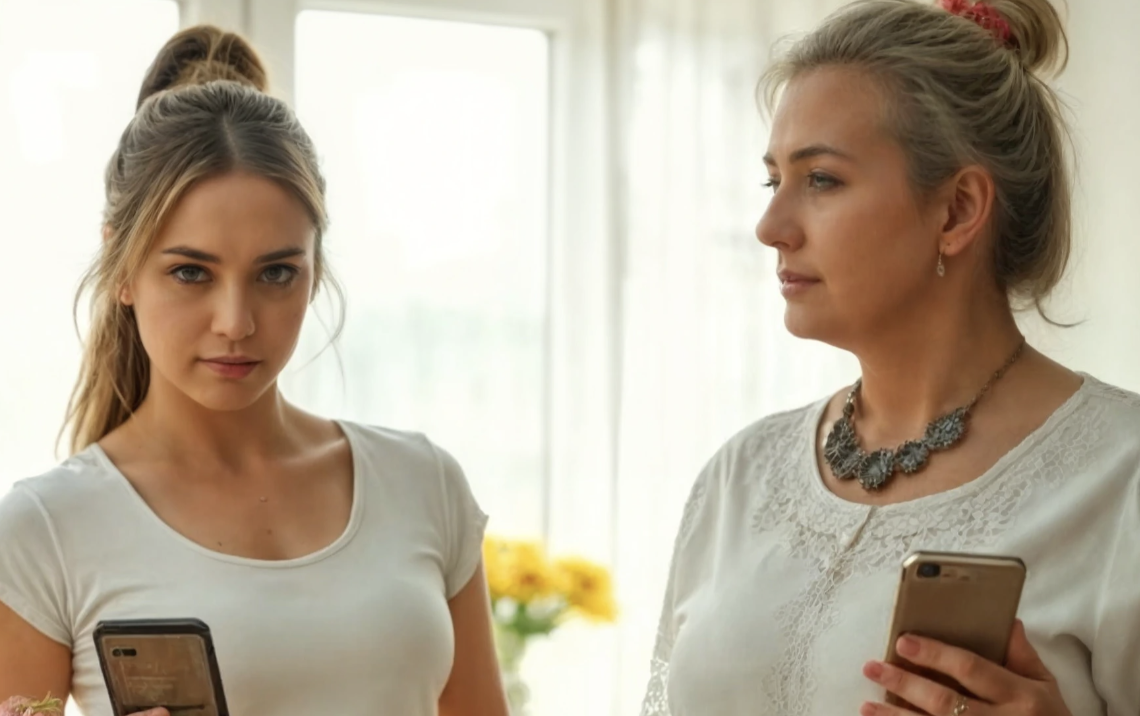
— “Do you even understand what you’ve done?!” Roman’s voice broke into a shout as the door slammed shut behind his mother.
Alina stood by the window, holding a cup of tea that had already gone cold. The tea trembled—just like her hands.
“I protected myself,” she replied quietly.
“You threw my mother out!” Roman tossed his jacket onto a chair. “You just kicked her out like a dog!”
“She was demanding my apartment!” Alina lifted her eyes. “I put up with your mother for three months, Roma. I kept quiet when she called me a freeloader. When she called me ‘an outsider.’ When she poked her nose into every little thing—from dinner to the bed linens. But today she crossed the line.”
Roman froze—then flared up again.
“Crossed the line? And are you sure it wasn’t you who crossed it?”
“Not me!” Alina set the cup down on the table with a sharp clink. “I don’t have to justify defending my own home!”
Silence hung in the kitchen. Outside, a tram hissed past, its wheels thudding hollowly. Somewhere upstairs, a door banged.
“Rom,” Alina said softly, “she would have destroyed us. And you wouldn’t even have noticed how we’d ended up living by her rules.”
Roman sank into a chair. His face was gray, exhausted. He’d spent the whole day at work, and now his family was finishing him off.
“I’m tired of all this,” he said dully. “Of the fighting, the screaming, the accusations. Of always being stuck between you.”
“And I’m tired of being the one to blame,” Alina answered. “Every time your mom’s unhappy—it’s my fault. When you stay silent—it’s my fault too.”
She walked up to him and stopped in front of him. There was no anger in her voice—only pain.
“You know, Rom,” she said, “I’m not a bad person. I just want to live in peace.”
He didn’t reply.
A week passed. The apartment was quiet again—but the peace didn’t return.
Alina woke up in the mornings to emptiness—not to the sound of the radio, not to the smell of coffee Roman used to make—but to a strange, sticky silence.
Roman started coming home later and later. Dinner sat cold on the table, and the TV droned in the corner. Alina stopped counting the days—everything blurred together: evening, night, morning.
“Late again?” she asked one night when he came back at midnight.
“Meeting,” he answered shortly, without looking up.
“A meeting until twelve?”
“Ali, don’t start.”
She sighed.
“I’m not starting. You leave in the morning and come back at night. I barely see you.”
“Maybe that’s for the best,” he threw over his shoulder as he took off his shoes. “We’re both tired.”
Alina bit her lip. Her chest tightened.
“‘For the best’—are you serious right now?”
“Yes, I’m serious.” He glanced at her. “I can’t breathe in this apartment. In every corner—her yelling, your reproaches, my attempts to keep the peace.”
“And you think it’s easy for me?” Alina snapped. “I held on all this time only because of us!”
“Because of us?” Roman gave a bitter little laugh. “No, Ali. Because of yourself.”
She wanted to answer, but fell silent. His words sliced like a knife.
That weekend Alina decided to go to a friend’s place—just to escape, even for a day.
In the evening, when she returned, the apartment smelled of men’s cologne and something new—not her shampoo, not her cream.
In the bathroom there was someone else’s toothbrush. Pink.
She froze in the doorway. Her heart hammered in her chest like a trapped bird.
Roman came out of the bedroom in a T-shirt, saw her—and stopped.
“It’s… not what you think,” he began, but the words hung uselessly in the air.
“And what do I think, Rom?” Alina asked. “That you’ve found someone else?”
He looked away.
“We were just talking.”
“In bed?”
“Don’t dramatize,” he said раздражённо. “It’s a coworker. She has problems. I helped.”
“Helped?” Alina laughed. “Interesting way to help—give her a toothbrush.”
“She brought it herself,” he muttered.
“So she feels at home here.”
He fell silent.
Alina spent the night in the kitchen. She sat staring out the window, trying to understand exactly where everything went wrong.
Once they’d laughed until they cried, argued about who would go out for bread first, made plans for vacations.
Now they were strangers in the same apartment.
She remembered how Roman once said, before the wedding:
“I don’t want to repeat my parents’ fate. I want everything between us to be honest.”
The irony was that it was the parents who destroyed everything. Or rather—one parent: Galina Petrovna.
Alina imagined her, sitting in her rented one-room flat, calling her son to complain:
“She threw me out, and you’re defending her.”
And Roman, torn between duty and love, listening again as his mother sobbed into the phone.
The phone on the table vibrated. A message from Roman:
“We need to talk. Tomorrow.”
Morning.
He sat at the table, grim and unshaven. In front of him—a mug of cold coffee.
“I think we should live separately for a while,” he said at once.
“So… a divorce?”
“No. Just… a pause.”
“Right. A pause until your coworker finds a new toothbrush?”
“Ali, enough!” he exploded. “I can’t live under constant tension anymore!”
“And I can?!”
“I’m not saying it’s your fault. But maybe we both backed ourselves into a corner.”
Alina laughed—bitterly, almost hysterically.
“A corner? No, Rom. This isn’t a corner. This is the end.”
She stood, went to the window, and stared for a long time at the gray sky.
“When your mother moved in with us, I thought I’d endure it. For you. But you didn’t endure it yourself.”
He didn’t answer.
“Fine,” she said softly. “Leave. But not on a pause. For real.”
“Do you know, Romochka, I’m not evil,” Galina Petrovna sighed, looking at her son over a cup of cheap instant coffee. “It’s just that life has been hard for me. No one understands how difficult it is for a woman my age to end up alone.”
Roman said nothing. He sat opposite her, staring past his mother. The rented one-room apartment was tiny: a bed, an old table, a wardrobe with peeling doors. It smelled of bleach and damp rags.
“I never asked you for anything but attention,” his mother went on, pretending not to notice him avoiding her gaze. “And you… you just abandoned me. For that wife of yours…”
“Mom, stop,” he said wearily. “I didn’t abandon you. I’m just tired of the scandals. And don’t start about Alina.”
“And I’m not allowed to tell the truth?” she snapped. “That wife of yours ruined everything! You used to be different—kind, caring. And now… cold.”
“Maybe I just grew up,” he said quietly. “Or realized it’s impossible to live under constant pressure.”
“Pressure?!” Galina Petrovna jumped up. “I gave my whole life for you! Worked, didn’t sleep nights so you could get an education, so you’d have everything! And now I’m ‘pressure’?!”
“Mom,” he stood too, trying to keep calm. “Don’t start again. I came just to see how you are.”
She turned to the window. Her face reflected in the glass—tired, lipstick smeared, eyes empty.
“How am I? I’m nothing. No son, no home. Sitting in this rented kennel like a lodger.”
Roman let out a heavy breath.
“I’ll transfer you money for the month ahead. But Mom, please—don’t call Alina.”
“I wasn’t going to,” she threw back resentfully. “Let her live with her pride.”
Alina lived alone now.
Six months passed. She changed jobs—left the office where every corner reminded her of Roman and took a position at a small real-estate agency. She worked a lot—ten hours a day—just so she wouldn’t think.
Every morning began the same: coffee, the mirror, a brief “hold on” before leaving the apartment.
Friends invited her out—to parties, cafés—but she almost always refused. She felt like she had no strength left for other people’s conversations.
Sometimes, walking past their old building, she caught herself searching for their former windows—the ones with the white curtains and her violets.
She replanted the violets, but one of them withered. For some reason, it was the one that had stood closest to the couch where Galina Petrovna used to sleep.
One evening, when Alina came home, she found an envelope in the mailbox.
No return address. Handwriting familiar to the point of pain.
“Alina, hello. Don’t be angry with me. I’m very sick. Romka doesn’t talk to me. I’m alone. Help. Please.”
Signed: Galina Petrovna.
Alina stood in the stairwell for a long time, holding the letter. Then she went up to her apartment, tossed the envelope onto the table, and sat down.
Something pounded inside her—not pity, not anger, but a kind of exhaustion mixed with duty.
“Of course,” she said out loud to herself. “How could it be otherwise.”
She scrolled through her contacts. Roman’s number was still there.
Her fingers trembled as she hit “call.”
“Hello?” His voice was hoarse, as if he hadn’t slept.
“Hi,” she said quietly. “I got a letter from your mother.”
A pause.
“And what does it say?”
“She says she’s sick. Looks serious.”
“Yes, I know,” he answered dully. “They found diabetes. Her sugar was nearly forty. She was in the hospital for two weeks.”
“Why didn’t you tell me?”
“We weren’t talking, Ali. Remember? You said it yourself: ‘leave forever.’”
She closed her eyes.
“That doesn’t mean I want you to die.”
Roman exhaled.
“She’s home now. Alone. I tried to hire a caregiver, but she threw the woman out. Says she ‘steals food.’”
“Typical,” Alina said—and caught herself hearing warmth in her own voice. “Listen, if you want, I’ll go see her. Check what’s going on.”
“You?” Roman sounded genuinely surprised. “After everything?”
“Yes,” Alina replied softly. “Not for her. For myself. To put a period on it.”
Two days later she stood at the door of that same tiny apartment. The door didn’t open right away—inside there was coughing, then heavy footsteps.
“Oh… it’s you,” Galina Petrovna said, leaning on the doorframe. She looked worn out: hollow cheeks, inflamed eyes.
“May I come in?” Alina asked.
Her mother-in-law didn’t answer, but stepped aside.
Inside it smelled of medicine and stale laundry. On the table—a pile of pills, next to it half-eaten soup and a cup with dried coffee streaks.
“So here I am, sick,” Galina Petrovna said quietly, as if making excuses. “No one comes. Not even my son.”
“Are you surprised?” Alina replied evenly. “You destroyed everything yourself.”
“I just wanted him nearby,” the older woman whispered. “I wanted him not to forget his mother.”
“And you forgot he was a husband,” Alina said. “And that he had a family.”
Galina Petrovna sat down, hugging her knees.
“You know, I thought I could bring everything back. That he’d forgive me. And now I understand—it’s too late.”
Alina silently pulled medicine, water, and a clean towel from her bag.
Then she warmed up the soup, washed the dishes. All of it—without a word.
When she was about to leave, Galina Petrovna said softly:
“I know I’m guilty. I’m not asking for forgiveness. Just… thank you for coming.”
Alina nodded and walked out.
A week later Roman called.
“Mom’s gone,” he said. “In her sleep.”
Alina didn’t say a word. She just clenched the phone until it nearly slipped from her hand.
The funeral was modest. A few neighbors, the district doctor, Roman, and Alina.
After the ceremony they walked silently along the cemetery path.
“She remembered you,” Roman said. “Before she died. She said she was wrong.”
“Too late,” Alina replied.
“Too late,” he echoed.
They stopped at the gates. The wind stirred the poplar branches, and leaves fell at their feet.
“You know,” Roman said quietly, “I’ve been thinking about us this whole time. That maybe we could still bring it back.”
Alina looked at him. There was no anger in her eyes—only fatigue.
“Bring it back?” she repeated. “Rom, we lost too much. Your mother, our home, our faith in each other. You don’t rebuild from that.”
He was silent.
“Live,” she said. “Just live. Without me.”
And she walked away without looking back.
In spring Alina rearranged the flowers on the windowsill again.
This time the violets stood strong, with large lilac blossoms.
She looked at them and thought that maybe life really can begin again—not with smiles and kisses, but with a quiet where you can finally breathe.
The phone on the table vibrated. A new message:
“Alina, thank you for going to Mom back then. Without you I wouldn’t have made it in time. Take care of yourself. —R.”
She stared at the screen for a long time, then deleted the message.
She turned to the window, added fresh soil to the pot, and whispered:
“That’s it. Now—really, that’s it.”
The End.