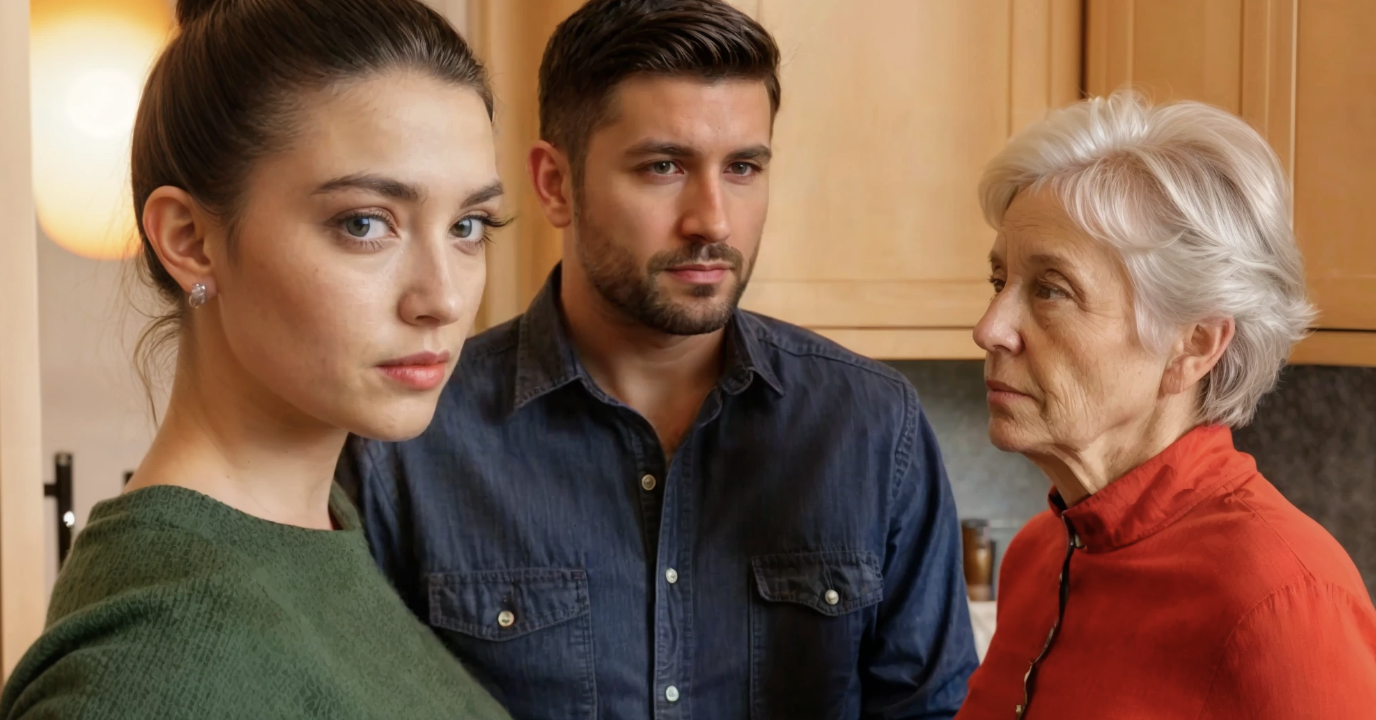
— You decided everything for me again? Dima burst into the kitchen as if someone had set him on fire from behind, slammed the refrigerator door, and stared at Katya like she’d personally offended his entire bloodline.
Katya slowly lifted her eyes from her mug of tea, took a breath, and said calmly—but with that signature chill that appeared when her patience was on its last gasp:
— I didn’t decide anything. I just took my keys back. Because I’m tired of coming home and finding your mother here without warning. Sometimes you’re not even here, and she’s already grading my “behavior.”
Dima flared up:
— You’re dramatizing! Mom is just helping! She can see that we… well, that it’s hard for you.
— Hard? Katya smirked. — Yeah, it’s hard—especially when a grown woman prowls around my apartment with the look of “time for an inspection,” and you stand there like a schoolboy scared you’ll be sent to the corner.
Dima opened his mouth, but from the hallway came the distinctive click of heels—confident, loud, the kind of sound that made it feel like someone was walking across a stage, not down the narrow corridor of an ordinary Moscow apartment.
— Oh, come on, Tamara Ivanovna said from the entryway. — I can hear you. And while I’m at it, I’ll say this: if I come in, it’s because I have a key—which, by the way, MY son gave me. And if you’ve got a mess here, at least I’m not ashamed in front of the family.
Katya pulled in a breath through clenched teeth.
Here we go.
She sat on the stool, gripping her mug as if she could warm her nerves with it. Outside it was February—gloomy Moscow February: when the snow is already gray, the roads are slush, and everyone walks around with a face that says, don’t touch me, I’m at my limit. Katya fit right into that atmosphere.
— Well, hi, she said when her mother-in-law finally marched into the kitchen, not even bothering to greet properly or take off her scarf. It hung on her like a symbol of authority. — We were just discussing why you think you can come in whenever you want.
— Because I’m the mother, Tamara Ivanovna snapped. — And I worry. I can see how you live… well, so-so. Cramped, uncomfortable. The girl clearly isn’t coping. And the smell in the kitchen is… homemade, I guess. Simple.
Katya let out a laugh a little louder than she should have.
— “Homemade” is bad now?
— It’s cheap, her mother-in-law cut in. — I stopped by today—you’ve got vegetables on the windowsill. Vegetables. What, did you start a garden in here?
— Yes, Katya said. — If I want, I’ll get a goat too. This is my apartment.
Dima choked like he’d swallowed air wrong.
— Katya, can you not—
— Not what? Katya snapped. — Not tell the truth? Or not remind you that I’m actually the owner of this place?
Tamara Ivanovna crossed her arms:
— Owner, yes. But a family isn’t just you. And since you’re married, decisions should be shared. And I, as the older person—
— As the older person, you could learn to knock, Katya cut her off.
A heavy, sticky silence hung in the room, like steam over a boiling pot—hot, suffocating.
And what was worst of all: Katya knew this wasn’t new. She knew what she was signing up for when she married Dima. She knew he was a mama’s boy, that he made decisions slowly, that he sometimes confused confidence with convenience. She knew—and still she hoped her love, her calm, would somehow make up for it.
Yeah. Sure.
She’d thought about it a hundred times. From the very beginning—from that wedding that didn’t go the way she’d dreamed. Not even close. A small, cozy ceremony turned into a banquet “for eighty people,” where Katya saw half the guests for the first time in her life. And they all looked at her like she was an accessory to Dima. Like she was a checkbox: “son got married, now we can brag to the neighbors.”
That was when Katya first felt like an extra at her own celebration.
And now—at home, on her own territory—she felt the same way.
— Tamara Ivanovna, she said at last, slowly, calmly, without yelling. — Let’s do this. I’m tired. Truly. Tired of the pressure, the comments, your “advice,” the way you act like you’re checking whether I meet your standards. But I don’t owe anyone anything. Not you. Not your idea of how a “proper wife” should live.
Her mother-in-law leaned forward, looking at Katya like a surgeon at a patient who’d suddenly dared to argue:
— You’re still young. You don’t understand. I want things to be better for you. For you to live like people. This apartment—it’s small. You’ll grow—then what? Where will you put kids?
Katya felt a hot wave of irritation rise in her chest.
— You keep going on about “kids,” “family,” “life.” But asking what I want… doesn’t even cross your mind?
Tamara Ivanovna rolled her eyes:
— Girl, at your age people don’t know what they want.
Katya snorted:
— But they know perfectly well what they don’t want. And I, for example, don’t want you running my house.
Dima finally вмешался—quietly, pathetically, as if embarrassed by the sound of his own voice:
— Katya… come on, let’s not fight.
— And how are we not supposed to? Katya spun on him. — While you stand there and keep silent? While your mother tries to turn my apartment into a hallway anyone can walk through? While I’m being taught how to live?
Dima dropped his eyes, scraping at the edge of the table with his fingernail.
Katya suddenly caught herself thinking: there was no anger in him. No certainty. Not even stubborn male pride. Just the habit of listening to whoever spoke louder.
Her mother-in-law, feeling victorious, delivered the final line:
— So. Dima and I decided this: we’re selling the apartment. We’ll buy something spacious—everyone will be happy. The money goes to the family. You agree?
Katya laughed. Quietly. Dangerously quiet.
— “Dima and I decided,” huh? — she repeated. — And where am I in that decision?
— You’re part of the family, — her mother-in-law replied. — But the elders decide.
Katya set down her cup, stood up, and said evenly, clearly:
— Then listen: I’m not selling anything. And I’m not signing your little papers. This is my home. And my decisions.
— That’s not your decision! her mother-in-law shouted.
Katya stepped closer and looked her straight in the eyes:
— Then you’ll have to live with it.
And in that moment, she understood: there was no road back.
Dima lifted his head, lost:
— Katya… maybe… maybe we’ll think about it?
Katya looked at him in a way that made him fall silent instantly. He wasn’t evil. Just weak. And weak people always choose the side with less resistance.
— Well, this is just f—ing great… Katya muttered to herself the next morning when she heard the front door creak. She knew that creak by heart: light, with a pause in the middle, like the door reconsidered letting unwanted guests in—then gave up anyway.
She went into the hallway and saw Dima scuffing his boots like a kid sneaking in from outside, trying to hide the tracks. In his hands was a grocery bag—the classic move: when a man feels guilty, he brings food, like you can fix a relationship with groceries.
— Katya… — he started, but his voice sounded like even he couldn’t hear himself. — I bought your… um… that porridge. The one you eat sometimes. It’s a normal one.
Katya nodded restrainedly:
— Thanks. Very touching.
He shifted awkwardly:
— Mom вчера… well… she went too far. And you… well, you too. Everyone snapped.
— Dima, — Katya stepped closer, — do you understand this isn’t about “snapping”? It’s not the first day, not the first month. She doesn’t come to visit—she dictates how I live. And you stand next to her and nod.
— I don’t nod, — he said, offended. — I just… well… I don’t want fights.
— You’re like someone permanently sitting between chairs, — Katya said quietly. — And every time you choose the one your mother is standing under.
Dima frowned as if she’d insulted his favorite toy:
— So what am I supposed to do? She worries. Dad worries. Everyone worries. We’re family.
Katya snorted:
— Family isn’t when you press someone down until they’re a doormat by the door. Family is when—attention—people respect you. But I guess I’m expecting the impossible.
She walked past him into the kitchen. Dima trailed after her, like he hoped the conversation would magically turn into, “Okay, fine, let’s have tea and forget it.”
Katya set the kettle on, leaned on the counter, and said:
— I thought about it yesterday for a long time. If you plan to come here again in a crowd and tear me apart, I’ll just change the locks.
Dima flinched:
— Is that… a threat?
— It’s a warning, — she answered calmly. — I’m tired. I don’t have to put up with your mother’s theatrical performances in my home. And your constant “let’s not fight” doesn’t work anymore.
He lowered his eyes, grabbed some corner of the tablecloth off the chair, started twisting it—a habit that sometimes made Katya physically recoil.
After breakfast he left—not slamming the door, but not kissing her cheek either, like he used to. Just left. And the apartment filled with a silence where Katya could hear everything: the cars under the windows, the upstairs neighbor’s footsteps, even the lazy slide of a water droplet down the metal sink.
She sat on the couch and stared at the wall. No TV, no music—just like that. There were so many thoughts, but they moved chaotically, like people rushing into the метро at rush hour: each with their own agenda, all pushing, and no one getting forward.
She had a feeling something would blow soon. And it would blow so hard that everything still holding together would go flying.
Around noon her phone buzzed.
Tamara Ivanovna.
Of course.
Katya didn’t answer. A minute later—again.
Then a third time.
Fourth.
Fifth.
Katya stared at the screen like the phone was inviting her to join a pyramid scheme. Finally, she hit “answer”—not because she wanted to talk, but because she was tired of the ringing.
— Katya? — her mother-in-law’s voice was icy, but beneath it there was a nervous tremble.
— Yes?
— I wanted to say that Dima and I talked. He also thinks your decision is childish. You should think about the future, not cling to that old two-room little burrow like it’s a talisman.
Katya slowly closed her eyes.
“Burrow.”
Again.
— Tamara Ivanovna, — she began evenly, — I’ll repeat it one last time. I’m not selling the apartment.
— That’s not a decision! her mother-in-law shrieked. — You’re behaving… well… selfishly! You’re not thinking about the family! You—
Katya calmly hung up.
Listened to the silence.
And for the first time in months, she didn’t feel guilty.
That evening Dima came back again. This time he was visibly wound up.
— Katya, can you explain what this circus is? — he started from the doorway. — Mom’s in tears, says you screamed at her and hung up on her! She worries about us!
Katya slowly stood up from the table and walked right up to him:
— Do you ever hear my words? Or only hers?
— I hear everyone! — he shouted. — It’s just… you could’ve been softer! She means well!
Katya laughed—loud, nervous, like someone opened a window in winter:
— Means well? Pressure, demands, an attempt to take my apartment away from me—means well?
Dima began pacing around the room like someone trying to solve a hard equation and not cry from panic at the same time:
— Katya, just understand… things are hard right now. Dad’s business is collapsing. He’s really in debt. If we help—
Katya cut him off sharply:
— Helping is giving money if you have it. Helping is support. Helping is doing something voluntarily. But you’re not asking me to help—you’re asking me to give up the only thing I have. My grandfather’s apartment. My home. My safety. They want me to hand over everything, and in return… what? Your mother’s gratitude, which tomorrow will turn into “you’re not grateful enough”?
Dima stopped, turned toward the window, and said quietly:
— I just want peace. I want you to get along.
— And I want you to take my side at least once, — Katya said. — Just once.
He stayed silent. And that silence was worse than any scream.
That night Katya lay awake. He was beside her, but as if in a different apartment. They barely spoke. The air between them grew so dense it felt like they both had to push their way through it just to breathe.
Katya thought about how it began.
Their first dates.
His laughter.
The illusion that he was “reliable.”
And then—the wedding run by his mother, like Katya was just a prop.
The move.
And that was it. The machine rolled downhill. Faster and faster.
By morning she already knew: the end was close. So close she could feel it—like the first thaw in spring: first in the air, then underfoot, in puddles, in dampness.
Only now it wasn’t spring. It was February. And ahead was an icy, hard conversation.
Katya turned onto her side and whispered into the darkness:
— Well then. Tomorrow—we’ll continue.
— If you walk out of this apartment now, you don’t come back! Katya shouted, even though she didn’t expect herself to start that sharply.
Dima froze in the doorway, one hand on the handle, the other on his backpack. He’d taken it “just in case,” but his face said he’d already left mentally. All that remained was taking the physical step.
— Don’t start, — he muttered. — I’m just going to my parents for a couple of days. We… well… need to talk. Mom’s worried, Dad’s stressed, everyone’s on edge.
— And what am I? — Katya stepped toward him. — An emergency flashlight? Turn me on when it’s dark and forget about me?
He let out a heavy sigh like it was supposed to solve their whole family drama.
— You know it’s temporary. We just need to wait it out.
Katya laughed so hard he flinched:
— Wait it out? You’ve been “waiting it out” for three years! Every time you need to stand up even a little for yourself, every time you need to tell your mom “Mom, enough,” you vanish into the fog: “We need to wait it out.” You’re a professional waiter-outer, Dima.
He winced:
— Why do you have to be so rude?
— Because nobody in your family understands kindness, — she snapped. — You and your mom are used to living like this: she says it—you do it. She decides—you agree. But I’m not your mother. I’m not going to jump through hoops.
He opened his mouth to reply, but his phone buzzed. On the screen: “Mom.”
Katya raised an eyebrow:
— Go on. Answer. She’s more important, right? I’ll wait.
Dima muted it and shoved the phone into his pocket, as if that could fix anything.
— Katya, stop. Don’t do this. I love you…
— You love peace, — she cut him off. — And for that peace you’re willing to sacrifice anyone. Me, you, our life—whatever. As long as nobody argues.
He looked down.
— So what am I supposed to do? It’s family…
Katya slapped her palm on the table:
— Family is you and me! Not you and your mother against me!
He was silent. Long. Too long.
And then he said quietly, firmly:
— I’m going anyway. Do you understand? I need to be there right now. Dad’s not well, Mom’s in panic, everything’s a mess. I’m their son. I can’t just sit here.
Katya looked at him and felt everything inside her breaking. And at the same time—something strange was being released.
— Go, — she said, stepping back. — Just know this: when you come back—if you come back—everything will be different.
Dima frowned:
— Is that… a threat?
— It’s a fact, — Katya said. — You chose this yourself.
He looked at her for another second, two… then turned and left. The door closed—not loudly, but dully, like the lid of a heavy box.
Katya stayed in the silence. So thick it felt almost physical.
For the first hour she just walked around the apartment. Just walked. Touched shelves, pillows, kitchen towels, as if checking: this is mine, this too, and this is mine as well. And there was more air in it now. Much more.
When two hours later someone knocked, Katya already knew who it was.
She opened—and saw Tamara Ivanovna. In her coat, hood pulled down low, but with the face that always meant one thing: “There will be a scene now.”
— Katya, we need to talk, — she said, stepping over the threshold without being invited.
Katya closed her eyes, inhaled, exhaled:
— Make it quick. I don’t have time.
— You don’t have time? — her mother-in-law lifted her brows. — We don’t have time. Dima just got here, sitting there like he’s been drowned. And it’s all because of your hysterics!
Katya smirked:
— Hysterics? And you pressing on me for three months, forcing decisions, barging into my home—that’s what? Meditation?
— I’m trying for you! — her mother-in-law shouted. — I’m pulling you up! I want you to live нормально!
— Normal by your standards, — Katya уточнила. — Meaning under your control.
Tamara Ivanovna stepped closer:
— You’re acting like a child. You don’t understand how family works. You—
— I understand everything, — Katya interrupted. — Which is exactly why I’m not doing this anymore.
Her mother-in-law froze, like Katya’s words hit her straight in the forehead.
— Katya, — she said more cautiously now, — let’s not destroy everything. I know you’re stubborn. But think: if you don’t change your mind… Dima will leave.
Something twitched inside Katya. But she still said:
— That’s his decision. He’s an adult.
— He loves you! — Tamara Ivanovna shouted.
— And where was that love when you were pressuring me? — Katya asked. — Where was it when he let you climb into my life? Where was it when the three of you came with documents?
Silence. Sticky. Heavy.
— See? — Katya said. — You don’t know the answer.
Tamara Ivanovna looked at her for a long time. Then, unexpectedly quiet:
— Do you think I’m bad? Do you think I want you harm?
Katya shook her head:
— No. You just want to live in a way that’s convenient for you. And you expect everyone else to adjust. But that doesn’t work anymore.
Her mother-in-law lifted her chin:
— Still… Dima loves you.
Katya looked her straight in the eyes:
— If he loves me—he’ll come back. If he doesn’t—then it’s how it’s supposed to be.
— And you’re ready to разрушить a family over an apartment? — she asked.
— I’m ready to stop being удобной for the sake of myself, — Katya answered.
Tamara Ivanovna turned sharply and left, slamming the door.
And Katya… for the first time, wasn’t scared of the slam.
A week passed.
Neither Dima nor his parents showed up. No calls. No messages. Total silence. And that silence was both frightening and… healing. Katya gradually started breathing deeper, freer.
She washed the floors—and didn’t think who might walk in without knocking. She cooked—and didn’t brace for comments. She played music loud—and didn’t catch disapproving looks.
For the first time in a long time, she lived.
And then on Thursday afternoon, the doorbell rang.
Katya opened—and saw Dima. Tired, dark circles under his eyes, but… calm. Or just drained.
— Hi, — he said quietly.
— Hi.
He walked in and looked around the apartment like it was чужая.
— It’s… clean, — he muttered.
Katya smirked:
— Thanks for the rating. What do you want?
He sat on the edge of the couch like someone afraid he’d be thrown out:
— I thought all week. A lot. You were right. About Mom. About me. About everything. I… yeah… I really am too зависим. And I… I understand it’s hard for you with me.
Katya listened in silence.
— I want to try again, — he said. — For real. Without Mom. Without pressure. I… I want to come back. If you… well… if you’re ready.
He lifted his eyes to her. And there was everything in them: fear, regret, hope. And something like real взросление.
Katya was silent for a long time. A minute. Two. Three.
Then she said:
— Dima… do you know what I realized this week?
He swallowed:
— What?
— That I’m not ready anymore to live in constant fear that your mother will show up again with demands. I’m not ready to wait for you to decide your life is yours. I’m tired. And I don’t want to start over where there’s no trust left.
He went pale:
— So… you…?
Katya nodded:
— Yes. It’s better for us to let each other go. You—your way. Me—mine. No anger. No war. Just… that’s it. Enough.
Dima lowered his head. His shoulders sagged. Quietly he said:
— Honestly… I felt it. But I hoped…
— I hoped too, — Katya said more softly. — But hope isn’t a relationship.
He sat there for a long time. Then he stood up, walked to the door, and turned back:
— Thank you for being honest.
— Thank you for hearing me, — she replied.
He left. And this time Katya didn’t feel emptiness. Only a warm, deep clarity.
A month later she received a letter from the court: the divorce was finalized. Everything official. Everything clean. No scandals.
Katya came home, hung up her coat, put the kettle on.
The apartment was quiet. Calm. Free.
She went to the window and looked out into the courtyard—kids kicking a ball around, a neighbor yelling at her dog, cars pushing through a traffic jam at the exit. Everything familiar, everything alive.
Katya smiled.
— Well then, home, — she said out loud. — Now it’s definitely just you and me.
And for the first time, that thought didn’t scare her.
She breathed in. Deeply. Calmly.
And she understood: now life begins—the kind where she’s the main person.
And no one will walk into it without knocking.