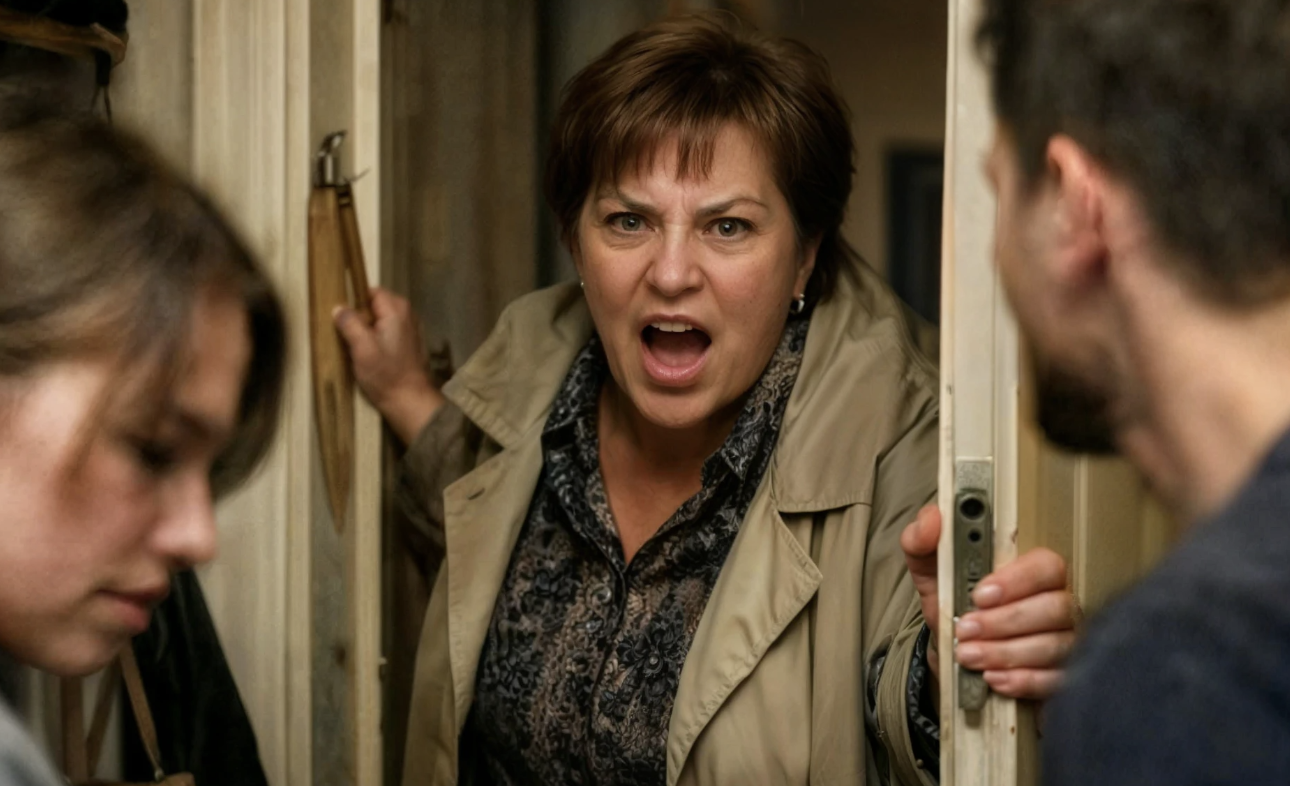
— How could you refuse to register my daughter at your address?! — the mother-in-law burst into the apartment”
Lena closed the door of the rented apartment and leaned wearily against the doorframe. Another workday was over, and another paycheck had partly gone toward rent. She kicked off her heels and walked into the kitchen, where Sergey was already reheating dinner.
“Hi,” he said, turning and kissing his wife. “How was your day?”
“Same as always. I’m tired.”
They had been married for almost two years, and in that time they’d gotten used to a modest lifestyle. Their combined income was around 110,000 rubles—not poverty, but not luxury either. Most of their money was devoured by the rent on their one-room apartment on the outskirts. Thirty-eight thousand a month—and that wasn’t even the most expensive rate in the city.
“I looked at listings today,” Sergey said as he served pasta and cutlets onto their plates. “Prices went up again. A one-bedroom in a decent area is already close to five million.”
Lena nodded, sitting down at the table. They often talked about buying their own place, but every time the conversation hit a dead end. Their savings grew slowly—after rent, groceries, transportation, and utilities, at best they had about twenty thousand left. They saved consistently, but a mortgage down payment still felt unattainable.
“Someday we’ll have our own place,” Lena said, trying to smile.
“Of course we will,” Sergey said, taking her hand. “We just need time.”
Time. Only they needed too much of it. By their calculations, it would take at least three more years to scrape together a down payment. And by then prices would rise again, and the circle would close once more.
Every month Lena opened the bank app and looked at their savings account. The number crept up, slowly but steadily. One hundred seventy thousand. One hundred ninety. Two hundred five. By the end of the year they hoped to reach three hundred thousand—but that was still disastrously little.
On her way to work she scrolled through apartment ads. Two-bedrooms started at six million, three-bedrooms at seven and a half. Even old panel buildings in sleeping districts didn’t dip below five. Lena closed the app and sighed. The dream of their own home kept drifting farther away.
“Maybe our parents could help?” Sergey suggested once.
“Yours don’t have that kind of money, and mine…” Lena hesitated. “My mom lives alone on a pension. She needs help herself.”
“Okay. Then we keep saving.”
They economized on everything. No restaurants or movies, clothes only when necessary, meals at home. Friends invited them to someone’s birthday at a bar—they had to decline. Coworkers suggested a weekend trip out of town—another no. Their whole life revolved around one goal: saving for their own home.
But the money grew slowly. Painfully slowly.
“Sometimes it feels like we’ll never save enough,” Lena admitted one evening.
“We will,” Sergey said. “The main thing is not to give up.”
Sergey was always an optimist. Lena loved him for it. But sometimes his optimism seemed naïve. Reality was too harsh—on their income, buying a home in the foreseeable future felt impossible.
A call from a notary’s office caught Lena off guard. She was at work, sorting through emails, when her phone rang.
“Elena Sergeyevna? This is Notary Pavlova. We have an inheritance matter concerning you.”
“Inheritance?” Lena blinked in confusion. “What inheritance?”
“Your grandmother, Elena Ivanovna Krylova, left a will. You need to come in to complete the paperwork.”
Lena froze. Her grandmother had died three months earlier, and it had been a heavy loss. They were close—Grandma often invited her over, fed her pies, told stories from her youth. But she had never mentioned a will.
“What exactly did she leave me?” Lena’s voice trembled.
“A three-room apartment in the central district. We’ll discuss the details in person.”
Lena ended the call and stared at her phone screen. A three-room apartment. A three-bedroom. Their own home. It couldn’t be real.
She called Sergey immediately.
“Seryozha, you won’t believe this! Grandma left me an apartment!”
“What? Seriously?!”
“The notary just called! A three-bedroom in the central district!”
Sergey laughed with joy.
“Lena, that’s unbelievable! I’m so happy!”
That evening they met and talked for hours. Lena couldn’t believe her luck. An apartment. Her own apartment. Not in three years, not in five—right now. It would be theirs. Or rather, hers—the inheritance wasn’t shared by law; it belonged only to Lena. But to her, it was their shared home.
“We should go see it,” Sergey said. “When did the notary schedule the appointment?”
“Monday. She said the registration will take a few weeks.”
“That’s fine. We’ll wait. The main thing is we’ll have our own home soon.”
The paperwork took a long time. Trips to the notary, to Rosreestr, collecting certificates, paying state fees. Lena checked the application status every day, counting down the days until the ownership certificate. Finally, a month and a half later, she held the cherished document in her hands.
“Want to go take a look?” Sergey suggested on the weekend.
They took the keys and went to the address. The apartment was in an older building on a quiet street near a park. The entryway was clean, the elevator worked. With her heart pounding, Lena opened the door.
The apartment was spacious, but clearly needed updating. The wallpaper had faded, the furniture was still Soviet-era, the parquet floor squeaked in places. An old mirror hung in the bathroom, and a bulky sideboard stood in the kitchen. But the layout was great—three separate rooms, a wide hallway, a big kitchen.
“We can turn this place into something amazing,” Sergey said, hugging her. “Should we invest in renovations?”
They had about three hundred thousand saved—the money they’d been putting away for the down payment. Now they could spend it on making the place livable.
“Let’s do it ourselves,” Lena suggested. “We can handle a cosmetic renovation. We’ll save a ton on labor.”
They got to work. Evenings after work and weekends they painted, hung wallpaper, replaced plumbing. Sergey turned out to be a pretty decent handyman—he installed new faucets, hung light fixtures, assembled a new wardrobe they bought at the store. Lena chose textiles, arranged plants, picked out decor.
Two months later the apartment was transformed. Light walls, fresh floors, new living room furniture. The renovation was budget-friendly, sure, but the result exceeded their expectations.
Moving day was sunny. Lena stood in the middle of the living room, looking at the boxes. There were surprisingly few—after two years in a rental they hadn’t accumulated much.
“That’s it,” Sergey said, hugging her from behind. “No more rented apartments. This is our home.”
Lena leaned into him, glowing inside. No more rent. Thirty-eight thousand a month would stay in the family. They could spend it on travel, improvements, savings. They could start planning for a baby—in the rental they hadn’t even considered it.
“Should we celebrate?” Sergey asked.
They ordered pizza and sat in the kitchen late into the night, talking about plans. Lena wanted to set one room up as an office; Sergey dreamed of a home theater in the living room. They talked about kids—maybe try in a year? Now that they had their own place, they could think about expanding their family.
“I should call Mom and tell her,” Sergey suddenly remembered.
“Tomorrow,” Lena yawned. “Today I just want to enjoy this moment.”
They went to sleep in the new bedroom, on a new mattress bought specifically for the move. Lena couldn’t fall asleep for a long time—it still didn’t feel real that this was their apartment. Their home. A place no one could throw them out of, where they could live however they wanted.
In the morning Sergey did call his mother.
“Mom, hi! We’ve got news—we moved into Lena’s apartment. Yes, the one she inherited. Come visit, you’ll see it!”
Lena heard Tatyana Petrovna’s excited voice through the phone. Her mother-in-law was happy for them and promised to drop by in a few days.
But Tatyana Petrovna came the very next day. She brought a bag of fruit and a jar of homemade jam.
“Oh, what a place!” she exclaimed as she stepped into the hallway. “So spacious! And the ceilings are high!”
Lena showed her the rooms. Tatyana Petrovna admired everything—the layout, the renovation, the neighborhood.
“You’re lucky,” she said, sitting at the kitchen table. “To get housing like this! A real gift from fate.”
“Yes, Grandma was very generous,” Lena said, setting tea in front of her.
“And she did the right thing leaving it to her granddaughter. Young people need support. You’re just starting to build your life.”
The conversation was pleasant. Tatyana Petrovna talked about her life, asked about work, showed interest in their plans. Lena relaxed—her mother-in-law had always been friendly, even though they didn’t see each other often.
“I’ll bring you a floor lamp one of these days,” Tatyana Petrovna offered as she was leaving. “It’s just sitting there at my place, and you could use it.”
After she left, Sergey smiled.
“Mom’s thrilled. Did you see her eyes?”
“Yes. She’s happy for us.”
Lena didn’t think much of the visit. A normal thing—relatives come to see your new place and share your joy. Nothing strange.
But Tatyana Petrovna started coming by more often. A week later she brought the promised lamp. A few days after that she showed up with a set of towels—said she saw them on sale and decided to buy them. Then she brought a potted houseplant.
“You really didn’t have to spend money,” Lena kept saying as she accepted gift after gift.
“Oh, it’s nothing! Anything for family.”
During one visit, Tatyana Petrovna sat with Lena in the kitchen and sighed.
“It’s so spacious here. You can really breathe. And Marina and I are crammed in a tiny one-bedroom. Especially now that she moved back after the divorce.”
Lena nodded sympathetically. She knew Sergey had a sister, Marina, but Lena had barely seen her—maybe a couple of times at family gatherings.
“Marina got divorced?” Lena asked politely.
“Oh, don’t even get me started!” Tatyana Petrovna threw up her hands. “Her husband turned out to be… well, an alcoholic. Marina endured and endured, then finally couldn’t take it anymore. Filed for divorce. The apartment was his, so she moved out. Now she lives with me.”
“I see. That must be hard.”
“Hard? You have no idea! Imagine—two of us in a one-bedroom! I sleep on the couch, she sleeps on a fold-out cot. There’s no space. Nowhere to put things. In the kitchen we’re always in each other’s way. A nightmare!”
Lena listened, offering little murmurs of agreement. She genuinely felt sorry for Tatyana Petrovna—sharing such a small place really was miserable.
“It’ll be okay. Marina will find a better job and rent something,” Lena tried to reassure her.
“Sure, sure…” Tatyana Petrovna stared out the window. “Only jobs are hard to find right now. And rent is expensive. A young woman can’t manage alone.”
The talk shifted to other topics, and Lena forgot about it. It was just family problems—nothing unusual.
But with every new visit, Tatyana Petrovna returned to the topic of her cramped apartment more and more. She complained that Marina interfered with her TV shows, that they couldn’t cook at the same time, that sharing one bathroom was unbearable.
“And you have three rooms!” she would exclaim, looking around. “So much space! Even if guests come, you can fit everyone.”
Lena began to notice the conversations were happening too often. It was like Tatyana Petrovna was steering her toward a certain idea, but hadn’t said it outright yet.
“You know, Lenochka,” the mother-in-law began one day, “are you planning to let anyone stay with you? Just temporarily?”
“No,” Lena looked at her in surprise. “Why?”
“Oh, just thought of it. You have so many rooms. You could help someone with housing.”
“We want to make the third room a nursery,” Lena replied.
“Oh, that won’t be for a long time! And for now the room is just standing empty!”
Lena frowned. She didn’t like where this was going.
“Tatyana Petrovna, it’s not standing empty. We’re keeping things in there for now. Later we’ll organize everything properly.”
“Yes, yes…” the mother-in-law fell silent, but Lena could see the subject wasn’t closed.
The next week Tatyana Petrovna started again:
“Marina is really down. Says she can’t live with me anymore. It’s too cramped. She wants to move out, but she has no money.”
Lena kept quiet, hoping it would end on its own. But her mother-in-law continued.
“So I’m thinking—maybe she could stay with you? Temporarily, of course. Until she gets back on her feet.”
Lena froze with her cup in her hand. Had she heard that right?
“You’re suggesting Marina move in with us?”
“Yes!” Tatyana Petrovna brightened. “Just temporarily! Three or four months. She’ll find work, save some money, and move out. It won’t be a burden—you’ve got plenty of room.”
“Tatyana Petrovna, this is our apartment. Sergey and I just settled in. I don’t think we need housemates.”
“What housemates?!” her mother-in-law threw up her hands. “She’s Sergey’s own sister! Family! And family is supposed to help each other!”
“We help however we can,” Lena insisted. “But letting someone live with us is too much.”
“Oh, Lenochka, don’t be so hard-hearted! The girl needs help! She’s in a difficult situation!”
“Marina has a mother she’s living with,” Lena said firmly. “That’s enough.”
Tatyana Petrovna pressed her lips together. The rest of the visit passed in strained silence. As she left, she only gave a short nod in farewell.
That evening Lena told Sergey.
“Can you imagine? Your mom suggested moving Marina in with us!”
Sergey raised his eyebrows.
“Seriously?”
“Yes. Says it’s temporary. Three or four months.”
“And what did you say?”
“I refused, of course. I’m not going to share our apartment with someone.”
Sergey nodded, but something in his expression made Lena uneasy.
“Seryozha… you don’t think it’s a good idea, do you?”
“No, of course not,” he replied quickly. “It’s just… Marina really is having a hard time right now…”
“So? She’s an adult. Let her solve her own problems.”
“You’re right,” Sergey agreed, but Lena could see he wasn’t fully convinced.
A few days later Tatyana Petrovna called again.
“Lenochka, I’ve been thinking… maybe you could at least register Marina at your address? She doesn’t have to live with you—just registration. She needs city registration for work.”
Lena squeezed the phone tightly.
“Tatyana Petrovna, I’m not registering anyone in my apartment.”
“Why not?! It’s just a formality! Just a stamp in a passport!”
“Registration isn’t a formality. It has legal consequences. I don’t want to risk it.”
“Risk it?!” the mother-in-law’s voice rose. “Marina isn’t a stranger!”
“To me, she is,” Lena said firmly. “I’m sorry, but my decision is final.”
She hung up and exhaled. Her hands were shaking from the tension. Tatyana Petrovna clearly wasn’t going to back off.
That evening she came in person. She burst into the apartment without even taking off her shoes.
“Lena, you have to help Marina! She’s your sister-in-law!”
“Tatyana Petrovna, I already said no. This is my apartment—my decision.”
“What do you mean your apartment?! It’s a family apartment! Seryozha lives here too!”
“The apartment was inherited by me. Sergey is registered here, but I’m the owner.”
“Oh, so that’s how it is!” the mother-in-law folded her arms. “So you’re playing the ownership card? What about family feelings? Mutual support?”
“I don’t owe anyone anything,” Lena felt anger rising. “Your daughter is an adult. Let her build her own life.”
“Heartless!” Tatyana Petrovna spun around and left, slamming the door.
Lena sank onto the couch. Her heart was pounding. She understood the conflict was only beginning.
When Sergey came home from work, Lena immediately told him what had happened.
“Seryozha, your mom has completely lost it. She’s demanding we register Marina here!”
“Oh, Mom…” Sergey took off his jacket. “She’s just worried about her daughter.”
“Worried? She’s barging into our life!”
“Lena, let’s stay calm. Maybe we really could do temporary registration? Marina truly needs it for work.”
Lena couldn’t believe her ears.
“Are you serious?”
“Think about it. It’s not forever. Just a stamp in the passport.”
“Sergey, do you understand that registration gives someone rights connected to the apartment? That it can be hard to deregister them later?”
“It won’t be hard! Marina isn’t some enemy!”
Lena jumped up from the couch.
“And to me—who is she? I barely know her! I’ve seen her a couple of times in two years!”
“She’s my sister,” Sergey raised his voice. “And I don’t not care what happens to her!”
“And I do care what happens to our home!” Lena shouted. “We just moved in! We just started settling! We were planning a baby! And you want me to register a stranger here?!”
“She’s not a stranger!”
“To me she is!”
They argued until late at night—first time since the inheritance. Sergey insisted they should help his sister; Lena refused. In the end Sergey went to sleep on the couch in the living room, slamming the bedroom door.
Lena lay in the dark staring at the ceiling. Tears ran down her cheeks on their own. She couldn’t understand how her husband could take his relatives’ side. It was her apartment. Her inheritance. Why did she have to prove anything to anyone?
On Friday Lena stayed late at work. She had to finish a quarterly report and ended up sitting there until evening. She got home around nine, hungry and exhausted.
When she opened the door, she heard voices in the kitchen—Sergey’s and a woman’s voice she didn’t recognize at first. No—not entirely unfamiliar. Lena remembered it from family gatherings. Marina.
Lena kicked off her shoes and went into the kitchen. Sergey and his sister sat at the table, and some papers were spread out in front of them. Seeing Lena, Marina smiled broadly.
“Oh, hi, Len! Perfect timing!”
Lena looked at her husband. He avoided her eyes.
“What is going on here?”
“Here,” Marina pushed a stack of documents toward her, “everything’s ready for my registration in this apartment. Sergey explained where to sign. And in a week or so I’ll move in. You’ve got plenty of space—I’ll fit right in. We won’t get in each other’s way.”
Lena took the documents with trembling hands. An application for registration at the place of residence. The address field had her apartment’s address. The “owner” field listed her name. At the bottom, a space waited for her signature.
“Have you lost your mind?” Lena threw the papers onto the table.
“What?” Marina lifted her eyebrows, surprised. “What are you talking about?”
“I’m not registering you here! And I’m definitely not letting you move in!”
“Lena, let’s talk calmly,” Sergey began.
“Calmly?!” Lena turned on him. “You brought your sister here with the paperwork ready—behind my back?!”
“I thought you’d agree…”
“On what grounds did you think that? I said no!”
Marina stood up.
“Lena, don’t be like that. I really do need help. I got a new job—I need registration, and I need a place to sleep at first.”
“At first?” Lena laughed, but it was a nervous laugh. “Your mother said three or four months! And now you’re saying ‘at first’! Who guarantees you’ll ever move out?!”
“What are you doing?! I’m not some monster!” Marina grimaced. “Just until I get back on my feet…”
“Get back on your feet somewhere else. This is my apartment.”
“Your apartment?!” Sergey cut in. “We live here together! I get a say too!”
“You might get a say,” Lena stepped close to him, “but you don’t have ownership rights. The apartment is mine. Inherited. And I’m not registering anyone here!”
“You’re such a bitch!” Marina shouted. “Mom said you were a snake, but I didn’t think it was this bad!”
“Out!” Lena pointed at the door. “Get out of my apartment. Now!”
“And who are you to order me around?!”
“I’m the owner!” Lena yelled. “And you’re an uninvited guest. Get out!”
Marina grabbed her bag and stormed to the door. On the threshold she turned around:
“You’ll regret this! My mother will never forgive you!”
She slammed the door so hard the windows rattled. Lena stood in the middle of the kitchen, breathing heavily. Adrenaline surged through her veins. She turned to Sergey.
“How could you?”
“I just wanted to help my sister…”
“At my expense! You wanted to help her at my expense! You brought her here with documents without even asking me!”
“I thought you’d understand…”
“Understand what? That your family matters more to you than I do?”
Sergey lowered his head. Lena waited for an answer, but he said nothing.
They didn’t speak all night. Lena slept alone; Sergey went to the couch again. In the morning Lena woke to noise in the hallway. She peeked out of the bedroom and froze.
Tatyana Petrovna was in the apartment. Her mother-in-law was clearly furious—face red, eyes blazing.
“You!” she pointed at Lena. “How could you refuse to register my daughter here?!”
“Tatyana Petrovna…”
“Quiet!” her mother-in-law barked. “Marina cried all night! Says you threw her out like some beggar!”
“She came without permission with ready-made documents!” Lena stepped closer. “She thought I’d just sign!”
“So what? You should have signed! The girl needs help! She’s in trouble!”
“Her trouble is not my problem!”
Tatyana Petrovna moved closer, looming over Lena. She was taller and used it.
“You heartless egoist! You got a free apartment and got full of yourself!”
“Free?!” Lena’s voice shook. “It’s an inheritance from my grandmother! She left it to me!”
“So what now? Now you think you can spit on your husband’s family?”
“I’m not spitting on anyone. I just don’t want to register anyone in my apartment!”
“Mine, mine!” Tatyana Petrovna mocked. “And who is Seryozha here—some freeloader?”
“Seryozha is my husband. He lives here. But the apartment is mine!”
“Greedy!” her mother-in-law turned to her son, who had come out of the living room. “Seryozha, do you see who you married? A greedy bitch!”
“Mom, stop,” Sergey tried.
“How can I stop?! She hurt your sister! Your own sister!”
Lena took a deep breath, trying to calm herself. Yelling was useless—Tatyana Petrovna wouldn’t hear anyway.
“Listen,” Lena said as evenly as she could. “I understand Marina is having a hard time. But that doesn’t mean I have to solve her problems. The apartment came to me by inheritance. It’s my property.”
“Property!” her mother-in-law snorted. “And what about family? Mutual help?”
“Family is me and Sergey,” Lena said firmly. “Everyone else are relatives. And they should respect our boundaries.”
“Boundaries? What boundaries? Marina asked for something simple—registration! It’s nothing!”
“It’s not nothing. Registration gives rights tied to the apartment. If I register Marina, I may not be able to get her out later.”
“Who told you that nonsense?!” Tatyana Petrovna flailed her arms. “Marina isn’t a criminal! She’ll leave once she’s back on her feet!”
“When will that be? In a month? A year? Five years?”
“There you go!” the mother-in-law looked triumphantly at her son. “She’s already thinking the worst! She doesn’t trust us!”
“I’m protecting my interests,” Lena folded her arms. “And the interests of my family with Sergey.”
“What family? You don’t even have children!”
“Because we’re just starting! And we don’t want outsiders interfering!”
“Outsiders!” Tatyana Petrovna threw up her hands. “You’re calling Marina an outsider?! She’s your husband’s sister!”
“To me she’s exactly that—an outsider. I barely know her.”
Tatyana Petrovna turned to Sergey, tears appearing in her eyes.
“Seryozhenka, say something! She’s your sister! Your own blood!”
Sergey was silent. He stood between his mother and his wife, and Lena could see how torn he was. Finally, he spoke:
“Mom, Lena is right. It’s her apartment. And she has the right to decide who gets registered here.”
Tatyana Petrovna’s eyes widened.
“What? You’re taking her side?!”
“I’m taking the side of common sense,” Sergey stepped closer to his mother. “Marina is an adult. Let her handle her own life.”
“How can you say that?!” his mother recoiled. “I gave birth to you! Raised you! And you choose this… this…”
“My wife,” Sergey said firmly. “I choose my wife. And my family.”
“What family?” Tatyana Petrovna sobbed openly now. “You’re not even really married! There wasn’t even a wedding!”
“We signed the papers. That’s enough.”
“Seryozha…” she tried to grab his hand, but he pulled away.
“Mom, please leave. We’ve discussed everything. The decision is made.”
“You’ll regret it!” she shouted, clutching her bag. “Marina will suffer—you’ll regret not helping her!”
“Marina will manage,” Sergey replied calmly. “She’s strong.”
Tatyana Petrovna ran out of the apartment, crying. The slam of the door echoed into the silence. Lena and Sergey stood without speaking. Finally, Lena walked up to him.
“Thank you.”
“For what?”
“For taking my side.”
Sergey hugged her.
“I’m sorry I didn’t understand right away. You were right from the beginning. Mom and Marina went too far.”
“They wanted to solve their problems at our expense,” Lena pressed her face to his chest. “And if I’d agreed, they wouldn’t have stopped. First registration, then moving things in, then living here permanently…”
“I know. I get it now.”
That evening Sergey called his mother. Lena didn’t hear every word, but his tone was firm.
“Mom, we made a decision. And it’s final. No, we won’t register Marina here. No, it’s not up for discussion. Lena is my wife, and I’m on her side.”
He hung up and exhaled.
“How is she?”
“Offended. Said she doesn’t want to see us anymore.”
“And what did you say?”
“That it’s her choice. But we’ll always be glad if she changes her mind.”
Lena sat next to her husband on the couch.
“Was it hard for you to talk to her?”
“Very. But it had to be done. She has to understand we have our own family now. With our own rules and boundaries.”
“And Marina?”
“Marina’s offended too. But that’s her problem. She’s not alone in the world. She’ll figure it out.”
The next few weeks were calm. Tatyana Petrovna didn’t call or come by. Lena knew her mother-in-law was sulking, but she wasn’t particularly worried. She had never been close to Sergey’s family.
Sergey spoke to his mother sometimes, but the conversations were short and formal. Marina found a job and rented a room in a dormitory. According to Tatyana Petrovna, her daughter was managing on her own.
“See?” Lena said one day. “She managed without our help.”
“Yes,” Sergey admitted. “Mom exaggerated the scale of the problem.”
“Or she just wanted Marina to live more comfortably at our expense.”
Sergey nodded, not arguing.
A few months later Lena and Sergey returned to the topic of having a baby. They were sitting in the kitchen late in the evening, finishing their tea.
“You know,” Lena said, “I’ve been thinking. Maybe it’s time?”
“Time?” Sergey looked at her.
“About a baby. We have everything now—our own apartment, steady jobs, savings.”
Sergey smiled.
“I’ve been thinking about that too. Want to try?”
“Let’s try.”
They hugged, and Lena felt warmth spread inside her. At last their life had settled into a normal rhythm. The conflict with the relatives was behind them, the apartment was their fortress, and the future looked bright.
A month later Tatyana Petrovna called Sergey. The conversation was short, but warm.
“Mom, hi. How are you?”
“Fine, son. Listen… I wanted to apologize. For putting pressure on you.”
“It’s okay, Mom.”
“Marina’s doing well. Working, renting a room. Managing.”
“Glad to hear it.”
“Can I come visit sometime?”
“Of course. Come by.”
Lena heard the conversation and nodded. She wasn’t holding a grudge. It was just important that Tatyana Petrovna understood the boundaries.
And she did.
That evening Lena and Sergey stood on the balcony, looking out over the city. The lights of the buildings shimmered in the dark, and somewhere in the distance cars hummed.
“You know, I’m happy,” Lena said.
“Me too,” Sergey hugged her around the waist. “We did it.”
“Yes. We protected our home.”
“And our family.”
Lena smiled. Their little family—one that might soon become bigger. Their apartment, their life, their rules. No one could take that away from them now.