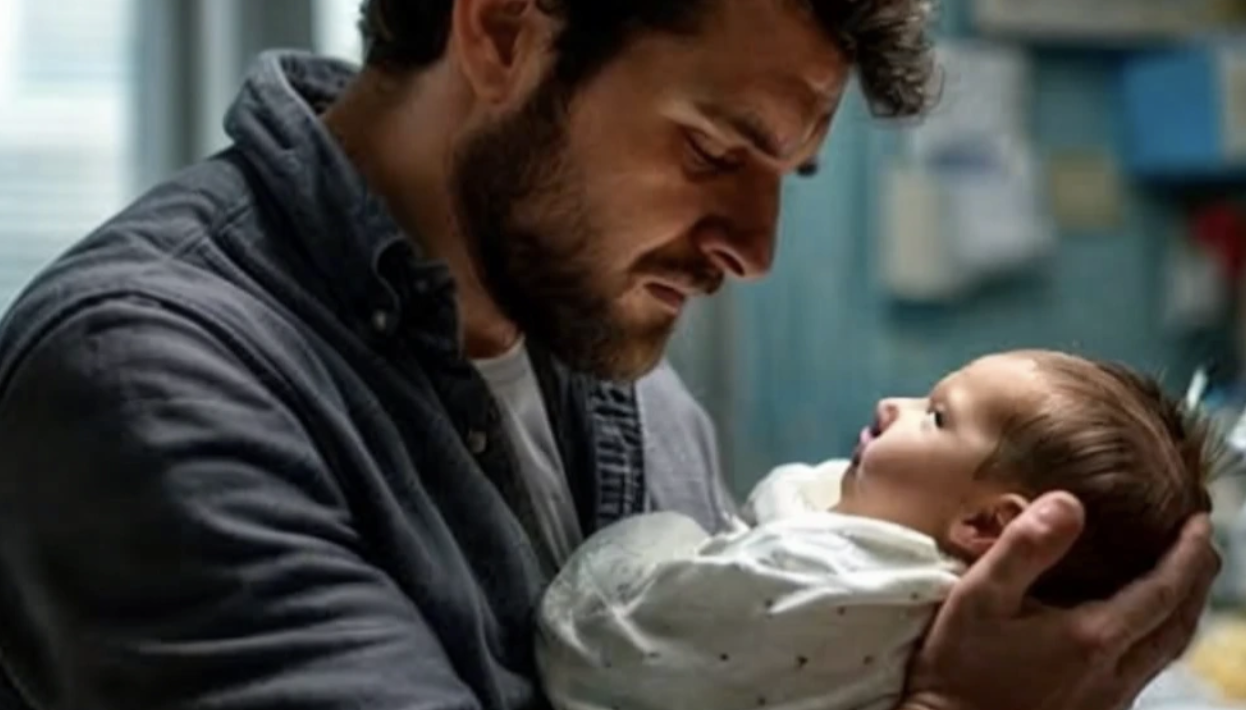
Our boy was born deaf? Leave him at the hospital—I’m not ready to raise a child like that!” My wife’s voice rang with a fury I had never heard in her before.
“Olya, what are you saying? He’s flesh of our flesh,” I stared at her as if seeing her for the first time.
Her words hurt more than the doctor’s news an hour earlier. The doctor—an elderly man with eyes inflamed from sleeplessness—had placed a hand on my shoulder: “Congenital deafness. Complete. Unfortunately, there is no chance of recovery.”
I stood by the ward window. Autumn rain drummed monotonously against the glass, as if the world were sending me some unknown signal. In those sounds my son would never hear, reality turned upside down.
“You don’t understand, Sasha,” Olga wrapped her arms around herself as if defending herself. “This is a life sentence for us. Special conditions… We’ll ruin ourselves. When are we supposed to live?”
I looked at the tiny bundle. A small wrinkled face, softly pink and peaceful. The baby slept, unaware that his fate was being decided right now. His diagnosis didn’t make him any less my son.
“I’m taking him home,” I said quietly but firmly.
“What?”
“I said I’m taking the child. Alone.”
Olga’s lips trembled, as though she’d been struck.
“Have you lost your mind? You’re an electrician working part-time! How are you going to raise a baby like that?”
“The same way you raise any other. Day by day.”
I spent the night beside my son’s crib. Nurse Irina—a woman with kind eyes and hands worn down by work—let me into the newborn nursery without a word.
I watched Denis’s tiny chest rise with every breath. His little heart beat with such confidence, such stubborn persistence. It was amazing how something so small could have such a powerful will to live.
In the morning I discovered Olga was gone. She had left a note of two lines: “Forgive me. I can’t do this.” Five years of marriage collapsed into four words on a torn scrap of notebook paper.
A week later I brought my son home. An old bus rattled along the broken road, and Denis slept curled against my chest, wrapped in the only thing Olga and I had managed to buy for him—a soft blue flannel blanket.
“And how exactly are you going to manage on your own?” our neighbor Marina Petrovna called from behind her fence as I approached the house.
“I have no idea,” I answered honestly. “But I don’t have a choice.”
The first months became an endless race to survive. I learned to change diapers with one hand while holding a bottle of formula with the other. Sleep came in scraps; constant exhaustion and loneliness became my faithful companions. Around the village people whispered: “Poor man,” “He should’ve stopped his wife from leaving,” “It’s not a man’s job to mess with diapers.”
Denis often cried at night.
In those moments, when despair pressed hardest, I picked him up, held him to my heart, and whispered, “We’ll make it, son. I promise.”
He couldn’t hear the words, but he felt the vibration of my chest when I spoke. Gradually he would calm down. And then—he smiled at me for the first time.
His toothless little mouth stretched into a grin worth every sleepless night and every doubt. I understood a simple truth: my son didn’t know he was “missing” anything. For him, the world had always been silent. But that didn’t mean he was incomplete—his world simply followed different rules.
Day by day, we learned a new language. It was made of glances, touches, expressions. I learned to read the subtlest shades of his mood, and he learned to understand me without a single spoken word. Looking at my son asleep in his crib, I often thought, How can someone abandon their own child just because he isn’t like everyone else?
Fortunately, I had recently inherited a house from my parents and sold it, so we had enough money to live on. I could work only in my spare time, when neighbors were able to sit with the child.
That’s how we began a new life—just the two of us against the whole world.
Five years flashed by like a single moment. Denis grew into a bright, curious boy with unruly light-brown curls and eyes just like mine.
In the mornings he would burst into my bedroom with the first rays of sun and leap onto the bed—his signature way of saying “good morning.”
Our home filled with a soundless language—a language of images and touch. I mastered sign language for objects, actions, feelings. My son learned too.
At night, when Denis fell asleep, I hunched over books ordered from the regional center, drilling the alphabet until my fingers went numb. A few more years passed like that.
“Alexander, you do understand our school isn’t equipped to teach a child like this?” the principal, Nadezhda Igorevna, spoke gently but firmly. “You need specialists, special methods…”
“What if I come with him to lessons? Translate everything the teachers say?”
“And when will you work?” she sighed. “Sasha, understand—he needs a boarding school for the hearing-impaired in the city.”
I stared out her office window at the schoolyard. There among the other kids, Denis was focused on building a tower of sticks with Petya, the neighbor’s boy. They got along perfectly without a single word.
“I’m not sending him to a boarding school,” I said quietly. “I’ll find another solution.”
The solution came unexpectedly—with the arrival of a new teacher.
Anna Sergeyevna transferred to our rural school from the city. She was petite, with short hair and lively brown eyes.
I first met her at the village store, where she was unsuccessfully trying to explain to Nina Fyodorovna that she was looking for local newspapers.
“We don’t carry newspapers,” I cut in. “But we do have Zinaida Petrovna. She delivers the mail—and collects and spreads all the gossip. A walking newspaper, you could say.”
Anna laughed, and her laugh—so strangely bright—woke something in me that had been sleeping for a long time.
“Thanks for the tip,” she said, holding out her hand. “I’m Anna, the new primary school teacher.”
Denis, standing beside me, watched closely. Suddenly he made a few gestures with his hands.
“My son says you have a beautiful smile,” I translated.
Anna’s eyebrows shot up.
She quickly signed a few words. “You understand sign language?”
Now it was my turn to be surprised.
Denis signed back: “Yes. Dad taught me.”
“My aunt was deaf from birth,” Anna explained. “I grew up speaking sign language with her.”
That evening we talked for a long time on a bench near the school while Denis played nearby. Anna told me she had worked with special-needs children in the city, but city life had worn her out.
“I could work with Denis,” she offered. “Adapt the school program. If you don’t mind.”
I couldn’t believe a coincidence like that. It felt as if someone up above had heard my silent prayers. Anna began coming three times a week. She brought special cards with pictures, letters, numbers.
To my amazement, Denis already knew a lot—he had taught himself basic math and learned to lip-read some words.
“He has a phenomenal mind,” Anna said once, watching him solve a puzzle. “And extraordinary observation skills. He can’t hear, but he notices what many people miss.”
Gradually the lessons turned into something more. Anna started bringing books for me—“so you won’t be bored while Denis and I study.” She stayed for dinner. She taught me to cook something more complicated than my eternal fried eggs.
One evening, after Denis had fallen sound asleep, we sat on the veranda.
The sky over the village glittered with stars like scattered diamonds on dark velvet.
“You know,” Anna said softly, “I’ve never met a father like you.”
“Like what?”
“Real. Someone who doesn’t look for the easy way out.”
I didn’t know what to say. I just took her hand in mine. She didn’t pull away. In that moment everything clicked into place—like the last puzzle piece finally fitting where it belonged.
Six months later, we got married. No pomp, no noise—only the closest people. Denis carried the ring pillow, glowing with pride at his important task.
And six months after that, a small miracle happened. Anna brought home an experimental hearing aid from a trip to the city—pulled through old connections.
“It won’t give him full hearing,” she warned, “but it may let him distinguish very loud sounds.”
We fitted the device, not hoping for much. Anna took a little bell and rang it right next to Denis’s ear.
My son’s face changed—his eyes widened, his lips parted in astonishment. He turned toward the source of the sound, then back to us, and his hands moved with unbelievable speed:
“I felt something! What was that?”
That night I cried for the first time in many years—not from grief, but from overwhelming happiness.
And later, Denis called Anna “mom” for the first time. Not with his voice—with his fingers. But that word shone in his signs brighter than any spoken sound.
“Tell me about my real mother,” Denis signed confidently, as he did everything now.
We were sitting on the porch. The autumn sun painted the garden in honey tones. Denis had turned twenty.
He was tall, broad-shouldered, with attentive eyes where that same spark sometimes flashed—the one that had once glowed in a baby’s gaze.
I knew the question was inevitable. Still, it caught me off guard.
“Why now?” my hands moved slower than usual.
“I want to know. Also, I’ve been offered a job,” Denis smiled. “At an IT company. Remote development. They’re looking for a cybersecurity specialist, and they liked my competition project.”
Pride flooded me. The boy people had urged me to “send away to a special boarding school” had become one of the best programmers in the field.
Despite his deafness—or maybe because of it—he had developed an incredible ability to see patterns in code that others couldn’t.
“Congratulations, son!” I pulled him into a tight hug. “But what does that have to do with your biological mother?”
“A new stage is starting,” his fingers wove sentences with the skill of an experienced storyteller. “I want to sort out everything that’s still in the past before I move forward.”
I sighed. Twenty years ago I had sworn to myself I would never smear the woman who gave me my son, even if she hadn’t found the strength to stay.
“She was scared, Denis,” I signed, trying to convey the complexity. “Your mother, Olga, was young and beautiful. We loved each other, but…” I hesitated. “She wasn’t ready for hardship.”
When the doctors told us about your deafness, she broke. She was afraid she wouldn’t manage—afraid of the life waiting for us.
“She wanted to leave me in the hospital?” Denis’s eyes stayed calm—no judgment, only a need for truth.
“Yes,” I admitted. “She said she couldn’t raise a special-needs child.”
Denis stared toward the horizon, where a thin mist lay over the fields. His face was expressionless, but I knew a storm was raging inside. I had long learned to catch the tiniest shifts in his eyes.
“Did you ever tell her about me? Try to find her?”
“No,” I shook my head. “She left for good. People said she married in the city, had other children. I didn’t look for her. I thought—if she wants to, she’ll find us herself.”
“Do you regret it?” his gaze was piercing. “That you stayed with me alone?”
I gave a crooked smile.
“Not a single day, son. Not a single minute.”
Anna appeared on the porch soundlessly, like a shadow.
“Such a serious conversation—what about?” her hands fluttered, forming words.
“About the past,” Denis answered, then turned to me. “I forgive her, Dad. But I don’t want to meet her. My real mom is here,” he signed, casting a warm look at Anna.
She hugged him, pressed her cheek to his shoulder. When they stood together, I was always struck by their resemblance—not in appearance, but in some inner bond, as if the branches of one tree had intertwined with another to create a new pattern.
Later, when Denis went back to work (his days were always scheduled down to the minute—another result of living in a world without sound, where order becomes a necessity), Anna sat down beside me.
“He grew into an extraordinary person,” she signed, resting her head on my shoulder.
“Thanks to you,” I kissed her temple.
“No,” she shook her head. “Thanks to your decision.”
A light was on in Denis’s room. Through the curtain I could see his silhouette, bent over his laptop, focused.
I remembered Olga’s face on that last day—confused, dim. Strangely, I didn’t hate her. Over time I even began to pity her—she had missed the chance to know real love, the kind that doesn’t demand perfection.
Anna seemed to read my thoughts.
“You know, sometimes the greatest courage is staying when everyone around you says to leave.”
I looked at my son, and my heart filled with a feeling so deep I couldn’t put it into words. My son. My exceptional, strong, kind son.
He lifted his eyes from the laptop and smiled when he caught our gaze. Then he came out to join us.
So we sat there, the three of us, under the evening sky—not a perfect family, but a real one. She left because she couldn’t handle it. And we stayed. And we became a family.
Denis didn’t need to hear me to understand how much I loved him. True love doesn’t need words—only actions and the decisions we make every day