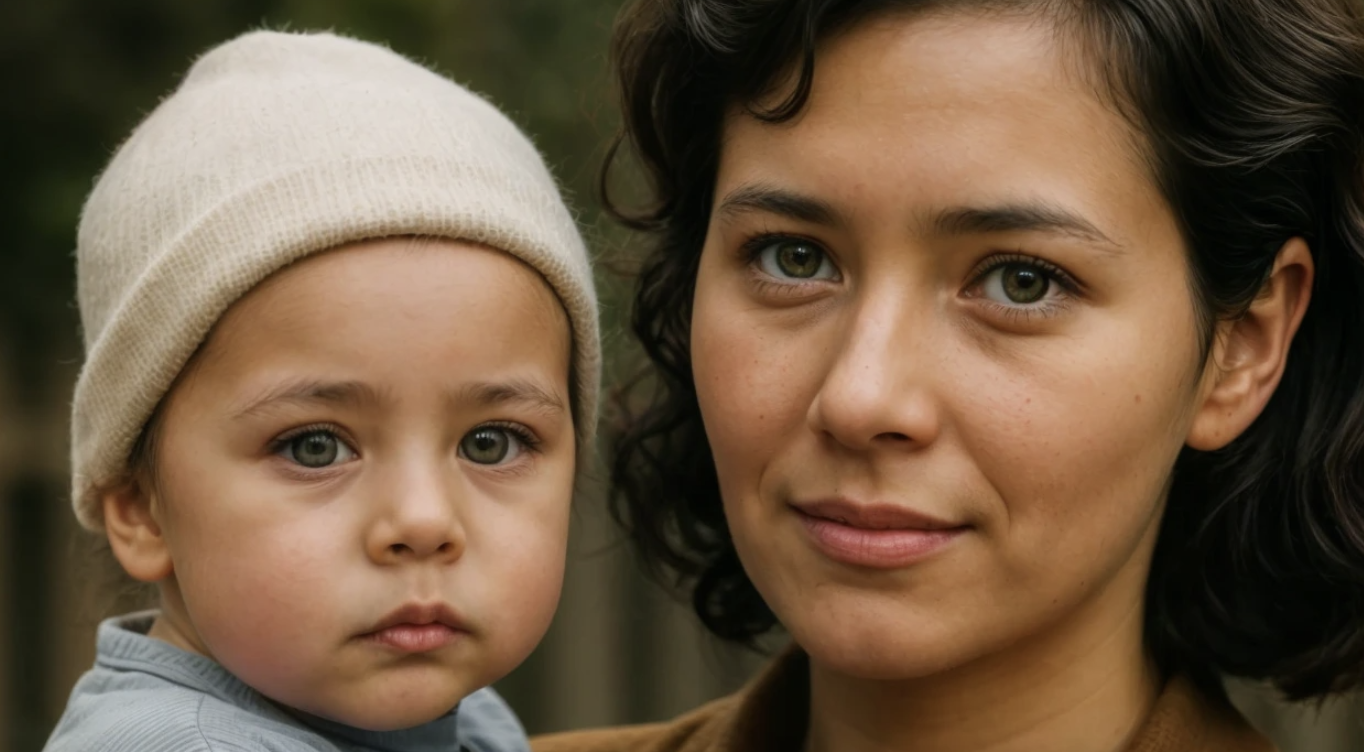
— “Misha, look!” I froze by the gate, not believing my eyes.
My husband awkwardly stepped over the threshold, bent under the weight of a bucket of fish. The sticky morning chill seeped into my bones, but what I saw on the bench made me forget everything.
— “What is it?” Mikhail set the bucket down and came over to me.
On the old bench by the fence stood a wicker basket. Inside, wrapped in a faded swaddling cloth, lay a child—a little boy, about two years old.
His big brown eyes looked straight at me—without fear, without curiosity. He just looked.
— “My God,” Mikhail whispered. “Where did he come from?”
I carefully ran my finger over his dark hair. The toddler didn’t move or cry—he only blinked.
In his tiny fist he was clutching a scrap of paper. I gently uncurled his fingers and read the note: “Please help him. I can’t. Forgive me.”
— “We need to call the police,” Mikhail frowned, scratching the back of his head. “And inform the village council.”
But I had already lifted the boy into my arms and pressed him to my chest. He smelled of road dust and dirty hair. His little jumpsuit was worn, but clean.
— “Anna,” Misha looked at me anxiously, “we can’t just keep him.”
— “We can,” I met his eyes. “Misha, we’ve been waiting five years. Five. The doctors say we won’t have children. And now…”
— “But the laws, the documents… His parents might show up,” he objected.
I shook my head.
— “They won’t. I can feel it—they won’t.”
The boy suddenly smiled wide at me, as if he understood what we were talking about. And that was enough. Through friends we arranged guardianship and the paperwork. 1993 was not an easy year.
A week later we noticed something strange. The toddler, whom I named Ilya, didn’t react to sounds. At first we thought he was just dreamy, deeply focused.
But when the neighbor’s tractor thundered past our windows and Ilya didn’t even flinch, my heart tightened.
— “Misha… he can’t hear,” I whispered that evening as I put him to bed in the old cradle left from my nephew.
My husband stared at the fire in the stove for a long time, then sighed.
— “We’ll go to the doctor in Zarechye. To Nikolai Petrovich.”
The doctor examined Ilya and only spread his hands.
— “Congenital deafness. Complete. Don’t even hope for surgery—this isn’t that kind of case.”
I cried the whole way home. Mikhail was silent, gripping the steering wheel until his fingers turned white. That evening, when Ilya fell asleep, he took a bottle from the cupboard.
— “Misha, maybe you shouldn’t…”
— “I have to,” he drank half a glass in one gulp. “We won’t give him up.”
— “Give whom up?”
— “Him. We won’t give him up to anyone,” he said firmly. “We’ll manage ourselves.”
— “But how? How do we teach him? How—”
Mikhail stopped me with a gesture.
— “If we have to, you’ll learn. You’re a teacher. You’ll figure something out.”
That night I didn’t sleep. I lay staring at the ceiling, thinking: How do you teach a child who can’t hear? How do you give him everything he needs?
And only toward morning did the realization come…
He has eyes, hands, a heart. Which means he has everything that truly matters.
The next day I took a notebook and began to make a plan. I searched for books. I invented ways to teach without sound. From that moment on, our life changed forever.
By autumn, Ilya turned ten. He sat by the window drawing sunflowers. In his sketchbook they weren’t just flowers—they danced and spun in their own special rhythm.
— “Misho, look,” I touched my husband’s shoulder as I came into the room. “Yellow again. Today he’s happy.”
Over the years Ilya and I learned to understand each other. First I mastered fingerspelling—the manual alphabet—and then sign language.
Mikhail learned more slowly, but the most important words—“son,” “love,” “pride”—we both knew.
We didn’t have a school for children like him, so I taught him myself. He learned to read quickly: letters, syllables, words. And to count—even faster. But most of all, he drew. Constantly. On anything he could get his hands on.
At first—with his finger on fogged-up glass. Then—with charcoal on a board Mikhail made especially for him. And later—with paints on paper and canvas. I ordered paints by mail from the city, saving on myself as long as the boy had good materials.
— “Your mute’s mixing something up again?” snorted our neighbor Semyon, peering over the fence. “What use is he?”
Mikhail lifted his head from the garden bed.
— “And you, Semyon—what useful thing do you do, besides wagging your tongue?”
It wasn’t easy with the villagers. They didn’t understand us. They mocked Ilya, called him names. Especially the children.
One day he came home with a torn shirt and a scratch on his cheek. Silently he showed who did it—Kolya, the village head’s son.
I cried as I cleaned the wound. And Ilya wiped my tears with his fingers and smiled, as if saying: Don’t worry. It’s okay.
That evening Mikhail left. He came back late, said nothing, but he had a bruise under his eye. After that, no one touched Ilya again.
In his teenage years his drawings changed. A style appeared—distinctive, as if from another world.
He portrayed a world without sound, but there was so much depth in every piece it took your breath away. The walls of our house were covered with his paintings.
Once a district commission came to check how I was teaching my son at home. An elderly woman in a строгий suit stepped inside, saw the paintings, and froze.
— “Who drew this?” she whispered.
— “My son,” I answered with pride.
— “You need to show this to specialists,” she took off her glasses. “Your boy has… a real gift.”
But we were afraid. The world beyond the village seemed too big and too dangerous for Ilya. How would he manage there—without us, without familiar signs and glances?
— “We’re going,” I insisted, packing his things. “There’s an artists’ fair. You need to show your work.”
Ilya was already seventeen. Tall, thin, with long fingers and an attentive gaze—he seemed to see everything. Reluctantly he nodded; arguing with me was useless.
At the fair, his pieces were hung in the farthest corner. Five small paintings—fields, birds, hands holding the sun. People walked past, glanced, but didn’t stop.
And then she appeared—a graying woman with a straight back and a piercing look. She stood before the paintings for a long time without moving. Then she turned sharply to me.
— “Are these your works?”
— “My son’s,” I nodded toward Ilya, standing beside me with his arms folded over his chest.
— “He doesn’t hear?” she asked, noticing our signing.
— “Yes. Since birth.”
She nodded.
— “My name is Vera Sergeyevna. I represent an art gallery in Moscow.”
— “This piece…” she caught her breath, studying the smallest painting with a setting sun over a field. “It has something many artists search for for years. I want to buy it.”
Ilya went still, watching my face as I awkwardly translated the woman’s words. His fingers trembled, and in his eyes a shy hope appeared.
— “You truly never thought of selling it?” Vera Sergeyevna’s voice held the certainty of someone who knows the value of art.
— “We never…” I stumbled, feeling my cheeks burn. “We never even thought about selling. It’s… his soul on canvas.”
She took out her wallet and, without bargaining, laid down a sum Mikhail earned in half a year at his carpentry shop.
A week later she returned. She took the second painting—the one where hands hold the morning sun.
And in mid-autumn the postman brought an envelope with a Moscow postmark. “In your son’s works there is rare sincerity. An understanding of depth without words. That is exactly what true connoisseurs seek.”
The capital greeted us with gray streets and indifferent faces. The gallery was a small space in an old building on the outskirts. But every day people came—eyes attentive.
They studied the paintings, spoke about color, composition. Ilya stood to the side, watching lips move and hands gesture. He couldn’t hear the words, but he saw everything—faces said more.
Then came grants, internships, publications. They called him “The Artist of Silence.” His works—mute cries of the soul—echoed in everyone who saw them.
Three years passed. Misha couldn’t hold back tears as he saw his son off to St. Petersburg for a solo exhibition. I kept my composure, but inside everything clenched. Our boy—already grown. Without us.
But he came back.
One sunny day he appeared on the doorstep with a bouquet of wildflowers. He hugged us, and taking our hands, led us through the village past astonished stares—to a distant field.
There stood a house. New, snow-white, with a balcony and big windows. The village had long wondered which rich man was building here, but no one had seen the owner.
— “What is this?” I whispered, not believing my eyes.
Ilya smiled and took out keys. Inside—bright rooms, a studio, bookshelves, new furniture.
— “Son,” Mikhail looked around in confusion, “is this your house?”
Ilya shook his head and signed: “Ours. Yours and mine.”
Then he led us into the yard, where a huge painting hung on the outer wall: a basket by the gate, a woman with a radiant face holding a child—and above them, written in signs: “Thank you, Mom.” I froze. Tears ran down my cheeks, but I didn’t wipe them away.
My always-reserved Misha suddenly stepped forward and hugged his son tightly—so tightly he could barely breathe.
Ilya hugged him back, then reached out his hand to me. And the three of us stood together in the middle of the field by the new house.
Now Ilya’s paintings adorn galleries around the world. He opened a school for deaf children in the regional center and funds support programs.
The village is proud of him—our Ilya, who hears with his heart.
And Mikhail and I live in that very white house. Every morning I step onto the porch with a cup of tea and look at the painting on the wall.
Sometimes I think: what would have happened if that July morning we hadn’t stepped outside? If I hadn’t seen him? If I’d been afraid?
Ilya still can’t hear my voice. But he knows every word I say.
He doesn’t hear music, but he creates his own—from color and line. And when I see his smile, I understand: the most important moments in life are truly born in silence.