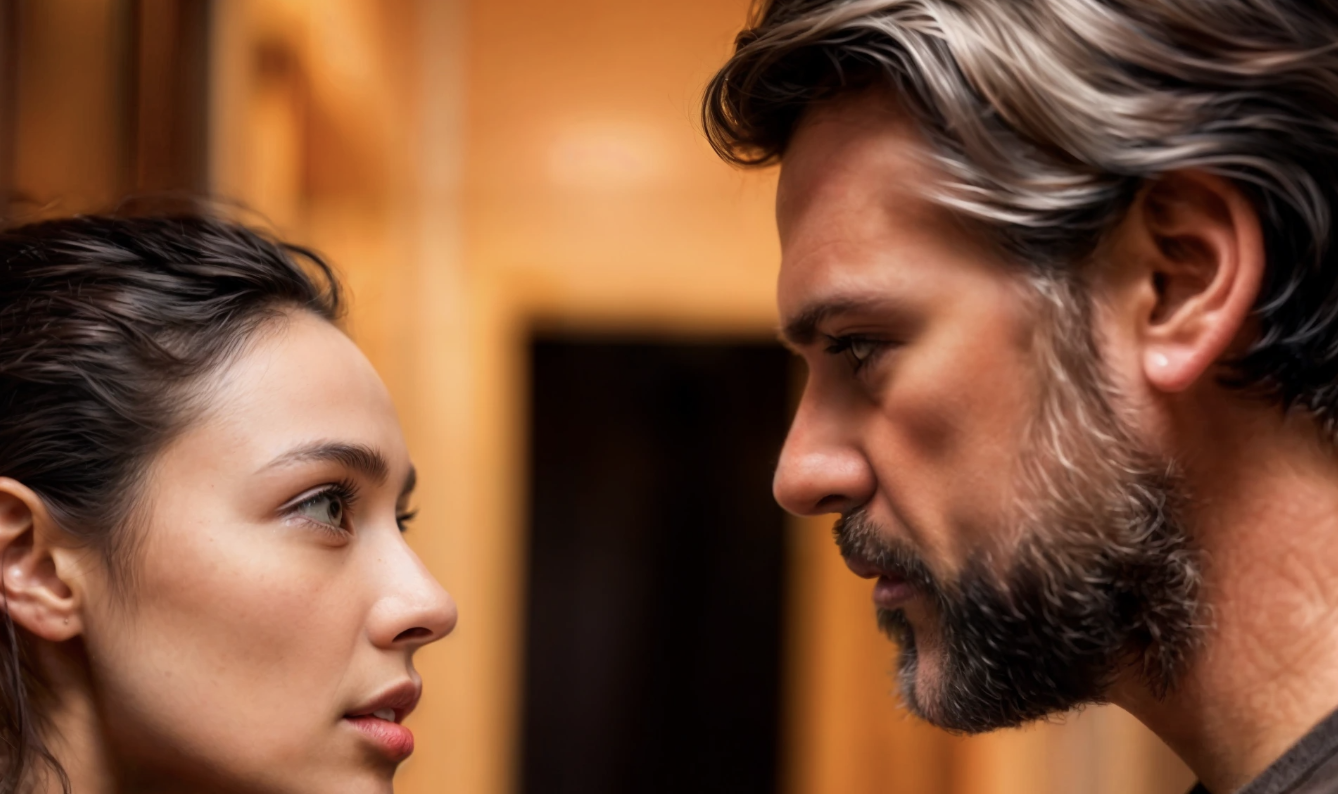
“Irisha, the guys and I are going fishing for the whole weekend! You’ll watch Nastyukha, yeah?”
Valera’s voice—loud, carrying the bracing street-cold and a clean, undiluted selfishness—burst into the apartment’s cozy stillness. Irina didn’t turn around at once. She sat at her desk in a soft set of loungewear, moving the mouse with focused precision across her laptop screen, choosing bathroom tile. It was her small Friday-evening ritual: planning the renovation, arranging her own space—the one she’d bought before him. She’d heard the click of the lock, but didn’t attach any importance to it. Valera often came back like this—without warning, noisy, as if the entire world ought to switch its attention to him immediately.
She slowly turned her head. There he was in the hallway doorway—jacket unzipped, a wide, smug grin on his face. In one hand he held a bulky rod case, and in the other—a small, warm little palm. Beside his solid frame shifted five-year-old Nastya. In a bright pink jacket and a pom-pom hat, she looked like a tiny, bewildered gnome who’d wandered into someone else’s fairy tale. The girl stared at Irina with big, serious eyes—no joy, no curiosity, only wariness.
Irina silently moved her gaze from the child’s face to Valera’s shining one. She looked at him for a long time, without blinking, letting his jaunty question drown in the emptiness that formed between them. She said nothing. She simply looked—and her silence spoke far louder than any scream.
“Why are you silent?” His smile twitched slightly as it collided with her steady stare. “I’m telling you, we’re going to the base, staying overnight. I’m driving—borrowed a minibus from work, I’ll take all the guys. I already promised. So where am I supposed to put Nastyukha? The ex is on a business trip, her turn fell through.”
He spoke fast, stumbling over his words, as if he had to lay out all his irrefutable arguments before anyone could object. He even stepped farther into the apartment, tugging the child along—she resisted and tried to hide behind his leg. The warm room filled with the smell of frost, exhaust fumes, and some kind of masculine bustle.
“Valera,” her voice came out level and emotionless, as though she were reading an excerpt from a rulebook. “We discussed this. We discussed it very clearly—before you brought your things here.”
She didn’t raise her tone. She stated a fact. They really had had that conversation—straight, tough, initiated by her. She’d said at once that she wasn’t ready to play “the new mom.” She didn’t mind him spending time with his daughter, but that was his area of responsibility. His time, his territory. Her apartment was her fortress—the place where she rested, not where she performed someone else’s parenting duties.
“Oh, come on, Ira, why are you starting?” He waved her off like an annoying fly. The conversation was clearly not following the script he’d expected. “What plans could you possibly have this weekend? You’ll sit with her—watch a movie, play. It’s not hard for you. We’re family, after all.”
The word family sounded like a gunshot. He tossed it out carelessly, like a trump card, sure it would beat any objection. He genuinely didn’t understand why she didn’t share his simple, convenient logic. To him it was obvious: he had a problem, she had free time and a place to live. Family helps.
Irina slowly rose from her desk. She walked closer and stopped a couple of meters from him. She looked over his head at the wall for a moment, then lowered her eyes back to him.
“So you didn’t get it?” she asked so quietly Valera had to strain to hear. There was no anger in her voice, no hurt—only a cold, absolute certainty. “This isn’t a request. And it’s not a discussion. I’m not going to watch your child. You take her by the hand, turn around, and solve this problem yourself. Like an adult man and a father. Without my involvement.”
For a second the hallway went so quiet you could hear Nastya’s soft sniffing as she pressed her face into the denim of her father’s jeans. Valera stared at Irina, and his face began to change. The carefree smile slid away, exposing bewilderment that quickly turned to irritation. He’d expected anything—persuasion, mild displeasure, a flirty kind of bargaining—but not this ice-cold, impenetrable refusal.
“Are you serious right now?” he gave a nervous snort, trying to seize control of the situation again. “Ira, this is Nastya. My daughter. You want me to drag her somewhere right now? At night? Are you out of your mind?”
His voice took on a metallic hardness. He still didn’t believe this was happening for real. This had to be some stupid female test, a whim he just needed to break through. He took another step forward, invading her space—his heavy body almost looming over her now.
“We discussed this, Valera,” she repeated, not retreating a centimeter. Her calm drove him far more insane than if she’d started yelling. “Clearly. Your daughter is your responsibility. I didn’t ask you to cancel your plans. I’m asking you not to dump the consequences of them on me. You promised the guys? Great. You took the minibus? Wonderful. Now be so kind as to handle the issue with your daughter as efficiently as you organized your entertainment.”
“Handle the issue?” he practically spat the words. “That’s my child, not an ‘issue’! How can you talk like that? Look at her!” He jabbed a finger down toward the crown of the girl’s head. “Do you even have a heart? Any normal woman would be happy, and you… You’re just an egoist. All you think about is your renovation and your tile!”
He hit the mark—but not the way he expected. Mentioning her plans, her small world he was trying so brazenly to trample, became the stone that triggered the avalanche. The ice in Irina’s voice didn’t just crack—it exploded, crashing down on him in a burst of boiling fury she’d been holding back for far too long.
“Take your precious little daughter and get the hell out of here, Valera! I’m not your nanny—raising and caring for someone else’s child while you go off fishing!”
This was no longer a calm conversation. It was the roar of a wounded animal defending its territory. Her face twisted, her eyes burned with contempt. Everything that had accumulated for months—his carelessness, his certainty that her apartment and her life now belonged to him too, his consumer attitude—spilled out in that single shout.
“How dare you say that in front of her?!” he hissed, trying to shield himself with the child like a living barrier. “Do you even understand what you’re doing?”
“It’s you who doesn’t understand!” Her voice didn’t break; it lashed like a whip. “You dragged her here like small change, like a free pass to your little vacation! When you brought her here you weren’t thinking about your daughter—you were thinking about yourself! You’re an irresponsible father who hides behind the guys and fishing, and a lousy husband who thinks that a woman in his house is free labor!”
She stepped forward—and now she was the one forcing him back toward the exit. She extended her arm and pointed at the front door. Her finger didn’t tremble. It was hard, like a nail she was driving into the coffin of their relationship.
“Out. Of my apartment. Both of you.”
The door shut without a slam. Just the dull, solid click of an expensive lock, cutting him off from the warmth and light. Valera froze for a moment, still holding the rod case. The cold stairwell air—damp and reeking of other people’s cigarettes—hit him in the face. He stood on the landing, humiliated and stunned, with a small trembling girl clinging to his pant leg. Humiliated not only in front of her, but in front of himself. In his world—his coordinate system—women didn’t behave like this. They could sulk, cry, make scenes, but they never kicked him, Valera, out the door.
The initial shock quickly gave way to a murky, hot rage. She had no right. She was his woman, his home—if not on paper. He’d invested his life, his presence, into this apartment. He turned and slammed the base of his fist into the smooth surface of the door. The thud was dull and heavy.
“Open the door, Ira!” His voice was low, full of restrained threat. “What the hell are you doing? Open it, I said!”
No response—not a sound. As if behind the door there wasn’t a living woman, but a vacuum. The silence enraged him even more. He hit again, harder this time; his knuckles stung against the solid wood. Behind him Nastya gave a small sob, but he barely noticed. His entire world narrowed to that unyielding oak barrier—and the one who stood behind it.
“You’ll regret this! You hear me?! Decided to show attitude? I’ll show you attitude! Open up right now!”
From inside the apartment Irina heard every удар, every word. She hadn’t gone far. She stood in the hallway with her back against the opposite wall, staring at the door. Her heart was pounding somewhere in her throat, flooding her veins with adrenaline—yet not a single muscle moved on her face. She listened to his shouting, analyzing it the way a doctor listens to wheezing in a patient’s lungs. There was no remorse in it. Only offended pride and a demand for obedience. He wasn’t asking—he was ordering.
Taking a deep, slow breath, she pushed off the wall and went to the kitchen. Her movements were deliberately smooth, almost ritualistic. She took the kettle from its stand and filled it with water at the sink. The sound of running water muffled his screams for a moment. She set the kettle back and pressed the button. A blue light came on. An ordinary, simple action performed in the middle of chaos gave her strength. This was her kitchen, her kettle, her water.
“What am I supposed to tell the guys?!” came from the landing. His voice cracked with helpless fury. “That some woman kicked me out of the house?! You decided to humiliate me in front of everyone?!”
Irina smirked to herself—without joy. There it was. Not the child, not the relationship, not the family. His reputation with “the guys.” She opened a cupboard, took out her favorite large mug with a whale on it, and dropped in a chamomile tea bag.
The pounding stopped. Valera went quiet, breathing hard. He leaned his forehead against the cold door, trying to steady the tremor in his hands. He couldn’t leave like this. That would be total defeat. He had to squeeze her into giving in.
At that moment the apartment was pierced by the sharp whistle of the boiling kettle. That domestic, peaceful sound seeped through the door and hit Valera harder than any insult. She was in there… just drinking tea. While he stood on a dirty stairwell with a child, she was brewing herself some damn tea.
Irina poured the boiling water over the tea bag and carried the mug into the living room. The blows resumed—but different now: desperate, chaotic. She set the mug on the side table, picked up the remote, and turned on the sound system. The room filled with calm, enveloping saxophone—softly, but loud enough to drown out what was happening beyond the door. She sat in the armchair, wrapped her hands around the warm mug, and took a sip. Music, the scent of chamomile, the familiar chair… she was deliberately surrounding herself with her own world, pushing him out, erasing his presence from her space.
Outside the door the pounding stopped again. Through the thickness of the wood and the melody of jazz, it reached him: she wasn’t just ignoring him. She was canceling him—erasing him like an unnecessary line in a document. He was no longer part of her life. He was just noise behind a wall—noise you could get rid of by turning the music up a little.
Time on the landing stretched like thick, cold syrup. The saxophone behind the door faded, dissolving into silence. The tea in Irina’s mug had long gone cold. The noise outside stopped as suddenly as it had begun, replaced by a heavy, crushing quiet. Valera wasn’t shouting or knocking anymore. He was simply there. Irina could feel his presence through the layers of wood and metal, the way you sense a storm coming by the thickened air. This silence was worse than yelling. There was no despair in it—only a decision taking shape.
Maybe twenty minutes passed. Irina stood up, took the cold mug to the kitchen, and rinsed it. She moved through her apartment as if it were someone else’s, listening for every rustle. She needed to be sure he’d left—that the siege was lifted and her fortress belonged to her alone again. She approached the door and pressed her ear to it for a moment. Not a sound. He’d gone. Finally it had sunk in.
At that exact moment someone knocked—quiet, but insistent. Three distinct, measured taps with a knuckle. Not aggressive. Not demanding. The knock of someone who knew the door would open. Irina froze. It didn’t resemble his earlier rage. This was something else—cold and alien. She hesitated, but the urge to put a final full stop—to see him leaving and close the door behind him forever—won out. She turned the latch and flung the door open.
He stood there. He no longer looked enraged or humiliated. His face was calm, almost serene, but his eyes were empty and cold—like two shards of gray ice. He straightened to his full imposing height, still gripping the rod case in one hand. With the other he held Nastya firmly by the hand. The girl, no longer crying, stared at the floor where parquet met tile. Her small face looked serious and tired.
Irina looked at him, expecting the fight to continue—new accusations, maybe a clumsy attempt at reconciliation. But he was silent. He simply stared at her, letting the pause fill with poison. He waited until her attention focused completely on him.
When he finally spoke, his voice was quiet, almost tender. He didn’t even look at Irina. He bent slightly toward his daughter and drew her closer in a fatherly way, as though protecting her from something terrible inside the warm, bright apartment.
“Come on, sunshine,” he said softly, but with such clarity that every word would reach Irina and lodge in her memory forever. “Remember this face. Remember it well. This is the aunt who didn’t want you to stay with her. Who threw you out—little you—into the street at night.”
He didn’t shout. He didn’t accuse. He delivered a verdict. Calmly, methodically, cruelly, he took an innocent child and turned her into a weapon aimed straight at Irina’s heart. He wasn’t just leaving—he was poisoning the very space where she lived. He was branding her not in his eyes—that no longer mattered—but in the eyes of this small human who understood nothing.
Irina stood frozen, unable to say a word. The air caught in her lungs. She stared at the top of the girl’s head, which dipped even lower after his words.
Without waiting for an answer, Valera turned away. He didn’t look at Irina again. He simply went down the stairs, his heavy steps booming in the stairwell’s silence. Thud-thud-thud—answered by the quick, small scuff of little boots. He was leaving—taking not only his daughter and his fishing rods. He was carrying away any chance that this evening could be written off as a stupid argument.
Irina remained standing in the doorway, letting the cold smell of stairwell dust seep into her clean, renovated apartment. She hadn’t broken anything, hadn’t smashed anything. And yet her home—her fortress—had just been defiled. The victory she’d felt half an hour earlier crumbled to dust. He’d left, but he’d left something worse than a scandal behind: the echo of his words, which would now live in these walls forever…