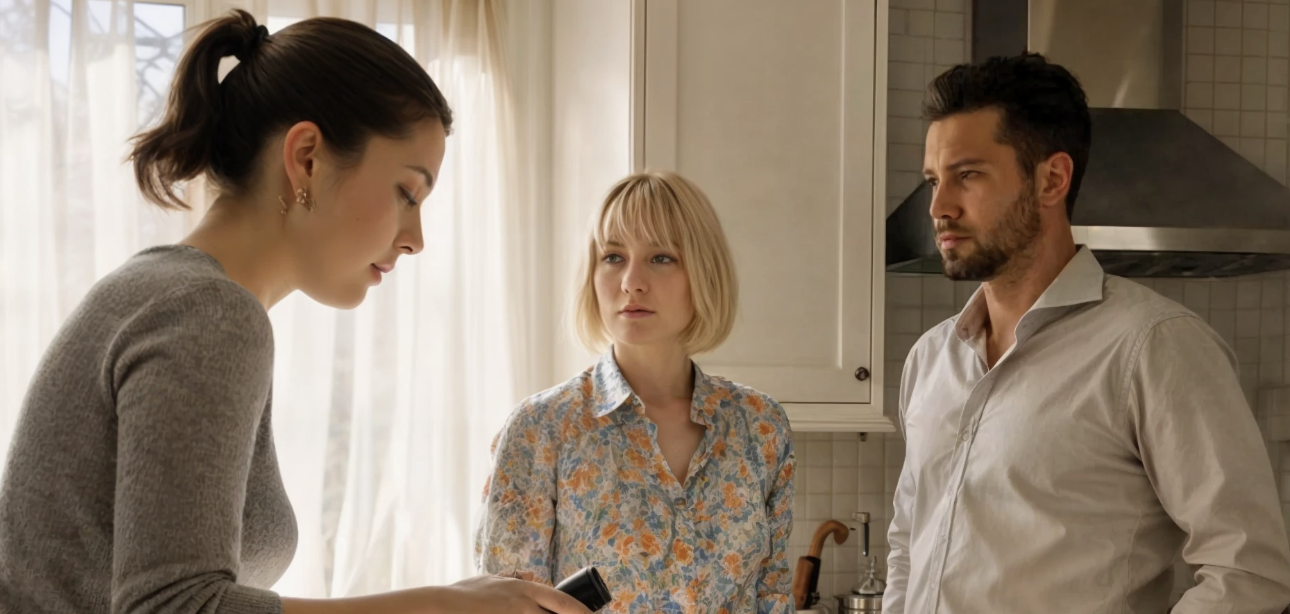
Morning was like any other morning: a gray mug with half-finished coffee, a plate with a lonely piece of bread, and car keys tossed onto the table so the keychain gave a plaintive jingle. Tatyana sat on the edge of a stool, holding her cup with both hands as if it weren’t coffee at all, but some kind of shield against the conversation she knew was coming.
“Tim,” she called to her husband. “You left the keys in the walkway again. Your mom will come by, grab them herself, and drive off wherever she feels like.”
Timofey—tall, awkward, with a permanently sleepy look—stood by the window trying to put on a tie, a task for him roughly on the level of mastering space travel.
“Tanya, don’t start,” he sighed, grimacing. “Mom will just pop in, drop off the documents, and that’s it.”
“Yeah, ‘just pop in,’” Tatyana mimicked. “And she’ll definitely ask how much gas we’ve already burned in ‘her’ car.”
Timofey flinched as if his back suddenly hurt.
“Tanya, seriously, don’t work yourself up. You know what she’s like…”
“Oh, I know,” Tatyana cut him off. “I know exactly what she’s like. Always with that five-hundred-ruble pomp. Yes, she helped—thank you. But fifty thousand isn’t ‘bought my son a car,’ it’s ‘chipped in for the wheel caps.’”
She spoke quietly, but steel had already crept into her voice.
Timofey gave a weak smile, pretended not to hear, and reached for his jacket. At that moment, the doorbell rang.
“There she is,” Tatyana muttered, clearing the cup off the table so it wouldn’t be in the way.
Svetlana Ivanovna walked in like she owned the place—didn’t even ask if she could. She set her bag on a chair, sighed loudly, and without taking off her coat, went straight to the table.
“Well then, my children,” she drawled in a sugary voice. “How’s our little car doing?”
Tatyana felt her teeth clench.
“It’s doing fine,” she answered curtly.
“I was just thinking—maybe I should toss you some more for gas?” Svetlana Ivanovna sat down, crossed her legs, and adjusted a strand of hair. “With prices these days, you know… oh dear.”
“Thank you, we’re managing,” Tatyana smiled in a way that even Timofey understood: she really should’ve said nothing at all.
But Svetlana Ivanovna, as always, decided not to notice.
“I insist,” she went on. “The car is ours together, isn’t it? I put my money into it.”
Tatyana felt a wave of anger rise inside her. She looked at her husband: he was carefully pretending to zip up his jacket, even though it had been zipped for a full minute already.
“Svetlana Ivanovna,” Tatyana began, trying to keep her voice calm. “We’re very grateful for your help. But the car is ours. We bought it on credit. You just helped a little.”
“A little?” her mother-in-law arched an eyebrow. “Kids, do you not understand? Fifty thousand is a huge amount of money! You could eat for half a year on that!”
“Sure—if you eat nothing but pasta,” Tatyana muttered under her breath.
“What did you say?” Svetlana Ivanovna’s eyes flashed.
“I said,” Tatyana paused and looked her straight in the eye, “that we really appreciate your help.”
Timofey stepped in:
“Mom, don’t start. Tanya’s right—the car is ours, we took out the loan. You helped, thank you.”
“Yeah, thank you,” the mother-in-law repeated with sarcasm. “So without my money you wouldn’t have bought it, but now it’s ‘yours.’ Wonderful.”
She stood up sharply, pulled a folder of documents from her bag, and with a theatrical sigh slapped it onto the table.
“Here, take them. And the keys, by the way—I’ll take those. I need to go to the clinic.”
Tatyana almost physically felt something snap inside her.
“No,” she said sharply. “We need the car. Timofey has errands, and I was going to stop by the store too.”
“Tanya,” her mother-in-law stretched the word with a smile. “Don’t be greedy. The car is shared.”
“No,” Tatyana repeated.
The pause dragged on. The kitchen fell silent, only the wall clock ticking loudly. Timofey shifted from foot to foot like a schoolboy in front of the principal.
“So,” Svetlana Ivanovna finally said, taking the keys from the table, “since you’ve forgotten who helped you, I’ll have to remind you. The car wouldn’t exist without me. Which means I have the right to use it whenever I want.”
Tatyana jumped up, yanked the keys out of her mother-in-law’s hand, and put them back on the table.
“That’s enough,” her voice trembled. “This isn’t your car. And it isn’t ‘shared.’ It’s mine and Timofey’s. Fifty thousand doesn’t give you the right to drive it whenever you feel like it—and it certainly doesn’t give you the right to humiliate me every time you come here.”
Her mother-in-law opened her mouth to say something, but Tatyana didn’t let her.
“If you want, I’ll pay you back. As soon as tomorrow. With interest. But I’m not putting up with this circus anymore.”
Timofey stood frozen in the doorway. His face showed everything: fear, confusion, and at the same time relief that his wife had finally said what he was too afraid to say himself.
Svetlana Ivanovna slowly sat back down, her lips trembling.
“Oh, is that how it is,” she hissed. “So my money isn’t money anymore? So I’m nobody to you?”
Tatyana took the half-finished coffee, poured it into the sink, and turned to her mother-in-law face-to-face.
“You are Timofey’s mother. And the grandmother of future grandchildren—if we have them. But you will not walk into our family with your demands anymore.”
The silence hit harder than any shouting. Even the refrigerator seemed to fall quiet.
And in that moment the conflict truly exploded: Svetlana Ivanovna sprang up, grabbed her bag, and slammed the door so hard the walls shook as she stormed out of the apartment.
Timofey closed his eyes and rubbed his forehead.
“Tanya…” he said softly.
“What—‘Tanya’?” she snapped. “We should’ve put a period to this a long time ago.”
He didn’t answer.
And for a long time afterward, the apartment still smelled of someone else’s perfume and unsaid words.
Svetlana Ivanovna, as always, didn’t wait. That very evening, she called. The phone rang insistently, like it was a fire alarm. Tatyana didn’t want to pick up at first, but Timofey, pacing back and forth around the room, practically begged:
“Tanya, please, answer. Otherwise she’ll drill a hole in my brain.”
Reluctantly, Tatyana tapped the green button.
“Yes.”
“What was that just now?” her mother-in-law’s voice trembled—not with tears, but with outrage. “At my age, do you know how painful it is to hear those words from a daughter-in-law? I’m making your life easier, and you throw me out!”
Tatyana pressed the phone to her ear and sat on the edge of the couch.
“Svetlana Ivanovna,” she said calmly. “No one threw you out. I only asked you not to treat the car as yours.”
“Oh, so I don’t even have the right to think of it that way anymore?” her mother-in-law’s tone was like a prosecutor’s. “Fifty thousand! Do you even understand what that is for me? I saved, I put money aside, and you…”—a theatrical pause—“and you put me out on the street.”
Tatyana rolled her eyes.
“We’ll return the money,” she said shortly. “So there won’t be any more talk.”
Silence fell on the other end.
“Oh, is that how it is,” her mother-in-law drawled. “So I’m such a stranger now that my money disgusts you?”
“Yes,” Tatyana said—and hung up.
Timofey gasped.
“Tanya! Why would you say that?”
“Because enough,” she shot back, standing up abruptly. “How long are we supposed to endure this theater of the absurd? Are we adults or not?”
The next day, Svetlana Ivanovna came in person. Without calling, as always.
Tatyana opened the door—and caught that familiar scent of her perfume. As if yesterday’s conversation had only been a rehearsal.
“My children,” her mother-in-law began, “I’ve thought it all over. No need to return the money. Let it be my help to your family.”
Tatyana narrowed her eyes.
“With a condition?”
“Well… of course.” Svetlana Ivanovna stepped into the hallway and took off her coat. “I’ll use the car when I need it. Fair is fair.”
“No,” Tatyana cut her off. “If there’s a condition, we don’t need it.”
Her mother-in-law looked as if she’d been slapped.
“What, have you totally gotten cheeky?” she snarled. “You don’t even have children, and you’re already laying down rules!”
Tatyana went pale, but stayed firm.
“Precisely because we don’t have children yet, I can still afford to set boundaries.”
Svetlana Ivanovna clearly didn’t understand the word “boundaries,” but she understood the meaning.
“Timofey!” she screamed into the apartment. “Do you hear how your wife is talking to me?”
Timofey appeared from the room, pale as a sheet.
“Mom, stop it. No scenes.”
“And what, I’m supposed to keep quiet?” his mother flung her hands up. “Me, who worked my whole life for you—now I didn’t even get grandchildren, and I’m not even entitled to the car anymore?”
Tatyana snapped.
“That’s it. Stop.” She went to the closet, took out a folder of documents, pulled out an envelope of cash. “Here’s fifty thousand. Take it.”
Her mother-in-law went rigid.
“Where did you get that?”
“I saved. And added some from my salary.”
She held the envelope out directly.
Svetlana Ivanovna hesitated. It was clear: she didn’t need the money. She needed power.
“I won’t take it,” she finally said, pushing the envelope away. “That’s an insult.”
“And I won’t do it any other way,” Tatyana said coldly. “Either you take it now, or I transfer it to your card.”
For a second they stared each other down. The silence was so thick you could cut it with a knife.
“Fine,” her mother-in-law ground out, snatching the envelope. “If that’s what you want—live on your own.”
She shoved the money into her bag and turned sharply. But she didn’t hurry to leave.
“Just keep in mind,” she added venomously, “you have no right to my help anymore. None. Not even if something happens to you.”
Tatyana smirked.
“Notice those are your words, not mine.”
When the door slammed behind her, Tatyana sank straight down onto the floor.
Timofey lowered himself beside her.
“Tanya… do you realize what you did?”
“I do,” she said wearily. “I paid the debt. And now we’re free.”
He nodded, but it was obvious he didn’t feel any calmer.
“She won’t just let this go,” he whispered.
“Let her try,” Tatyana replied.
And suddenly tears welled in her eyes—not out of pity for herself, but out of rage. At the endless manipulation, at her husband’s weakness, at the fact that even a simple car purchase had turned into a war.
A couple of days later the calls started again. But now Svetlana Ivanovna changed tactics:
“Tima, son,” she would say in a plaintive voice. “I only wanted what was best. And your wife humiliated me. Do you understand that I can’t just let that go?”
Tatyana heard it out of the corner of her ear and felt a fresh wave of fury rising inside her.
And then she understood: simply returning the money wasn’t enough. She had to put a final period on this—so definitive that no one would have any doubts left.
And that decision—final, sharp—was already hanging in the air.
After Svetlana Ivanovna left with the envelope, the apartment fell quiet. But not for long. A week later it started all over again.
First—calls in the evenings. Then—long messages in the messenger, whole poems: about ingratitude, about “what kind of mother I am and you treat me like this.” They swung between pity, reproach, and outright threat:
“You’ll have to share the car anyway. If my money is in it, I have rights!”
Tatyana read them, gripping the phone until her fingers turned white.
“Tim, do you realize she’s actually going to go to court?” she asked one evening.
Her husband sat at his laptop clicking the mouse as if his life depended on it.
“Tanya, she can’t be serious…”
“She can,” Tatyana cut in. “And she will.”
That’s exactly what happened. A couple of weeks later, a summons arrived. Svetlana Ivanovna had filed a lawsuit: she demanded the car be recognized as “joint property” and that she be granted the right to use it.
Tatyana held the paper and felt herself shaking.
“Well,” she said to her husband. “Here we are.”
“Tanya,” he tried to take her hand, “why right away like this… we’ll figure something out.”
“‘Figure something out’?” She yanked her hand away. “Do you understand your mom doesn’t need the car? She needs power. Over you. Over me. Over everything.”
Timofey lowered his head. He knew she was right.
The courtroom was small and stuffy. It smelled of old paper and disinfectant. Svetlana Ivanovna showed up dressed up like for a celebration, with a folder of documents and the face of an offended queen.
“I only want fairness,” she said plaintively to the judge. “I invested my money, and now I’m being deprived of my rights!”
Tatyana listened, barely holding back a laugh. Fifty thousand against eight hundred thousand—and this kind of drama.
The judge listened, nodded, and calmly explained: the vehicle was purchased by the spouses on credit and paid by them. The fifty-thousand contribution was a gift. It did not grant any ownership rights.
“Claim denied,” he said at last.
Svetlana Ivanovna went pale.
For the first time in a long while, Tatyana felt relief.
After the hearing, the three of them stepped outside. The frosty sun stung their eyes; the asphalt glistened with puddles. Svetlana Ivanovna stood on the steps, trembling with anger.
“You’re not my son anymore,” she said to Timofey. “Since you chose her side.”
He exhaled heavily.
“Mom, I’ve been an adult for a long time. I want to live my own life.”
The words came out unexpectedly firm. Even Tatyana was surprised.
Svetlana Ivanovna turned away, pulled on her gloves, and walked off, her heels clacking loudly.
Tatyana took her husband’s hand.
“So,” she said softly. “Free?”
He nodded. And for the first time there was something new in his eyes—not confusion, but determination.
“Free,” he confirmed.
And that mattered more than any car