Mom didn’t open the door right away. First the chain slid, then her face appeared—older now, deep lines gathered around her mouth. I was holding a basket of fruit, my fingers gripping the handle so hard my knuckles turned white. Palm Sunday. Aunt Elena had talked me into trying.
“Mom, I wanted to…”
She looked straight through me.
“Get out. You’re nobody here.”
The door slammed. The basket slipped from my hands, apples rolling across the landing. Seven years earlier, my father had thrown me out of that apartment because I wouldn’t give my brother Ilya three hundred thousand rubles from Grandma’s money for a car. Three hundred thousand—my entire inheritance, my only chance. I was twenty-one then, fresh out of technical college.
“Ilya needs it more,” my mother said back then. “He’s a man, he has to build himself up. And you’re a girl—your husband will provide for you.”
I refused. My father grabbed my bag and tossed it into the stairwell.
“Don’t come back until you’ve grown some sense.”
I left. And in seven years, I turned three hundred thousand into fifteen million. I bought wrecked apartments, renovated them myself, and resold them. I worked twelve-hour days, slept five hours a night. My family didn’t call once.
I bought the townhouse in July. Two stories in a gated community—panoramic windows, a white staircase, a terrace overlooking the forest. My own home. Mine alone.
Friends and coworkers came to the housewarming, and my fiancé Evgeny too—the head mechanic at the bus depot where I worked as an engineer. Aunt Elena walked from room to room, gasping and taking photos.
“Alice, this is just gorgeous! I’m so proud!”
We clinked glasses. Music played, guests laughed.
And then the front door flew open.
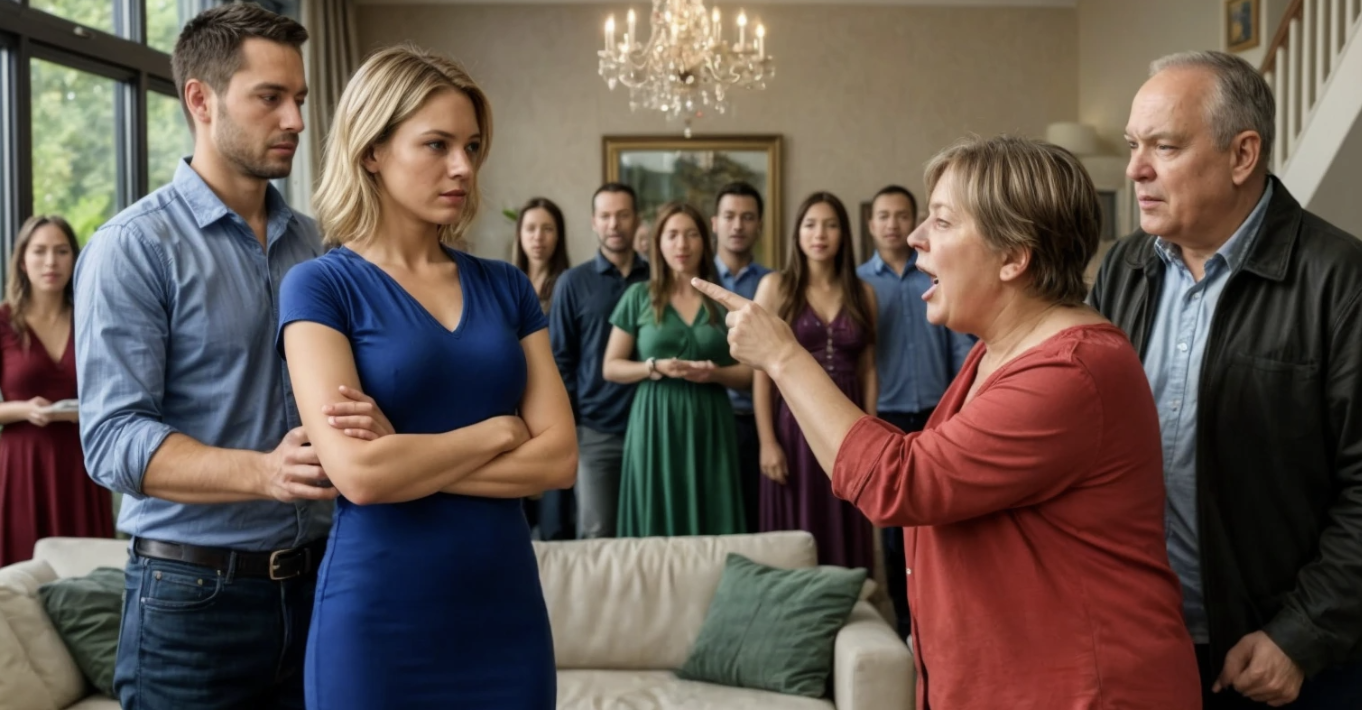
My father stormed in first, followed by my mother, Ilya, and Maria. The music died. The guests froze.
My mother stopped in the middle of the living room and swept her gaze over the chandelier, the staircase, the sofas. Her face twisted.
“So that’s how it is! Pretending to be poor while you’ve been hiding millions!”
She was shouting so loudly my ears rang. My father said nothing, but his eyes darted around the room—counting, appraising.
“Where did you get the money?” he stepped toward me. “Who are you working for? Who bought all this for you?”
I set my glass down.
“I earned it myself. This is my home. You weren’t invited.”
“We’re your parents!” my mother raised her voice. “You don’t have the right!”
“Seven years ago you threw me out. You told me I was nobody. I left and didn’t ask you for a kopek. You don’t know how I lived, you never cared. And now you show up making demands? Get out.”
“We raised you!” my mother didn’t move. “Fed you, clothed you!”
“And that gave you the right to control my life? You did what you were supposed to do. That’s not a reason to demand gratitude forever.”
Ilya smirked.
“Wow. What a princess. Forgot where you crawled out from?”
I turned to him.
“You got your car. I don’t owe you anything. I don’t owe any of you.”
My father took another step, his face flushing red.
“You have to help! We’re family!”
“Family?” I laughed. “You’re just people who want money. Security!”
Two guards came into the living room. My father and mother exchanged a look.
“Escort them out. And don’t let them in again. Blacklist.”
My mother grabbed the doorframe.
“Alice, you’ll regret this! We’re your own blood!”
“I might,” I said. “And I’m still doing it.”
They were taken out. My mother screamed about ingratitude, my father tried to pull free. The door shut. Aunt Elena put her arm around my shoulders.
“Good. You’re holding your ground.”
I nodded. Everything inside me was shaking—not from fear, but from relief.
The next day the calls began. My mother—long voice messages about cruelty. Ilya—short, brazen ones:
“Listen, I need a loan for a car. You’ve got money—help your brother out.”
I didn’t answer. I blocked him. Two days later Maria messaged me—tearful lines about not having money for school, about my parents’ debts.
Deleted. Blocked.
Then they started waiting for me at work. My father showed up at the depot gate, waiting for me to come out. He walked up and grabbed my elbow.
“Alice, talk like a normal person. We really need help. I’m a pensioner, your mother is sick.”
I pulled my arm free.
“Were you sick for seven years? Didn’t need anything? You did. But you didn’t come to me—because you thought I had nothing. And now you saw the house and remembered you’re ‘family.’”
“Money has spoiled you.”
“No. You spoiled everything when you threw me out because I wouldn’t hand over the last thing I had.”
I walked past him, got into my car, and drove away. The next day he came again. Then my mother. Then both of them.
Evgeny suggested filing a complaint. The local officer came, spoke to them. They left, but my mother yelled as a parting shot:
“You’ll burn in hell for abandoning your parents!”
I didn’t turn around.
Three weeks of silence. I almost believed they’d finally backed off. I worked, planned the wedding—small, only close friends.
Then Aunt Elena called. Her voice was dull.
“Alice… your father had a heart attack. They took him to the hospital. It’s serious.”
I stayed quiet.
“Your mother asked me to tell you. She wants you to come. Your father’s asking about you.”
“Asking?” I said. “Or does she want me to pay for his treatment?”
Aunt Elena sighed.
“I don’t know. I’m passing it on. You decide.”
I hung up. Evgeny sat down beside me and waited.
“I’m not going,” I said.
He nodded.
An hour later my mother called. I didn’t pick up. The voice message was hysterical, full of sobs:
“Alice, your father is dying! Do you even understand?! Come before it’s too late! Or are you completely heartless?!”
I listened and felt emptiness. Not anger, not pity—emptiness.
She called five more times. Ilya wrote a furious message about betrayal. Maria sent another tearful one.
I didn’t reply to anyone.
My father survived. A week later Aunt Elena told me they’d discharged him home. My mother didn’t call again.
We got married in September. On the terrace of my house. Aunt Elena cried with happiness, friends congratulated us—everything was as it should be. My parents, Ilya, and Maria weren’t there. I didn’t even notice.
That evening Evgeny and I sat on the terrace, watching the stars. He put his arm around me.
“Do you regret it? Not going then?”
I paused.
“No. You know what they did all those years?” I said. “Aunt Elena told me—my mother and father kept telling all the relatives I’d become an alcoholic, that I was drowning in debt, that I’d disappeared somewhere. They wanted me to be miserable. They needed it to prove they were right. And when they saw I’d made it out—they got furious. Because I proved they weren’t needed.”
“Right choice,” he said, and kissed the top of my head.
I nodded and closed my eyes. The house smelled of flowers and happiness. My happiness.
Later Aunt Elena let slip that my parents had moved in with Ilya—they sold the apartment to cover their loans. Ilya is angry, there isn’t enough money. Maria dropped out of university and married the first man she met, just to escape. Everything started sliding downhill right when they decided to burst back into my life with demands.
“Maybe you should still help?” Aunt Elena asked cautiously. “Just a little?”
I shook my head.
“They don’t need help. They need a sacrifice—someone who’ll spend her whole life paying for daring to disobey. I won’t be that.”
Aunt Elena didn’t argue.
Now I’m thirty. I have my own business, a loving husband, a house where I wake up without anxiety. Aunt Elena comes every Sunday for lunch. My cousins help with renovations, I pay them fairly, and we laugh around the table.
That’s my family. Not the one tied to blood and obligations, but the one that chose me—and that I chose.
Sometimes I drive past the old neighborhood and look at those familiar windows. I feel nothing. No pain, no anger. Just an empty place in my memory.
They wanted me to be nobody. But I became myself. And that’s the best revenge—living happily, without them.
Evgeny once asked if I was afraid I’d regret it in old age. I answered honestly: no. You can regret what you didn’t do. But I did everything. I left, I endured, I built a life. And I shut the door on the people who shut it on me seven years ago.
Only they did it with shouting and curses. And I did it calmly, without extra words. I turned the key and kept going.
They called me nobody. But in the end, they were nobody—people without gratitude, without respect, without the ability to be happy for someone else’s success. And I became everything I wanted to be.
The door is closed. Forever