The doorbell rang at the exact moment Lena finally exhaled after a brutal workweek. Saturday morning was supposed to be lazy: the smell of fresh coffee, plans to repot the flowers on the balcony, and maybe a long breakfast with her husband. But the insistent chime seemed to slice the cozy silence of the apartment in two.
Igor, Lena’s husband, raised an eyebrow over his espresso.
“Are you expecting someone?”
“No,” Lena shrugged, feeling an unpleasant chill in her stomach. “Are you?”
Igor went to open the door. A second later, from the hallway came the clatter of suitcase wheels on laminate and a loud, painfully familiar voice:
“What are you fussing around for? Open wider—my suitcase is heavy! Igoryok, sonny, help your mother!”
Lena closed her eyes and took a deep breath. Antonina Pavlovna. Her mother-in-law, who lived in a nearby city and usually warned them a week in advance so Lena could “get the apartment into a decent state.” Today there had been no warning.
When Lena stepped into the hallway, it already looked like a train station at rush hour. Two enormous suitcases took up almost all the free space, and Antonina Pavlovna—a heavyset woman with a commanding face and flawless hair—was already unfastening her coat, critically inspecting the coat rack.
“Hello, Mom,” Lena forced out, trying to smile.
“Hello, Lenochka, hello,” her mother-in-law’s gaze flicked over her like she was a piece of furniture. “Why is it so dark in the entryway? Saving on light bulbs? Igoryok earns good money—you could put in brighter lights. You’ll ruin your eyes.”
“Mom… what brings you here?” Igor looked confused, shifting in place, not knowing what to do with his hands.
“What brings me? I came to my son!” Antonina Pavlovna threw her hands up theatrically. “They’re starting renovations in my apartment. The upstairs neighbors flooded me—can you imagine? The wallpaper is peeling off everywhere. It’s impossible to live there: dampness, mold will start. So I decided—while the workers mess around, I’ll stay with you. A month or two.”
“A month or two?” Lena echoed.
“Yes. Why? What’s the problem?” Her mother-in-law snapped her head toward her. “You’ve got a big apartment, three rooms. Plenty of space. Or is the daughter-in-law against it?”
She said the word “daughter-in-law” like it was a diagnosis. Igor shot Lena a pleading look. Lena knew that look: Please don’t start. Just endure it—it’s Mom.
“Of course, stay, Antonina Pavlovna,” Lena said, feeling irritation boil inside her. “It’s just that our guest room is full of boxes right now—we were planning a walk-in closet…”
“It’s fine, we’ll sort it out!” her mother-in-law waved her off and marched into the kitchen like she owned the place, without even taking off her shoes. “Oh, Lena, and what are these curtains of yours? So gray, so gloomy. You need peach-colored ones—something cheerier. I brought my old ones, actually. They’re almost new, German. We’ll hang them.”
That was only the beginning. The first day passed under the banner of a total inspection. Antonina Pavlovna seemed determined to find a flaw in every square meter.
“The stove is dirty,” she declared, running a finger over a perfectly clean cooktop. “Igor, why haven’t you bought your wife a proper cleaner?”
“The wardrobe is in the wrong place—it blocks the light.”
“Why is the fridge empty? My son is starving!”
Lena silently chopped salad, gripping the knife so hard her knuckles turned white. She reminded herself: the apartment was spacious, everyone had their own corner, they could simply avoid each other.
But Antonina Pavlovna had her own view of boundaries. That evening, when Lena was taking a shower, her mother-in-law barged into the bathroom without knocking.
“Oh, I’m just grabbing a towel!” she announced, rummaging in the cabinet. “Lena, why do you buy such expensive shampoo? Igor needs to save money for a car, and you waste it. Regular soap is no worse.”
Lena yanked the curtain closed, feeling her face burn.
“Antonina Pavlovna, please get out!”
“What is there I haven’t seen?” her mother-in-law snorted, but she left, slamming the door loudly.
At dinner the performance continued. Igor sat hunched over his plate, trying to become invisible.
“The apartment is nice, of course,” Antonina Pavlovna began, smearing mashed potatoes across her plate. “Igor did well. Snagged a place like this! I always knew my son would go far. City center, high ceilings. You can tell—a man’s hand chose this.”
Lena choked on water.
“Actually, I chose this apartment,” she said quietly.
“She chose it,” her mother-in-law mimicked with a condescending smile. “Choosing is women’s work. Paying is men’s. Igor works like an ox paying off the mortgage, and you just ‘choose.’”
Lena opened her mouth to argue, but under the table Igor squeezed her hand. His eyes begged: Don’t. Lena knew Igor had never gone into financial details with his mother. Antonina Pavlovna lived in the sacred belief that her son was the sole breadwinner—owner of factories and steamships—and Lena was merely a lucky accessory to his success.
“By the way, Igoryok,” her mother-in-law set down her fork. “I’ve been thinking. That room where you made a storage area… the windows face south. My joints need warmth. Tomorrow I’ll sort everything out in there, we’ll rearrange the furniture. We’ll move your old sofa in there, and that wardrobe—into the hallway.”
“Mom, that’s the future nursery,” Igor said carefully. “We just finished renovating it. The wallpaper was expensive…”
“What nursery?” Antonina Pavlovna looked genuinely surprised. “There aren’t any children yet. But you do have a mother—and she’s sick. By the time you have grandchildren, I’ll have moved out a hundred times. But right now I need comfort. I’m here, at my own son’s, as a guest. I have the right to normal conditions.”
“We’ll think about it, Mom,” Igor said quickly, getting up from the table.
When they were alone in the bedroom, Lena exploded.
“‘We’ll think about it’?! Igor, are you serious? She wants to turn the whole place upside down!”
“Lena, please, just endure it. She’s bored, she needs attention. She won’t stay forever. She rearranges the furniture—then we’ll put it back. I don’t want a scandal. Her blood pressure…”
“My blood pressure too!” Lena hissed. “She’s acting like this is her apartment!”
“She’s Mom… that’s how she was raised. She thinks everything that’s mine is ‘ours.’ Let her feel important. Please, for me.”
Lena looked at her husband. He looked tired and pitiful. She loved him, despite his softness.
“Fine,” she breathed out. “But she doesn’t go into my office. And she doesn’t touch our documents.”
“I promise,” Igor kissed her forehead.
Lena didn’t know that Igor’s promises were worth less than a broken penny against Antonina Pavlovna’s force. And most of all—she underestimated her appetite. “A month or two” was only a pretext. Antonina Pavlovna hadn’t come to visit. She’d come to take territory.
A week passed, and the apartment became unrecognizable. Lena’s fine taste—her love of minimalism and light tones—was buried under an avalanche of Antonina Pavlovna’s “coziness.”
Crocheted doilies appeared on the living-room sofa. The windowsills sprouted armies of geranium pots that smelled sharp and shed dry leaves onto the floor. But the worst part wasn’t that. The worst part was how methodically her mother-in-law pushed Lena out of her own home.
Lena came back from work as if to a battlefield. Every evening brought a new surprise.
On Tuesday, her favorite vase disappeared.
“It broke,” Antonina Pavlovna tossed off casually. “It was right on the edge. I told you—it was inconvenient.”
On Wednesday, Lena couldn’t find her slippers.
“I threw them out,” her mother-in-law said. “They’re worn down—shameful in front of guests. Here, I gave you my old ones. Wear those.”
Igor stayed silent. He came home late, ate quickly, and hid behind his laptop screen. He chose an ostrich strategy, hoping the two main women in his life would sort it out themselves. But no one was sorting anything out—this was a cold war.
The climax arrived frighteningly fast. On Friday, Lena took a day off to see a doctor—they were planning a baby, and she needed tests. She returned home earlier than usual, at one in the afternoon, and walked into chaos.
Two unfamiliar men in dirty coveralls stood in the hallway. With strained effort, they were dragging a heavy oak dresser out of the bedroom across the parquet (across the Italian parquet Lena had chosen for three months).
“Stop!” Lena shouted, dropping her bag on the floor. “What is going on? Who are you?”
The men froze, wiping sweat. From the room they now called “the future nursery,” Antonina Pavlovna floated out. She was in battle mode—apron on, tape measure in hand.
“Oh, Lena, you’re early. We’re rearranging things, like I said.”
“What rearranging? Why are you touching furniture from the bedroom?”
“Because that room,” her mother-in-law nodded at the nursery, “is empty. I decided to make my bedroom-living room there. I need this dresser for the TV. And you don’t need it anyway—it just gathers dust.”
“Antonina Pavlovna,” Lena’s voice shook with fury. “Tell them to put everything back. Now. It’s our furniture. It’s our room. We’re preparing it for a child.”
“Oh, what child!” her mother-in-law waved her hand. “By the time you get pregnant, by the time you give birth… and I’m living right now. And anyway, I’ve been thinking… I like this neighborhood. The park is close, the clinic is good. I’ve decided to sell my apartment outside the city and move in with you permanently.”
Lena froze. Her ears rang.
“What did you decide?”
“Move in,” her mother-in-law repeated, enjoying the effect. “We’ll put the money from my sale into Igor’s account so interest accrues. And I’ll live here, help with the house, later with the grandkids. There’s enough space for everyone. This room is mine. Bright, warm. Perfect for an older woman.”
She turned to the movers:
“What are you standing around for? Drag it! Don’t leave a scratch!”
“Put the dresser down,” Lena said in an icy tone.
“Carry it—I said!” Antonina Pavlovna barked. “I’m paying!”
“Get out!” Lena screamed so loud the men flinched. “Both of you! Out of my apartment!”
The men exchanged a look, carefully set the dresser down in the middle of the hallway, and backed toward the door.
“Ma’am, you sort it out yourselves…” one muttered and bolted out onto the landing.
Antonina Pavlovna turned purple.
“You… how dare you? Throwing out people I hired? In my son’s home!”
“This is not your son’s home,” Lena said quietly.
“Oh really!” her mother-in-law laughed, but the laugh was mean and barking. “Then whose is it? Yours? A poor nobody who came to everything ready-made! I know how much Igor put into this apartment! He didn’t sleep at night, he worked! And you’re giving orders? I’ll call Igor right now—he’ll set you straight fast!”
She grabbed her phone and jabbed at the screen with trembling fingers.
“Hello, Igor! Come home, now! Your wife has gone crazy! She’s kicking me out of the house! She threw out the workers! My heart is acting up! Now!”
Lena watched the show and felt a strange calm. The kind of calm that comes when there’s nothing left to lose. She understood the point of no return had been crossed. Enduring “for her husband” was no longer possible—because if she stayed silent now, she’d lose not only a room, but her self-respect, her family, her future.
“Call him,” Lena said, arms crossed. “Let him come. We all have something to talk about.”
“You’ll regret this,” Antonina Pavlovna hissed, sinking onto a chair and theatrically clutching her chest. “You’ll fly out of here faster than a cork the moment Igor finds out how you treat his mother. This room will be mine. And the kitchen will be mine. And you’ll know your place.”
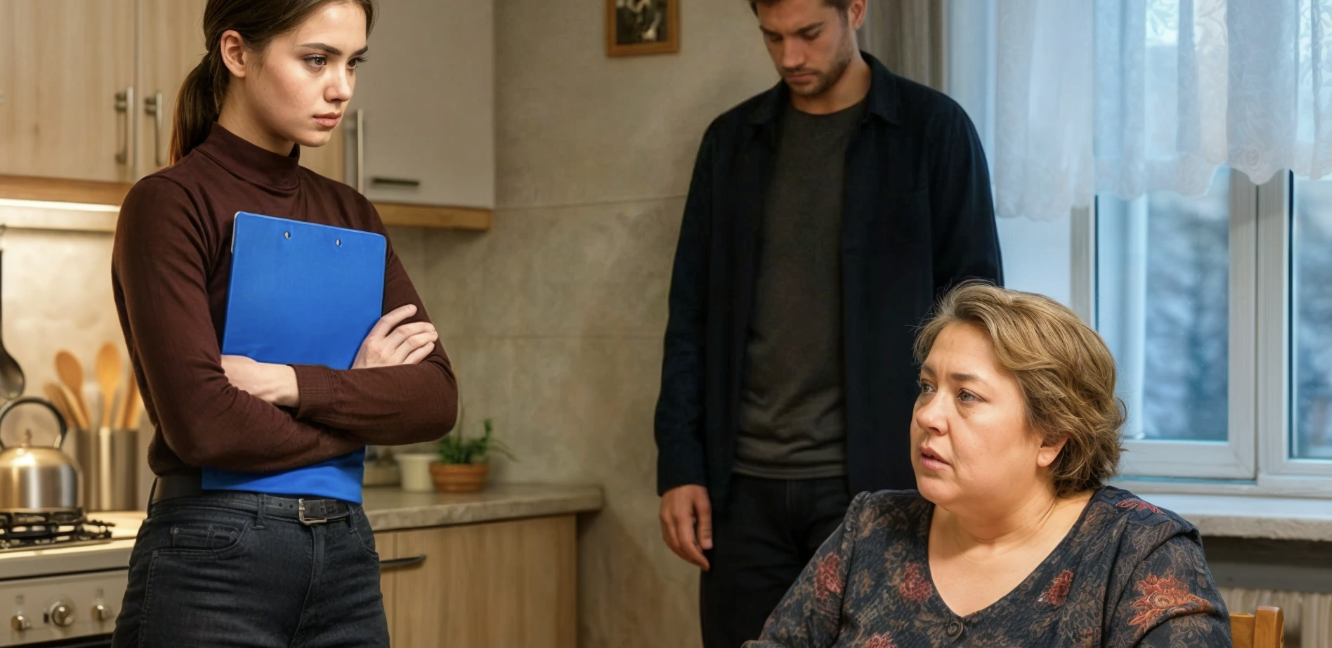
Without a word, Lena turned and went into the bedroom. Deep in the closet was a small safe. She entered the code. The electronic lock beeped. Lena pulled out a blue folder of documents.
She had never wanted to use this as a weapon. She believed there shouldn’t be “mine” and “yours” in a family. But Antonina Pavlovna had declared war—forgetting to check what weapons the enemy possessed.
Lena returned to the kitchen, set the folder on the table, and poured herself water.
“We’re waiting for Igor,” she said. “In the meantime, you can start packing your things back into the suitcase.”
Her mother-in-law stared at her with genuine astonishment, mixed with pity for an insane woman.
“Well, well,” she said. “We’ll see who wins.”
Igor arrived twenty minutes later, pale and disheveled, his tie crooked. Bursting into the kitchen, he saw a scene fit for a battle painter: his mother sat at the table with a blood pressure cuff on her arm and an expression of universal sorrow, while Lena calmly drank tea opposite her, one hand resting on the blue folder.
“What happened?! Mom, are you unwell? Lena, what is going on?” Igor darted between them, not knowing who to save first.
“Son!” Antonina Pavlovna wailed. “She’s driving me out! She threw out the workers! I wanted to make things cozy, set up my room since I’m moving in, and she threw a tantrum! She screamed that I’m nobody, that I have no rights! In your home! Tell her! Tell her I’m your mother and I have the right to live with my son!”
Igor froze, looking at his wife.
“Mom is moving in with us?” he repeated.
“Yes, Igoryok. I decided to sell that shack and live with you. I’ll help, cook… and Lena is against it! She thinks she can boss your mother around!”
Igor rubbed the bridge of his nose.
“Mom, we didn’t discuss this. Moving in is serious.”
“What’s there to discuss? The apartment is yours, it’s big. Or are you against your own mother too? Henpecked!”
“Igor,” Lena’s voice was quiet but firm, cutting through the lamentations. “Sit down.”
There was so much steel in her tone that Igor obediently dropped into a chair.
“Antonina Pavlovna says this is her son’s apartment and she has the right to decide what happens with rooms, furniture, and my life,” Lena continued. “Igor, do you want to tell your mother anything? About who actually owns this apartment?”
Igor flushed. He lowered his eyes and began picking at the tablecloth.
“Lena, why now… Mom is nervous…”
“Because your ‘forgetfulness’ has gone too far. You didn’t tell your mother how we bought this apartment so you wouldn’t hurt your male pride. I kept quiet. But now she wants to live in the nursery. She thinks I’m a freeloader.”
Antonina Pavlovna’s gaze flicked between her son and daughter-in-law, sensing trouble.
“What is she talking about, Igor? The mortgage is in your name, isn’t it? You’re paying!”
“Mom…” Igor mumbled.
Lena opened the folder and pulled out a document with an official seal.
“Read it, Antonina Pavlovna. Out loud.”
Suspiciously, her mother-in-law took the paper. Squinting, she began:
“‘Purchase… agreement… owner… Elena Vladimirovna Skvortsova…’” She faltered. “So what? They often put it in the wife’s name. It’s still marital property! It was bought in the marriage! The court will split it in half, and Igor’s half is my home too!”
“Keep reading,” Lena said mercilessly. “And look at the date.”
“The date…” Antonina Pavlovna frowned. “That’s… that’s two months before your wedding.”
“Exactly. Now look at the source of funds. Here’s the bank statement. The payment came from my father’s account.”
A ringing silence filled the kitchen.
“My father gave me this apartment as a wedding gift,” Lena said clearly. “We registered it before the marriage so I would have my own place to live. Igor didn’t invest a single ruble in the purchase. Renovations and furniture—yes, we did together, from our shared budget. But the walls, the square meters, the apartment itself—that’s my premarital property. Completely. One hundred percent.”
Antonina Pavlovna let the paper slip from her fingers. It drifted slowly to the floor.
“Igor?” she whispered. “Is it true? You said… you said, ‘I bought it,’ ‘my apartment’…”
“I didn’t want to upset you, Mom,” Igor forced out. “You were always so proud that I was successful… And Lena’s dad has a business, he could afford it…”
Red blotches spread across her mother-in-law’s face. Her world—where she was the queen mother of a successful feudal lord—collapsed. It turned out she wasn’t just visiting. She was a guest in the home of the woman she had considered nobody. In an apartment her son had access to only because of a stamp in his passport.
“All right,” Lena stood up. “I endured the rearranging. I endured the criticism. But I will not allow you to take over the nursery and move in here permanently. This is my home. And my rules apply here. Rule one: no surprise visits. Rule two: no moving in. Rule three: respect me.”
Antonina Pavlovna rose slowly. All her swagger and pomp vanished, leaving only a confused elderly woman.
“I… I need to pack my things,” she muttered, not looking at Lena.
“I’ll call you a taxi to the station,” Lena said, softening her tone. “Igor will push the dresser back.”
An hour later, a taxi waited outside the building. Igor carried out the suitcases. His mother stayed silent. At the car door she turned to her son:
“Well, son… why did you… deceive your mother. I thought you were the master of the house. And you… you’re living as a kept man.”
Igor didn’t answer—he just closed the door behind her.
When he returned to the apartment, Lena sat on the sofa (now without the crocheted doily) and stared at one point.
“Forgive me,” Igor said, sitting beside her but not daring to put an arm around her. “I’m an idiot. I just wanted to look cooler in her eyes. I didn’t think it would turn into this.”
Lena looked at him. There was no anger in her eyes—only exhaustion.
“You didn’t just want to look cooler, Igor. You let her humiliate me to keep your illusion alive. That won’t happen again. Either we’re partners and we protect each other, or—”
“I understand,” he said quickly, taking her hand. “I understand everything. I swear. Tomorrow I’ll change the locks. Just in case.”
Lena managed a weak smile.
“Changing the locks is a good idea. And let’s finish the nursery anyway. I think yellow would look great there. Sunny.”
“Agreed,” Igor nodded. “Yellow is perfect.”
In the middle of the hallway, the heavy oak dresser still stood—like a monument to a won battle for personal boundaries.
When the entrance door closed behind the taxi carrying Antonina Pavlovna away, the silence in the apartment became deafening. It pressed down, filled with unspoken reproaches and belated realizations. Igor and Lena stood in the hallway, where the oak dresser still loomed—an orphaned dark shape, a mute witness to their family battle.
“I’ll… move it back now,” Igor said dully, breaking the silence.
Alone, with visible effort, he dragged the heavy piece back into the bedroom, to its rightful place. Every centimeter it scraped across the parquet sounded like the creak of their strained relationship. Lena watched without a word. She didn’t offer help, even though she saw the veins bulge in his neck. She needed him to fix, with his own hands, what he had allowed.
That evening passed in a strange, tense ritual. Igor ordered their favorite pizza, opened a bottle of wine they’d saved for a special occasion. He fussed, topped up her glass, complimented her hair. He behaved like a guilty husband from a joke—and it would have been funny if it weren’t so sad.
“Lena, please, say something,” he asked when they sat on the sofa. “I know I’m to blame. I should’ve explained everything to her immediately. I’m a coward.”
“You’re not a coward, Igor,” Lena replied slowly, looking not at him but at the wall opposite. “You just love your mom very much. And you want to be a hero to her. But you forgot you have your own family now. And here, the hero is needed by me.”
Her words were calm, but to Igor they sounded like a verdict. He lowered his head.
“I’ll fix it. Honestly. Tomorrow I’ll call a locksmith and change the locks. And… I’ll talk to her again. Tell her this can’t happen.”
“No,” Lena stopped him. “You already talked. Or rather, I talked. Now she needs time to accept it. And we do too.”
The next week turned into a “honeymoon” on a minefield. Igor was a model husband: breakfast in bed, flowers for no reason, calls in the middle of the day—“How are you, my love?” He vacuumed, washed dishes, took out the trash. He desperately tried to atone, but Lena felt the falseness. It wasn’t partnership—it was penance. She accepted the gestures with a polite smile, but inside she stayed on guard. Trust, once undermined, doesn’t rebuild with a bouquet of roses.
And then the calls began.
Igor’s phone buzzed on the nightstand in the middle of the night. He jumped up, rejected the call, and muted the sound.
“Who is it?” Lena asked sleepily, though she already knew.
“Spam,” he lied, turning to the wall.
But Antonina Pavlovna was a strategist. When she couldn’t get through to her son, she started sending messages—long ones, full of passive aggression and manipulation. Lena accidentally saw one over Igor’s shoulder when he read it in the kitchen:
“Sonny, my blood pressure spiked again, the doctor said it’s from nerves. The neighbor brings me bread because I’m so weak I can’t even go to the store. I’ll probably die alone, forgotten by my own child whom I raised…”
Igor quickly locked his phone, but Lena had read it all. She said nothing, but inside everything turned cold. She knew that tactic. Guilt was the strongest weapon in her mother-in-law’s arsenal.
On Saturday, Igor approached her with a guilty expression.
“Lena, I was thinking… maybe we should go to Mom’s this weekend? Check on her. I’ll go alone if you want. Just to make sure she’s okay.”
Lena set aside the magazine with nursery-room ideas.
“She’s fine, Igor. There was never any renovation. She lied to move in with us. Now she’s lying about her health so you’ll run to her and abandon everything.”
“But what if she isn’t lying?” he asked desperately. “What if she really is unwell? She’s my mother. I can’t just erase her from my life.”
“No one is asking you to erase her,” Lena replied harshly. “But going now means showing her that her manipulation works. It means everything that happened was pointless. She’ll understand that if she presses your pity hard enough, you’ll be back at her feet. And I’ll become ‘the woman who turned her son against his mother’ again.”
They had their first real fight since the incident. Igor shouted that she was heartless; Lena shouted that she simply didn’t want her life to become hell again.
“I’m not going! And I don’t advise you to go either!” she yelled in a burst of anger.
“I am going!” he snapped, grabbed the car keys, and stormed out, slamming their new, sturdy door.
Lena was left alone. She sat on the floor in the future nursery. The room felt empty and cold. She realized she had won the battle for the apartment—but the war for her husband was only beginning. And in that war, her mother-in-law was an experienced, ruthless opponent. She knew all her son’s weak points, and she would strike them again and again.
Igor returned that same evening. From his slumped look, Lena understood everything. He brought a huge bag of homemade pickles—and guilt the size of Everest.
“So how is she? Dying?” Lena asked sarcastically.
“Fine,” Igor muttered, unpacking jars in the kitchen. “Blood pressure normal. She’s just… lonely. And offended. Very.”
“I’m offended too,” Lena reminded him.
“I know,” he sighed. “It’s just… she told Aunt Galya. And Aunt Vera. And Uncle Kolya. Now the whole family thinks you’re a monster, and I’m henpecked.”
So that was the next move: public condemnation.
“And what exactly did she tell them? Let me guess. That I’m a predator who tricked you into marrying me, stole the apartment, and then threw your sick mother out on the street?”
Igor nodded silently.
“And you… you didn’t explain how it really was?”
“I tried!” he threw up his hands. “But they listen to her! She’s a woman, a mother, a ‘victim’! And I’m a traitor. They called me the whole way back, told me I had to come to my senses—stop abandoning my mother for ‘some skirt.’”
“Some skirt.” The phrase cut into Lena’s heart. To them, she would always be an outsider. A stranger. A usurper.
The next day the phone harassment began. Aunt Galya called first—Antonina Pavlovna’s older sister, a woman with the voice of a military commander.
“Lenochka? It’s Aunt Galya. I want to talk to you. Woman to woman. You must understand—you can’t treat a mother like this. A mother is sacred. Igor is her only son, the light in her window. And you’re taking him away. Think, girl. Husbands come and go, but a mother is forever.”
Lena listened politely and answered calmly:
“Galina Stepanovna, I understand your concern, but this is our family matter—mine, Igor’s, and his mother’s. We’ll handle it ourselves.”
“Oh, so that’s how you’re talking now! Family!” Aunt Galya snapped. “What family are you to him? You’re the one dragging him out of the family!”
After that call, Lena stopped answering unknown numbers. But the relatives were persistent. They began writing on social media. Igor’s cousin from Saratov messaged her: “Lena, come to your senses. Antonina Pavlovna is a saint, and you treat her like this. God sees everything.”
Igor walked around like a storm cloud, torn between love for his wife and the childhood-installed duty toward his mother and her many relatives. He tried to defend Lena in phone conversations, but his arguments drowned in a chorus of outraged voices.
The peak came with an unexpected visit. On Saturday afternoon, while Lena and Igor were trying to paste cheerful giraffe wallpaper in the nursery, the doorbell rang. On the threshold stood Aunt Galya herself. She had arrived from another city without warning, wearing the determined expression of a national savior.
“I’m here for my nephew!” she boomed, pushing past Lena and striding into the apartment. “Igor, sonny, I came to save you!”
She marched into the kitchen, set down a heavy bag that smelled of pies and valerian, and looked around.
“She’s worn you down, you’ve lost weight! Don’t worry—I’ll put things in order here now.”
Igor froze with a paint roller in his hand, smeared in glue.
“Aunt Galya? How are you here?”
“How, how? By train!” she barked. “My sister calls, crying, says her son is disappearing. So I rushed. Now take me to that… your wife of yours. I’ll explain party policy to her.”
Lena stepped into the hallway, arms crossed, heat rising in her cheeks.
“Hello, Galina Stepanovna. You didn’t understand: you are not welcome here.”
“Oh you!” Aunt Galya planted her hands on her hips. “How dare you tell me what to do in my nephew’s home!”
“This is not my nephew’s home,” Lena repeated in an icy tone—her signature line now. “This is my home. And I’m asking you to leave. Immediately.”
Aunt Galya opened her mouth, but no words came out. She looked to Igor for support.
“Igor! Do you hear? She’s throwing me out—your own aunt!”
Igor looked at his wife, then at his aunt. He looked like a man being torn in half.
“Aunt Gal…” he mumbled. “Lena is right. You should’ve called first.”
It was a weak, pathetic answer, but to Aunt Galya it sounded like betrayal.
“I see,” she hissed, grabbing her bag. “She got to you too. Fine. Live as you like. Just don’t come crying later when you end up alone in old age. Your mother won’t forgive you. And neither will we.”
She stormed out, slamming the door so hard plaster dust fell from the wall.
Lena and Igor stood in the hallway. The air was so heavy it felt like you could hang an axe in it.
“Thanks for the protection,” Lena said with bitter irony. “‘You should’ve called first’—that’s all you’re capable of?”
“What was I supposed to do?!” Igor exploded. “Throw her out by kicking her? She’s my aunt!”
“Yes!” Lena shouted. “You were supposed to say: ‘That’s my wife, and I won’t let you insult her in her own home. Get out!’ That’s what you were supposed to do!”
They stared at each other, and Lena understood the giraffe wallpaper might stay in rolls forever—because the family that nursery was meant for might never exist.
After Aunt Galya’s visit, they didn’t speak for two days. Igor slept on the living-room sofa; Lena in their bedroom. The apartment they’d paid such a high price for became two hostile camps. Lena went to work, came home, ate alone, and locked herself away. She no longer cried. Inside was a burned-out desert. She thought about divorce. The thought was cold and clear like winter air. She loved Igor, but she couldn’t live with someone who was neither her wall nor her support.
On the third evening, Igor knocked on the bedroom door.
“Lena, can I come in?”
She nodded silently. He entered and sat on the edge of the bed, not daring to come closer.
“I’ve been thinking a lot,” he began quietly. “You were right. About everything. I behaved like a child. I was so afraid of disappointing Mom and the family that in the end I betrayed you—the only person who’s truly on my side.”
Lena stayed silent, waiting.
“I realized you can’t sit on two chairs at once. You can’t be good for Mom and good for your wife if they’re at war. I have to choose my family. And my family is you.”
He took out his phone; his hands trembled slightly.
“I’m going to call Mom right now and put everything on the table. Once and for all. I want you to hear it.”
He found “Mom” in his contacts and hit call, turning on speaker. Lena held her breath.
The ring went on for a long time. Finally, Antonina Pavlovna’s annoyed voice answered:
“Well, finally! You remembered your mother! I thought you’d been bewitched completely!”
“Mom,” Igor’s voice was firmer than it had ever been. “I’m calling to tell you three things. First: Lena is my wife. I love her, and I will not allow anyone to insult her—neither you, nor Aunt Galya, nor anyone else. Any disrespectful word about her means you’ve insulted me.”
Silence.
“Second,” Igor continued. “The apartment belongs to Lena. It’s her territory. We live here by her goodwill. You have no rights here except the rights of a guest. And you will behave accordingly.”
“How dare you, son…” Antonina Pavlovna started, but Igor cut her off.
“And third, the most important. I forbid you and the whole family to interfere in our life. No calls with lectures, no surprise visits. You want to talk to me? Fine. But if I hear even once more that you’re scheming behind my wife’s back or turning relatives against her, we won’t communicate. At all. And you won’t see any grandchildren either—ever. Is that clear?”
The silence was so deep it felt like you could hear Antonina Pavlovna’s world collapsing in her head. Then a muffled sob.
“You… you’re threatening me? Because of that—”
“I’m stating a fact, Mom,” Igor cut in. “You either accept my terms and my wife, or you lose your son. The choice is yours. Think about it.”
And he ended the call.
Igor set the phone down and looked at Lena. His eyes were wet—but these weren’t tears of weakness. They were tears of release. He had finally grown up.
Lena walked over and, for the first time in days, truly hugged him. Tight, with all her strength.
“Thank you,” she whispered into his shoulder.
That night they didn’t talk about the future. They simply stayed together. They ordered food, watched some silly movie, and held hands. The wall between them fell.
The next morning, Sunday, they slept late. Sunlight filled the bedroom.
“You know what?” Lena said, stretching. “Let’s finish the wallpaper today.”
Igor smiled.
“Let’s do it.”
They went into the nursery. Lena picked up the roll and looked at the yellow giraffes on a blue background.
“Or maybe we don’t need giraffes,” she suddenly said.
“You don’t like them?” Igor asked, surprised.
“I do. But let’s make one wall just yellow. Bright. Like the sun. So it reminds us of today—the day our home became light again.”
Igor stepped behind her and wrapped his arms around her, resting his hands on her stomach.
“I agree. Let it be yellow. The color of our new beginning.”
They stood there, holding each other in an empty room full of sunlight, both understanding that the biggest battle they’d won wasn’t for the apartment or against a mother-in-law—but for their own small, fiercely strong family