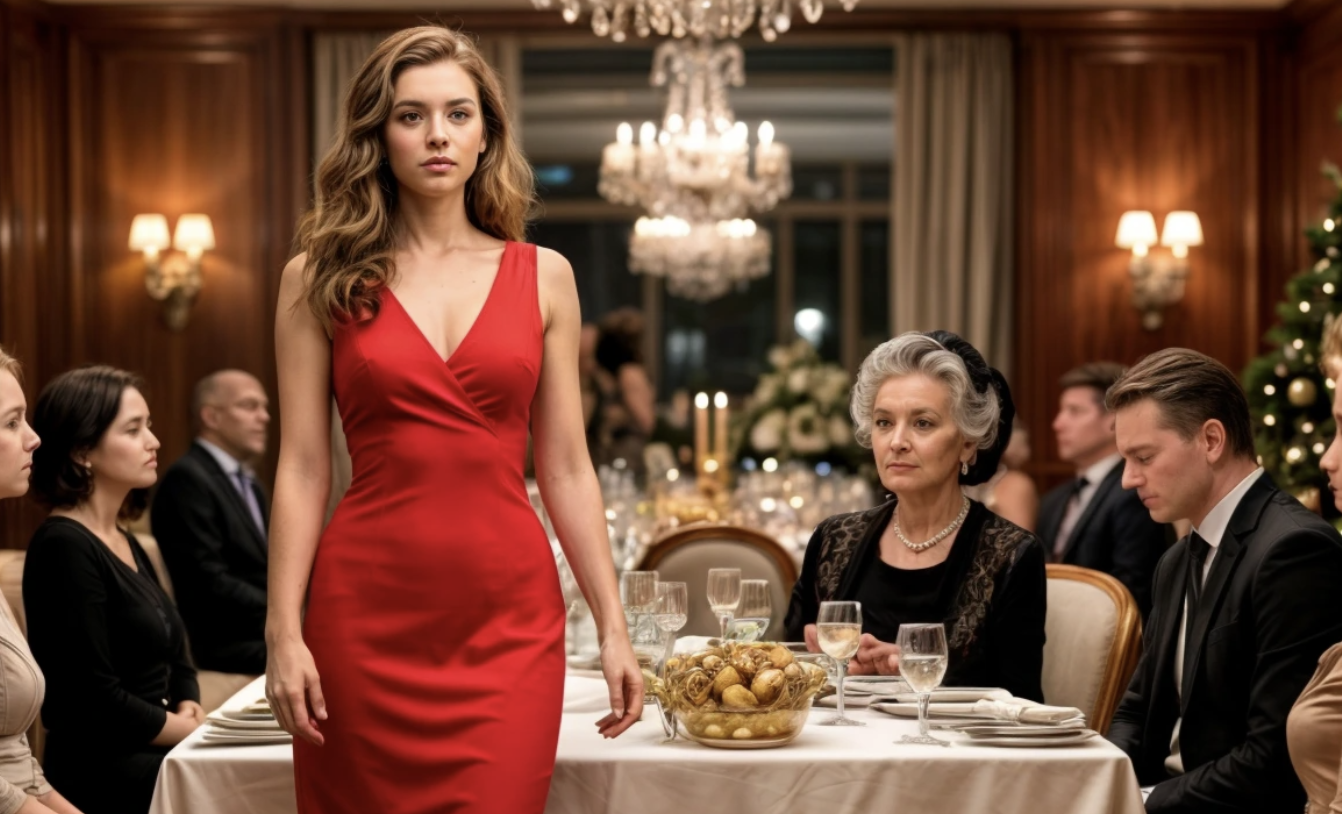
Now that was a New Year’s, alright. Olga would later remember it like a very bad, very cruel fairy tale—one where she wasn’t Cinderella at all, but some useless, dusty thing they’d forgotten to throw out of the house.
They celebrated, as usual, at Galina Petrovna’s place. A lavish table, set so heavily that the tabletop sagged under the weight of salads—her mother-in-law knew how to do that. And Olga knew how, too: she cooked, carried dishes back and forth, washed up, and pretended she adored Olivier salad, even though these family gatherings were already lodged right here—up to her throat.
Dima, her husband, was already sitting there, pleased as punch. Well, Dimochka—what did he care? He was warm, he was comfortable, Mom was nearby, his wife was pretty, his daughter was at his side. An idyll, you know. And the fact that his mommy was drilling Olga with a venom-soaked stare, and that Olga sat at the table like she was taking an exam—he didn’t notice. His eyes, I swear, were set to “positive vibes only.”
And then came Moment X. The chimes finished, champagne was drunk, and Galina Petrovna—glowing like a polished copper basin—began the gift-giving ceremony.
“Well then, my children!” Her voice rang like a bell. “Happiness, health! And of course—what’s a holiday without presents!”
She started with Dima. He got an expensive watch. “You’re the head of the family, my Dimulechka! You must look respectable!” Dima beamed and kissed his mother.
Then it was the older son and his wife. Ira—the model daughter-in-law—received gold earrings. “Irochka, you’re not just my daughter-in-law, you’re my daughter! True blood family!” Galina Petrovna hugged Ira with such love that Olga’s teeth actually ached.
Masha got a huge LEGO set. Masha was happy.
Olga waited. Stood ready, smiling. She’d bought Dima a shaving kit—he’d wanted one. And for her mother-in-law, an expensive embroidered tablecloth the woman had been talking about forever.
Galina Petrovna handed out bags to everyone and then suddenly froze. All eyes turned to her. Slowly she faced Olga. Her gaze was ice-cold, with not a hint of holiday in it.
“Olga? You’re standing there like a watchman… What is it? Waiting for something?” she asked, with mockery in her voice.
Olga tried to keep her composure.
“Galina Petrovna, well of course I’m waiting!” she gave a nervous little laugh.
And then her mother-in-law did the thing that broke Olga. She set her empty glass on the table, adjusted her hair, and said loudly—so every person at that cursed table could hear:
“And you, Olenka, will not be getting any gifts. So stop waiting.”
Silence fell. The kind where you can hear champagne bubbles popping. Dima started coughing, pretending he’d choked on Olivier.
Olga felt as if someone had stabbed her—not once, but with an entire bundle of knives.
“Excuse me, Galina Petrovna? I… I don’t understand…” Olga managed.
Her mother-in-law savored the moment.
“What’s there to understand, Olga? You’re nobody to me. You’re just Dimochka’s wife—you’re not blood family. This is a holiday for my own people, for us. Ira is different. She’s my daughter to me. But you… you just live with us. I don’t have to spend money on you. A daughter-in-law isn’t family.”
That blow—right to the solar plexus. Olga felt her cheeks burning, and tears were already there inside her, pressing up under her eyes. Dima finally snapped awake.
“Mom! What are you even saying?!” he tried to laugh it off, turn it into a joke. “What, you’re being weird again?”
“Me? Weird?” Galina Petrovna pursed her lips. “Am I wrong? Dima, are you ashamed that I’m telling the truth?”
And then Olga looked at her husband. He was pale. He didn’t stand. He didn’t take her hand. He didn’t say, “Mom, either apologize or we leave.” He just sat there shriveled up, staring at his mother like he was begging her. Passivity. That was the word Olga hated in that moment.
That look—his cowardice—was the last straw. Olga felt something inside her snap, like a thin elastic band that had held on for far too long.
She straightened up. Put on the coldest, most marble-like smile. And, looking straight into her mother-in-law’s evil, well-fed eyes, she said:
“How interesting, Galina Petrovna. So I—the one who set this table, washed the dishes, bought you that tablecloth—by the way, it’s lying on the bench in the entryway, very expensive!—I’m nobody? But the tablecloth is family, right?”
Her mother-in-law blinked, stunned. Olga had never spoken to her like that. Dima finally stood.
“Olya! Stop it!” he hissed.
Olga ignored him.
“You say I’m not blood, so I’m a stranger to you. Fine. I’ll remember that. And now listen to what happens next.”
The marble smile fell away, leaving only ice. She didn’t even look at Dima, who was trying to pretend he wasn’t there—just furniture.
“You say I’m a stranger, Galina Petrovna?” Olga’s voice was quiet, but that quiet rang in everyone’s ears like broken glass. “You say I’m nobody? Wonderful.”
She took two steps toward the entryway. The guests sat frozen. Even Ira, the perfect daughter-in-law, stopped chewing her salmon.
Olga returned with a huge, heavy bag she’d brought half an hour earlier. Inside was that very tablecloth—real linen, hand-embroidered—the one her mother-in-law had been eyeing in the store for almost a year. Expensive. Damn expensive.
Olga walked to the table and placed the bag on the tabletop.
“Here it is, Galina Petrovna. Your tablecloth. I spent three months’ salary on it. It was my gift to someone I considered family. But if I’m nobody to you, then my nothing is not something you need.”
Galina Petrovna finally found her voice. She bristled like a hedgehog.
“What are you doing, Olga?! How dare you—”
But Olga didn’t let her finish. She tore the bag open—a sharp, powerful rip—and pulled out the beautiful, heavy fabric.
“I’m doing justice, Galina Petrovna,” Olga said as she walked to the trash bin by the refrigerator, “so you’ll know exactly what your words are worth.”
She squeezed the costly white cloth in her hands—the symbol of her attempts to become “one of them”—and hurled it into the bin. Right on top of peels and wrappers.
“There,” she said. “That’s for me being nobody. A stranger’s tablecloth—for a stranger.”
In the kitchen, a silent chaos erupted. Her mother-in-law opened and closed her mouth like a fish thrown onto shore. Her face went from crimson to green. This wasn’t just a thrown-away gift—it was public humiliation, and an expensive one.
Dima finally came to life. He sprang up like he’d been scalded.
“Olya! HAVE YOU LOST YOUR MIND?!” He grabbed her arm. “That’s money! My mother! That’s RUDE!”
Olga yanked her hand away. Finally, he had emotions. Too bad those emotions were anger at her, not protection.
“Money? That’s what you’re thinking about right now, Dima?!” Olga stared him down. “She said I’m nobody! In front of everyone! And you sat there like a stone statue because you were afraid of her! You’re worried about a tablecloth while your wife—the mother of your child—is being humiliated in public?!”
Olga turned to her mother-in-law, who was already starting to wail theatrically:
“Oh my God, what is happening!”
“And now, Galina Petrovna, I’m giving you a chance to fix your son,” Olga said loudly and clearly. It was an ultimatum.
“Dima,” she turned back to her husband, “you have exactly three minutes while I get Masha ready, to walk up to your mother and say: ‘Mom, you were absolutely wrong. You hurt my wife. Apologize to her immediately, or we leave—and we will never set foot in your house again.’”
Olga lifted her phone.
“You have three minutes, Dima. Exactly. Otherwise you stay here forever. And then you’ll be the blood son, and I’ll be nobody—the one who left with your daughter.”
She said it and walked into Masha’s room without looking back.
Those three minutes were the longest in Dima’s life. He stood in the living room like he’d reached a crossroads. On one side—his mother, her tears, her power. On the other—Olga, her fury, her threat.
The guests were silent. Dima’s older brother, Seryoga, muttered, “Well, Dima… you’re screwed.”
Seeing her son hesitate, Galina Petrovna lunged at him, grabbed his sleeve, and began hissing:
“Don’t you dare, son! She’s manipulating you! She wants to destroy our family! She—”
“Mom, stop!” Dima jerked his hand away. He looked at the closed door where Olga was gathering their things. He knew her well. She wasn’t joking.
Olga came out with their daughter, bundled into her coat. Little Masha, not understanding the drama, just held her bag with the LEGO.
Olga didn’t say a word. She simply raised her hand and pointed at her watch: time was up.
Dima exhaled. He walked to his mother. Opened his mouth to say the important, decisive words.
Olga stood in the doorway, holding Masha’s hand. Time was up.
Her gaze was cold as winter glass. She didn’t blink. She looked at her husband, and that look held one word: Choose.
Dima stood between his mother, who crushed him with tears and hysteria, and his wife, who crushed him with truth and silence. He saw condemnation in his brother’s eyes and fear in the guests’ eyes.
And in that moment, something in him broke—but not in the worse direction. The trigger flipped. He pictured Olga leaving right now, forever. He pictured himself staying in that stifling, manipulation-soaked house, alone with his mother. And that became scarier than her anger.
“Mom…” Dima took a step back from Galina Petrovna.
“You don’t have to, sweetheart! She’s blackmailing you!” his mother hissed, clutching his jacket.
But Dima wasn’t listening anymore. He looked at Olga, then at his mother—and suddenly he exploded.
“Enough! I said—ENOUGH!”
His shout was so powerful that even Masha flinched. The guests shrank into their chairs. Galina Petrovna let go.
“I’m sick of it!” Dima wasn’t just speaking loudly—he was yelling, dumping out thirty years of suppressed anger. “Sick of your endless reproaches! Your comparisons! Your perfect Ira! You constantly humiliate my wife! MY WIFE! And you call her nobody?!”
He was shaking with rage. For the first time in his life, he attacked his mother.
“I love Olga! She gave me a daughter! She is my FAMILY! Not you, Mom! You’re my relative, yes—but my family is Olya and Masha! And I’m tired, do you hear me?! Tired of your blood being more important than everything else! I choose freedom!”
He went to the trash bin, grabbed the expensive tablecloth Olga had thrown away, and flung it right back into the bin.
“She’s right!” He stared at his mother. “You don’t need the tablecloth! You need power! You want all of us crawling in front of you!”
Galina Petrovna stood like a statue. Dima’s reaction was completely unexpected. Her whole system was collapsing.
Olga watched him. There was no gloating in her eyes—only shock and, for the first time in a long while, hope.
Dima walked up to Olga. He cupped her face in his hands, then turned toward the guests and his mother.
“I’m leaving. With Olga and Masha. We won’t come back until my wife gets a sincere apology from you. Not ‘for the tablecloth’—for calling her nobody.”
He turned and, without hesitating for even a second, lifted Masha into his arms.
“Come on, love. Let’s go home.”
They left. Olga drew in that frosty New Year’s air—it felt like pure oxygen. She felt a massive stone fall off her shoulders, a stone called “you have to endure.”
And what about Galina Petrovna?
When the door slammed behind them, she made some strange gurgling sound and… collapsed onto the floor. A classic, well-practiced manipulation move: a fainting spell!
Ira and Seryoga rushed to her, while Dima and Olga were already riding away in a taxi.
Olga leaned into her husband. He held her tightly.
“You… you really mean it? That I… matter more?” she whispered.
Dima kissed the top of her head.
“You don’t matter more, Olya. You’re mine. And I didn’t protect you. That’s my biggest mistake. From today on, I won’t let anyone humiliate you. No one.”
For the first time, Olga felt truly protected—not just with words, but with action. She understood this was only the start of a long road of setting boundaries, but the first—and hardest—step had been taken. She didn’t stay silent, and her husband stood on her side.
And Galina Petrovna? Let her lie there. It’ll do her good. Let her feel what it’s like to lose control over her “blood” family.