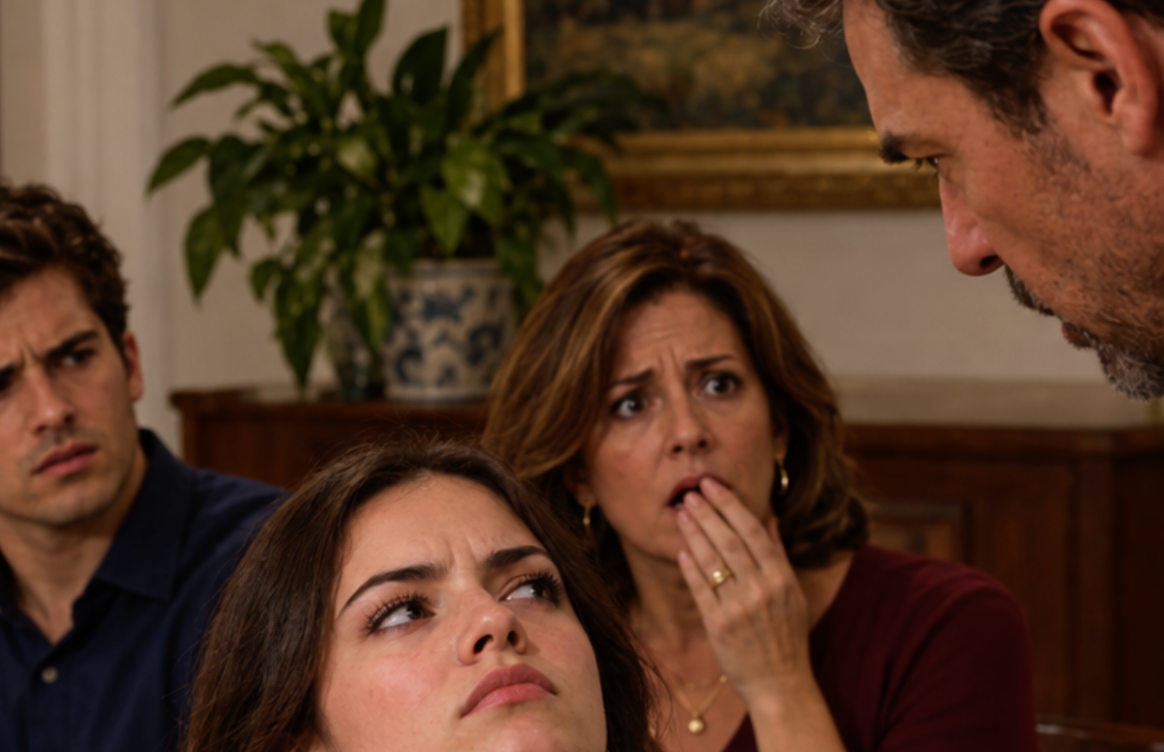
Sunday morning brought nothing special—just another attempt to scrub a baking tray after yesterday’s chicken. Alina, 48, toughened by years of battles with the housing services, stood at the sink. The water was running, drowning out all her deeper thoughts—mainly the realization that dish soap had gone up by another thirty rubles, and now foams like it’s been watered down by the tears of civil servants.
Vitalik shuffled into the kitchen in his slippers, looking as tragic as a cavalry officer who’s just been told there’s no champagne. He slumped down at the table, pushed aside the sugar bowl, and let out a heavy sigh, staring out the window where the gray November view perfectly matched his gloomy mood.
“Alina,” he began, his voice heavy with the weight of the world. “We need to talk. I can’t go on like this. I feel suffocated.”
Alina turned off the water. “Suffocated, is he,” she thought to herself as she wiped her hands on a waffle towel. “Of course, if you pack away half a kilo of pork roast by yourself last night, your diaphragm’s bound to suffer, and shortness of breath appears. I told him: don’t eat heavy food before bed.”
“Suffocated, how, Vitalik?” she asked out loud, sitting across from him. “Want me to open the window? Or is it your heartburn acting up again?”
“You’re always so down-to-earth!” Vitalik exclaimed dramatically, throwing his hands in the air. “I’m talking about the soul, the cosmos, our relationship! The spark is gone, you know? We’ve become strangers, just roommates in a communal flat. I feel my creative potential withering away… in this routine!”
Alina squinted. Vitalik’s so-called “creative potential” involved reinstalling Windows for the neighbor in exchange for a bottle of cognac and leaving angry comments online about geopolitics. Otherwise, he worked as a plastic windows salesman, but business was slow. According to Vitalik, people these days were too broke to appreciate such happiness.
“So, Vitalik, get to the point, as Maupassant used to say,” Alina pressed him. “Are you leaving or what?”
“I’m leaving!” he announced solemnly. “I’ve met someone. She’s different. She listens to me. She’s my muse, if you must know!”
“A muse, huh? Alright then,” Alina nodded calmly. Inside, there was no pang, no heartbreak. In fact, she felt oddly relieved, like slipping off tight shoes after a long party. “Are you packing your things now, or will your muse send the movers?”
Vitalik was taken aback. He expected tears, plates smashing, screams of, “How could you leave me!” He had prepared a speech: “We’ll stay friends,” and “It’s not you, it’s me.” Instead—just a dry, business-like response.
“You’re not even upset?” he asked, wounded.
“Vitalik, I’ll be fifty soon. I only get upset when housing bills go up or when my favorite cheese disappears from the store. You’re a grown man. If you’ve decided—go. The suitcase is on the top shelf; get it yourself, my back’s not what it used to be.”
The next two hours went by under the banner of the Great Migration. Vitalik dashed around the apartment gathering his things. Alina sat in her chair, focused on a crossword puzzle, but kept a close eye on his every move.
“I’m taking this laptop. I need it for work!” he declared, clutching the old Asus to his chest.
“Go ahead,” Alina waved graciously. “It overheats like an iron anyway and the battery’s shot.”
“And the coffee maker!” Vitalik was getting into the swing of things. “I can’t function in the morning without coffee.”
“The coffee maker?” Alina raised an eyebrow. “Vitalik, we bought that when you were out of work for three months, remember? With my bonus. But fine, take it. Let your muse make you cappuccinos. Just don’t forget the filters, they’re in the top drawer. I know how you artsy types are; otherwise, you’ll end up straining coffee through a handkerchief.”
Vitalik puffed as he stuffed sweaters and jeans into his suitcase. He tried to grab the toolbox too, but that’s when Alina stood firm to protect her property.
“Put the drill back.”
“Why? I hung the shelf with it!”
“You hung it, but I bought it. And that shelf is crooked, by the way—it’ll have to be fixed. The tools stay in the family. Meaning with me.”
Once all the bags were packed, a sweaty and disheveled Vitalik glanced around the apartment. He seemed to want to say something epic as a final word, but all that came to mind was ‘thanks for the borscht,’ which felt a little underwhelming for the moment.
“Well, I’m off,” he grumbled. “Not calling a cab, too expensive. I’ll take the car. Got a lot of stuff.”
Alina, who was peacefully finishing her cold tea at that moment, suddenly choked.
“Sorry, what car are you talking about?”
“Our car! The Toyota. What’s the big deal? I have to drive all the way to Lenka—ugh, my new place across town. You have the metro right nearby. And honestly, why would you need a crossover? You never even know where the edges are.”
With confidence, Vitalik took the keys to the silver RAV4 off the hook. He already pictured himself: free and proud, driving his foreign car into a new life where he’d be cherished, loved, and not forced to take out the trash.
Alina slowly set her cup down on the table. The chime of the porcelain echoed through the silence like a gong before a duel. She stood up, adjusted her robe, and walked right up to her former beloved.
“Vitalik, my dear,” she began gently, but her eyes were so icy that he felt chills run down his spine. “Let’s recall the timeline. What year did we get married?”
“2018,” he replied uncertainly. “Why?”
“2018, correct. In November. And when did I buy the car?”
Vitalik wrinkled his forehead. He wasn’t great with dates, but he clearly remembered proudly sitting in the passenger seat when they drove out of the dealership.
“Well… that was in the fall too.”
“August, Vitalik. August 2018. Three months before we went to city hall and stamped our blue stamps. And may I remind you, I paid off the loan with money from selling my grandmother’s dacha, while you were finding yourself in network marketing and trying to sell some miracle supplements made from dried grasshoppers.”
“But we’re family!” Vitalik protested. “I used the car! I changed the oil!”
“You changed the oil with my money, and you used the car because I was generous. Was. Until now.”
“Alina, this is petty!” he shrieked, realizing the ground—more precisely, the wheels—were slipping from under him. “You want to leave a man stranded without a ride? Out on the street with his suitcases?”
“I want to restore fairness,” she cut in sharply. “A divorce is a divorce. Property gets split according to the law. Everything earned together in marriage is there, in the suitcase: your shirts, the coffeemaker, and that barbecue set we never even used. But darling, the car—that’s premarital property.”
She held out her hand, palm upward. The gesture was commanding, brooking no argument.
“The keys.”
Vitalik hesitated. The perfect image he’d pictured of showing up at his new lover’s place was falling apart. It’s one thing to roll up in a shiny crossover, toss the keys casually on the nightstand, and say, “Here, I brought the essentials.” Quite another to spill out of an “Economy” taxi with plaid bags, looking like a refugee, and whine about your ex-wife being bitter.
“Alina, let me at least drop off my stuff! I’ll return the car tomorrow! Honest!”
“I know your ‘honest,'” Alina smirked. “Tomorrow you’ll fix the shelf, tomorrow you’ll find a job. No way. What’s done is done. Keys—now.”
Red as an overripe tomato, Vitalik hurled the keys onto the nightstand.
“Choke on your hunk of metal!” he shouted. “I always knew you were materialistic! You care more about things than people!”
“Not things, Vitalik, assets,” she corrected him in a mentorly tone. “And not more than people—just more reliable. The car never betrayed me, never whined about a ‘creative crisis,’ and never left me for another driver because he had tastier gas.”
He grabbed his suitcases and, stumbling, dragged them to the door. One of the wheels whimpered and fell off. Vitalik cursed under his breath, shoved the bag under his arm, and tumbled into the hallway.
“And don’t ever set foot here again!” he shouted from the elevator, though the logic of that demand was questionable.
Alina locked the door twice. The lock clicked. Silence settled in the apartment—blissful and deep.
She walked to the window. Downstairs, by the entrance, Vitalik was struggling to call a taxi. Judging by his gestures, the prices in the app were outrageous, and the wait time was endless. He kicked a suitcase, then pulled out his phone and, apparently, started calling his muse to complain about the cruelty of the world.
Alina picked up the car keys and turned them over in her hand. The nice weight of the keychain felt good in her palm.
“I should get it washed,” she thought. “And swap out the air freshener in the car. His cologne has soaked into everything.”
She threw on a jacket, laced up her comfy sneakers, and stepped outside. The wind was cold but refreshing. Vitalik was gone—probably already riding off in some old Logan.
Alina settled into her RAV4. The seat was pushed far back—for her husband’s long legs. With a practiced motion, she slid it forward and adjusted the rearview mirror. Looking back at her was a woman—not young, but well cared for, with a sly sparkle in her eyes and a calm smile. A woman who knows exactly how much a kilo of beef costs, how to pay taxes with an app, and why you should never register property in the name of husbands who are still “finding themselves.”
She turned the ignition key. The engine responded with a smooth, contented purr.
“Well, sweetheart,” Alina said out loud, giving the steering wheel a gentle pat. “Shall we go get some pastries? Today I’ve earned a Napoleon. And some champagne. And maybe even new seat covers.”
She turned on the radio. Something upbeat was playing about how “everything will be alright.” Alina put on her turn signal and smoothly pulled out of the yard.
Ahead was a free evening. And a free life. And a full tank of gas—which, unlike some men, always takes you exactly where you want to go.