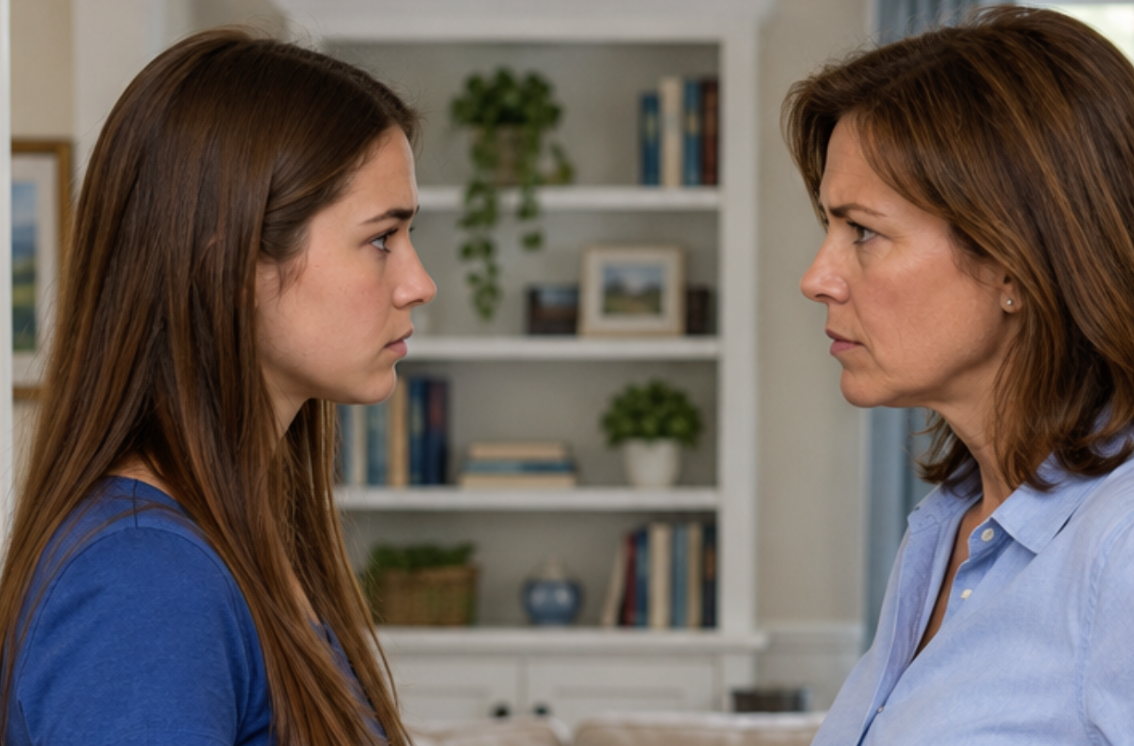
The notary looked at my mother over her glasses and said slowly:
“Are you sure you want to go through with this? Because undoing it… will be difficult.”
Mom gave a regal nod. Next to her, Inna was positively glowing, as if she was already picturing where she’d place the furniture in Grandma’s apartment.
I sat quietly in the corner, not saying a word. As always.
But it all started three months ago, when Grandma passed away.
To be more precise—when they read her will.
“There must be some mistake,” Mom muttered, smoothing the paper on the notary’s desk. “Mother wasn’t herself these last few years. Dementia. We’ll contest this.”
I stared at the document, unable to believe my eyes. Grandma had left everything to me: the apartment downtown, the country house, her savings. As for Mom and Inna—they got a symbolic 1,000 rubles each “to remember her by.”
“Lyudmila Petrovna,” the notary remained perfectly professional, “your mother underwent a complete psychiatric evaluation a week before signing. All the paperwork is in order.”
“Natashka put her up to this!” Inna jumped to her feet, her heels clacking on the parquet. “She kept going to Grandma’s, buttering her up on purpose!”
I stayed silent. What could I say? That for the past seven years I had made the 200-kilometer trip every weekend? That I changed Grandma’s diapers while Mom and Inna were “busy”? That Grandma only ever recognized me?
“We’re not letting this go,” Mom stood up, her lips pressed into a thin line. “Family council. Tomorrow. No outsiders.”
The “family council” was held at the country house—the very one Grandma had left to me. The irony stung.
Mom sat at the head of the table, queenly and commanding. Inna took her right side, flipping through her phone for all to see.
“Natasha,” Mom said in her “reasonable” voice, “we all realize there’s been a misunderstanding. Your grandmother was old and mixed things up. You’re not really planning to keep everything, are you?”
I didn’t answer. I stared at the little bowl of cookies. Grandma always put it on this table.
“Mom, why even bother talking to her?” Inna put down her phone. “She knows we’ll challenge it. We’ve already got a lawyer. It’ll get ugly, Natasha. Very ugly.”
“We don’t want to go to court,” Mom shook her head. “We’re family. Let’s be fair: you renounce the inheritance voluntarily, and we’ll split everything equally.”
“Equally?” I finally spoke up.
“Well,” Mom exchanged a look with Inna, “the apartment will go to Inna. She works in the city, she needs it more. We’ll sell the country house and the money will go to me—for retirement. And you… you’ll get Grandma’s things. Her albums, the old dishes. You love those, don’t you?”
I felt my fingers go numb. It was a familiar sensation—the same one I always had just before swallowing another injustice.
“And the money in the accounts?” I asked.
“What money?” Inna frowned.
“Three million two hundred thousand. Grandma’s savings. She put money away all her life.”
Silence. Mom and Inna exchanged glances. I realized—they hadn’t known about the money.
“That… that will be split too,” Mom quickly composed herself. “It’s family property.”
“But Grandma left that to Natasha,” Uncle Seryozha suddenly spoke up. Mom’s younger brother had been sitting quietly in the corner, and I had almost forgotten he was there. “It’s in the will.”
“Seryozha, no one asked you,” Mom cut him off.
“You don’t need to ask me. I’m a witness. Mother explained everything to me before she died. Why Natasha gets everything—and why you two get nothing.”
Inna snorted:
“Oh really? And why’s that?”
— Because, Inka, you haven’t visited even once in six years. Not even for her 80th birthday.
— I was working!
— Oh right. On Instagram. Mom saw your stories from Turkey. On her birthday.
— And you, Lyuda, — uncle turned to Mom, — you even claimed she was faking it. After her stroke. Remember?
— That was a misunderstanding…
— A misunderstanding is when you mix up salt and sugar. But you said — and I’m quoting — ‘she’s pretending so that Natasha runs around after her.’
I swallowed hard. I didn’t know Mom had said something like that. Although—I probably should have guessed.
A week later, Mom called.
— Natashenka, — her voice was sweet as honey, — you do realize I just got carried away? You’re my daughter. I love you.
— Mom…
— Why don’t you just sign over your share of the apartment to Inna? And the cottage — to me. The money… well, you can keep that. That’s only fair.
I stayed silent. Outside my rented studio apartment, it was raining.
— It’s the right thing to do, — Mom continued. — Inna’s forty-two, she’s alone, she needs a place of her own. And you — you’re almost fifty, you’ve gotten used to living without your own place, why do you need it?
— And what about me? — I blurted out.
— What do you mean, ‘what about you?’
— The apartment to my sister. The car — that went to her too, last year. When Dad passed, she got everything. And me — what about me?
A pause. Then Mom’s voice turned icy:
— I gave you life. That should be enough.
The call ended. Or maybe I hung up. I can’t even remember anymore.
The next two months turned into a war.
Mom and Inna hired a lawyer. Filed a lawsuit to contest the will. Claimed Grandma was incompetent, that I ‘applied pressure,’ and that the certificate of mental health was forged.
Old acquaintances started calling me:
— Natasha, is it true you let Grandma die?
— Natasha, they say you stole from your own mother?
— What are you doing? Your own mother, and you treat her like that?
Inna really put in the effort. Social media was on fire. She posted old family photos with captions like: ‘Mom has loved us both equally all our lives, and now she’s been betrayed.’
In one photo, I was six. I stood off to the side while Mom hugged newborn Inna.
‘Loved us equally.’ Sure.
I almost gave up.
Seriously. One night, I took out the renunciation form Mom mailed me. I grabbed a pen.
I thought: maybe it would just be easier? For thirty years I’ve been the ‘difficult daughter.’ The one who always got in the way. Who asked for too much. Who never quite fit.
Maybe if I gave up everything — Mom would finally say: ‘Well done, Natasha. You’re a good daughter.’
The pen touched the paper.
And then the phone rang.
— Natalia Igorevna? This is Anton Sergeyevich, your grandmother’s notary. I need to give you something. She asked me to — after all the drama died down. I think now is the right time.
Grandma wrote the letter a month before she died.
‘Natashenka, my dear girl.
You’re probably wondering — why do you need this? Why the war with your mother and sister? Just give it all to them, live in peace.
Don’t give it up.
All my life, I watched as Lyuda turned you into a servant. How Inna got the best of everything, and you got the scraps. How they convinced you that you didn’t deserve any better.
You do deserve better.
I couldn’t protect you when I was alive — I was afraid of falling out with my daughter. I was a coward. But now — now I can.
This isn’t a gift. It’s justice. Take it.
And one more thing: check the bottom drawer in the sideboard at the summer house. Everything you need to know about your family is in there.
Your grandmother Nina.”
At the summer house, I found a box.
Inside were documents. Receipts. IOUs.
All written in my mother’s handwriting. Signed by her, too.
I discovered that twenty years ago, my mom borrowed money from my grandmother—supposedly ‘just a loan’ to buy an apartment for Inna. 800,000 rubles—a huge amount back then. She promised to pay it back. There was an IOU, even notarized.
She never paid a single ruble back.
There were more notes, in my grandmother’s handwriting:
“2015 — Lyuda asked for 200,000 for a car for Inna. Gave it.”
“2018 — Inna said she’d repay for the renovations. 340,000. She didn’t.”
“2020 — Lyuda took my gold. Said it was just ‘for safekeeping.’ Didn’t return it.”
The total amounted to nearly two million rubles. All documented. With IOUs, receipts, and messages.
Grandma was building a dossier on them. Quietly. For years. She waited.
The trial was three weeks later.
My mom and Inna showed up fully armed. Their lawyer looked polished and expensive. They had a support squad—two older women from mom’s circle who stared at me like I was a murderer.
I came alone.
“Your honor,” their lawyer stood up, “we demand that the will be declared invalid under Article 177 of the Civil Code. The testator was not mentally competent to understand the significance of her actions…”
He spoke at length. About dementia, about my supposed ‘manipulation,’ about ‘family values.’
Mom nodded. Inna recorded everything on her phone—probably for Instagram.
Then I stood up.
“Your honor, I would like to submit some documents to the case.”
The judge raised an eyebrow:
“Which documents exactly?”
“IOUs documenting the debts owed by the plaintiff, Lyudmila Petrovna, and co-plaintiff, Inna Igorevna, to the deceased. The total is one million nine hundred and twenty thousand rubles.”
Silence.
My mother turned pale. Inna dropped her phone.
“What?” the lawyer was rattled. “What IOUs?”
I pulled out a folder.
“Notarized. With dates, amounts, and terms of repayment. And these messages, where the plaintiff calls the deceased ‘a senile old woman who’s going to die soon anyway.’ Dated May 2021.”
The lawyer took the documents, leafed through them. His face went gray.
“Your honor,” he cleared his throat, “we need a recess to consult with my clients.”
“Thirty-minute recess.”
They left for the hallway. I stayed seated.
Through the glass door, I watched my mom waving her arms around. Inna shouting something. The lawyer seemed to be backing away.
Twenty minutes later, the door opened.
“Natalia Igorevna,” the lawyer looked like he’d bitten into a lemon, “my clients are willing… to discuss a settlement.”
“A settlement?”
“They’re withdrawing their claim. Completely. And… they won’t contest the property.”
I nodded:
“And what about the debt?”
“What debt?” my mom burst into the room. “What debt are you talking about?!”
“Two million, mom. You borrowed it from grandma. Never repaid it. I’ll be giving those IOUs to the bailiffs right after the hearing.”
“You wouldn’t dare!”
“I absolutely will.”
Mom froze. I could see her searching for words. For some argument. Anything she could use as a weapon.
“I’m your mother,” she finally hissed. “I gave you life!”
I stood up. Slowly. Calmly.
“You know, Mom,” for the first time in fifty years I looked her straight in the eye without fear, “I’ve thought a lot about that phrase. ‘I gave you life, that’s enough.'”
“And what of it?”
“Here’s what: life isn’t a gift. It’s your decision. You had me because you wanted a child. Not for me—for yourself. That doesn’t make me indebted to you. It makes you responsible.”
“How dare you…”
“I do dare. For the first time in my life—I dare.”
Inna grabbed her mother’s elbow:
“Come on, Mom. She’s crazy. Let’s go!”
They left.
The judge announced the decision in my favor.
Three months later.
I’m sitting on the porch of my grandmother’s country house. My house now. I’m drinking tea from her cup—the one with blue flowers she saved for special occasions.
Uncle Sergey stopped by yesterday. He shared the news.
Mom is selling her apartment—she can’t pay the debt. Inna moved back in with her because without Mom’s help, she couldn’t manage the mortgage.
They filed an appeal. Lost again.
They called me—the number is blocked.
They wrote letters—they came back to sender.
I’m not gloating. Really. It’s just… I feel at peace. For the first time in fifty years—peace.
Yesterday I found a photo in my grandmother’s album. I’m four years old, sitting on her lap, laughing. She’s hugging me as if I were the most important thing in the world.
On the back—her handwriting:
“Natashechka. My treasure. You deserve everything.”
I put the photo on the mantel.
Next to it—the very same letter.
And every time I start to think I’m not good enough—I read it again.
They say the best revenge is a life well lived.
I don’t know. Maybe that’s true.
But I do know one thing: there are things you can’t buy. And there are things you can’t steal.
Grandma didn’t leave me an apartment or money.
She gave me the right to exist.
Finally.