Friday evening kicked off with a loud crash in the hallway: Mira zoomed in on her scooter right up to the coat rack and braked with her heel against the baseboard.
“Mom, I barely even touched it!” she shouted.
“Barely is like ‘almost passed the exam,'” replied Polina. “Park your vehicle in the corner, racer.”
“Dad, did you see how I stopped?”
“I saw,” Gleb said without looking up from his phone. “Good job.”
Polina brought in a dish of potatoes and mushrooms, set it in the middle of the table, and set out the utensils. The room was warm, bright, and noisy—just the way she liked it.
“By the way, I ran into Ksenia today,” she said as she sat down. “Remember her? My classmate?”
“The one whose husband is always in sweatpants?” Gleb finally put down his phone.
“Now he’s in sweatpants at their own place. They built a house out by the bypass, can you imagine? Two floors, a porch, a yard.”
“On the bypass?” Gleb straightened up. “How many acres?”
“Eight, I think. It’s not like I walked there with a measuring tape.”
“Eight is decent,” he suddenly started speaking quickly, as if he’d been waiting six months for this topic. “See, people make things happen, and we’re just sitting in a box.”
“We’re sitting in an apartment with a balcony where you can see half the city,” Polina clarified. “A box is what pizza comes in.”
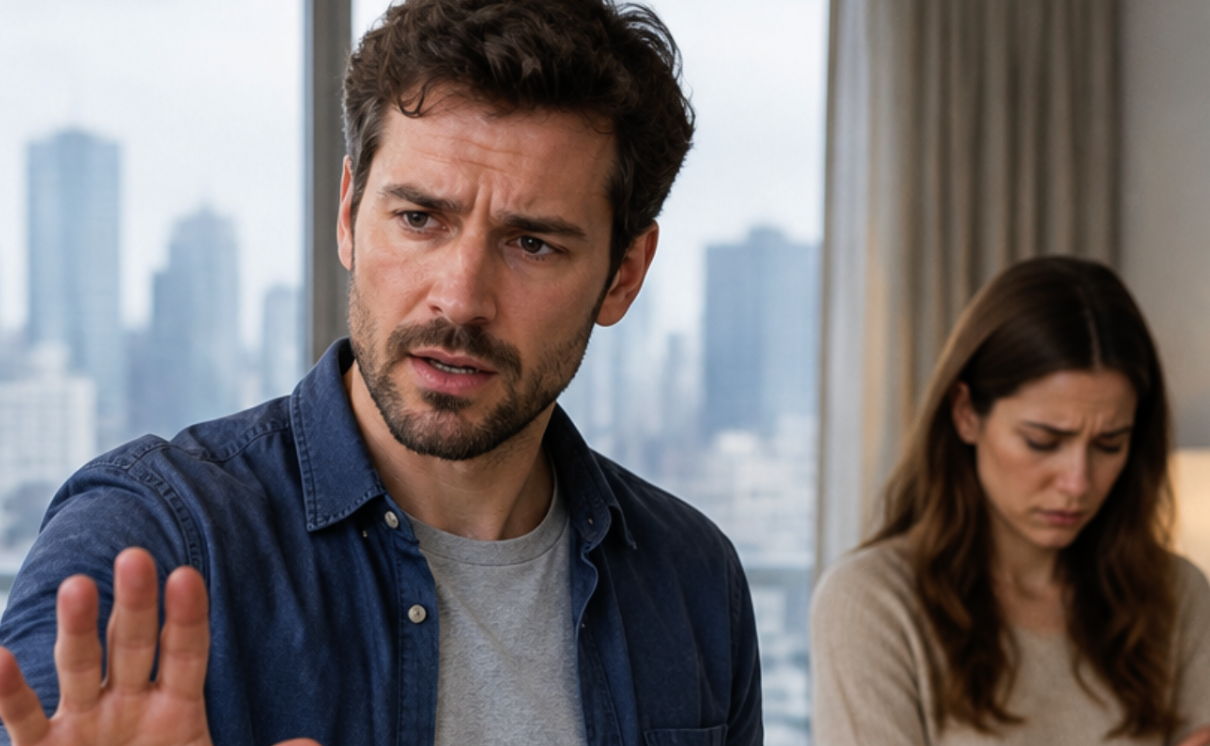
“Polina, that’s not funny. The pipes are rusty. The riser sounds like a tractor. Do you seriously want Mira to grow up here?”
“Mira is already growing up here. And judging by the scooter, she’s doing just fine.”
Gleb pulled his chair closer, and his voice took on that certain insistence she recognized instantly.
“My mother called. Her roof leaks every spring, the house is falling apart. We could sell the property for a good price—the location is great.”
“Let her sell. It’s her house, her decision.”
“Her money plus your apartment—and we can build a place in Beryozovka. Just think: a sauna, a proper garage, plenty of space for everyone.”
Polina slowly put down her fork.
“Interesting math. Looks like you forgot to add ‘my consent’ into the equation.”
“That’s what I’m telling you now!”
“You’re not telling, you’re declaring the result. Like the weather report.”
The conversation didn’t end—it just went underwater for a bit and resurfaced the next day.
In the morning, Raisa Pavlovna called. Her voice was sweet and drawn out, every word dusted in sugar.
“Polinochka, sweetheart, have you thought it over?”
“Thought about what exactly, Raisa Pavlovna?”
“What do you mean, what? Glebushka already told you. I found a plot of land just thirty minutes from the city—the price is ridiculous.”
“The only thing ridiculous in these stories is usually the price.”
“Don’t be sarcastic,” her voice dropped a little. “I’ve done all the math. We sell my land, your apartment—and there’ll be more than enough.”
“Raisa Pavlovna, could you tell me when exactly you decided about my apartment? I’d like the date—for the record.”
“Gleb and I already discussed everything,” she snapped. “We just need your signature, it’s a formality.”
“A formality is when you sign a receipt at the store. This is the only thing my grandmother left me.”
“Your grandmother, may she rest in peace, wouldn’t she have wanted her granddaughter to live in a house? With a garden, and apple trees!”
“Grandma wanted her granddaughter to have her own place. She said that in words, not through intermediaries.”
Raisa Pavlovna paused for exactly two seconds.
— You have to understand, it’s hard being alone. When I get up at night, there’s only silence—no matter how much I shout, no one will hear me.
— It really is tough. But there are options—a caregiver, moving closer to you, a hundred different things. All of them seem to be cheaper than selling my apartment for some reason.
— You’re such a… calculating girl.
— I’m just careful. Calculating are the ones who measure other people’s square meters with a calculator before breakfast.
That evening, Polina sat in the dark, turned on her phone, and scrolled through old photos. Her grandmother Antonina Fyodorovna in an apron making dumplings, her mother laughing on the balcony, and little Polina herself sitting on the windowsill, swinging her legs.
Mira was asleep, the house filled with its familiar sounds. The old maple tree in the yard rustled just as it had twenty years ago—almost as old as these walls.
Two days later, Raisa Pavlovna showed up without calling, carrying a bag of apples and a pie wrapped in foil.
— I’ll just be a minute! she announced from the doorway. — Let me take a look at my granddaughter.
She walked through the rooms like she owned the place, ran her finger over the windowsill, and grimaced at the wallpaper.
— Polina, your wallpaper is… prehistoric.
— At least it’s honest. It doesn’t pretend to be bricks.
— And the pipes are humming. Hear that? They’re humming!
— They are. Just like all the neighbors’ pipes. It’s even made us bond with them.
Raisa Pavlovna sat down next to her and put her hand over Polina’s—heavy, like a seal.
— Oh, don’t act like a stranger. We’re family. Let’s live together: I’ll be on the first floor, you upstairs, I’ll help around the house…
— Raisa Pavlovna, I respect you. That’s why I won’t lie: I don’t want to live together. Not upstairs, not downstairs, not even on the veranda.
— Oh, is that so! she snapped her hand away. — So you think I’m beneath you!
— It’s not that. It’s just that love has an expiration date when you’re too close. Like milk.
Suddenly Mira burst into the room, waving a piece of paper like a flag.
— Look! I drew this!
— Oh, how pretty, Raisa Pavlovna forced a smile. — What is it, bunny?
— It’s our house. Here’s the balcony, here’s the tree, and here’s me on the windowsill.
— Would you like a different house? A big one! With a pool!
Mira frowned, thought about it very seriously—like an adult.
— No. I want to stay in my house.
— But it would still be yours!
— No, the girl said firmly. — My house is where the maple tree is.
Polina let out a slow breath. Her daughter had just spoken aloud what Polina herself had been thinking for the past two weeks, never quite able to say it out loud in one piece.
— Out of the mouths of babes, Raisa Pavlovna, she said softly. — Kids don’t know how to bargain, they go straight to the point.
On Saturday, Gleb invited his sister over.
— Darya and Egor are coming, we’ll just hang out, he said, glancing away.
— ‘Just hang out’ with that face usually means a shareholders’ meeting, Polina joked. Alright, I’ll get out the big plates.
Darya arrived all dressed up, Egor quiet and carrying a bag of tangerines. For the first half hour, they chatted about nothing, then Darya cautiously, as if testing the floor with her foot, began:
— I’ve always said: in our family, we never divided things into ‘mine’ and ‘yours’.
— That’s a great principle, Polina nodded. Especially handy for those whose ‘yours’ is bigger.
— I just mean that we need to help each other.
— Darya, you’ve been renting for five years. Need help? I can vouch for you to the landlords or help you move. I can even watch your kids while you check out other options.
— And what does this have to do with me?
— Everything! It’s much easier to give advice than it is to give up square meters.
Egor gave a barely noticeable smile into his tangerine and stayed silent.
— Polina, — Gleb slapped his hand on the table. — That’s enough fooling around. Let’s figure this out like adults.
— Doing things like adults means two people coming to an agreement. Not one handing down a verdict and the other applauding.
— We’re selling the apartment. Don’t make a scene, — he said loudly. — With that money, we’ll get a house, and my mom will be nearby. That’s it, discussion over.
— It’s not over. It’s very much open, for both of us, — Polina placed her hands on the table. — I remember the story of an acquaintance, Zhanna. Her mother put her own apartment into her son’s house. Then came the divorce—and the woman was left with just a bag and kind words.
— Are you confusing me with someone else?
— I’m not confusing you with anyone. I just don’t consider stupidity to be a family tradition.
In that moment, Polina’s phone rang. The number was unfamiliar. She put it on speaker just because her hands were busy with a salad bowl.
— Polina Andreyevna? Good evening. I’m calling about the apartment, your husband gave me your number. Just confirming: is a viewing on Tuesday at six convenient? I’ve already done the appraisal by photos, and Raisa Pavlovna has the documents ready.
A heavy silence fell over the room, wrapping them up like a blanket.
— Could you tell me, — Polina asked calmly, — exactly when you were contacted about this?
— Uh… about two weeks ago, maybe longer. Raisa Pavlovna called first, then Gleb Romanovich.
— Thank you. Tuesday is cancelled. And Wednesday. And the whole calendar.
She put the phone down. Darya suddenly became very absorbed in peeling a tangerine.
— Two weeks, — Polina said. — So I’ve already been sold, and my ‘consent’ just came as part of a free delivery package.
— Don’t start! — Gleb jumped up. — You’re supposed to listen to your husband! I’m the one making decisions here, not running a circus!
— Supposed to listen? I know how to listen. Obeying is a different story—I always got failing grades in that subject.
— That’s it, I can’t take this anymore! — he grabbed his jacket. — I’m going to my mother’s. Call me when you calm down.
— When I calm down, I’ll probably be right where I am now. Close the door gently—we have neighbors with grandkids.
He left. Polina didn’t make a move to stop him.
— Polina, — Darya said softly, — he didn’t mean any harm.
— Darya, ‘didn’t mean any harm’ is an excuse for a child who broke a vase with a ball. Not for an adult who’s been negotiating over my home behind my back for two weeks.
Egor was the first to get up.
— Let’s go, Dasha, — he said. — Everything’s been said here.
For five days, a strangely peaceful silence settled over the apartment.
No one counted someone else’s money out loud, no one explained how to live the right way, no one droned on about pipes. In the evenings, Mira would draw, Polina would read to her before bed, and would end up falling asleep halfway through a chapter herself.
— Mom, where’s Dad? — the little girl asked on the third day.
— He’s with grandma. He’s thinking things over.
— About what?
— About important stuff. Sometimes grown-ups need to sit in the corner and think, just like in kindergarten, only it’s more complicated.
Raisa Pavlovna didn’t call—she was offended and held onto that grudge like a precious trophy. She sent one message: “You’re destroying the family.” Polina replied briefly: “It’s not ‘no’ that destroys a family, it’s lies.”
On Thursday, Gleb came back. He had bags and flowers in his hands, looking lost, as if he’d stepped into a stranger’s home.
— May I come in?
“This is a place for you to stay, not an invitation,” Polina stepped aside. “Come in.”
He sat down across from her, placed his hands on the table, and spent a long moment gathering his thoughts.
“I was wrong.”
“Good start. Go on, I won’t interrupt you.”
“My mother and I put pressure on you. I knew it would hurt you, and I did it anyway. I’m ashamed.”
“Something else matters more to me. You lied for two weeks. Not that you simply didn’t say anything—you lied, sat at this very table talking about our eight hundred square meters all while knowing the realtor was already looking at pictures.”
“I thought you’d agree if everything was almost ready.”
“That’s where you miscalculated,” Polina said. “You can’t just present me with a finished deal. You can only invite me to be part of it.”
“I’ll talk to my mother. I’ll put an end to it. Personally.”
“Do that. And also explain something simple to her: I never suffered in silence, and I never will. I’m not the patient type, I’m the type who talks things out.”
“Do you forgive me?” he asked quietly.
“No,” she answered calmly, without any anger. “I hear you. That’s already something. Forgiveness doesn’t work like a switch—it takes time.”
“And what should I do?”
“Live nearby, and don’t test the strength of something that’s already cracked. It’ll be new for you: here, you need to ask, not announce.”
Gleb nodded and quietly started to unpack groceries from his bag. He was awkward, like a guest, and they both felt it.
Mira rushed in, climbed onto her mother’s lap, and handed over yesterday’s drawing: a house, a balcony, a big tree, and the crooked letters at the bottom—‘OUR HOME’.
“Shall we hang it up?”
“Absolutely,” Polina said, holding the sheet to the fridge with a magnet. “Let it hang in the most visible place. Between us, this is the most important document in this house.”
Outside, the old maple rustled—just like it did back when grandma was around. Polina thought that Antonina Fyodorovna wouldn’t have been proud of the square meters. She would have been proud that her granddaughter had learned to say ‘no’ in a steady voice—and never forgot how to respect people along the way.