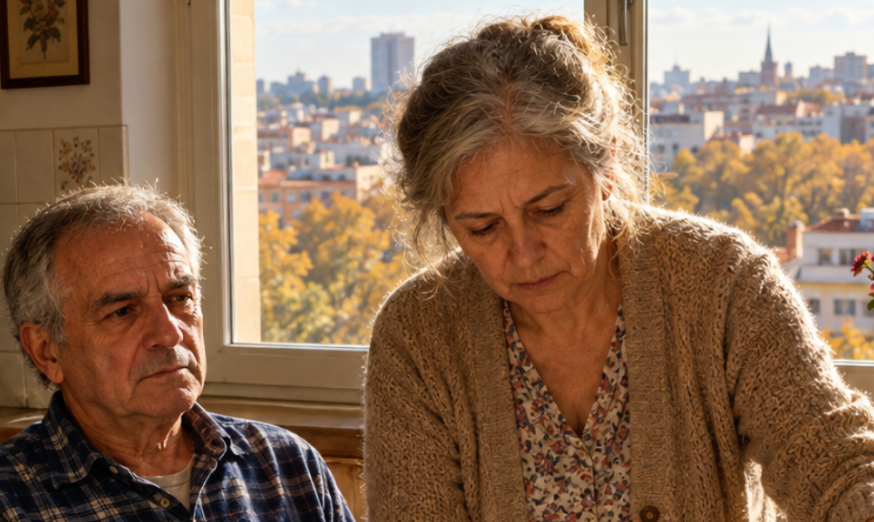
“We’ll split everything! Your apartment, your car—everything we got during the marriage, Nina, belongs to both of us. That’s the law.”
Gennady said this over dinner, not even looking up from his bowl of buckwheat, as if he were just announcing the weather. I was left standing there, ladle poised over the pot. We’ve spent twenty-eight years together, and not once had he ever said the word “split” out loud.
“What law, Gena?” I put the ladle down on a saucer. “That was my father’s money.”
“It was your father’s money while he had it.” He finally looked up at me. “But once you bought something with it while we were married, it became family property. I checked.”
“I checked.” That’s what got under my skin the most. My husband, who needed three reminders just to pay the electric bill, somehow found the time to go and check something out somewhere.
Dad passed away last January, on the fourteenth, in the hospital after being taken in with high blood pressure. He was eighty. I’m his only daughter—Mom died long ago. I spent half a year waiting at the notary’s office and finally received the inheritance certificate for his two-room apartment in an old building on Krasny Perekope. In the fall, I sold it for 6.2 million. The buyer transferred the money to my account, which I had originally opened while Dad was alive to receive his pension on his behalf.
Back then, Gennady acted indifferent to the whole thing. All he said was, “Well, now you’re the rich one in our family,” and then he went to watch hockey.
In spring, I bought a car. Gena crashed our old Lada the year before last, and for twenty years, I’d traveled across the city to work at the clinic—first by bus, then walking from the stop. I got myself a small crossover for 1.4 million. In the summer, I found a one-bedroom apartment in a new building near the Volga for 4.6 million. I planned to rent it out, or maybe give it to our daughter if Oksana ever returns from St. Petersburg.
We lived in the two-room apartment we bought together back in ’99, after we got married, with joint money. I never thought of it as only mine. But now it turned out that Gena considered everything as his.
“Are you planning to get a divorce?” I asked directly.
He just shrugged.
“I’m not planning anything. I’m just saying how it is. So you don’t get to thinking you have your own separate life.”
Then he went out to the balcony to smoke, even though he’d quit back at his brother’s sixtieth birthday.
That night, I lay awake going over what had changed during the summer. It felt like nothing had. I still got up at six, made porridge, ironed his shirts, and on Saturdays, went to his mother’s dacha to weed the garden beds, “because Mom can’t anymore and you’re on vacation anyway.” He still grumbled when I came home late. The only difference was that now he took his phone with him everywhere, even into the bathroom.
A week later, he brought up the car.
“Hey, why don’t you transfer it to my name” he said on Saturday, while we were stuck in traffic on the bridge. “I’ve been a licensed driver since ’89, the insurance would be cheaper—maybe 10,000 a year less.”
“You could just be added to the insurance policy.”
“Being added isn’t the same,” he said, looking out the window. “The owner gets a bigger discount.”
I didn’t know if that was true or not. But he’d only driven my car twice, and both times he complained, “It’s so high, feels like a bus.” I said I’d think about it. He nodded as if I’d already agreed.
On Monday, my mother-in-law, Lidiya Pavlovna, called me.
“Nina, don’t upset Gena,” she began without even saying hello. “He told me everything. A man needs to feel like the head of the house. But you’re out there buying apartments and keeping it to yourself.”
“I didn’t keep it to myself. He came with me to every showing.”
“Oh, he went with you, sure. But you registered it in your name. That’s not right. Your father—may he rest in peace—wouldn’t have approved of this either.”
My dad, the same man who once kicked my fiancé Gena out onto the stairwell for showing up a bit tipsy, wouldn’t have approved of something very different. But I kept that thought to myself.
That evening I opened my folder of documents. I’m one of those people who keeps everything: the sales contract for my dad’s apartment, the bank statement with the incoming payment, the car purchase contract, a receipt from the same account, the deed for the studio apartment, and an ownership extract. I laid them out in order on the kitchen table. Every sum came from the exact account where the buyer’s money landed. The only other deposits there were my dad’s pension, back when he was alive.
Gennady peeked into the kitchen, saw all the paperwork, and paused in the doorway.
“What are you doing?”
“Getting things organized.”
“And what’s this account?” He jabbed a finger at the statement. “Is this separate? Not our joint card?”
“Separate. It was my dad’s.”
He was silent for a while, rubbing his chin.
“And your salary never went there?”
“No.”
“Alright,” he said and left. He didn’t even put the kettle on, though he’d come in for tea.
The next day, I asked my friend Tamara for her lawyer’s number. Back in 2019, Tamara had a court battle with her ex-husband over their summerhouse and ever since she’s called her attorney a saint.
The lawyer’s name was Rimma Olegovna. Her small office sat above a pharmacy; there was a ficus on the windowsill and stacks of cases covering the floor. She carefully went through my paperwork, flipped over the bank statement, and checked all the dates and amounts.
“Property inherited is personal property,” she said. “Anything bought with that money is also yours, as long as you can trace the money trail. And you can—start to finish. Your father’s apartment, money in your account, payment from the same account. Your husband is entitled to sue, but your evidence is solid. Just don’t transfer ownership or keep these documents at home.”
“He wants me to register the car in his name. For the insurance, he says.”
Rimma Olegovna glanced at me over her glasses.
“If you do, then it’s his car—the law sees it as a gift. No insurance discount is worth that.”
I felt calmer when I got home. I took the documents to work and locked them in my medical office locker. But the question still lingered—why did he need this? Gena is fifty-five, works as a furniture factory foreman, makes sixty thousand a month, and has never cared about cars or apartments. All he’s ever wanted is a couch, a TV, and to be left alone.
I thought I found the answer a week later. After my shift, I stopped by the café near the mall to buy pastries for the weekend, and saw Gena at a window table. Sitting across from him was a woman around forty-five, well-dressed in a light blazer. There were some papers between them, and she was showing him something with a pen, while he nodded, hunched over.
I left the store without buying anything. I walked all the way to the bus stop, completely forgetting that my car was parked just around the corner.
Everything was falling into place. My phone was still in the bathroom. He said, ‘I didn’t pack anything.’ Half of my things were like a dowry for a new life. He’s fifty-five, she’s a little over forty, he wants to start again, but there’s nothing to start with. And of course, his mother knows everything.
He came home later that evening, close to nine o’clock.
“Where were you?” I asked.
“At Valerka’s. Helping out with work.”
Valery, his older brother, ran a small workshop making kitchens. Just half a year ago, he used to visit us every Sunday with his wife and a cake, but since spring he disappeared. Gena would say his brother was ‘swamped with orders.’ I didn’t think much of it at the time.
“I saw you at a café,” I said. “With a woman.”
He froze with his shoe in his hand. Then, slowly, he set it back on the shelf.
“It was business.”
“What kind of business, Gena?”
“My business.” His voice turned dull. “You wouldn’t understand. You live with your millions, but other people have problems.”
And that was it. He went to sleep on the couch in the living room, turning his back to the wall.
The next day, Oksana called.
“Mom, Dad texted me,” she said cautiously. “He asked if you told me you wanted to transfer the apartment to me. I said no. He immediately seemed to calm down. What’s going on with you two?”
“I don’t know yet,” I answered honestly. “I’m trying to figure it out.”
Another odd thing. If he really has another woman, why does he care so much that the apartment doesn’t go to our daughter? Wouldn’t it be easier just to split everything left over? Instead, he seemed afraid of losing the very thing he could take.
On Saturday, he didn’t come alone. He brought Lidiya Pavlovna, in her festive burgundy scarf, and a man in a jacket I’d never seen before.
“This is Arkady, he knows about legal matters,” my mother-in-law introduced him. “We’re doing this as a family, no courts. Let’s sit down and settle things.”
Arkady put a printed form on the table.
“This is a property division agreement,” he said cheerfully. “We’ll get it notarized, no stress for anyone. The one-bedroom apartment stays with you, the car goes to Gennady Petrovich, and the two-bedroom you live in now will be divided equally, as it should be. Fair, right?”
I looked at Gena. He was studying the pattern on the tablecloth.
“Fair is when what’s mine stays mine, and the shared things get divided,” I said. “The car was bought with my father’s money.”
“Ninochka, why are you acting like a stranger?” sighed Lidiya Pavlovna. “Why do you need the car? You rode the bus for twenty years. For a man, not having a car is shameful.”
“If you don’t sign,” Gena chimed in, and for the first time that evening looked me in the eye, “I’ll go to court. For everything. Even the one-bedroom. Let them decide what’s yours and what’s shared. You’ll spend a year running to hearings. With your job.”
That’s when I got genuinely scared. Not for the apartment—I was calm about the documents. What frightened me was how he said it. As if I wasn’t the wife he raised a daughter with and buried two dogs with, but an enemy he needed to wear down.
I stood up.
“I’m not signing anything today. Want some tea?”
Arkady gathered his papers into his briefcase, my mother-in-law pursed her lips, and ten minutes later they were gone. Gena walked them to the elevator and didn’t come back for a long time.
That night, I didn’t go to bed. I sat in the kitchen with the laptop Oksana gave me for my fiftieth birthday. I kept thinking about the woman in the light jacket, about the papers spread out on the café table, about how Gena hunched over as he listened to her. That’s not how you sit with a lover. That’s how you sit at the doctor’s when you’ve just heard bad news.
And about Valery, who vanished in the spring.
Rimma Olegovna once mentioned that you can look up all general jurisdiction court cases by surname on the court’s website. I pulled up the district court’s webpage. Typed in Valery’s last name—he and Gena share it.
The case popped up immediately. The bank had filed a claim to recover a debt on a credit agreement. There were two defendants: Valery Petrovich and Gennady Petrovich. The sum was two million eight hundred thousand. The lawsuit was filed in May, and by August a ruling was issued in the bank’s favor.
I reread the line with my husband’s surname about five times. Then I went to the bailiffs’ website and found an enforcement proceeding in his name, started in September. It was a week after he’d first said at dinner: “We’ll have to split everything.”
Gena was the guarantor. Valery had taken out a loan for equipment for his workshop, but the equipment never paid for itself, he stopped making payments, and now the bank wanted both of them to pay. The woman in the jacket was probably the lawyer he’d been secretly seeing. Then it was all simple arithmetic. There was no way his salary would cover two million eight hundred thousand before retirement. The only thing in his name was half of our two-room apartment. But if my car became his, or my one-bedroom was ruled joint property, the bailiffs would have something to seize. From me. From what my dad left me.
He wasn’t planning to leave me for another woman. He was planning to use my inheritance to pay off his brother’s debt and still stay right here, with my pot of buckwheat on the stove.
In the morning, when Gena came out to the kitchen, printouts from the court and bailiff websites were waiting for him on the table. His coffee cup sat beside them.
He saw his surname and sat down. Said nothing for a long time.
“I didn’t want you to know,” he finally said.
“I figured that out. You wanted me to pay, but not to know it.”
“Nina, it’s my brother!” His voice broke. “He would pay it back! He said he would, once the orders came in. I just needed to buy a little time. We could sell the car, pay off a bit, and from there…”
“The car. My car.”
“Our car!”
“No, Gena.” I was surprised by how steady my voice was. “Yours is half this apartment and your signature on the loan guarantee. You signed it without telling me. You didn’t even tell me when the claim came. You showed up with your mom and Arkady to divvy up my dad’s money.”
He covered his face with his hands.
“Does Mom know?” I asked.
“She knows. The idea was Valery’s, to go through you. Mom said you’re kind and would sign.”
Kind. Twenty-eight years of tending my mother-in-law’s garden beds, ironing shirts, making porridge at six in the morning. That’s what all that came to in their calculations.
On Monday, I was back in Rimma Olegovna’s office, this time with the printouts. She read them over and nodded.
— The loan I co-signed for my brother was his personal responsibility; that money never went to our family. The creditor can’t touch your inherited property, but they could ask to separate out your husband’s share in your joint apartment and try to claim it. You should file for divorce and split the marital property so your half is clearly defined. Whatever you do, do not transfer anything into his name.
I filed for divorce through the government portal that same evening. Gena refused to give his consent, so I had to go to court. We also split the two-room apartment through court, but the lawsuit threatening to “divide everything,” which he kept talking about, he never actually filed. I heard Arkady looked at my bank statements and told Lidia Pavlovna it wasn’t worth pursuing.
My mother-in-law called only once.
“You destroyed the family over a car,” she said.
“The family was destroyed by Valery Petrovich’s signature on that loan,” I replied. “And your son decided I should be the one to pay for it.”
She hung up. She hasn’t called again since.
I moved into a one-bedroom near the Volga at the start of October. I had fewer things than I expected: clothes, my dad’s books, a sewing machine, pots and pans that Gena never knew how to use anyway. I bought some affordable new furniture, put the bed by the window so I could see the river every morning.
Gena stayed in the two-bedroom. As Rimma Olegovna explained, now his share will be divided with the bank instead of me. I heard Valery sold his machines and moved to his wife’s place in a village near Rostov. He doesn’t call his brother anymore.
Yesterday, Oksana flew in for the weekend. I picked her up at the airport in my car. She got in, buckled her seatbelt, and sat there quietly looking at me for a long time.
“Mom, you drive differently now,” she said. “You’re calm.”
We drove along the embankment. I rolled down the window, letting the chilly October river air in. The keys to my new apartment hung on the keychain next to the car keys—two keys, and none of them for anyone else.
Every woman has her limit. And sometimes, real freedom only begins once you’ve crossed it. Follow me if stories like these speak to you. continued in the comments