“So light,” my mother-in-law said, weighing my gift in her palm. “Maybe two hundred grams. That means it’s another discounted item.”
Everyone at the table burst out laughing, with Regina leading the way.
It was March 8th, and we had gathered at Antonina Borisovna’s: me and Igor, his sister with her husband, and their summer house neighbor, Zoya Ilinichna. The place smelled of mimosa and warm pastry, the crystal chimed quietly in the cabinet. I looked at the hand with the amber ring where my present swayed, and counted. This was the ninth one.
That’s how many gifts I’ve brought to this house in the three years I’ve been married to her son. Birthday, New Year’s, Women’s Day — and every time, it’s the same show. My mother-in-law worked as a department store merchandiser for thirty years, and she still checks gifts like a new shipment: weighing, turning inside out, looking for a tag, announcing the price. Out loud. In front of everyone.
She unwrapped the paper and pulled out a shawl. Soft gray-blue cashmere, something I spent two weeks choosing, going back to the store three times just to touch it again. It looked warm even from a distance.
“Well,” Antonina Borisovna slid her glasses down to the tip of her nose and turned the edge inside out. “You cut off the tag. Was that so I couldn’t check the material?”
“I took it off because it was scratchy.”
“Synthetic is what’s scratchy.” She pinched the fabric between her fingers and declared, “Market, about four hundred rubles. You can’t fool me, I’ve worked thirty years with goods.”
The shawl landed on the back of the chair like an ordinary kitchen towel.
Then it was Regina’s turn. Igor’s sister handed over a box the size of a stool, and my mother-in-law received it with both hands.
“Now that’s some weight! Three kilos, at least. My daughter knows what her mother wants.”
Inside was a set of pots. I’d seen the exact same set for 2,900 rubles on a marketplace, with a discount. But in this house, price is measured by the kilo, so I kept quiet.
Why do I swallow all this? I asked myself this question every holiday, and the answer was always the same. I married at forty-five, after a divorce, and I didn’t want to start my second marriage with a battle. Igor was forty-six then, and before me, he’d always lived with his mom. Truth is, she hadn’t given her son to me — she’d only lent him, and reminded me three times a year. Three evenings a year — isn’t that a fair price for peace in the marriage?
I tried doing things differently. I talked to my husband, but he just asked me to ignore it. Once, instead of a gift, I brought an envelope. My mother-in-law counted the bills over her salad and announced to the guests, “Five thousand. That’s how well a hairdresser lives.”
A hairdresser. I’m a colorist—clients book me three weeks in advance, and I make more than her son. Maybe that’s the real issue here.
“Igoryok,” my mother-in-law tapped her fingernail on the table, “you should give your wife more money. It’s embarrassing — she brings her mother-in-law low-grade stuff, people talk, you know.”
Igor spin the car keychain around his finger, staring at the tablecloth.
I felt my ears burning. I noticed I was lining up my fork with the knife, perfectly parallel. That’s how I line up my combs at work whenever a client says something nasty and I can’t answer back.
But here, I could answer.
I pulled out my phone, opened the store app, and placed it screen-up in front of my mother-in-law.
“Eight thousand four hundred. Cashmere, Mongolia, the details are all right here. Read it out loud, Antonina Borisovna — since you like doing things out loud.”
The laughter stopped instantly. Reginin’s husband craned his neck toward the screen and let out a whistle.
“And another thing,” I added. “Igor doesn’t give me any money. We keep separate budgets, so any gifts I give you come from my own pocket. Fifty-one thousand, in case anyone’s curious.”
My mother-in-law looked over her glasses at her phone, and her tapping nail fell silent.
“So, they overcharged you,” she finally muttered. “Cashmere, she says. You’re so easy to fool.”
But even so, she still picked up the wrap from the chair and placed it on her lap.
In the hallway, I buckled my boots alone while everyone else finished their compote. The zipper wouldn’t budge, and my fingers felt foreign. All through these holidays, I stayed silent—and all it took was a receipt from my phone. And no one collapsed, the chandelier is still hanging.
continued in the comments
Igor took his time warming up the engine, then let out a little snort.
“You really went all in with that receipt. Mom’s going to sulk for a week now.”
“Let her sulk.”
He laughed, and for a moment, everything felt light. But I already knew nothing was actually over; that night, they marked down my value—not just the wrap—and you can’t fight that with a receipt.
And in April, my mother-in-law’s Lada Kalina broke down. My Saturdays stopped being mine.
***
The Kalina was a 2008 model, and the mechanic at the shop was honest: repairs would cost one hundred and ten thousand, more than the car was worth. But my mother-in-law had a dacha twenty-six kilometers from the city, seedlings, strawberries, and a firm belief that buses are only for failures.
Igor works shifts at the bakery, two days on, two days off, and gets a ride to work in the factory shuttle. On those days, our Duster sits under our window—which Antonina Borisovna knew perfectly well.
“Al, just until the fall,” my husband asked. “She’s all alone.”
I agreed. But it’s important to explain why Saturdays matter. For a colorist, it’s the key day: three complicated dyes, eleven grand in my hand. By mid-July, I’d driven my mother-in-law to the dacha nine Saturdays out of fourteen. It’s not just the inventory manager who can do math: nearly a hundred thousand has already slipped past my register. And how much more will go?
On July 11th, we set out at seven in the morning. My mother-in-law sat in the back, surrounded by empty strawberry crates, and directed everything.
“You brake like a cab driver. Igor drives softer.”
The car smelled of dill and warm plastic, and she made me turn off the AC—it’d give her a chill. I stayed quiet and kept my eyes on the road. Thanks to these trips, I’ve learned that I park crooked, signal too late, and that women nearing fifty should just be passengers anyway.
At the dacha, I carried the crates deeper into the yard and paused at the fence. On the neighbor’s garden swing beyond the pickets, I spotted a blanket. Gray, herringbone, with a leather patch in the corner. My New Year’s gift, five thousand six hundred.
“Zoya Ilyinichna,” I called out, “where did you get that blanket?”
The neighbor straightened up over her vegetable bed and wiped her hands on her apron.
“Tonya gave it to me, back in winter. Said it was extra, nowhere to put it.” She glanced at me and immediately stumbled over her words. “Albinachka, I had no idea it was a gift.”
“It’s not your fault.”
My mother-in-law was already kneeling in the strawberry patch, picking runners. The sun was hot, bees buzzed, and the ground smelled of warmth and ripe berries. Under her knees lay something soft, folded several times. Gray-blue.
I stepped closer. My cashmere was pressed into the rows between the plants, and dry grass was tangled in its fringe.
“Antonina Borisovna, is that a shawl?”
“Why let something good go to waste?” She didn’t even turn around. “My knees aren’t made of iron, you know. At least your cheap thing is finally useful.”
My mouth puckered, sour like eating unripe currants. I set the boxes down on the path, lining them up neatly along the curb.
“Please stand up.”
“What?”
“Stand up, you’re sitting on my gift.”
My mother-in-law stood up, more out of surprise than anything else. I pulled the shawl out from under her feet, shook it off, folded it neatly corner to corner, and put it in my bag. Dirt sprinkled onto my sandals.
“I’m taking this back. And I’m taking back my Saturdays too. Starting the eighteenth, I’ll be working on Saturdays.”
“So who’s going to drive me then?”
“Igor will, when he has a day off. Or call a taxi. It’s eleven hundred rubles one way, I already checked.”
“Look at you, always counting!” She put her hands on her hips, her ring gleaming in the sun. “Ever heard that you don’t take back gifts?”
“Well, gifts aren’t for covering garden beds.”
She opened her mouth, then shut it. Then she shouted over the fence about what kind of daughters-in-law people have these days, but Zoya Ilyinichna pretended not to hear.
Of course, I gave her a ride back. You don’t just leave someone outside the city with a car full of boxes. We were silent the entire way, and for the first time, no one told me to use my turn signal.
After dropping her off at her building, I sat in the car for a long time with the engine off. The bag on the passenger seat smelled of earth. I felt a mix of fear and excitement—is it possible that all this time, just one word would have been enough?
I took the shawl to the dry cleaner, nine hundred rubles, and it came back looking brand new. The next Saturday I spent at the salon: three heads, each one harder than the last, and my apron pocket full of tips.
On my break, I opened the classifieds site. There it was: a white Granta from 2022, one owner, forty-one thousand kilometers, listed since June for six hundred ninety thousand. I’d been saving for two and a half years for my own car, eighteen thousand a month, and I’d saved up five hundred forty. I decided I’d reach my goal by spring and bookmarked the listing.
Then on August second, Igor came home from his mom’s and sat across from me. She’d made him take three taxis—it cost six thousand six hundred.
“Al, let’s make a decision. Her seventieth birthday is in September. Let’s buy her a car.”
***
I got my Saturdays back, but there was no peace. Now Igor was switching shifts, losing money, and every Friday he wandered around the apartment with his phone pressed to his ear while his mom dictated what time someone should pick her up. The problem didn’t stay at the dacha; it moved right into my kitchen.
That’s why I didn’t have to think long about his suggestion. If I bought a car for myself, I’d be the family driver forever. But if my mother-in-law had her own wheels, she could drive herself.
We decided to split the cost three ways. Regina promised two hundred thirty thousand by the first of the month, from her paycheck. Igor had a hundred seventy, no more because of his Duster loan. The remaining two hundred ninety was on me.
“There’s a Granta,” I said, surprised at how calm I sounded. “White, and I’ve been watching it since June.”
I showed him the listing.
“That’s a bit much,” Igor scratched his eyebrow. “Maybe we could find something simpler for around four hundred thousand?”
“For four hundred you’ll get a bucket of bolts. Your mom would break down on the highway and who would she call? Me.”
He didn’t argue.
We went to see the “Granta” on Thursday evening after my shift. The seller, a dry old guy in a vest with lots of pockets, was waiting by the garages on the far side of town and immediately popped the hood. Igor dove under there with a flashlight, while I walked around the car. It was white, spotless, and there wasn’t a single sticker on the back window. In person, it looked even better than in the photos.
“Come on, get in, stop walking around,” the seller said. “One owner, that’s me. Not open to bargaining—price is as listed.”
I got into the driver’s seat. The men were talking under the hood about the belt and spark plugs, and I half-listened. The seat was pushed back for a tall driver, so I pulled it up, straightened the backrest, and adjusted the mirror. The cabin smelled of rubber floor mats and just a hint of apple. The wheel fit my hands perfectly, as if I’d been driving this car for years. For two and a half years, I’d imagined this exact moment—but in that version, the keys would be mine to keep.
“So, what do you think?” Igor looked through the window. “Will it work for Mom?”
“It’ll work.”
“What’s with you?”
“Nothing.”
I slid the seat back to where it had been. Not mine—no point adjusting it for myself. He didn’t get it, and I didn’t bother to explain. How could I? That a forty-eight-year-old wife could be jealous of a car going to her mother-in-law?
We drove back in the Duster, and Igor called his sister from the road. He put her on speaker so everyone could hear.
“Oh, you guys are amazing!” Regina yelled so loud she filled the whole car. “Mom will go crazy! Of course I’m in—no need to even discuss it. I’ll be there on the first, count on it.”
“For sure on the first?” I asked. “The seller won’t wait any longer.”
“Al, you sound like a bank! I said as soon as my paycheck comes, I’ll send it. Oh wait, my kid’s calling—bye!”
She hung up. Igor slapped his knee with satisfaction, as if to say, see—family. And that night, I really did believe it: family, the three of us, sharing things fairly, like real people. I wanted so badly for that to be true.
I handled the sale of my own car myself. That was probably the hardest part, but I kept telling myself: I’m not buying a car for my mother-in-law, I’m buying peace and quiet on Fridays. On August 24th, I sent the seller a deposit: thirty thousand.
On the 28th, we were sitting on the couch. The TV murmured in the background, the smell of fried zucchini drifted in from the kitchen, and Igor spun the remote in his hand. My phone buzzed on the table and started sliding toward the edge.
The chat was called “Mom’s Jubilee.” Regina had added nineteen people: relatives from Syzran, cousins, friends. She asked what everyone was planning to give as a gift so that there wouldn’t be any repeats.
The birthday girl replied.
“I don’t need much. Albina, specifically for you: don’t bring any scarves, throws, or other discounted junk. Better to come empty-handed than embarrass me in front of everyone again.”
One by one, laughing emojis appeared under the message. Regina, her husband, some Aunt Lyuba. Then Aunt Lyuba wrote: “Tonya, you’re unbelievable!”
I read it twice. Half of these people I’d only met once, at the wedding, and already they all knew this about me: brings discounted gifts.
“Don’t answer,” Igor said. “Al, she doesn’t mean anything by it. She just needs an audience—she’s always like that around people.”
And what am I like around people?
He picked up his phone, and I thought: he’s about to type something. Even just a few words, maybe a simple ‘Mom, stop it.’ He scrolled across his screen for a long time and finally hit send.
A little monkey covering its eyes with its hands appeared in the chat.
My husband—forty-nine years old, a shift supervisor—stood up for me with a monkey emoji! My cheeks felt hot. I slid the remote to the edge of the table and laid my glasses beside it, parallel, side by side.
Then I typed out my own reply, checking every single letter.
‘Antonina Borisovna, the shawl cost eight thousand four hundred, I can send the receipt here. The throw blanket was five thousand six hundred, it’s with your neighbor from the summer house now. I’ll come to the birthday party and there’ll be a gift. Just please, don’t comment on its value out loud.’
Sent. Instantly, the ‘read’ notifications started popping up under my message.
“Why did you do that?” Igor let out a sigh. “In front of everyone.”
“And what about her—in front of everyone?”
The chat stayed silent for forty minutes, not a single emoji. Then my mother-in-law wrote: ‘Look at her, rolling out a price list.’ And that was it. Aunt Lyuba went offline.
That night I stood in the kitchen by the dark window, listening to the fridge hum. It felt like I had just burned a bridge no one was crossing anyway. And honestly, I didn’t feel bad about it.
But on Saturday evening, ‘Antonina Borisovna’ flashed on my screen. She was calling ME for the first time, not Igor.
‘Albin, why’d you have to do it in front of the family?’ Her voice was so soft—unusually so. ‘I’m just showing I care, that’s all. My tongue slips sometimes, being a seller for so long. Come on over. And hey, listen, can you color my hair for the party? Why would I go to a stranger’s salon when I have someone in the family?’
On Sunday, I colored her hair right there in her own kitchen. The air smelled of dye, the foil rustled, and my mother-in-law sat quietly and small beneath her towel.
‘You have such gentle hands,’ she said, peering into the mirror. ‘Igor’s lucky, that’s for sure.’
I rinsed out the dye with warm water and wondered: do seventy years really change a person? Except one thing nagged at me—she had called me directly, but that message in the family chat still hung there for everyone to see.
I tried to push that thought away. I shouldn’t have.
On Monday, Regina messaged: ‘Al, here’s the thing. I won’t be able to cover the two hundred thirty.’
***
Regina explained—mortgage, you know how it is. You get things started, and I’ll catch up later. The party was five days away. Igor followed me around the apartment, promising he’d pay me back with every paycheck, a deposit already with the seller, yet in my ears I still heard last Sunday’s ‘you have such gentle hands.’ On September 1st, we paid for the car. My share was five hundred and twenty thousand, leaving just twenty in my account.
I had one condition: if I’m paying, then the contract should have my name on it. We’ll transfer it to my mother-in-law right after the party and take care of the registration, too. Igor didn’t argue. He came up with a surprise: the keys tucked inside a tiny box, under a card, wrapped in tissue paper so they wouldn’t jingle too soon.
‘Maybe we should just tell her right away?’ I asked.
‘Are you kidding? Mom’s gonna freak out.’
On September 5th, twenty-two guests gathered in the banquet hall of the café. The air was filled with the scent of lilies and roast chicken, golden balloons bobbing above the table. Since morning, a white Granta had been standing outside; Igor drove it over himself. I drank cranberry juice—because soon, according to the plan, I’d be driving the birthday girl home in her brand new car.
Antonina Borisovna sat at the head of the table in a deep burgundy dress, with her hair dyed the same as my ashy blonde. She accepted gifts as always, with her usual comments.
Regina brought out a box tied with a golden ribbon. It was a robot vacuum.
“Must weigh about four kilos!” My mother-in-law hefted it in both hands. “That’s my girl! She knows what her mother needs.”
The guests burst into applause. Then Igor nudged me with his elbow, and my little box wrapped in kraft paper was passed down the table to her. He was beaming.
My mother-in-law set it on her palm. She had a ring on, glasses perched at the tip of her nose, and she paused for the audience.
“Barely a hundred grams,” she announced to the guests. “She brought me something cheap again!”
And she burst into laughter. The whole table followed her—Regina first, then the rest. My mother-in-law tore through the wrapping, still laughing.
“A no-name box,” she said, lifting the lid. “Just a card and some scraps of paper.”
“Mom, look inside,” said Igor.
“What could possibly be in there that I haven’t seen?”
“Come on, Mom, just check,” he urged.
She waved him off and immediately handed the box to the woman sitting to her left.
“Zoya, take it. Good for storing buttons or something.”
Zoya Ilyinichna held it between two fingers, like it was someone else’s wallet. Someone else at the table started laughing. I carefully set my fork next to my knife, stood up, and felt my mouth sticky-sweet from the fruit punch.
The table was long, and as I walked around it, the room grew quieter and quieter.
“Zoya Ilyinichna, if I may.”
“Take it back, dear. I don’t need what’s not mine.”
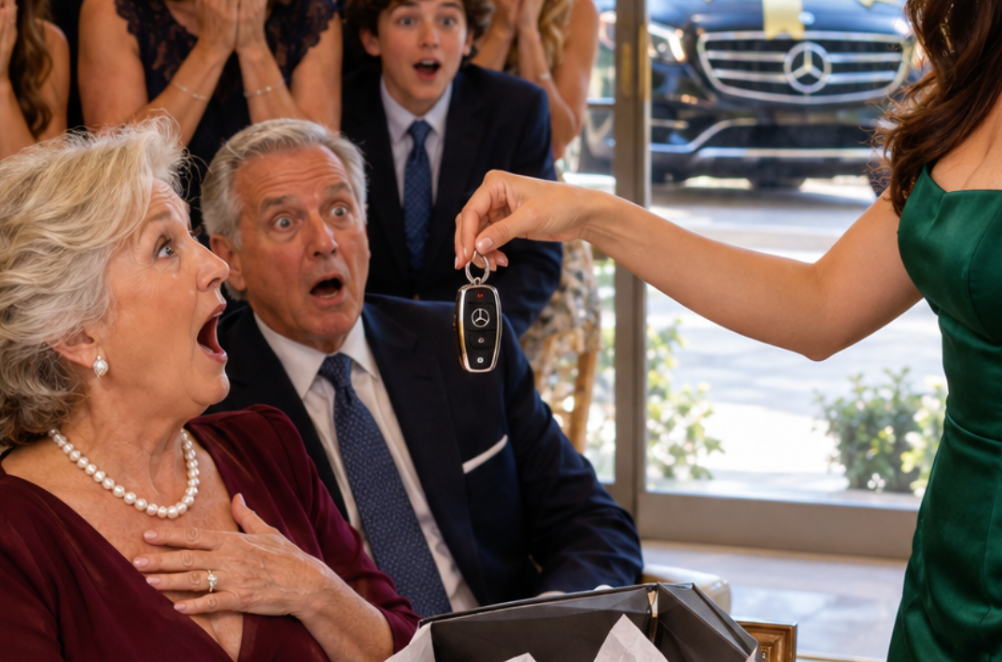
I unwrapped the paper, and the keys jingled for the whole room to hear.
“These are car keys. To a white Granta, parked right under that window. Up until a minute ago, it was yours.”
My mother-in-law turned to the window, then to her son.
“Igor, is this true?”
“Mom, it’s for you. We wanted it to be a surprise.”
“Then hand it over!” She reached across the plates. “My son bought me this! His money!”
“His share is 170,000 out of the 690,000. I’ll return it to him today. The rest is mine, and the car documents are in my last name.”
“Albina, have you lost your mind?” Regina shouted. “It’s Mom’s birthday!”
“Regina, your share never arrived. Now’s the perfect time: buy the car for Mom together.”
“Al, not in front of everyone,” Igor said, getting up. “Let’s talk at home. Give it back.”
“For three years you’ve all weighed in on me in front of everyone. So let’s finish it in front of everyone, too.”
My mother-in-law sank heavily into her chair. Her face looked confused—and very old.
“I didn’t know! Who gives gifts like that? You’re not supposed to take back a gift!”
“You never accepted it. You gave it away without looking.”
I dropped the keys into my bag, next to the contract, and made my way to the exit.
It was windy outside. I sat in the Granta, adjusted the seat, and started the engine. The car smelled like someone else’s air freshener, and the red ribbon we never managed to tie was still lying in the trunk.
About ten people stared at me from the café window. Igor didn’t come outside.
When I got home, I sent Igor his share and put my phone face down. There was no joy—just emptiness, like the salon after my last client leaves. Only one question kept turning in my mind: What if she really didn’t know?
My husband didn’t come home that night.
***
Three weeks went by.
That same evening, I was removed from the ‘Mom’s Birthday’ chat. Antonina Borisovna now tells the whole family that her daughter-in-law robbed a pensioner on her birthday, and half of Syzran feels sorry for her. Regina sent me one message: “You’re not family anymore.” She still hasn’t found her part of the money for the car for Mom.
At least Zoya Ilyinichna sent my blanket back through Igor. Freshly washed, neatly folded in quarters.
Igor came back on the third day. He accepted the money transfer but didn’t say thanks. We talked about bread, utilities, the weather—but we kept silent about his mother. Eventually, he couldn’t hold it in anymore.
“You didn’t punish her,” he said. “You punished me. Now, every Saturday, I’m stuck in the middle between the two of you.”
Every Saturday, he drives her to the dacha himself in the Duster, coming home silent late at night. He doesn’t twirl the keychain anymore. I don’t go to that house, and for the first time since our wedding, I won’t be giving a New Year’s gift.
Meanwhile, I work on Saturdays. Three heads, my eleven thousand rubles, and I pull up to the salon in the white Granta—the same one I’d been eyeing since June and almost gave away.
I keep the keys in my coat pocket. Sometimes, I take them out and let them sway in my palm, just like she used to. They weigh barely a hundred grams.
Saturdays belong to me now, and the car is truly mine. My husband drives to his mother alone and stays silent for longer and longer. Tell me honestly: was that one minute at the anniversary really worth the cost?