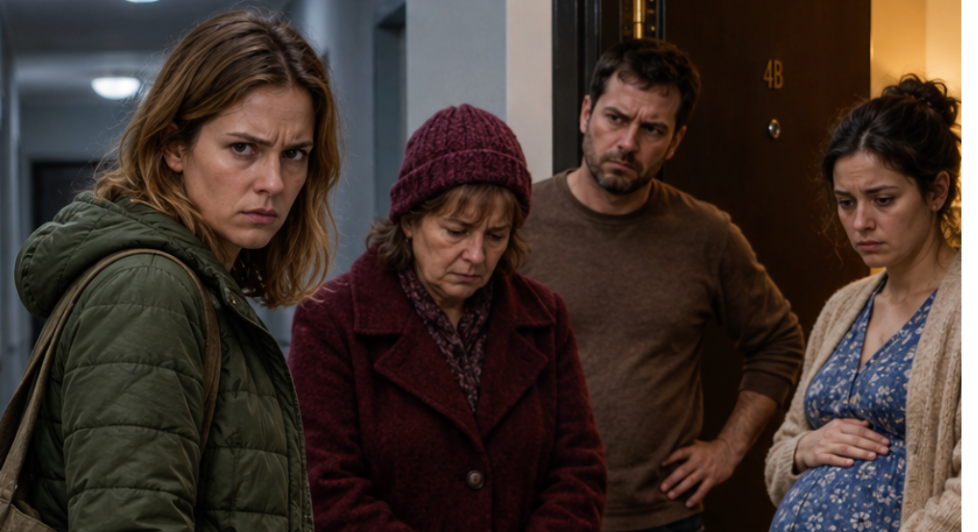
“Let me in, Oksana. I’ve left them.”
My mother-in-law was standing on the doormat at my door with a rolling suitcase and a plastic carrier, inside which the cat was complaining softly. Her coat was buttoned incorrectly, and on her head was the burgundy beret Dasha once knitted in home ec and gave to her grandmother for New Year’s.
“Valentina Egorovna, it’s almost ten. What happened?”
“Nothing happened. Stasik is downstairs, in the car. He brought me but didn’t come up.”
Three weeks ago, my husband packed two sports bags and left for Zhanna, the administrator from the car dealership where he used to work as a service advisor. He told me honestly, didn’t lie, even finished his tea. Twenty-three years of marriage packed into one night and two bags. Since then, we haven’t had a conversation longer than a minute.
“Come in to the kitchen,” I said, taking her carrier. “The kettle’s hot. But you’re not spending the night here until I talk to him. You can’t just show up without calling this late.”
My mother-in-law didn’t say a word. She nodded and started unbuttoning her coat, struggling with that button that was out of place.
I went outside just as I was, in my house pants, throwing a jacket over my shoulders. In the yard under the street lamp stood a grey Logan with its hazard lights blinking.
Stas opened the passenger door from inside without getting out. The cabin smelled of a strange vanilla air freshener, and a plush dog was dangling from the mirror. There never used to be anything there—he used to hate having something swinging in front of his eyes.
“Get in. People in the yard can hear us.”
“Let them hear. Why did you bring your mother over?”
“Oksana, please get in, okay? Just give me one minute.”
I sat down. He wasn’t looking at me, but at the steering wheel, as if there was something written there in tiny letters.
“It’s a bit cramped for us right now. Zhanna’s landlord is selling her apartment and asked us to move out by the end of the month. While we look for a new place, we’re staying with my mom. But Zhanna’s five months pregnant, and the smell of cats makes her sick—doctor said absolutely no cats. It was Mom who suggested staying with you.”
“She suggested it herself. With a suitcase. At almost ten at night.”
“To you,” he finally turned to me. “Who else? You’ve been her daughter-in-law for twenty-three years.”
“I was. You ended that three weeks ago, along with the tea.”
He rubbed the bridge of his nose, like he always did when he didn’t know what to say. I remembered that gesture from our first date, at the café on Susaninskaya Square, where he spilled compote on me and spent the whole evening rubbing his nose and apologizing.
“Then go live together with your mom. The apartment is hers, not yours.”
“They’ll eat each other alive! Mom spends all day telling Zhanna how to sit and what to eat. Zhanna ends up crying in the bathroom. I’m stuck between them, feeling like an idiot.”
“So I wouldn’t eat her alive, is that it?”
“You’re not like that.”
He said it like it was a compliment. Then his voice turned harsher.
“Let’s be honest. The apartment on Profsoyuznaya belongs to both of us. I’ve paid the mortgage for twelve years, just like you. I have the right for my mother to stay there.”
“You have the right to file for divorce and to split the apartment. But not to drop your mother off with me like she’s a box of winter tires.”
He twitched his cheek but kept silent.
“Did you tell Dasha? That you’re leaving her grandma with me like some left luggage?”
“I’ll tell Dasha myself. Stay out of it.”
“I’m not interfering. You’re the one involving me—showing up with a suitcase and a cat.”
“One week,” I said. “Until next Saturday. After that, you pick her up yourself, and I don’t care who eats whom.”
“We’ll see,” he grumbled, turning off the hazard lights.
I walked up to the fourth floor, even though the elevator worked. I just wanted one more minute alone.
My mother-in-law was already sitting at the kitchen table. A bowl was under the radiator, and the cat itself—ginger and as plump as a couch cushion—was sniffing my slippers. On the table, on top of a folded waffle towel, was an old electric waffle maker with a chipped black handle.
“I took this from them,” my mother-in-law stroked the lid. “Zhanna said it was junk. But I used to bake wafer rolls for Stas on this, back when he was in kindergarten. I didn’t take anything else. Just Timofey and this.”
The cat’s name was Timofey. For nine years we called him Timosha and never kept him for more than a weekend.
“One week, Valentina Yegorovna. Stas will pick you up on Saturday.”
“Of course, Ksyusha. Of course—a week.”
She hadn’t called me Ksyusha in about fifteen years.
I made a bed for her in Dasha’s room, on a narrow fold-out sofa under a poster of some Korean band that my daughter never took down before moving out for college. My mother-in-law spent a long time smoothing the sheet with her palm, as if checking for wrinkles.
And in the hallway, her coat was already hanging on my rack. On the same hook where, just three weeks ago, Stas’s jacket hung.
============================
On Saturday, Stas didn’t show up. He replied to my three messages with just one word: “Busy.” On Sunday, I crossed the Volga myself.
I never had a key to my mother-in-law’s apartment, nor did I ever ask for one. I rang the bell, like a stranger.
Zhanna opened the door. She was short, round-faced, about twelve years younger than me, wearing a man’s plaid shirt pulled down over her belly. That shirt—I bought it for Stas for his fiftieth birthday: blue with green checks and a classic collar.
“You’re Oksana,” Zhanna stated, not asked. “Come in. Stas is in the shower.”
“I’ll just wait here on the doorstep.”
From the hallway I could see a small room. Where my mother-in-law had her bed and sewing machine, there was now plastic covering the floor and a flat box against the wall with a picture of a child’s bed on it. The smell of fresh paint hung in the air. The crystal cabinet had been moved out onto the glassed-in balcony and covered with an old bedsheet.
“I know how this looks,” Zhanna noticed where I was staring. “But I didn’t make her leave. She packed up herself. She said, ‘I won’t get in your way.’”
“And did you tell her to stay?”
Zhanna paused, resting her palm on her belly, as if checking that it was still there.
“I said: as you wish.”
Honestly, for some reason that made me feel worse than if she had just lied.
Stas came into the hallway with a towel around his neck, saw me and stopped.
“It’s been a week,” I said. “Time to take your mom home.”
“Where? Here? You can see what’s going on.”
“I do. You’re painting the nursery in her room. Is this what you call ‘looking for an apartment’?”
“It’s only temporary. Zhanna needs a place to sleep, her back hurts. And your place is better for mom anyway, you know that. It’s warm, there are pies, and an elevator.”
Zhanna slipped off to the kitchen and quietly closed the door behind her. Stas lowered his voice and suddenly stopped looking at me, staring instead at the sheet-covered cabinet.
“Ksyusha. I’m fifty-one. I thought that was it, no more kids. I missed out on Dasha: work, long shifts, I’d get home—she’d be asleep, I’d leave—she’d still be asleep. She grew up, and I hardly noticed. Give me one chance to do it right.”
His voice cracked on that last word. Not from anger. In twenty-three years, I’d heard him angry, cheerful, drunk at his godson’s wedding. But never this—never scared.
“One month,” I said. “Until the end of the month. And ten thousand for Mom—food and medicine—by the fifteenth, send it to my card.”
“I’ll transfer it. Promise.”
He paused, then added softly, almost to the floor:
“Thank you.”
***
My mother-in-law was up at six, always before me. By the time I was awake, oatmeal was ready on the stove, and Timofey was already fed, curled up on the windowsill like a ginger heating pad.
During the day I worked at the pastry shop in the “Vatrushka” café, and in the evenings I accepted private cake orders at home. My mother-in-law used to call my cakes “chemistry” and only tasted a spoonful out of politeness. Now, she’d sit next to me on a stool, watching as I smoothed the cream across the cake layers.
“So straight, like with a ruler,” she once commented. “I always did everything by feel.”
Midweek, a client called: a kids’ party, fifteen children, the cake was already ordered, but she wanted “something homemade, not store-bought.” My mother-in-law overheard, disappeared into her room, and returned with her waffle iron.
We baked until midnight. She poured the batter, counting to forty in her head, and opened the lid the moment the edges turned golden. I rolled the hot wafers around a wooden stick, burning my fingers. The cream filling was her recipe: boiled condensed milk with a spoonful of butter and a pinch of salt.
“Little Stasik used to sneak all the cream from the bowl,” my mother-in-law smiled as she looked at the pastries. “I’d tell him, ‘At least leave some for one pastry.’ And he’d say, ‘Mom, this is my last one.'”
The client later sent a voice message: the kids devoured the pastries before they even touched the cake.
The fifteenth came and went. No payment arrived. I called Stas—he answered quickly, saying his salary was delayed until next week. On Friday, I found five thousand rubles, folded into quarters, underneath the sugar bowl.
“That’s from my pension,” my mother-in-law said, eyes still down. “I eat at your place, after all.”
“Put it back. That’s not your responsibility—it’s his.”
“It’s not his duty, Ksyusha. He’s going to have a child.”
“And he already has you.”
She fell silent, and the money stayed under the sugar bowl. I texted Stas, “The fifteenth passed. I’ll wait until Monday.” He read my message, but didn’t reply.
On Sunday evening, while picking up her coat that had slipped from the hook, a folded paper fell out of her pocket. It was a document from a notary office on Sovetskaya Street. Appointment scheduled for Thursday at 11:30. Below, in the ‘Action’ field, handwritten: ‘Apartment gift contract. Both parties present. Bring passports and property documents.’
============================
I placed the paper on the table next to her plate. Monday morning, as the oatmeal was still steaming.
My mother-in-law put on her glasses, looked at it, then took them off and carefully put them back in the case, as if that might change something.
“Stasik just wants things to be official. It’s nothing, Ksyusha.”
“A gift contract is nothing?”
“You’re jumping to conclusions,” she reached for the kettle even though her cup was already full.
Suddenly, her old button phone rang loudly on the windowsill—the volume is always at max—and Stas’s voice filled the kitchen before she even brought it to her ear.
“Mom, hi, I have just a minute. Thursday at eleven thirty, remember? Don’t forget the passport and documents, they’re in the china cabinet, blue folder. I’ll pick you up myself. Don’t tell Oksana anything. After the notary, you’ll stay with her, she won’t kick you out, she’s kind. We’ll finish the nursery in your old room by spring.”
She hung up. The kitchen was so quiet you could hear Timofey crunching his food by the radiator.
“This was my decision,” she finally said. “Not his. Mine.”
“You’ve decided to give your apartment to your son and live with me.”
“Why not? They have a baby on the way. They need a room, a place for the stroller, the drying rack. And what do I need? A corner and the cat. The apartment will go to him anyway, so better now, while I’m alive and can see that he’s comfortable.”
“And where will you live? In a year? In five years?”
“With you,” she looked up, and her eyes were free of any cunning or shame. “You won’t throw me out, will you?”
I sat down across from her. There was so much I wanted to say, but only single sentences came out.
“Valentina Yegorovna. He’s your son, not mine. I treat you well, honestly. But you’re giving him your apartment, and I’ll be the one to care for you. In the apartment he also plans to split up.”
“He won’t split it. He promised.”
“He promised ten thousand by the fifteenth, too.”
My mother-in-law pushed her plate away. She stood up, grabbed a rag from the windowsill and started wiping the already spotless table.
“You count everything, Oksana. The thousands, the square meters, the dates. But I don’t count my son.”
She went into Dasha’s room and closed the door behind her. She had never closed it before.
***
I couldn’t sleep last night. As usual, Timofey made himself comfortable on my legs—warm and heavy—so I just lay there, trying not to move.
Around three in the morning, I wandered into the kitchen. On the shelf between the flour jars was the waffle maker, scrubbed until it sparkled. I stared at it and thought: maybe I should just let things be. My daughter is studying in Yaroslavl, she only needs her room twice a year—during holidays. My mother-in-law is quiet, up at six, baking treats that get her voice messages from happy customers. The cat is already asleep at my feet. Do I really mind so much?
But then I started thinking about the other side. If I let her stay, it’ll be forever. Stas could file for property division in a month or a year, and then I’d have to sell the apartment or buy his half. And then what? Where would my mother-in-law go? To her son, where her old room will become a nursery? Or squeeze into the one-bedroom I’ll scrape together from my share?
By morning, I couldn’t take it anymore and called Dasha. She listened quietly, not interrupting, and then said exactly what I was afraid of.
“Mom, what are you talking about? Kick Grandma out? She’s seventy-four. Let her stay—I’ll come home in the summer and help out.”
“In the summer, sure. But what about winter? Or in six years, when she’ll be eighty?”
“You’re just like Dad now,” my daughter said softly. “Always thinking about square meters.”
I sat there for a long time with the phone in my hand. Maybe Dasha is right. Maybe I really am just counting square meters when I should be opening the door. My mother-in-law coughed behind the wall, and I almost went to tell her: stay, it’s fine, whatever.
I didn’t, though. Instead, I opened my chat with Stas and started typing, erasing, and retyping my message:
“On Wednesday at six in the evening, I’ll bring your mother home. It’s her apartment, she’s registered there, she has every right to live there. If she decides on Thursday to give you the apartment, then she’ll live with you. But she’s not going to live with me.”
He called me a minute later.
“What are you doing?” he yelled so loudly I had to hold the phone away from my ear. “We’re still renovating—there’s paint everywhere! Zhanna can’t handle stress! Are you throwing an old lady out into the street?!”
“Not the street. Home.”
“Then I’ll file for division. You hear me? Let’s see how you sing when you have to hunt for your share in corners somewhere.”
“Go ahead.”
I hung up and put the phone face down next to the sugar bowl, under which her five thousand was still tucked away.
On Wednesday, I got back from work at five. The suitcase was already waiting in the hallway—zipped up, with her burgundy beret on top. My mother-in-law had packed it herself while I was out.
She didn’t put the waffle maker in the suitcase.
============================
We drove in silence. My mother-in-law sat beside me, holding the carrier on her lap and staring out the window at the Volga—gray and lightly rippling. On the bridge, she finally said just one thing:
“You’re probably right. But that doesn’t make it any easier for me.”
I didn’t answer. It wasn’t any easier for me either.
There was no elevator in her building. I carried the suitcase up to the third floor by myself, pausing to rest on every landing. My mother-in-law followed behind with the carrier, holding onto the railing. At the door, she pulled out her keychain—with that little plastic fir tree—and unlocked the door. The lock hadn’t been changed. For some reason, that was the thing I’d been most afraid of.
The hallway smelled of paint and fried onions. Zhanna came out of the kitchen, saw us, and froze mid-step with a ladle still in her hand.
“Valentina Yegorovna? Stas said you’d be gone until spring.”
She didn’t get to finish. Stas came out of the room in a gray T-shirt, blocking the way.
– Are you serious? I asked you nicely, like a normal person.
– You promised ten thousand by the end of the month, that’s what you said, she replied, setting her suitcase by the coat rack. – Your mother is home. This is her apartment, she’s the one in charge here. She was my guest—but she won’t be staying over anymore.
– The notary is tomorrow! You planned this on purpose!
– On purpose. Tomorrow your mother will make her own decision. But at least now she’ll know where she’ll be living afterward.
Zhanna stared at the carrier. Timofey, inside, sensed the familiar house and started scratching at the bars.
– Just not the cat, – she said quietly. – Please. I really can’t.
My mother-in-law stood there, looked at her, then at her son, and then at me. After a moment, she handed the carrier back to me.
– Take Timosha. Let him stay with you. He’ll be more peaceful there.
She took off her beret, hung it on her old hook, and went into the small room where a box with a baby crib stood on a plastic sheet. She sat down on a stool in the midst of the fresh paint, her back to the door.
Stas caught up with me on the stairs, at the window between the second and third floors.
– I’m filing for property division on Monday, – he said, no longer shouting, just tired. – Is that what you wanted?
– I wanted you to take your mother. You didn’t. So I had to.
He stood there for a moment, as if wanting to say something else, then turned around and climbed back upstairs, slowly gripping the railing like an old man.
***
On Thursday at eleven thirty I was standing in the workshop over a wedding cake, piping roses on the third tier with cream. After every rose, I glanced at the clock above the door. At eleven forty I messed up a petal and had to scrape off the whole rose with a spatula and redo it.
That evening, Stas sent a message. No greeting, no signature:
“Mom didn’t go to the notary. Happy now? Zhanna is crying, and we are looking for a place to rent in Davydovskoe.”
I reread it about five times. My mother-in-law kept her apartment, no gift deed, Stas and Zhanna were moving out. I guess I was supposed to be glad. But I wasn’t.
My mother-in-law wouldn’t pick up the phone. On Sunday, she finally answered, and her voice was steady, unfamiliar, like a train station dispatcher.
– Don’t call for now, Oksana. I need time to adjust.
She didn’t call me Ksyusha anymore.
Dasha didn’t call for a week. Then she sent a message: “You dropped grandma off like a suitcase. I don’t know how to talk to you right now.” I wrote a long reply and deleted it. I wrote a short reply and deleted that too.
On Monday the mailman brought a registered letter. A copy of the lawsuit for division of jointly acquired property. The apartment on Profsoyuznaya, half to each of us. The garage, which I’d totally forgotten about, was listed separately. He signed it neatly, with his full name, just like he used to sign Dasha’s school diary.
Timofey has adjusted. He sleeps on the windowsill where my mother-in-law used to keep her glasses in a case. He waits by the stove for oatmeal that I still can’t cook the way she used to.
The waffle maker is on the shelf between the flour jars. Last week I tried baking rolled wafers on it. I counted to forty, just the way she did. The edges burned, the center stayed raw. I tossed the whole batch out and stood over the trash can for a long time, holding the empty bowl.
I still don’t know if she actually forgot the waffle maker or left it on purpose. And I’m honestly not sure who I was protecting that day, when I drove her across the bridge: was I shielding her from her own son, or was I protecting myself from her?
Tell me honestly, if you were in my shoes: would you let your mother-in-law stay with you, knowing she decided to give her apartment to her son and spend her last years with her former daughter-in-law? Or would you do what I did, and take her back home the day before the notary appointment?