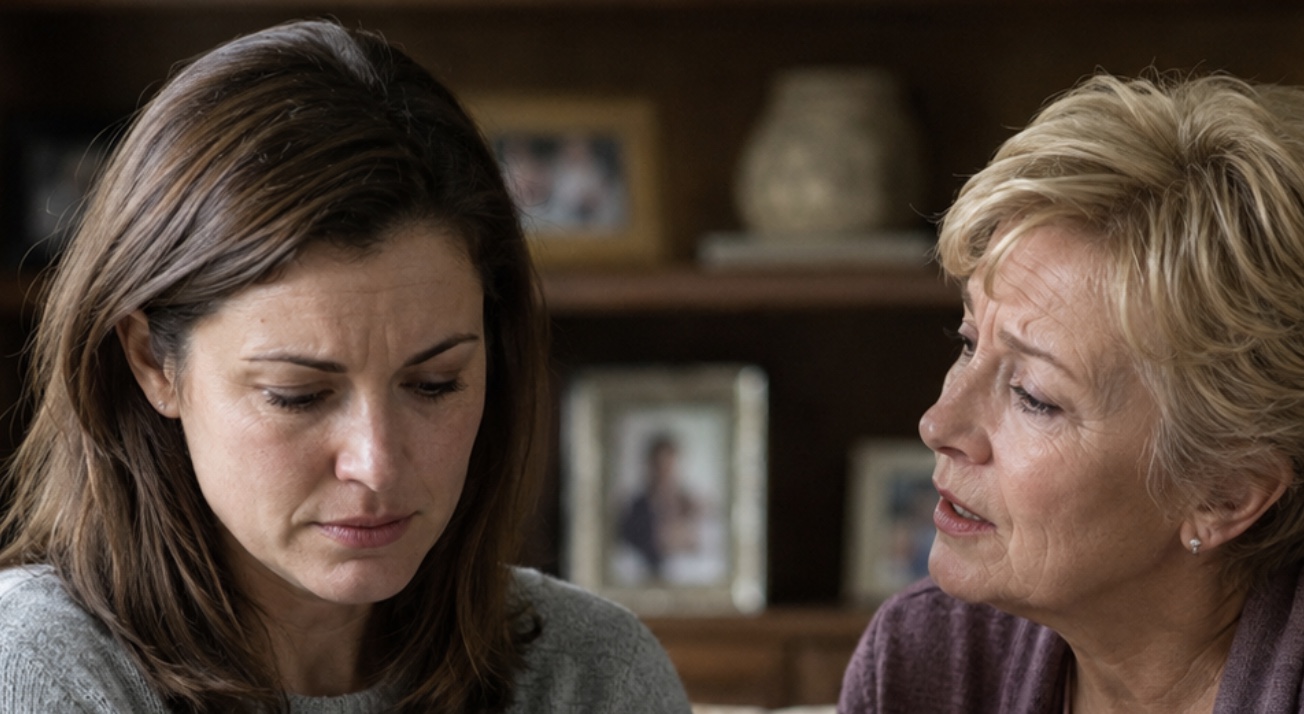
“Did Sveta really leave you with nothing?” Vera Andreyevna asked, looking around the kitchen in confusion.
“Why would she?” Maksim replied gloomily, without lifting his eyes from the calculator. “She left and said she didn’t owe anyone anything anymore.”
His mother opened her mouth to object, ready with one of her usual comments about selfish young wives, but the words never came.
She opened the refrigerator. It was almost empty.
On the table, beside a pile of receipts, lay an unpaid rent bill. Maksim had already told her there were still ten days left until payday.
Vera Andreyevna turned toward the shelf and noticed a box of medicine.
She recognized it immediately.
 
For the first time, she wondered how those pills had always appeared exactly when she needed them. For years, she had never asked. They were simply there.
Svetlana had bought them.
Just as Svetlana had paid the utilities.
Just as she had covered nearly every unexpected expense that came up.
Vera Andreyevna slowly lowered herself into a chair.
Her son had not simply lost his wife.
The woman who had quietly supported their entire comfortable way of life was gone.
Svetlana was thirty-five when she finally gave herself permission to leave.
But that came much later.
In the beginning, everything had looked completely different.
 
She and Maksim met during evening professional-development classes. Not at work, not through mutual friends, but in a small classroom with uncomfortable chairs and a whiteboard covered in marker stains.
Back then, Maksim seemed energetic, ambitious, alive.
He brought her coffee before class, made her laugh during breaks, and took her heavy bag from her whenever they met at the entrance.
He talked constantly about his plans to start a business of his own, his eyes bright with enthusiasm, his hands moving as he described all the things he was going to achieve.
One evening after class, he asked her:
“Do you really think I can make it?”
“With you, I do,” she answered.
The words surprised even her.
At the time, Svetlana truly believed they were walking toward the same future.
Maksim’s mother, Vera Andreyevna, greeted her with considerably less warmth.
At their first family dinner, she questioned Svetlana thoroughly and systematically.
 
Where did she work?
How much did she earn?
Did she own an apartment?
What did her parents do?
Was she planning to continue working after marriage?
Svetlana answered politely, though even then she understood that Vera Andreyevna was not trying to get to know her.
She was evaluating her.
After the wedding, Svetlana and Maksim rented a modest apartment on the outskirts of the city.
The first years of their marriage were genuinely happy.
They chose furniture together, took turns cooking, saved money, and dreamed about someday making a down payment on a home of their own.
Every Saturday, Vera Andreyevna arrived carrying containers of food, and almost every visit included some variation of the same remark.
“Maksim must remember that the man is the head of the household.”
Svetlana usually said nothing.
She had always been good at keeping quiet.
Things began to change during the fourth year of their marriage, when Svetlana was promoted to department manager.
Maksim congratulated her, and at the time she believed his happiness was sincere.
Gradually, however, her success stopped being something he admired and became something he relied on.
“Why should I look for another job?” he said one evening when she gently suggested that he might consider better opportunities. “You’re earning good money.”
She blamed his attitude on exhaustion.
 
Then she blamed it on his personality.
Eventually, she stopped bringing the subject up at all.
Without either of them officially agreeing to it, a financial system formed.
Svetlana’s salary belonged to the household.
Maksim’s salary belonged to Maksim.
He bought new phones whenever he wanted and spent evenings at restaurants with friends.
She paid the rent, groceries, insurance, vacations, and household expenses.
Then one day, while looking through a bank statement, she noticed a large purchase made on their shared credit card.
An expensive coffee machine.
For Vera Andreyevna.
When Svetlana cautiously asked Maksim about it, he immediately became defensive.
“She’s my mother,” he snapped. “I’ll decide how I help her.”
Svetlana said nothing.
But something inside her quietly recorded that moment, as precisely as another entry in a spreadsheet.
The turning point did not come during some dramatic argument.
It happened on an entirely ordinary evening.
Svetlana came home around ten.
She had spent the day dealing with reports, meetings, traffic, and deadlines. On the way home, she had also stopped for groceries and carried several heavy bags upstairs.
She put the groceries away, hung up damp laundry, opened the banking app, and paid the utilities.
Then she straightened and looked across the room.
 
Maksim was stretched out on the sofa, staring at his phone.
He did not even look up.
“Sveta, make me some tea, will you? And maybe something to eat?”
She stared at him for several seconds.
Then she silently filled the kettle.
It was not her job that had exhausted her.
She was tired of being the only adult in a household occupied by two adults.
The following week, she finally tried to talk to him.
She printed out a detailed list of expenses and placed it on the table.
Rent.
Groceries.
 
Utilities.
Household costs.
Vacations.
The car.
Financial help for his mother.
Maksim glanced at the pages and smirked.
“What are you now, the accountant of our marriage?”
“I want things to be fair,” Svetlana replied calmly.
“It’s perfectly logical that whoever earns more contributes more,” he said. “There’s nothing unusual about that.”
She did not argue.
She simply gathered the papers and put them away.
Inside her, something finally settled into place.
It was not anger.
It was clarity.
A few weeks later, Maksim asked her to pay for repairs to his car.
She refused.
That same evening, Vera Andreyevna called.
“Svetochka, is it really so difficult to help your husband?” her mother-in-law asked in a smooth, almost affectionate voice. “You’re earning very well these days.”
Svetlana immediately understood.
Maksim had already told his mother his version of the situation.
In that version, Svetlana had become the problem.
 
She was selfish.
Greedy.
Difficult.
“I’ll think about it,” Svetlana said.
And she did.
Only not about the car.
Svetlana did not create a scandal.
She had never liked unnecessary drama.
She simply began preparing.
She gathered important documents, separated her personal finances, and found a small apartment closer to her office.
Maksim refused to believe she was serious until the very end.
“Where exactly do you think you’re going?” he asked when she finally said the word divorce. “You’re used to living comfortably.”
Svetlana looked at him.
“I finally realized that I’m the one who created that comfortable life.”
Vera Andreyevna called the next day.
“Svetochka, marriages go through difficult periods. But leaving a family because of money is wrong.”
“It isn’t about money,” Svetlana answered evenly. “It’s about the fact that everyone here treated me like a wallet instead of a person.”
Her mother-in-law went silent.
Then she ended the call.
Svetlana’s new apartment was bright and quiet.
She arranged her clothes in the wardrobes and filled the refrigerator with food she actually liked.
On the windowsill, she placed a small pot of basil.
That evening, she sat alone and listened to the silence.
At first, it felt unfamiliar.
 
But it did not feel lonely.
It felt peaceful.
Within a few weeks, Maksim began having problems.
He could no longer afford frequent food deliveries.
He dipped into what little savings he had.
Then the rent payment was late.
Vera Andreyevna’s birthday came, and for the first time in years, there was no expensive present waiting for her.
That was when she truly looked at her son.
Not at the successful man she had always imagined him to be.
Not at the “head of the household” she had proudly defended.
She saw a grown man who had never learned how to support himself.
And once again she remembered the box of medicine on the shelf.
The medicine Svetlana had always bought.
The folder was old, its edges worn from years of handling.
Vera Andreyevna found it on a high storage shelf after Maksim asked her, once again, to help him cover the rent.
“Wait,” she said suddenly, stopping him in the middle of his explanation. “Where is your salary?”
“Mom, things just happened. I had expenses…”
“What expenses?”
Her voice was calm now.
 
Almost cold.
Maksim began talking about a friend, several restaurant bills, and some old debt he had apparently needed to repay.
Vera Andreyevna listened while opening the folder.
Inside were printed statements, receipts, and pages of carefully organized figures in Svetlana’s handwriting.
Rent.
Food.
Utilities.
Insurance.
Medication.
Repairs.
Year after year.
She turned another page.
Then another.
 
The expensive coffee machine Maksim had given her for her anniversary had been purchased during a month when Svetlana had covered three major household payments.
The fur coat she had received for her sixtieth birthday?
The same story.
Vera Andreyevna closed the folder.
For a long moment, she said nothing.
Then she looked at her son.
“Do you even understand,” she said quietly, “that she was supporting you this entire time?”
“Mom, she wanted to—”
“Be quiet.”
Her voice suddenly sharpened.
“Just be quiet.”
Maksim fell silent.
Vera Andreyevna left the folder on the table and stepped onto the balcony.
Outside, evening was settling over the city.
She thought about Svetlana.
About the way she used to smile politely at family dinners.
About how she had calmly endured Vera Andreyevna’s endless questions.
About how she had never complained.
 
And for the first time, Vera Andreyevna wondered whether Svetlana’s silence had actually been saying more than any argument ever could.
The divorce itself was quiet.
There were no scenes in courthouse hallways.
No shouting.
No theatrical accusations.
Svetlana signed the documents, walked outside, and breathed deeply in the cold air.
Her new apartment was small, but it belonged to her.
She had bought it using her savings and a mortgage taken entirely in her own name.
There was one bright main room, a window overlooking a courtyard filled with linden trees, and old parquet flooring that creaked beneath her feet.
On her first Saturday there, she cooked buckwheat, fried an egg, and placed the simple meal on the table.
Then she sat down.
 
She looked at the ordinary plate in front of her and suddenly realized something.
Nobody wanted anything from her.
Nobody was asking her to make tea.
Nobody was criticizing the meal.
Nobody was hinting about bills or reminding her that someone else needed financial help.
She simply ate.
And for reasons she could barely explain, it felt wonderful.
Vera Andreyevna occasionally sent her messages.
They were short and cautious.
Svetlana always replied politely, but never encouraged longer conversations.
Maksim called three times.
During the first call, he promised to find a better job and suggested couples therapy.
 
During the second, he insisted that he had changed.
The third time, he said only:
“I finally understand that I need you.”
Svetlana was quiet for a second.
“No,” she replied calmly. “You understand that you need the life I provided for you. That isn’t the same thing.”
He tried to argue.
But the words would not come.
For perhaps the first time in his life, Maksim had nothing to say.
Svetlana never went back.
Not because she wanted revenge.
Not because she was still angry.
She simply understood that trust was not like money in a bank account.
You could not restore everything that had been spent with a single phone call.