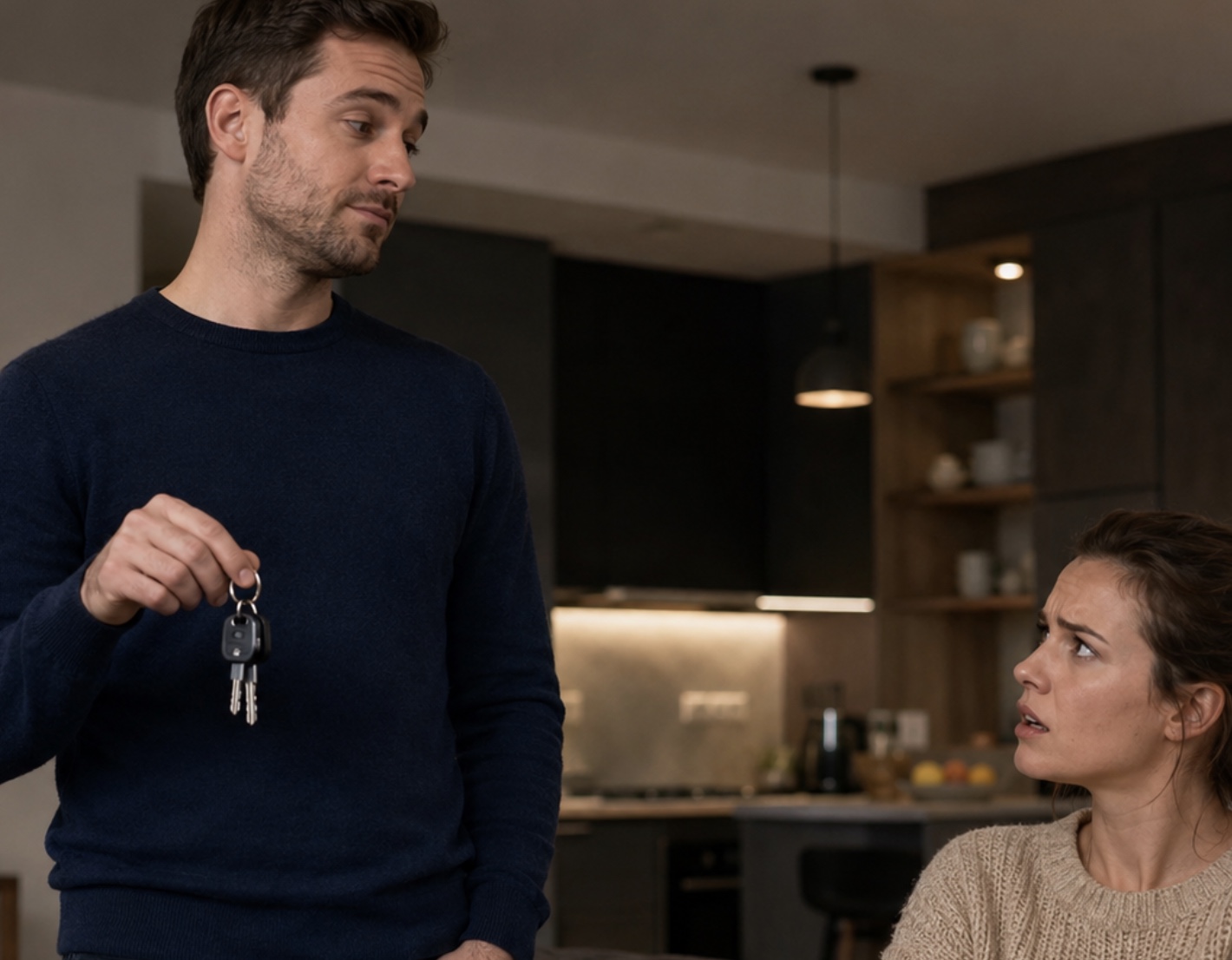
Kristina slowly set her spoon down on the table. The porcelain made a soft clink against the saucer.
“What do you mean… you gave them to her?”
“Well, why do you need such an expensive SUV?” her husband replied. “Mom has needed a decent car for a long time.”
Tamara Nikolaevna, sitting across from them, smiled with obvious satisfaction and adjusted the collar of her cardigan.
“Don’t worry, sweetheart. You’ll earn enough for another one. You’re young and healthy.”
Kristina slowly lifted her eyes, first to her husband and then to her mother-in-law. Not a single muscle moved in her face.
 
Without saying anything, she picked up her cup and took a sip.
Neither her husband nor his mother had any idea that the original documents for the vehicle were already somewhere they would never find them.
Kristina had bought the SUV three years before she had even met Artyom.
At the time, she had just opened her second beauty salon and, for the first time in her life, allowed herself to make a truly expensive purchase. She visited several dealerships, carefully compared different packages, and personally chose the color—a deep graphite shade with a metallic sheen.
She had saved for nearly a year. She arranged the insurance herself, studied reviews, compared maintenance costs, and thought through every detail before finally signing the papers.
To Kristina, the car was far more than transportation.
It was proof of what she had built with her own hands.
Artyom entered her life later.
He was charming, easygoing, sociable, and worked as a sales manager. After they married, he moved into Kristina’s spacious apartment overlooking a park, a home she had furnished carefully and paid for long before their relationship began.
Tamara Nikolaevna visited often.
From her very first visit, she inspected Kristina’s home with the expression of someone evaluating property that might eventually belong to her.
“You’ve done well for yourself,” she once remarked, running a finger along a shelf. “Though I don’t see why one woman needs so many expensive things.”
Kristina smiled politely and changed the subject.
When Tamara Nikolaevna’s old car began breaking down repeatedly, conversations around the dinner table gradually took on a different tone.
“Why don’t you give me your car?” her mother-in-law suggested one evening while spreading butter on a piece of bread. “You can always buy yourself another one later. It’s not as if you’ll go broke.”
“We’ll think about it,” Kristina answered politely.
But she had no intention of thinking about it.
The SUV had been purchased before the marriage, entirely with her own money.
 
As far as Kristina was concerned, that settled the matter.
Soon, however, the requests became pressure.
Artyom began siding openly with his mother.
“Mom is having a hard time,” he told Kristina one evening when they were alone. “She has heart problems. She shouldn’t be getting stressed every time her car breaks down.”
“Your office is five minutes away,” he continued. “You hardly even need a car.”
“We’re family, Kristina. Family members help each other.”
“I’m willing to help,” she answered calmly each time. “But I’m not giving away my car.”
Artyom would fall silent.
But never for long.
Then Kristina began noticing strange things.
One day, Artyom casually asked her for the second set of keys, claiming it would be useful to have them in case she ever needed his help.
Another time, she caught him photographing the vehicle documents.
He had also started asking questions about powers of attorney—how they were issued, what rights they granted, and whether a general power of attorney could be arranged.
Kristina dismissed it as curiosity.
That was a mistake.
A week before Tamara Nikolaevna’s birthday, Kristina went to the service center to collect the SUV after routine maintenance.
She walked through the glass entrance doors while reaching for her phone, intending to call the mechanic.
Then she stopped.
Artyom and his mother were standing near the reception desk.
Neither of them had noticed her.
Tamara Nikolaevna was speaking animatedly to a young technician, occasionally touching the sleeve of his uniform as though they were already old friends.
“Soon that beauty will be mine,” she announced proudly, nodding toward the glass-walled service bay where Kristina’s graphite SUV was parked.
 
Artyom laughed and slapped him lightly on the shoulder.
“All that’s left is to tell my wife once everything’s settled,” he said. “The decision has already been made.”
Kristina was standing less than ten feet away.
She said nothing.
She quietly turned around and walked back outside.
She took a taxi home and sat in the kitchen for a long time, staring through the window.
She wasn’t heartbroken.
What she felt was colder than that.
It was clarity.
That evening, Artyom came home late.
His laptop was still open on the table. Kristina had no intention of looking through it, but the screen had not gone dark, and a few lines from an open conversation caught her eye.
Artyom and his mother had been discussing a plan.
After the upcoming family dinner, Artyom intended to take the original car documents from the safe while Kristina was visiting a friend. He had even volunteered to drive her there himself.
While she was away, a notary he had already spoken to was supposedly going to help prepare a general power of attorney using copies of the documents Artyom had photographed earlier.
“I’ve already chosen the license plate numbers,” Tamara Nikolaevna had written. “Nice ones, with sevens.”
“We’ll get it done,” Artyom replied.
Kristina closed the laptop.
Carefully.
Without a single unnecessary movement.
 
Her husband had already made the decision.
Without asking her.
As though her opinion did not matter at all.
Chapter 3
The next morning, Kristina called a lawyer before either of her salons had opened for the day.
They met in a small office that smelled faintly of paper and coffee.
The consultation lasted less than an hour.
The lawyer was precise, practical, and direct.
That afternoon, while Artyom was at work, Kristina returned home.
She opened the safe and removed every original document connected to the SUV.
She placed them neatly inside a folder, drove to the bank, and rented a safe-deposit box.
She also prepared documents canceling any previously issued powers of attorney and made sure there would be no way for anyone to act legally on her behalf regarding the vehicle.
Back in the parking lot, she opened the service center’s app on her phone.
The second electronic key was deactivated.
The security system was reprogrammed with a new code.
That evening, Kristina called Artyom herself.
“I’ll come to your mother’s birthday dinner,” she said evenly. “Everything’s fine.”
Tamara Nikolaevna was glowing with happiness throughout the celebration.
She accepted congratulations, proudly showed everyone her new ring, and told one of her neighbors:
“Tomorrow I’ll finally be driving a new car. It’s about time.”
After dinner, Artyom stood and looked at his wife with exaggerated solemnity.
“Kristina, bring the documents, please. You remember—we wanted to take care of everything tomorrow.”
Kristina nodded.
 
She stood, walked into the hallway, and returned carrying a thin folder.
She placed it on the table between the plates.
“Are these the documents you were looking for?”
She opened the folder.
Inside were several papers: confirmation that any authorization had been revoked, paperwork showing that the original documents had been placed in a bank safe-deposit box, and a printout from the service application confirming that the second electronic key had been disabled.
Artyom stared at the pages in silence.
Tamara Nikolaevna stopped smiling.
The entire room went still.
One of the distant relatives quietly lowered a wineglass onto the table.
“What do you mean, disabled?” Artyom finally asked, staring at the printout. “There was a second key.”
“There was,” Kristina replied. “There isn’t anymore. The car belongs to me. I am the only person who decides what happens to it.”
Tamara Nikolaevna shot to her feet.
The decorative birthday brooch pinned to her blouse trembled with the movement.
“This is outrageous!” she cried. “We’ve already told everyone the car is my birthday present! People know about it!”
“People only know what you chose to tell them,” Kristina replied calmly, as though explaining something painfully obvious.
“You decided on your own that someone else’s property would become your birthday gift. You planned to take it without asking me and without receiving my permission.”
Then Kristina removed several more pages from the folder and placed them in front of Artyom.
They were printouts of his conversations with his mother.
 
Dates.
Times.
Messages.
Detailed discussions about what they intended to do.
Artyom did not look up.
Tamara Nikolaevna’s neighbor leaned forward and read several lines.
Then she sat back with her lips pressed tightly together.
Artyom’s cousin quietly moved her chair away from the table.
Everyone in the room could see exactly what had happened.
For weeks, a plan had been developing behind the legal owner’s back.
Without her involvement.
Against her wishes.
Not one person said a word in defense of the birthday woman.
The festive atmosphere disappeared instantly and completely, like a room going dark when someone suddenly pulls the plug from the wall.
Kristina and Artyom drove home in silence.
Artyom drove his own car while Kristina sat beside him, watching the streetlights slide past the passenger-side window.
There was nothing left to discuss.
Everything that mattered had already been said—or read—at the dinner table.
Inside the apartment, Kristina removed her coat, hung it on a hook, and turned toward him.
“Artyom, pack your things. Tonight.”
He stopped in the middle of the hallway.
 
“Kristina, wait. Let’s talk properly. I was only trying to do something nice for my mother.”
“At my expense,” she replied. “And without my consent. That isn’t doing something nice for your mother. That’s taking something that doesn’t belong to you. You know that.”
He tried to explain himself.
He talked about family.
He said everything could still be fixed.
He promised he would never do anything like it again.
His voice sounded tired and strangely confused—the voice of a man who had finally been confronted over behavior he had somehow convinced himself was perfectly normal.
Kristina listened.
She did not interrupt him.
When he finished, she simply walked into the bedroom and closed the door.
A few days later, she filed for divorce.
Her lawyer had already prepared the necessary paperwork. The property Kristina had acquired before the marriage was not part of the marital assets.
The SUV remained hers.
The apartment remained hers.
Her ownership interests in the beauty salons remained hers.
Artyom messaged her twice afterward, asking to meet and talk.
Kristina never replied.
Then Tamara Nikolaevna called.
Her voice sounded offended and exhausted at the same time.
“Are you really going to destroy a family over some car?”
 
Kristina was silent for a second.
“This stopped being about the car a long time ago, Tamara Nikolaevna,” she said quietly.
Then she ended the call.
And she meant it.
She was no longer thinking about the SUV.
She was thinking about every time she had said no—and every time the people closest to her had behaved as though that word had no meaning.
A year passed.
Kristina opened her fourth beauty salon at the beginning of autumn.
It was located in a newly developed neighborhood, bright and spacious, with large windows and living plants arranged along the walls.
The opening day was busy in the best possible way.
Employees, loyal clients, friends, and colleagues filled the salon with conversation and laughter.
 
In October, Kristina finally took the trip through Karelia that she had postponed for years.
She loaded a backpack, a thermos, and a camera into her graphite SUV and left early in the morning while the city was still asleep.
The roads were nearly empty.
The air was cold and exceptionally clean.
The lakes reflected the sky so perfectly that sometimes the horizon seemed to disappear.
Kristina stopped whenever she wanted.
She stayed as long as she wished.
And she continued driving only when she decided it was time.
Eventually, she heard through mutual acquaintances that Artyom had finally bought his mother a car.
It was used.
He had financed it.
 
And he was making the payments himself.
Kristina smiled when she heard the news.
There was no bitterness in the smile.
She had saved much more than an SUV.
She had protected something far more important: her right to decide what belonged to her and what did not.
Her right to say no.
And her right to know that the word actually meant something.