Victoria’s apartment smelled of freshly ground coffee and warm milk that morning. Outside, a light June rain was falling, tapping steadily against the window ledge. For some reason, the soft rhythm calmed her more than complete silence ever could.
A month earlier, Victoria had become a married woman. There had been no lavish wedding—just a quiet registration at the civil office and dinner for two in the apartment she had bought three years before, long before marriage had even entered her plans. Since then, very little had changed. It was still the same kitchen, the same unhurried routine: waking up early, making coffee for two, listening to Lev whistle some random tune in the bathroom while brushing his teeth.
Victoria loved this part of the day most of all, when the apartment was peaceful and the entire workday still lay ahead, untouched and therefore manageable.
She poured coffee into two cups, placed the cezve in the sink, and had just reached for the milk in the refrigerator when the doorbell rang.
It was sharp and persistent, as though someone were holding a finger on the button instead of simply pressing it. Neighbors did not ring like that. Neither did delivery drivers.
Lev appeared in the bathroom doorway with a toothbrush still in his mouth.
“Open it. It’s probably for me!” he called without waiting to see who it was.
 
Victoria opened the door.
Three people stood on the landing.
The first was an elderly man with a weather-beaten face, carrying two heavy suitcases. It was Lev’s father, Pyotr Semyonovich. Beside him stood Lev’s mother, Margarita Ivanovna, wearing a brightly patterned coat and holding a wheeled travel bag. She looked past Victoria into the apartment with the careful, assessing expression of someone inspecting a property before buying it.
Behind them stood Uncle Fyodor, shifting awkwardly from foot to foot with a sack of potatoes over one shoulder and two bulky bags tied with clothesline.
Lev rushed out of the bathroom with a towel around his neck. He froze for a moment in surprise, then immediately broke into a broad smile and hurried to embrace his parents as if he had not seen them in six months rather than spoken to them on the phone the previous evening.
“Finally,” Pyotr Semyonovich said, slapping his son so hard on the shoulder that Lev rocked slightly. “We were wondering how long it would take us to get through to you.”
Victoria remained near the kitchen doorway, still holding a dish towel.
She was confused.
No one had called her.
No one had warned her.
She looked at her husband. Lev caught her gaze, immediately looked away, and began ushering everyone inside as quickly as possible, almost as if he feared Victoria would ask the obvious question in front of them.
The visitors entered as though they were returning to their own home.
Shoes were abandoned in the middle of the hallway: Pyotr Semyonovich’s muddy boots, Fyodor’s worn slippers, Margarita Ivanovna’s shoes tossed in opposite directions. Their bags were carried directly into the bedroom—the same bedroom where a photograph from Victoria and Lev’s wedding stood on the dresser in a simple wooden frame.
 
Margarita Ivanovna slowly walked through the living room, studying the ceilings, windows, and available space.
“It’s spacious,” she said without smiling, sounding more like a property inspector than a guest giving a compliment.
“The kitchen’s small, though,” Pyotr Semyonovich added after looking inside. “Well, never mind. We’ll settle in.”
Victoria stood aside and watched strangers’ belongings gradually occupy her home.
She told herself they had probably come for a few days. A short visit. Nothing terrible. She could tolerate it until they left.
She even forced herself to smile when Margarita Ivanovna asked for “cleaner towels,” complaining that the ones Victoria had given her looked worn from too many washes.
The truth came out over lunch.
While moving his bowl of borscht closer, Pyotr Semyonovich casually announced that they were selling their village house. A buyer had already been found, and a deposit had been paid a week earlier.
His parents had decided to stay with Victoria and Lev “until they figured things out.”
“How long does ‘until’ mean?” Victoria asked, carefully keeping her voice even, although her spoon had frozen halfway to her mouth.
“Why are you in such a hurry?” Margarita Ivanovna replied with a shrug, as though the question itself were inappropriate. “We’re one family now. We’ll find a place eventually. You’re not going to throw us onto the street.”
“The house is already sold. No point dragging things out,” Uncle Fyodor added while helping himself to another serving. “We’ve had enough of village life. Time to live in the city, closer to the young people.”
Victoria finished her soup in silence.
One thought kept tightening inside her chest.
This had all been planned before they had ever rung the bell.
And Lev had known.
 
Meanwhile, Uncle Fyodor had already started deciding where to put a folding bed. He chose a corner of the living room beside the television so that, as he explained, he would not have to walk past the newlyweds’ bedroom at night.
“We’re not animals. We understand these things.”
Margarita Ivanovna opened the refrigerator without asking and immediately began rearranging everything according to her own preferences. Jam went beside jam, pickles beside pickles, cottage cheese closer to the refrigerator door.
At the same time, she criticized the kitchen curtains.
The fabric looked cheap, she said, almost like something from an old Soviet department store. Embarrassing if guests came over.
Victoria’s simple inherited tea set, which had belonged to her grandmother, received similar treatment.
“You can’t serve guests tea in something like this,” Margarita Ivanovna declared, turning one of the saucers in her hand.
“Even back in our village, we had nicer dishes.”
Victoria stood by the window, watching the rain blur the neighboring building.
She tried not to let her expression reveal what she felt: irritation, confusion, disappointment, and something close to hurt that she still could not quite name.
Later, when Lev entered the bedroom to get a clean shirt, Victoria quietly closed the door behind him.
“How long are your parents staying?” she asked. “I need to know, at least so I can plan the next week.”
Lev hesitated and turned the shirt around in his hands as though the answer might be hidden somewhere in the fabric.
“Well… they’ll stay for a while,” he finally said without looking at her. “There’s enough room.”
“Enough room for how many people, Lev?” Victoria stepped closer and lowered her voice. “This is a two-room apartment. Five people living here isn’t a visit anymore. It’s living together. People discuss things like that beforehand.”
“We’re family now,” he replied firmly, finally meeting her eyes. “Where else are they supposed to go? We can’t put them out on the street.”
That one sentence told Victoria more than everything else that had happened that day.
Lev had known.
 
He had known about the house being sold.
He had known about the move.
He had known his parents were going to arrive with their luggage.
And he had not said a word.
He had not asked her opinion, discussed it with her, or even warned her the day before.
He had simply allowed someone else’s plan to move into their apartment and placed his wife in front of an accomplished fact, along with suitcases at the door, as though her opinion were irrelevant.
By evening, Pyotr Semyonovich was already drilling into the hallway wall.
He was putting up a small shelf for his cap and keys without asking permission, behaving as though the apartment had automatically become shared family property where anyone was free to make changes.
The drill screamed through the apartment building. Dust and plaster fell onto the new laminate flooring Victoria had installed herself after spending two months choosing the exact shade.
Uncle Fyodor demanded that the television be turned up.
“Why watch it so quietly? My hearing isn’t what it used to be.”
Then he wanted to know when dinner would be ready, adding that back in the village they would already have eaten and gone to bed by that hour.
Margarita Ivanovna, casually drying her hands on Victoria’s towel, sat comfortably on the sofa and announced:
“Tomorrow I’ll show you how to cook borscht properly. Yours was too watery. And we’ll go over the rest of the housekeeping too. I can see you’re completely helpless—a city girl. Don’t take offense. I only want what’s best for you. I’ll teach you.”
Victoria had remained silent all day.
Until that moment.
Something inside her, something that had been building since the very first ring of the doorbell, finally broke free.
She placed her cup on the table hard enough to make the saucer clink, straightened her back, and spoke.
She did not shout.
In fact, she spoke more quietly than usual, which somehow gave her words even greater weight.
“This apartment is my personal property. I bought it three years ago, before the marriage, with my own money. It is registered in my name. The documents are in a folder in the cupboard, and I can show them to you if necessary. I’m happy to have you as guests for a couple of days, but I am not going to live here with five people in fifty square meters. If you need somewhere temporary while you decide what to do next, I’ll pay for a rental apartment nearby. That settles the matter.”
Silence filled the room, heavy and tense like the air before a thunderstorm.
 
Margarita Ivanovna threw up her hands so sharply that she almost dropped the towel she was still holding.
Pyotr Semyonovich’s face turned dark red.
Uncle Fyodor slammed his fist against the table. The cups jumped, and tea spilled across the tablecloth.
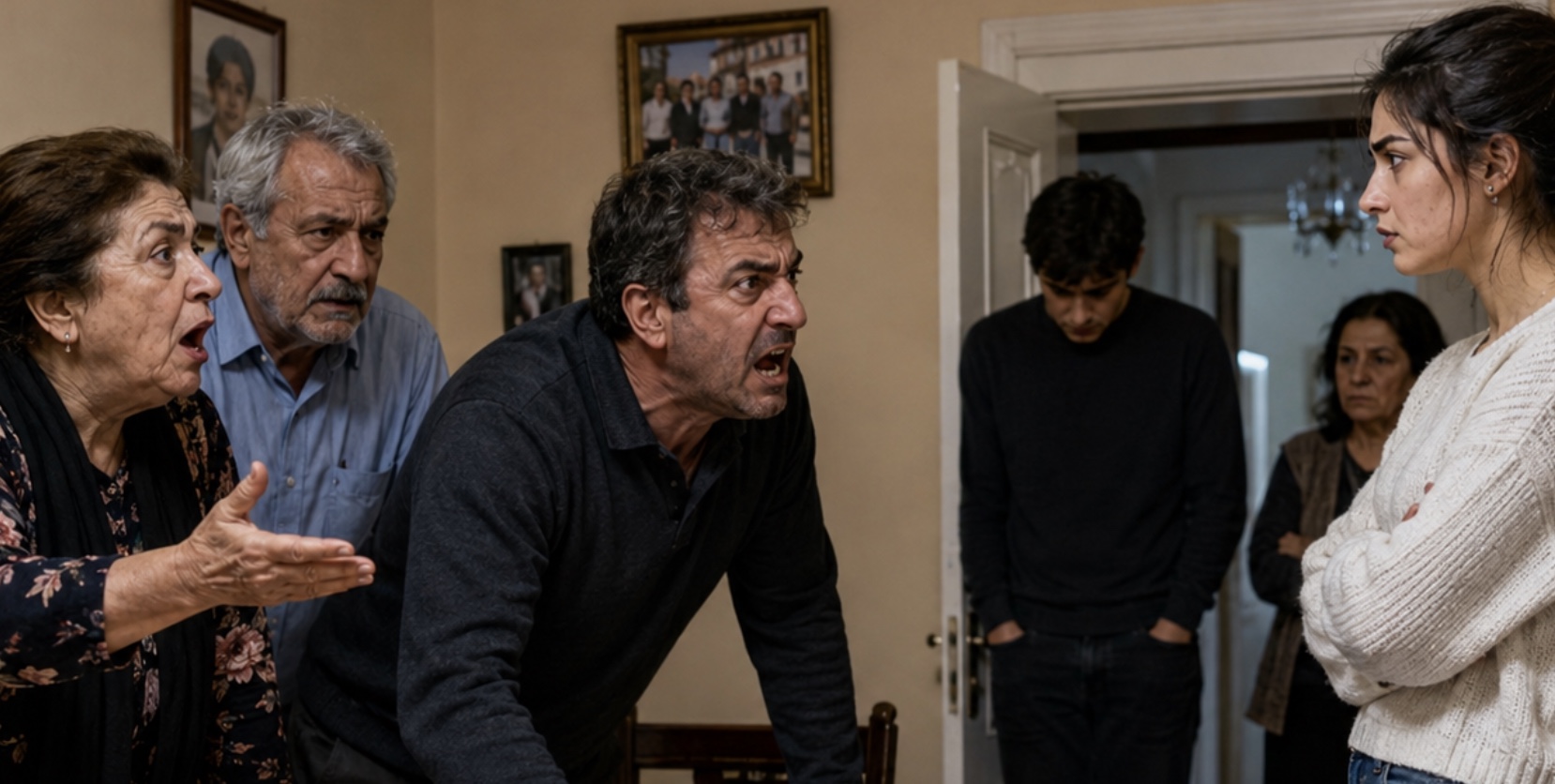
“We thought that after the wedding this apartment would become shared property!” Lev’s relatives protested when they heard her refusal.
Margarita Ivanovna immediately began shouting that she had not raised her son just so he could live in someone else’s home like an outsider.
She said she had sacrificed herself for her family her entire life, only to be humiliated over square meters as though she were some beggar asking for charity.
Victoria was called a selfish city woman who cared more about documents and private ownership than about her husband’s family.
Pyotr Semyonovich repeatedly slapped his palm against the table and talked about how things had been in his time.
 
His wife, he said, had given her husband every last kopeck she earned and would never have dared contradict him.
Women today had completely lost their place, he complained. No respect for elders. No understanding of how a proper family should function.
Uncle Fyodor eagerly joined in, accusing Victoria of arrogance and saying it was shameful to measure relationships with relatives in square meters.
Margarita Ivanovna, growing more furious by the second, eventually became personal.
She remarked that Victoria had already been married for an entire month and there was still no sign of a future child.
A daughter-in-law this stubborn—and perhaps even infertile, she hinted—could easily be replaced by a younger, more agreeable woman.
Lev stood nearby with his eyes lowered, staring at the pattern on the tablecloth.
He said nothing.
Once, he weakly muttered, “Mom, that’s enough,” but there was no force behind his words. He sounded as though he were politely refusing another serving of food rather than defending his wife from direct humiliation inside her own home.
That weakness hurt Victoria more than his parents’ shouting.
More than the cruel remark about children.
Angry words could eventually be ignored.
Silence from the person who was supposed to stand beside her was much harder to forgive.
 
Victoria straightened, folded her arms across her chest, and looked directly at her mother-in-law.
“The apartment is legally mine, and that is not up for discussion. You have one hour to pack. If your things are not ready in an hour, I will call the local police officer and we can continue this conversation with him present.”
Margarita Ivanovna shrieked and grabbed her son by the sleeve so sharply that he stumbled.
“Choose! Either us or her. There is no third option!”
Lev remained silent.
For far too long.
So long that the silence itself became an answer, even though he never actually chose either side.
He kept looking from his mother to his wife and back again, searching for some third solution in a situation where none existed.
Then, without ringing the bell or giving any warning, almost as though the intensity of the argument itself had summoned her, Victoria’s mother Vera entered the apartment.
The door had been left unlocked. Vera still carried a key from the time she had helped her daughter with renovations two years earlier.
She calmly walked through the shouting without pushing anyone aside.
 
Her eyes moved slowly around the room: the folding bed in the corner, the drill lying beside the fresh hole in the wall, the suitcases near the entrance, the flushed angry faces around the table.
“Guests who arrive without an invitation and refuse to respect limits are no longer guests,” Vera said quietly, looking directly at Margarita Ivanovna. “There are guests, and there are residents. First decide which one you are, and then you can start shouting.”
She spoke more softly than anyone else in the room, yet her words landed harder than all the yelling.
Margarita Ivanovna opened her mouth to reply, then closed it again.
For the first time that evening, she had nothing to say.
Lev shifted awkwardly near the window, avoiding both mothers’ eyes.
He suggested that perhaps his parents could stay “just one week” until they found another option.
He still could not bring himself to give a clear yes or no, as though one week could solve what the entire evening had already exposed.
Victoria no longer waited for him to decide.
She took out her phone and ordered a taxi for three people.
Then she called a hotel near the metro station and paid for three nights in advance.
She gathered their bags near the front door herself rather than waiting for the guests to do it.
Then she turned to her husband and gave him one final condition, saying it once, clearly and without raising her voice.
“You can be a husband in my home, or you can be a son in your parents’ home. There is no third option, Lev. The choice is yours, but you have to make it today.”
Lev left with his parents.
He said he was only going to help them get settled at the hotel as he zipped up his jacket in the doorway, still avoiding his wife’s eyes.
He did not return that night.
He did not call.
 
He did not send a single message.
It was as though the apartment where his married life had begun only a month earlier had suddenly stopped being a place he wanted to come back to after an argument.
The following week passed in ringing silence.
At first, Victoria did not know how to fill it.
She came home from work to an empty apartment, put the kettle on, sat beside the window, and listened to water dripping from a badly closed bathroom tap.
Previously, the sound had disappeared into the ordinary presence of another person.
Now it seemed to fill the entire apartment.
Her phone remained silent for two days.
Then one message arrived from Lev.
“We need to talk.”
Nothing else followed.
No explanation.
No phone call.
Victoria did not reply.
Instead, she filed for divorce at the local registry office without waiting for explanations that never came from either her husband or his parents.
A locksmith changed the locks in a single evening.
The new keys lay on the table beside a cup with a small chip along the rim—the same cup Victoria had never brought herself to throw away.
Vera came back a week later.
This time there was no urgency.
 
She brought a bag of fresh pastries from the neighborhood bakery and some of the tea Victoria had loved since childhood.
Mother and daughter sat together in the kitchen.
Outside, the summer sun was shining brightly. The rain had long since disappeared, as though it had never happened, as though the week with the unexpected doorbell, the suitcases, and the shouting across the table had belonged to another season, another life.
Vera poured tea into their cups and looked at her daughter over the top of her glasses, taking her time before speaking.
“I raised you to be the owner of your own life,” she finally said, placing a cup in front of Victoria. “Not a guest in your own apartment, and not someone who needs permission to live the way she chooses.”
Victoria silently stirred sugar into her tea.
The spoon lightly struck the sides of the cup.
Then she smiled.
It was a quiet, natural smile, without bitterness or strain.
For the first time in an entire month.