Exactly eighteen days ago, I handed my husband the keys to my car. I hate to admit it, but at the time I simply wanted to buy myself a little peace at home and avoid another round of endless arguments in the kitchen. I thought I was making a reasonable compromise for the sake of the family. Instead, I was opening the door to a level of entitlement that nearly cost me a large amount of money—and my faith in my marriage.
“Lyuba, just think about it logically,” Oleg told me that evening as he stirred his tea. “You drive your Duster twice a week at most. To the shopping center and to your sister’s country house. The rest of the time it just sits outside losing value. Meanwhile, I have to take two buses to get to work on the other side of town. Why don’t I drive it to work? I’ll pay for the gas and maintenance. Everything.”
My father-in-law, Nikolai Stepanovich, was sitting beside him. He had been visiting us more and more often lately, and now he nodded enthusiastically in support of his son.
“Those are sensible words, daughter-in-law,” he boomed in his deep voice, which always seemed to make the dishes in the drying rack vibrate slightly. “A machine is supposed to work. That crossover of yours just stands under the window collecting dust. A woman doesn’t need to drive every day anyway. All those traffic jams do is ruin your nerves. Oleg and I will take care of it, change the oil, check everything. We’re family. What’s yours is ours.”
 
And I gave in.
It seemed easier to agree than to sit through another joint lecture from the two of them about “using resources efficiently.”
I had bought that car myself three years earlier. Part of the money came from selling my mother’s old house in the village, and the rest I earned by taking on extra evening work, doing accounting reports for a businessman I knew. Oleg hadn’t contributed a single ruble toward the purchase because he was having employment problems at the time.
The car had been purchased while we were married, but my name alone was listed in the vehicle documents.
For the first few days, everything seemed fine. Oleg left in the morning, came home in the evening, and placed the keys on the small table in the hallway. I was even pleased that he was happy and no longer exhausted from commuting.
Then the routine began to change.
First, the keys stopped appearing on the hallway table. Oleg started keeping them in his jacket pocket.
Then, one Friday evening, the car didn’t come home at all.
“Where’s my Duster?” I asked, looking out the window.
“At Dad’s garage,” my husband replied casually while flipping through television channels. “We thought we’d check the suspension. Something’s knocking on the right side. It’ll stay there until Monday. Dad and I are going to work on it over the weekend.”
 
That weekend I needed to take seedlings and several heavy boxes of books to my sister. I had to call a taxi and load everything myself. Oleg didn’t even offer to help. He and his father left for the garage early in the morning.
From then on, it felt as if unfamiliar noise had slowly taken over my apartment.
Nikolai Stepanovich started coming over almost every evening. He and Oleg loudly discussed spare parts, tire prices, filters, and mechanical problems I had no interest in. Their voices filled the kitchen, hallway, and living room. The television was permanently tuned to sports channels, with commentators droning on late into the night.
Meanwhile, I felt as though I had been pushed into the background in my own home.
I tried talking to my husband. I reminded him that the car was mine and that I needed to use it too.
“Lyuba, don’t start,” Oleg would say with an irritated expression. “We already agreed. Besides, it’s partly taken apart right now. We ordered some filters. Just wait a couple of days.”
The real discomfort started when I realized my father-in-law no longer behaved like a guest in my home. He acted as though he owned the place.
One Wednesday evening, I came home exhausted from work. All I wanted was to sit quietly and have a cup of tea.
Nikolai Stepanovich was sitting in my kitchen, staring at his phone. In front of him was an open jar of my homemade pickled tomatoes—the ones I had prepared using a special recipe with mustard and garlic.
 
I stopped in the doorway.
Without looking away from his screen, my father-in-law pushed his thick, unwashed fingers directly into the jar. He pulled out a large tomato and shoved it into his mouth. Cloudy orange brine ran down his hand and dripped onto my clean linen tablecloth, leaving wet stains.
He didn’t even reach for a napkin.
Instead, he licked his fingers noisily and reached into the jar for another tomato.
The sight made my stomach turn.
Without saying anything, I picked up the napkin holder, placed it directly in front of him, and walked into the other room.
That was the moment I finally understood that my boundaries hadn’t merely been crossed. They had been trampled.
And all of it was being justified with one convenient word: “family.”
On Saturday morning, I decided I had had enough.
 
I needed to go to a home improvement store to buy paint for the balcony. I got dressed, walked into the hallway, and called out loudly:
“Oleg, give me the keys and the documents. I’m going out. If the car is still in the garage, I’ll go there myself and pick it up.”
My husband came out of the bedroom wearing sweatpants. He looked strangely nervous and kept pulling at the edge of his T-shirt.
Almost immediately, Nikolai Stepanovich appeared from the kitchen. He was holding a half-eaten sandwich.
“Oh, looks like Lyuba is going somewhere,” my father-in-law said with a smirk while chewing. “But there aren’t any keys. And there isn’t any car either.”
“What do you mean, there isn’t any car?” I stopped completely still.
A cold clarity began spreading through me.
“Where is my car?”
My father-in-law exchanged a glance with Oleg.
My husband looked away.
“We sold it, Lyuba,” Nikolai Stepanovich announced loudly and proudly, taking another bite of his sandwich. “Yesterday evening. Sold it to a reseller. Good guy. Transferred the money right away.”
I looked at Oleg.
He still wouldn’t meet my eyes, staring instead at the wallpaper.
“Oleg, is that true? You sold my car without telling me?”
 
My voice was calm, even though my fingers had started trembling.
“Come on, Lyuba, what’s the big deal?” my husband muttered, finally looking at me. “We talked about how the car was getting old. Dad found a great option—a seven-seat minivan. We only need to add a little money. Then we can all go out into the countryside together, go fishing. There’ll be plenty of room for you too. You can carry all your seedlings. Why are you making a scene?”
“It’s more convenient for everyone,” my father-in-law added decisively. “A woman doesn’t need to concern herself with all this mechanical stuff anyway. Oleg and I made the decision. The money is in my account. Tomorrow we’re going to pick up the new vehicle.”
Then he laughed.
Loudly. Happily. Condescendingly.
It was the kind of laugh adults use when a child is upset over a broken toy and supposedly doesn’t understand how the real world works.
My eyes fell on the old wooden case from a Podolsk sewing machine that stood in our hallway and served as a telephone table. A pile of advertising brochures lay on its polished lid.
I stared at the faded golden pattern on the case and thought about how casually these two men had decided they had the right to dispose of my property.
Simply because they were men and believed they knew better.
“Who signed the sale agreement?” I asked calmly. “The car is registered in my name.”
“Oh, what difference does that make?” Nikolai Stepanovich waved dismissively. “Oleg scribbled something that looked like your signature. The reseller barely looked at it. All he cared about was having the vehicle documents. We’re family. Nobody is going to order a handwriting examination.”
They stood in front of me looking completely certain of themselves.
Smug.
Convinced I would complain, maybe cry, and eventually accept what they had done.
The same way I had accepted the loud television.
The stained tablecloth.
 
The fact that my needs always came last.
I didn’t shout.
I didn’t cry.
I didn’t throw accusations at them.
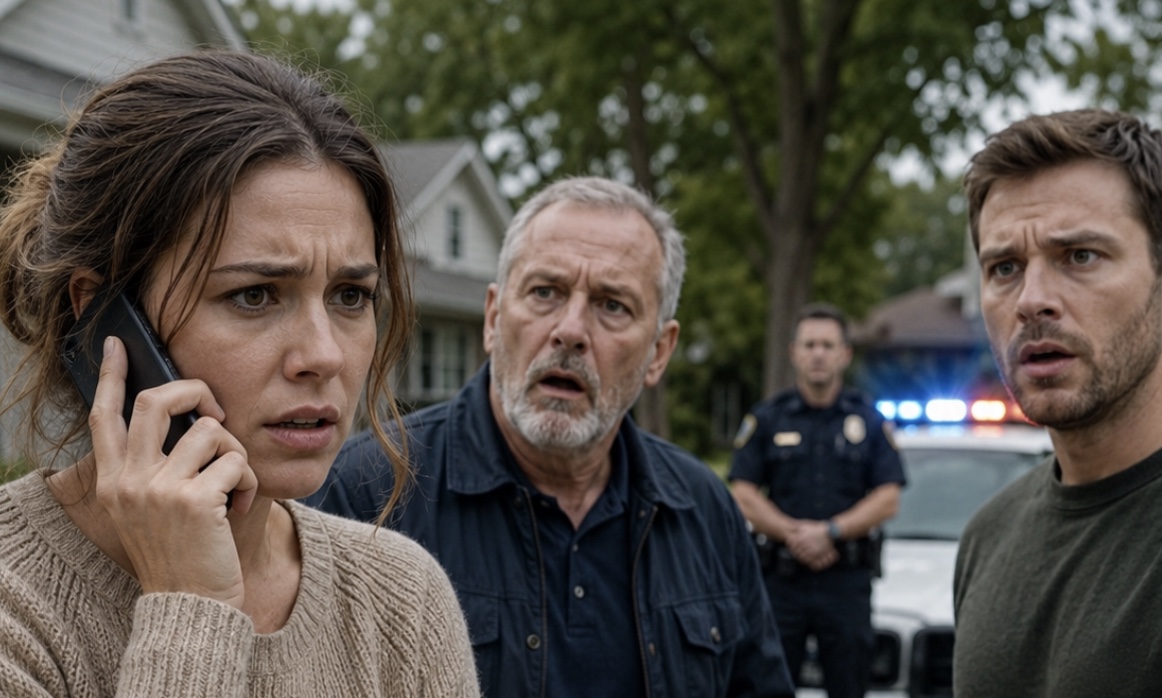
I simply walked over to the hallway table, picked up my phone, and dialed 112.
“Hello,” I said clearly and loudly enough for every word to echo through the hallway. “I would like to report my vehicle stolen. Yes. A white Renault Duster. License plate…”
Nikolai Stepanovich’s face turned blotchy red.
The sandwich slipped out of his hand and landed on the rug.
Oleg lunged toward me with his arms outstretched, as though he was about to snatch the phone away.
“What the hell are you doing?!” my father-in-law rasped, taking a step toward me.
I raised my free hand, palm outward, stopping both of them, and continued speaking into the phone.
“No, I don’t have the keys. The vehicle belongs to me personally. I am the registered owner. I believe it may have been sold illegally using forged documents. I’ll give you my address. I’ll wait for the officers.”
I ended the call and placed the phone on top of the polished sewing-machine case.
 
A heavy silence filled the hallway.
The only sound came from the kitchen, where the refrigerator compressor hummed steadily.
“Lyuba, are you out of your mind?” Oleg’s voice rose almost into a squeak. “Stolen? Do you understand what that means? That’s a criminal case! The reseller is going to check the database and see the car is wanted. He’ll tear me apart! And the police… I signed your name! That’s forgery!”
“Exactly,” I replied, looking directly into his eyes. “You forged my signature and sold property that wasn’t yours to sell.”
“But we’re family!” my father-in-law roared.
The arrogance was gone from his voice now.
There was only panic.
“Cancel the call! Call them back immediately and tell them you made a mistake!”
“I won’t.”
I crossed my arms.
“You decided you could sell my car without asking me. You decided my money would be used to buy your minivan for fishing trips. Now you can explain those decisions to the police.”
They immediately started rushing around the hallway.
Oleg tried to call the reseller with shaking hands, but the man wasn’t answering.
Nikolai Stepanovich started breathing heavily and clutching his chest, although I knew perfectly well that he was normally as healthy as an ox.
All their arrogance disappeared in seconds.
The great experts, planners, and masters of life suddenly looked like two frightened boys caught doing something they knew they shouldn’t have done.
The police arrived about twenty minutes later.
 
By then, I had already taken the original vehicle title out of the bottom drawer of my dresser—the document without which the car could not legally have been transferred.
“So what exactly did you give the buyer?” a young police officer asked while examining my original paperwork.
Oleg sat on the small hallway bench, pale as a sheet, staring at the floor.
“A duplicate,” he muttered. “We told the traffic police the original had been lost and got a replacement so we could sell the car.”
The officer shook his head and began writing the report.
Nikolai Stepanovich kept trying to explain that this was all about the family budget and that his daughter-in-law had simply overreacted, but nobody was interested in his excuses.
The essential fact remained the same: the car had been sold without the owner’s permission using a forged signature.
About an hour later, the buyer contacted them himself.
Traffic officers had stopped him at a checkpoint because the car had already been entered into the wanted-vehicle database.
The scandal was enormous.
The sale had to be reversed.
My father-in-law, who had already deposited the money into his bank account, had to withdraw it immediately and return it to an extremely angry and thoroughly unfriendly buyer right there at the police station.
Oleg was questioned repeatedly over the forged signature.
 
I got my car back from the impound lot two days later.
That same evening, I packed Oleg’s belongings into three large plaid bags and placed them in the hallway.
When my husband returned from the police station, exhausted and gray-faced, he didn’t even argue.
He simply picked up the bags and went to stay with his father.
Now my apartment smells like freshly brewed coffee instead of motor oil.
Nobody sits beside me with sports commentators droning in the background.
A clean, freshly ironed linen tablecloth lies across my kitchen table.
I didn’t make a dramatic announcement about divorce. I simply filed the paperwork. We don’t have children, and as it turned out, there was very little left for us to divide.
The car is parked beneath my window.
My car.
Would you have stayed silent to save your marriage if your spouse and his family had treated you this way?