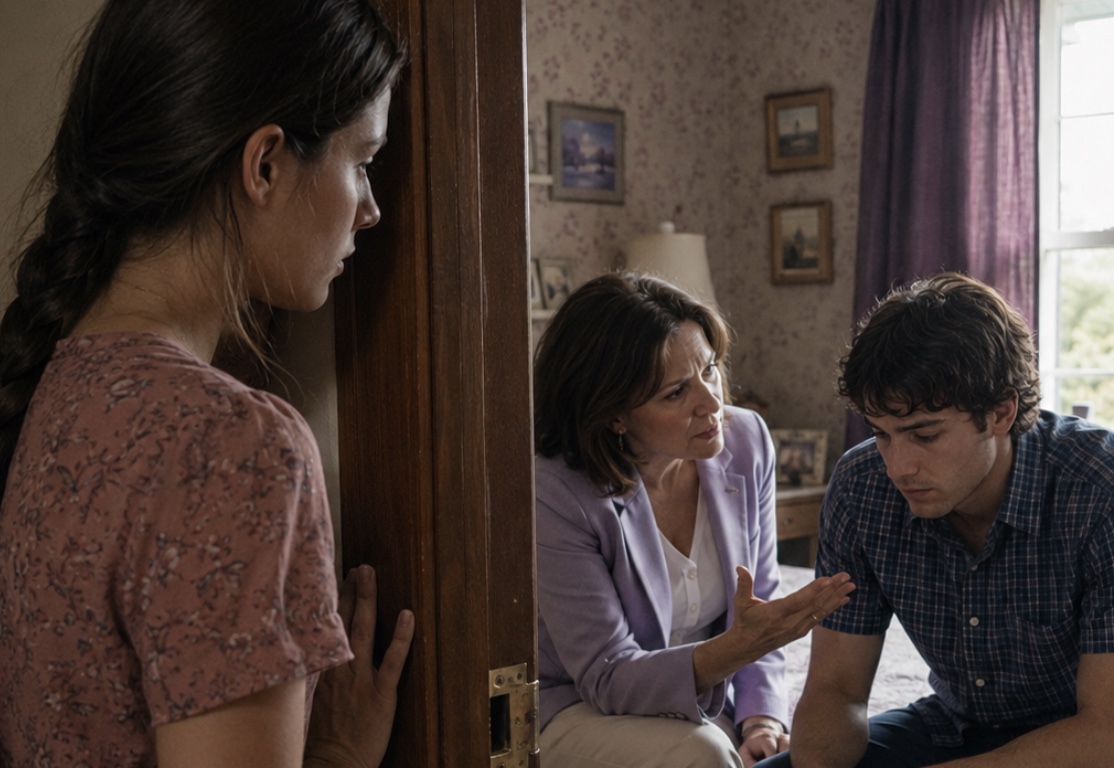
“Son, do you even understand that a clever woman never tells you directly what she wants? She makes you figure it out yourself. That’s the difference between a cunning woman and an honest one. An honest woman is naive. A cunning one survives no matter what happens.”
Nina Semyonovna spoke quietly, almost affectionately, with the bedroom door pulled nearly shut. She had no idea that Katya was standing in the hallway barely a meter and a half away, hearing every word through the old door that had never closed properly.
“And you, Dimochka, need to be smarter too. Don’t shout, don’t start arguments—what’s the point? Just create the right conditions. A woman will leave on her own if she feels uncomfortable. That way, you’re not throwing her out. You’re simply letting her go.”
Letting her go.
Katya repeated the phrase silently.
So that was what they called it.
Without making a sound, she stepped away from the door and returned to the kitchen. The August evening pressed humid heat through the open window. The air was so heavy that even the curtain remained completely still.
There were three plates on the table.
 
Katya stared at them for a moment, then picked one up and put it back in the cupboard.
She set the table for two.
Nina Semyonovna came every Saturday. Officially, she was visiting her son. In reality, she was conducting an inspection.
She was a neat, well-groomed woman and, in her own way, still attractive even at seventy. She carried herself straight, dressed conservatively, and never allowed her hair to look anything less than perfectly styled.
From a distance, she looked like an exemplary mother.
Up close, things were different.
Dima changed whenever his mother was around.
Not suddenly. Not dramatically. Gradually, the way the weather changes before a storm.
One moment he was himself—talking normally, looking Katya in the eyes.
Then he would start staring at his phone, answering in short phrases, looking past her instead of at her, as though she had become invisible.
It hadn’t started yesterday.
Katya had noticed the pattern a year and a half earlier. After every visit from his mother, something shifted slightly between them. Dima became colder. Eventually he would soften again.
Then Nina Semyonovna would visit once more, and the cycle would repeat.
But what Katya had overheard today was no longer subtle.
Three months earlier, she had opened a second bank card.
There had been no grand plan behind it. She had gone to the bank for something unrelated, accepted an offer for another account, slipped the card into her purse, and almost forgot about it.
Then, at the end of the month, while transferring her salary into their joint account, she hesitated.
For just a second.
And transferred only part of it.
She sent a small amount to the new card.
The next month, she did it again.
And again this month.
She wasn’t stealing anything.
Katya worked at a small architectural firm and earned her own salary. Before, everything had gone into their shared household account, which Dima could access whenever he wanted.
And he did.
He rarely asked first.
What did he spend the money on?
Katya didn’t always know.
Whenever she asked, he simply said it was for something necessary.
She had stopped arguing about it a long time ago.
Now, part of her income stayed with her.
 
Even Katya couldn’t fully explain why she had started doing it.
Something inside her had simply begun calculating.
Quietly.
Without panic.
Almost mechanically, like an accountant preparing for an audit.
Twenty minutes later, Dima came out of the bedroom. His mother followed behind him wearing the satisfied expression of someone who had accomplished something important.
“Oh, Katya, you’ve already set the table,” Nina Semyonovna said, sounding almost surprised. “Good girl.”
Katya smiled.
During dinner, Nina Semyonovna talked about her neighbor Tamara, who had apparently sold her country house and bought an apartment in another part of town.
Dima listened, nodded, and ate.
Katya listened too.
But her thoughts were elsewhere.
She was thinking about Friday, when she had met her friend Lena.
Lena worked as a real-estate agent and had casually mentioned a one-bedroom apartment in a nice neighborhood.
Quiet street.
Third floor.
Recently renovated.
“If you ever decide you need it, call me. I can hold it for you.”
Katya had laughed.
“Oh, come on.”
Lena had looked at her strangely but hadn’t pushed the subject.
 
]
Now Katya thought perhaps she shouldn’t have laughed.
After dinner, Dima drove his mother home. She lived on the other side of the city, and getting there by bus took too long.
Katya stayed behind.
She slowly walked through the apartment.
She stopped in the living room and looked at the shelves.
Her books on one side.
His on the other.
She looked inside the wardrobe.
Her half.
His half.
Then she looked at the desk by the window, where her laptop sat beside architectural drawings from work.
The apartment belonged to Dima.
He had inherited it from his grandmother before they were married.
Katya had moved in with her clothes, her dishes, her favorite blanket, and three boxes of books.
That was four years ago.
At the time, she had believed it would be forever.
She opened her laptop and logged into her banking app.
Then she checked the balance on the second card.
There was already a decent amount saved.
Not a fortune.
But enough to survive comfortably for at least three months.
Katya closed the banking app and opened her work chat.
There was a message from her colleague Artyom.
Katya, a client specifically asked for you. Interesting project for the autumn. Want to talk to them?
She replied:
Yes. Tomorrow.
Dima came home around ten.
He was in a good mood. He was always like that after spending time with his mother, as though she charged him with something.
Confidence, perhaps.
Or something else.
“Tired?” he asked, without sounding particularly interested in the answer.
“I’m fine,” Katya said.
He lay down and started watching something on his phone.
 
Katya read.
Outside, the August city hummed with traffic and distant music drifting up from somewhere in the courtyard. Groups of people sometimes gathered there late at night, talking and laughing.
Before they went to sleep, Dima said casually, without looking at her:
“Mom says we need to have a serious conversation.”
“All right,” Katya replied. “We’ll talk.”
She switched off the lamp on her side of the bed and closed her eyes.
Her heartbeat was steady.
Almost calm.
We’ll talk, she repeated silently.
We definitely will.
But she already knew the conversation would be very different from the one Nina Semyonovna had planned.
On Monday morning, Katya left for work earlier than usual.
August in the city had its own atmosphere.
The heat was no longer aggressive like it had been in July. Now it was slow and heavy, almost lazy.
The trolleybus moved through nearly empty streets, and Katya sat beside the window, watching the city pass.
She wasn’t thinking about Dima.
She was thinking about the project Artyom had mentioned.
About taking extra hours in the autumn.
About the fact that the architectural firm had been encouraging her for months to manage her own clients.
She had always postponed it.
There was always some reason.
First they had to deal with one thing.
Then another.
There would be time later.
Suddenly, Katya no longer wanted to postpone anything.
The firm occupied the fourth floor of an old building downtown, with high ceilings, enormous windows, and the constant smell of coffee and paper.
Katya loved the place.
Here, she was herself.
Not someone’s wife.
Not a daughter-in-law barely tolerated by her husband’s mother.
Just a professional people trusted.
Artyom was already there.
He was short, reddish-haired, and permanently dressed in slightly wrinkled shirts.
A good man.
A little restless.
“The client is serious,” he said immediately. “Private house outside the city. Big plot. They want something unusual. They definitely have the budget. But…”
He hesitated.
“There are two partners. They’re ordering it together, but I don’t think they get along very well. So be prepared.”
“For what exactly?” Katya asked.
 
“For both of them trying to pull you in opposite directions.”
Katya nodded.
That, she could handle.
After four years in the profession, she had dealt with plenty of people who couldn’t agree with one another.
The clients arrived on Wednesday.
There were two of them.
The first was Gennady Olegovich, around fifty-five, heavyset, with the hard gaze of a man accustomed to being obeyed.
Expensive jacket.
Large watch.
Slow, deliberate speech, with pauses that made every word sound as though it had a price attached.
The second man, Eduard, was younger, around forty, fit, wearing a pale shirt.
At first glance, he seemed more pleasant.
At second glance, not so much.
Eduard smiled easily and often, but the smile never reached his eyes.
It was the kind of smile people develop after years of learning exactly what expression to wear in any situation.
“So you’ll be handling our project?” Gennady Olegovich asked, looking Katya over with professional bluntness. “You look young.”
“That doesn’t interfere with my work,” she replied evenly.
Eduard gave a faint smile.
Whether it was approval or mockery, Katya couldn’t tell.
They explained what they wanted.
The house.
The land.
The concept.
It was genuinely interesting.
Katya listened, took notes, and asked questions.
At the same time, she noticed something else.
Every time one man spoke, the other subtly frowned.
Gennady Olegovich wanted solidity.
Stone.
Heavy architecture.
“Something that will last for generations.”
 
Eduard wanted glass.
Open spaces.
Something modern.
“Something that can breathe.”
Two men.
One project.
Completely opposite visions.
And both of them looked at Katya as though she were supposed to settle the argument for them.
Interesting, she thought.
And difficult.
But it certainly wouldn’t be boring.
After the meeting, Katya went for a walk.
It was a habit that helped her think.
She walked a block, entered a small café, bought some water, and sat beside the window.
Her phone vibrated.
Dima.
“When are you coming home today?”
“Probably around seven. Why?”
“Mom’s coming. She wants to talk. With both of us.”
 
Katya looked through the window.
A woman was walking a tiny, ridiculous dog that kept pulling its leash toward a pigeon.
The pigeon refused to move.
It stood there with great dignity, staring back.
“All right,” Katya said. “I’ll be there.”
Nina Semyonovna was sitting in the living room as though she owned the apartment.
Back straight.
Hands neatly folded on her knees.
Expression calm and intensely observant.
Dima sat beside her, slightly hunched, wearing the familiar look he always had in his mother’s presence—the expression of a man who felt vaguely guilty but didn’t quite know why.
There was also someone Katya hadn’t expected.
“This is Svetlana Markovna,” Nina Semyonovna announced in a tone that discouraged questions. “She’s a family psychologist. We decided the two of you need professional help.”
Svetlana Markovna was around sixty, dressed in a beige suit, with a notebook resting on her lap.
Her smile was gentle, polished, professional.
The same kind of smile Eduard had worn earlier that day.
Beautiful on the surface.
Empty underneath.
“Katya, we’re all here because we’re concerned,” she began in the tone of someone accustomed to speaking with resistant patients. “Dima says you’ve become very withdrawn lately. It happens. It can be worked through.”
Katya sat down calmly.
She looked at Dima.
He avoided her eyes.
“Dima told you that?” she asked.
“We’ve all noticed it,” Nina Semyonovna interrupted softly.
So that’s how it is.
The psychologist was the next stage of the plan.
 
It wasn’t enough to make Katya uncomfortable.
Now they needed professional confirmation that she was the difficult one.
The problem.
Smart.
Katya had to give Nina Semyonovna credit for that.
Svetlana Markovna continued talking about communication, acceptance, emotional openness, and the importance of working on oneself.
Katya listened.
She nodded at the appropriate moments.
From the outside, she looked attentive and cooperative.
Inside, a quiet counter continued running.
Dima stared at the floor.
Nina Semyonovna watched Katya.
And in her mother-in-law’s eyes, Katya caught something very close to anticipation.
Almost invisible.
Almost hidden.
But not completely.
When the visitors finally left, Katya stood on the balcony for a long time.
August smelled of the city after a hot day.
Somewhere far away, music was playing.
She took out her phone and found Lena’s message thread.
Is that one-bedroom apartment still available?
The reply came a minute later.
Yes. Want to see it?
Katya stared at the screen.
Then typed:
Yes. Tomorrow after six.
She put the phone away and returned inside.
Dima was lying on the couch, scrolling through his phone, already back in his usual evening state—separate, distant, unreachable.
“That went pretty well,” he said without looking at her.
“It did,” Katya agreed.
And she smiled.
Quietly.
For herself.
The apartment was better than Katya had expected.
Lena drove her there the following evening at exactly six.
Third floor.
Windows overlooking a quiet courtyard filled with large linden trees that provided shade until almost noon.
Freshly painted walls.
Light flooring.
A small but practical kitchen.
Nothing luxurious.
But clean.
Calm.
And most importantly, peaceful.
“Well?” Lena asked from the doorway.
Katya walked through the room.
She stopped beside the window.
Below, an elderly man was feeding pigeons in the courtyard.
Methodically.
 
Calmly.
Probably something he did every day.
“I’ll take it,” Katya said.
Lena exhaled.
Apparently she had been worried.
“Katya, I’ve wanted to ask you for a while…”
“Don’t,” Katya interrupted gently. “Everything’s fine. Really.”
For the next two weeks, Katya lived two separate lives.
During the day, there was work.
The project with Gennady Olegovich and Eduard developed exactly as Artyom had predicted.
Every meeting became a silent tug-of-war.
Gennady Olegovich arrived with revisions.
Eduard immediately suggested the opposite.
Both looked toward Katya, waiting to see whose side she would choose.
She chose neither.
Instead, she created a concept where both ideas existed together rather than fighting each other.
A heavy stone base.
Strong structural elements.
Above them, a lighter glass second floor and open terraces.
Earth and air.
Weight and light.
Gennady Olegovich studied the drawings for a long time.
Then he said:
“Unexpected.”
“But it works,” Eduard added.
 
For the first time since they had met, his smile looked genuine.
The project was approved.
Katya left the office and walked half a block smiling broadly and foolishly, completely unconcerned with what passing strangers might think.
Evenings were different.
She packed her belongings gradually.
No rush.
Only things that unquestionably belonged to her.
Books.
Work folders.
Her favorite mug.
Her blanket.
She packed everything into bags and hid them inside the wardrobe.
Dima never noticed.
Lately, he noticed very little around him.
He came home from work, ate dinner, and disappeared into his phone.
Sometimes his mother called.
He would go into the bedroom and speak quietly.
Whenever he returned, he seemed slightly more distant than before.
Katya never asked what they talked about.
Not because she didn’t want to know.
Because she already knew the answer.
Nina Semyonovna appeared unexpectedly on Friday.
No warning.
The doorbell rang at six-thirty, just after Katya had come home.
“I happened to be nearby,” she said as she entered, even though she lived on the opposite side of the city and had absolutely no reason to be nearby.
She looked around quickly.
Sharply.
The way she always did.
She sensed something.
Katya could see it in the slight tension in her expression.
But there was nothing concrete for her to find.
The bags were hidden.
The apartment looked normal.
Everything was where it belonged.
Dima was delighted to see his mother with his usual childlike enthusiasm.
He hurried to put the kettle on and pulled her into the living room to show her something on his phone.
 
For a second, Nina Semyonovna remained in the hallway.
She looked at Katya.
“Tired?” she asked, sounding almost concerned.
“I’m fine,” Katya replied. “There’s a lot of work. Interesting project.”
Her mother-in-law nodded.
Something in her expression suggested she was searching for an opportunity.
Waiting for a moment.
She needed a scene.
An argument.
Tears.
Anything she could later use as evidence.
See, Dima? She’s unstable. Look at how she behaves.
Katya had no intention of giving her that moment.
Svetlana Markovna called the next morning.
“Katya, I wanted to offer you an individual session. Without Dima. Just the two of us talking.”
Her voice was still soft and enveloping.
A professional instrument.
Katya thought for a moment.
“Svetlana Markovna, tell me honestly. Who is paying you?”
Silence.
Brief.
But extremely revealing.
“That information is confidential…”
“I understand,” Katya said. “Thank you, but I won’t need a session.”
She ended the call.
Then she took her coffee out onto the balcony.
 
August was ending.
She could feel it in the air.
In the way the linden trees smelled different in the evening.
In how darkness arrived a little earlier.
Summer was leaving without regret, calmly, as though it had completed everything it was supposed to do.
Katya felt something similar.
She left on Sunday.
Not in the morning.
In the afternoon.
Dima had gone to his mother’s house for lunch, as he usually did.
Katya helped him get ready and closed the door behind him.
Then she stood alone in the silent apartment for a minute.
After that, she started carrying out her bags.
There were four of them.
Lena arrived by car and helped load everything.
She didn’t ask unnecessary questions.
She was simply there.
And that was enough.
At the new apartment, Katya unpacked quickly.
She didn’t own much.
Books on the shelf.
Mug in the kitchen.
Blanket on the couch.
She opened the window.
The linden trees rustled in the courtyard.
The old man was feeding the pigeons again.
Calmly.
Methodically.
Katya sent Dima a message.
Short.
No pages of explanations.
No accusations.
I’ve left. I’ll collect the rest of my things later. We can talk when you’re ready.
Then she placed the phone face down.
Dima called two hours later.
His voice sounded confused.
Almost offended.
Like a child who couldn’t understand what had happened.
“Katya, wait. We can… Let’s talk. Why did you do this?”
“Dima, we will talk. I wrote that. Just not today.”
“But…” He paused. “Mom says you’ve always been…”
“Stop,” Katya said calmly. “Call me yourself when you want to talk. You. Not your mother.”
She didn’t know whether he was capable of that.
Speaking for himself.
Without someone telling him what to think.
Maybe he was.
Maybe he wasn’t.
That was his choice now.
 
On Monday, Katya arrived at the office before everyone else.
She spread out the drawings for the new project, switched on the coffee machine, and opened the window.
The city was waking slowly under the late-August morning sun.
Artyom appeared in the doorway and looked surprised.
“Why are you here so early?”
“Lots of work,” she said. “Good work.”
He nodded and walked away.
Katya looked down at the drawing.
The same one with the heavy foundation and the light glass above it.
Earth and air.
Weight and light.
She picked up a pencil.
And began.
September arrived almost without warning.
One day, everything simply felt different.
It wasn’t much colder.
The air had just become clearer, and the city seemed to breathe out after a long, tense summer.
Katya noticed it one morning on her way to work.
And realized she had stopped counting the days.
Dima called three weeks later.
This time, he called on his own.
No mother standing behind him.
He spoke awkwardly, with long pauses, like someone trying for the first time to put his own thoughts into words.
“I didn’t understand,” he finally said. “There were so many things I didn’t understand.”
“I know,” Katya replied.
“Can we fix this?”
She was silent for a moment.
She considered the question honestly.
Not for him.
For herself.
“I don’t know, Dima. Not yet.”
He didn’t pressure her.
He said goodbye quietly.
Katya put down the phone and stood for a long time looking out the window.
At the courtyard.
 
The linden trees.
The pigeons below.
Nothing inside her hurt.
But she didn’t feel victorious either.
There was simply a quiet steadiness.
The kind you feel after a long journey when you finally sit down and realize you don’t have to keep walking.
Nina Semyonovna called once.
Her voice was as controlled as ever.
“Do you understand that you destroyed this family?”
“Goodbye, Nina Semyonovna,” Katya replied.
Then she ended the call.
No anger.
 
No trembling hands.
She simply closed the door.
The project was completed on schedule.
Gennady Olegovich shook Katya’s hand firmly and sincerely.
Eduard said, “We’d like to keep working with you. We have more properties.”
Katya made a note of it, nodded, and promised to think about it.
She didn’t need long.
That evening, she opened her banking app.
She looked at the balance on the second card.
The same card she had opened three months earlier without any particular plan, on a suffocating summer day.
Katya smiled softly.
Sometimes the most important decisions in life are the ones you begin making before you even realize you’ve made them.