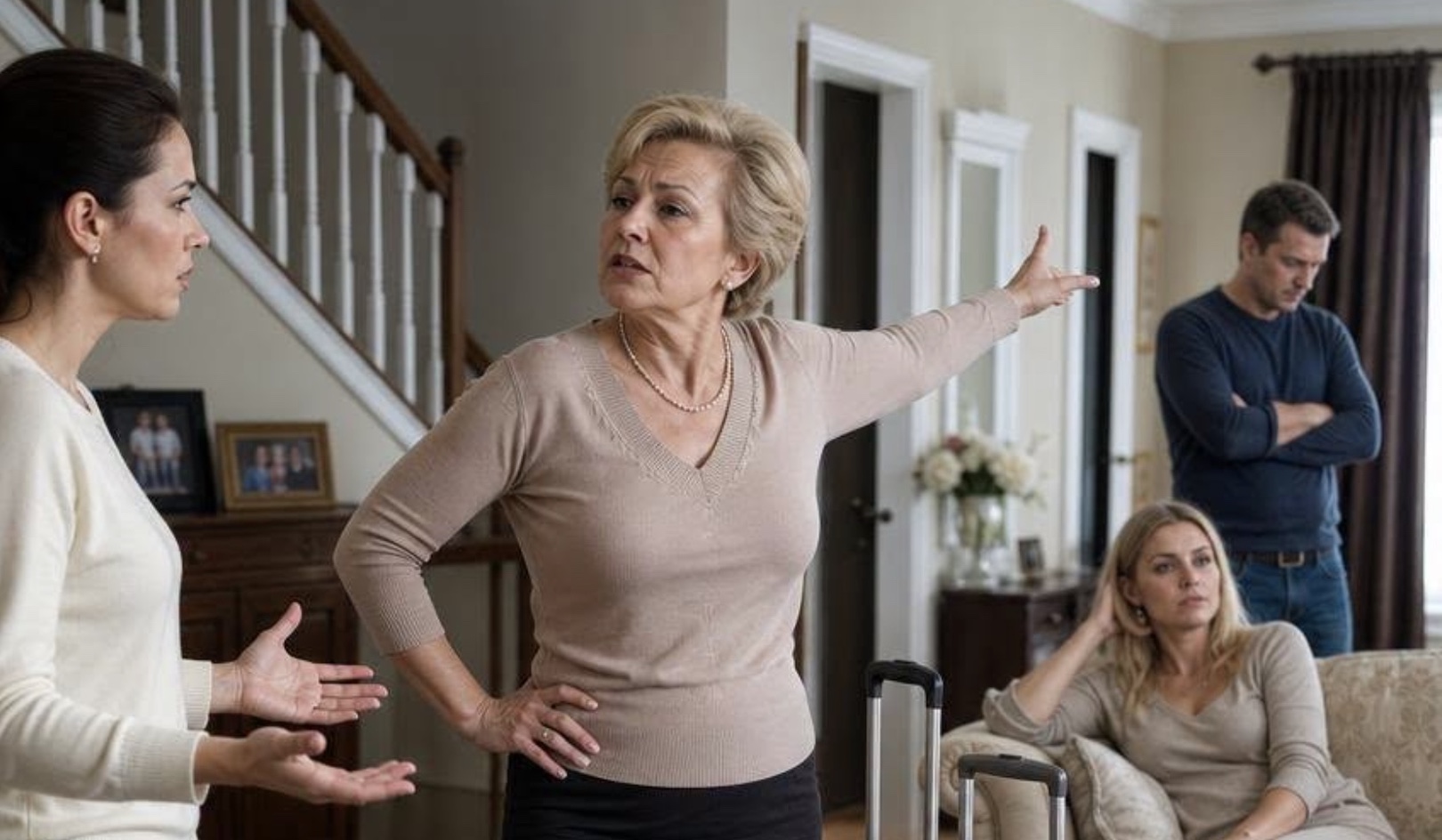
“Alright, we’ll give this room to Alyona. It’s bigger. And you, Larisa, can move your things into the small one for now. You’ll manage with less space.”
Tamara Viktorovna stood in the middle of the living room with her hands planted firmly on her hips, pointing around at the walls and assigning rooms with such confidence that anyone might have thought she had owned the house all her life.
Larisa froze in the doorway, still holding the grocery bags. She had only stepped out for half an hour to buy food, yet she had returned feeling as though she had walked into somebody else’s home—a place where decisions had already been made without her.
The strangest part was not even what her mother-in-law was saying. It was the calm certainty with which she said it. There was no hesitation, no question, no attempt to ask permission. She spoke in the commanding tone of a general arranging troops before battle.
Larisa slowly lowered the bags to the floor. Her fingers loosened almost by themselves, and a packet of buckwheat landed on the hardwood with a dull thud.
 
The same hardwood Larisa had chosen two years earlier, running her fingers over samples in a building-supply store while carefully calculating how much of her grandmother’s inheritance she could afford to spend.
To understand how another woman had reached the point where she felt entitled to rearrange Larisa’s home, one had to go back two years.
That was when Larisa’s grandmother died.
Anna Timofeyevna had been the woman who raised her, effectively becoming both mother and father after Larisa’s parents disappeared from her life early and under unhappy circumstances. Her grandmother had lived a long, difficult life and devoted almost everything she had to her granddaughter.
And when she died, she left Larisa the only real wealth she had ever managed to save: money.
It was not a fortune, but it was a respectable amount. Her grandmother had spent her entire life putting aside whatever she could, denying herself countless small comforts. Near the end, she had even sold her room in a communal apartment and moved in with Larisa.
Every last coin she had saved went to her granddaughter.
“Don’t waste it, Larochka,” she had said shortly before her death, holding Larisa’s hand with her dry, warm fingers. “This is supposed to give you something solid beneath your feet. So you always have somewhere to rest your head and never have to depend on anyone. Buy yourself a place. Your own place. Do you understand?”
Larisa understood perfectly.
And she did exactly what her grandmother had asked.
She did not invest the money in her husband’s business, even though Ivan hinted more than once that it might be a good idea. She did not put it into their joint account either. She refused to let it dissolve into everyday family expenses, where it would disappear like water into sand.
Instead, Larisa bought a house.
It was not huge, but it was sturdy and comfortable, located in a small settlement not far from the city. It had two proper bedrooms, a child’s room, a living room, a kitchen, and a small yard.
And Larisa registered the house solely in her own name.
Not because she distrusted Ivan.
The money had belonged to her grandmother. The house was tied to her grandmother’s memory, and Larisa felt strongly that it needed to remain hers.
That was what her grandmother had wanted.
That was what felt right.
Ivan did not object at the time. Their son, little Vanya, was six, and moving from a cramped rented apartment into a house of their own felt like happiness for everyone.
 
At first, life was peaceful. They settled in, decorated the rooms, bought furniture, and enjoyed having space of their own.
Then Tamara Viktorovna arrived.
Her mother-in-law came under the perfectly respectable excuse of helping with her grandson and taking care of things around the house. Larisa worked, after all, and having a grandmother nearby could be useful.
Larisa, who had only recently lost her own grandmother, was initially glad.
She imagined an older person in the house would make it feel warmer and more like a real family home. She tried hard to build a good relationship with Tamara Viktorovna. She listened to her advice, accommodated her habits, and did her best to please her.
She should not have bothered.
Tamara Viktorovna’s “help” quickly turned into something very different.
As soon as she became comfortable, she moved into the best bedroom—the brighter and more spacious one—without even asking. Larisa’s belongings were simply removed and left in the hallway.
Then Tamara Viktorovna began spreading her own things throughout the house: small religious icons, decorative cloths, photographs of her relatives.
She rearranged furniture because her version was supposedly “more convenient.” She reorganized all the kitchen cupboards. She introduced her own household rules.
Before long, Larisa apparently cooked incorrectly, cleaned incorrectly, and raised her child terribly.
“Why do you spoil Vanya so much?” Tamara Viktorovna would complain, pursing her lips. “And your borscht is so thin. When I was your age…”
Her strongest criticism, however, concerned Larisa’s treatment of Ivan.
According to Tamara Viktorovna, Larisa did not devote enough attention to her precious son. She did not praise him enough. She did not feed him properly. Apparently, she even looked at him incorrectly.
Her mother-in-law inserted herself into every detail of their lives, and slowly the house purchased with Anna Timofeyevna’s savings stopped feeling like Larisa’s home.
It was becoming Tamara Viktorovna’s territory, a place where Larisa herself seemed to be tolerated only as a favor.
Then there was Alyona.
Alyona was Tamara Viktorovna’s daughter and Larisa’s sister-in-law. She was going through her second divorce.
Her life had never settled into anything stable. She had no permanent job, survived on occasional temporary work, moved constantly from one rented apartment to another, and endlessly complained to her mother about having no money and nowhere secure to live.
Tamara Viktorovna listened to her daughter’s complaints over the phone, sighing sympathetically.
 
And then she started looking more and more thoughtfully around Larisa’s bright, spacious house.
Two bedrooms.
A child’s room.
A yard.
Apparently, a plan slowly formed in her mind.
Larisa was not blind.
She saw how her mother-in-law’s behavior was changing. She noticed how boldly Tamara Viktorovna was beginning to make decisions and how carefully she seemed to assess the house.
Larisa tried talking to her husband.
“Vanya, this is becoming impossible,” she would say in the evenings when they were finally alone. “Your mother acts as though this house belongs to her. She took over my room and dumped my things in the hallway. She orders everyone around and criticizes everything I do. I feel like a tenant in my own home.”
“Larisa, she’s an older woman,” Ivan would dismissively reply. “She’s sixty-three. She has her own ideas about things. Just be patient. What does it cost you? She’s my mother. We can’t exactly throw her out.”
And Larisa remained patient.
For a year and a half.
She gave way, swallowed her anger, made herself smaller and smaller inside her own home because she did not want a scandal. She did not want to destroy family relationships. She wanted to preserve at least the appearance of peace.
She kept hoping things would somehow work themselves out.
They did not.
 
One evening, Larisa came home from work and noticed an unfamiliar car parked in the yard, packed to the roof with belongings.
Inside the entrance hall were two enormous suitcases and several bags.
Alyona had arrived.
And she had brought her new boyfriend, Mikhail, a gloomy, quiet man.
It was obvious from the beginning that they had not come for a short visit. Alyona unpacked with complete confidence, opened cupboards as though they belonged to her, and behaved like someone moving into her permanent residence.
Her mother had clearly promised her she could stay.
That evening, Tamara Viktorovna finally stopped pretending.
She wandered through the house like a real estate agent inspecting a property for new tenants, deciding who should live where.
“Here’s what we’re going to do,” she announced after gathering everyone in the living room. “Alyona and Misha need a proper room. Larisa, you’re using the big bedroom, so you’ll clear that one out for the young couple. You and Vanya can move into the child’s room with your son. There’s enough space.”
Larisa could hardly believe what she was hearing.
“Excuse me?” she asked quietly. “Tamara Viktorovna, do you even hear yourself? This is my house.”
“What do you mean, yours?”
Her mother-in-law turned toward her, her expression cold and firm.
“A family shares everything. That means the house belongs to the family too. Alyona is going through the hardest time right now and she needs help, while you’ve spread yourself out in this mansion and act as though sharing is beneath you.”
Heat rushed into Larisa’s face.
She looked around the living room.
Tamara Viktorovna stood with her hands on her hips.
Alyona lounged comfortably in an armchair, watching with a detached, expectant expression.
Mikhail stood silently by the window.
Ivan avoided Larisa’s eyes.
 
“This house is what my daughter needs now!” Tamara Viktorovna declared. “So clear out the rooms!”
There was not even the slightest doubt in her voice. She seemed to have completely forgotten whose money had paid for those walls and who legally owned them.
Something inside Larisa, something that had been building for a year and a half, finally reached the edge.
“Explain something to me,” she said, surprised by how unfamiliar and clear her own voice sounded. “Why exactly am I supposed to give up rooms in my own house? What right do you have to demand that?”
“Family rights!” Tamara Viktorovna snapped. “You’re married to my son. Once you’re married, everything belongs to both of you. The house is jointly owned. That’s what the law says, by the way. So don’t start acting clever.”
“Exactly,” Alyona added lazily from the armchair. “Lara, what’s the big deal? You have an entire house while Misha and I are being dragged from one rental to another. Share with your relatives. It’s not going to make you poor. It’s simply the decent thing to do.”
Larisa stared at her sister-in-law.
This young woman had arrived with suitcases at someone else’s house fully convinced that everyone there owed her something.
“Share?” Larisa repeated. “Do any of you even know where the money for this house came from?”
She looked from one face to another.
“It was my grandmother’s inheritance. My grandmother, Anna Timofeyevna, worked herself to exhaustion her whole life. She sold the last room she owned. She saved every coin she could, and she left all of it to me so I would have a home of my own. This house is her memory. And now you want to divide it among yourselves like a cake?”
“Oh, enough with your grandmother already,” Tamara Viktorovna said with an irritated wave of her hand. “She died, she died. May she rest in peace. Are you supposed to worship that money forever? Money is money. Living people need somewhere to live. Alyona needs a roof over her head more than you need your precious memories.”
Those words—“she died, she died”—cut into Larisa so sharply that she could barely breathe for a moment.
Her grandmother had been the only person in the world who had truly been her family.
 
And now Tamara Viktorovna dismissed her memory with a wave of the hand simply because she wanted the house.
Larisa turned to her husband.
One last hope.
“Vanya. Say something. This house came from Grandma. My grandmother. You know that.”
Ivan remained silent for a few moments.
He shifted from one foot to the other, looked at his mother, then at his sister.
And then he said the words that made Larisa understand she was completely alone.
“Larisa, why are you being so stubborn? Mom has a point. We’re a family. Alyona really is having a difficult time. Just give them a room. What difference does it make to you? We’re all family here. Why are you acting like a stranger?”
That was it.
Three people against one.
Inside her own home.
Her husband of eight years, the father of her child, had chosen to stand shoulder to shoulder with his mother and sister against her.
And strangely, something inside Larisa suddenly became completely still.
Cold, clear silence replaced a year and a half of anger, compromises, hope, and patience.
It was as though someone had switched off all the noise.
And inside that silence, Larisa knew exactly what she had to do.
“Fine,” she said quietly. “Since you want to talk about the law, let’s talk about the law.”
She left the living room, went upstairs, and pulled a thick folder from the top shelf of the wardrobe. She had carefully preserved it for the past two years.
Then she returned downstairs and began placing documents on the coffee table one after another.
“Here is the ownership certificate. Look at the name. Mine. Only mine. Here is the purchase agreement. See the date? Six months before we bought this house, I received my inheritance. Here is the inheritance certificate from Anna Timofeyevna. And here is the bank statement showing exactly where the purchase money came from. My grandmother’s money. Every last kopeck.”
Tamara Viktorovna bent over the documents.
 
The confidence slowly disappeared from her face.
“And as for your claim that the house is legally shared,” Larisa continued in the same calm voice, “you’re wrong. Property purchased with inherited funds that belong personally to one spouse is not divided during divorce. It is not jointly acquired marital property. This house belongs to me. Entirely.”
She looked toward Alyona’s suitcases standing in the corner.
“So if anyone here needs to clear out a room, it isn’t me.”
Heavy silence filled the living room.
Alyona sat upright, suddenly losing her lazy confidence.
Mikhail frowned by the window.
Tamara Viktorovna straightened, her face turning blotchy with anger.
“How dare you!” she gasped. “What are we supposed to do, sleep on the street? You’re throwing your own family into the street?”
“I’m not throwing anyone onto the street,” Larisa replied sharply. “All of you came here from somewhere. Go back there. Alyona rented before, and she can rent again. My house is not a dormitory or a charity shelter for people who decided I owe them a place to live.”
The room immediately erupted.
Alyona jumped to her feet and shouted that Larisa had no heart and was throwing out her own relatives.
Tamara Viktorovna, recovering from the initial shock, launched into a new attack. She accused Larisa of being ungrateful, declared that she had always been an outsider, and shouted that Ivan would regret ever marrying such a woman.
Ivan moved helplessly between everyone, trying to grab Larisa’s arm and muttering, “Let’s talk about this calmly. Don’t make decisions while you’re angry.”
Larisa listened and realized one thing clearly.
They were not going to leave willingly.
They would shout, pressure her, delay, and manipulate her, hoping she would eventually give in just as she had for the previous year and a half.
But the Larisa who had kept giving in had disappeared somewhere beside those grocery bags abandoned near the front door.
She took out her phone.
“If you refuse to leave voluntarily,” Larisa said while dialing, “then the local police officer can deal with it. This is private property. It belongs to me, and there are people inside it without my permission.”
“What do you mean, people?” Tamara Viktorovna shrieked. “I’m your husband’s mother!”
 
“Are you registered here?”
“No.”
“Are you an owner?”
“No.”
“Then you have no right to stay here against my wishes.”
The local officer arrived roughly an hour later.
He was a heavyset, middle-aged man who looked as though he had witnessed more than enough family arguments in his career.
He listened to Tamara Viktorovna and Alyona speaking over one another.
Then he listened to Larisa’s calm explanation and examined the documents spread across the table.
The situation was clear.
The house was registered in Larisa’s name.
None of the others—apart from Ivan, who lived there as her husband—had any ownership rights.
Alyona and Mikhail certainly had none.
“Alright,” the officer said wearily. “The homeowner is requesting that people with no legal rights to the property leave the premises. Her request is lawful. Pack your things.”
And then Larisa added something Tamara Viktorovna never expected.
“One more thing. Tamara Viktorovna, I heard you promising this house to Alyona months ago. Around three months back, actually. You were talking loudly on the phone in the kitchen while I was standing in the hallway.”
 
She looked directly at her.
“You said, ‘Don’t worry, sweetheart. We’ll move you into Larisa’s place. The house is big. They can make room. They won’t have a choice.’”
Tamara Viktorovna went pale.
Ivan suddenly turned toward his mother.
“You really said that? You planned this beforehand?”
“I… She’s lying!” Tamara Viktorovna stammered. “She’s making it up!”
“I’m not,” Larisa said calmly. “I recorded the conversation. I had a feeling I might need it someday.”
Ivan stared at her.
“And Vanya,” Larisa added, “I kept that recording in case you ever decided to involve a lawyer and try to claim part of the house. That way it will be perfectly clear how all of this started.”
The recording became the final blow.
Judging by Ivan’s expression, he had apparently already considered speaking to a lawyer.
Now even he understood there was little point.
The house had been purchased with inherited funds. The documents established the financial trail clearly, and there was now also a recording showing that his mother had been planning to move Alyona into the property long before the confrontation.
Everything happened quickly after that.
Under the officer’s supervision, Alyona and Mikhail dragged their suitcases back to the car, swearing under their breath and throwing furious looks at Larisa.
Tamara Viktorovna packed her decorative cloths, icons, and photographs while loudly complaining that her daughter-in-law had turned out to be a poisonous snake.
Ivan stood in the middle of the living room looking lost, seemingly unable to understand how his entire life had changed in a single evening.
After Alyona and Mikhail’s car left the yard and the officer drove away behind them, only three people remained in the house: Larisa, Ivan, and Tamara Viktorovna.
“You’ll have to leave too, Tamara Viktorovna,” Larisa said. “Tomorrow. You can pack calmly tonight and sleep here one last time. In the morning, Vanya will take you home. To your own apartment.”
“Vanechka!” his mother cried, grabbing her son by the sleeve. “Are you really going to let her throw your mother out? I don’t want to go back to that miserable place!”
 
Ivan looked at Larisa.
Then at his mother.
And in that uncertain, conflicted look, Larisa saw everything she needed to know about what the next several years of her life would look like if she remained married to him.
Later, when Tamara Viktorovna finally disappeared into her room, Larisa spoke quietly.
“Vanya, I’m filing for divorce.”
“Lara, come on. Because of one evening?”
“Not because of one evening. Because of the last year and a half. And because of what you said tonight—‘Why are you acting like a stranger?’”
She looked at him steadily.
“For a year and a half, I’ve been treated like a stranger in my own home by your mother and your sister. Tonight, I learned that I’m a stranger to you too. When it mattered, you chose them.”
Her voice remained calm.
“So go back to them. If they’re your real family, then live with your real family.”
 
Ivan tried to argue.
He talked about their son, about their marriage, about how people could not simply end everything like this.
But Larisa had already made her decision.
And it was as firm and quiet as the strange calm that had settled inside her.
The divorce went through without the house being divided because there was nothing to divide.
The inheritance left by Larisa’s grandmother protected her position. Property obtained through inheritance and purchased with traceable inherited funds remained her personal property.
Ivan did visit a lawyer anyway.
The lawyer could offer him little hope.
The documents clearly showed where the money came from.
Ivan packed his belongings and left.
He went to live with his mother in her small apartment. Not long afterward, Alyona ended up there too after once again finding herself with nowhere stable to live.
 
So the three of them eventually squeezed into the very cramped space they had been so desperate to escape by taking over Larisa’s spacious home.
Tamara Viktorovna, who had grown accustomed to ruling somebody else’s house like a queen, returned to ruling her own forty square meters.
Little Vanya remained with his mother.
To Ivan’s credit, he continued visiting his son and paid child support, but that was now a separate part of Larisa’s life.
That same evening, after the final car had left, Larisa slowly walked through the house.
Her house.
For the first time in a year and a half, it truly felt like hers again.
There were no more unfamiliar decorations everywhere, no more imposed household rules, no commanding voice echoing from the living room.
The following morning, she called a locksmith and had every lock changed.
Every single one.
The new keys gleamed in her palm.
There were no spare sets in anyone else’s possession anymore.
Then Larisa started cleaning.
She removed Tamara Viktorovna’s icons and family photographs from the walls and carefully placed them in a box. Ivan could take them the next time he came for the rest of his belongings.
She moved the furniture back to the places she had originally chosen before her mother-in-law rearranged everything.
She went through the kitchen cupboards and put every plate, pot, and cup where she wanted it.
The house seemed to breathe out alongside her, shedding a year and a half of someone else’s presence.
Finally, Larisa entered the large bedroom.
The bright, spacious room Tamara Viktorovna had taken without permission and later attempted to hand over to Alyona.
Larisa opened the window wide.
Fresh evening air flowed inside, carrying away the stale feeling of somebody else having lived there.
Then she returned a single photograph to the bedside table.
 
It was the picture Tamara Viktorovna had once removed.
In the old photograph, Anna Timofeyevna was still relatively young. She was smiling and squinting slightly into the sunlight.
“Well, Grandma,” Larisa whispered, running a finger over the frame. “I almost gave away your house. Forgive me. I won’t do it again.”
Her grandmother smiled back from the photograph as though she understood everything.
As though this was exactly why she had left Larisa the money and made her promise to use it wisely.
So that Larisa would always have a place of her own.
Her own corner.
 
Her own fortress.
A place where no outsider could walk in and start giving orders.
A place where she would always have somewhere to rest her head and where she would never have to depend on anyone.
Larisa remained by the open window for a little longer.
She watched the first lights appearing throughout the settlement as summer twilight slowly settled over the yard.
The house around her was quiet and warm.
But this silence no longer rang with other people’s demands.
Tomorrow there would be plenty to do.
There were papers to organize, conversations to have with her son, and an entirely new life to begin.
But all of that could wait until tomorrow.
Tonight, Larisa simply stood inside her own house, breathed her own air, and for the first time in a very long while felt that she was finally, truly home.