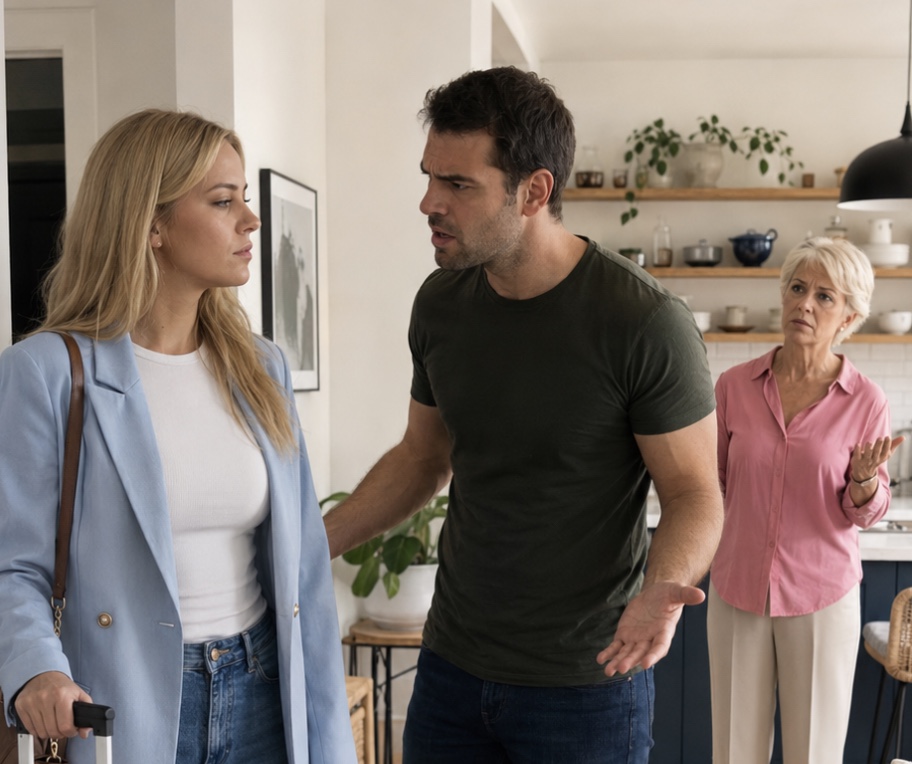
The suitcase had been standing by the front door since seven in the morning.
Oksana had packed it the night before, carefully and without any rush, while Maksim watched football in the living room and Lyudmila Ivanovna banged pots and pans around in the kitchen. Two suitcases, a bag containing her documents, and a box of books. Everything that truly belonged to her.
The rest could stay behind—the dishes they had bought together, the throw blanket and sofa cushions, the two pots of geraniums on the windowsill.
She didn’t need any of it.
Maksim noticed the luggage in the morning when he came out to make coffee. He stopped in the doorway, stared at the suitcases, then looked at his wife.
“What’s this?” he asked.
“A suitcase,” Oksana replied.
“I can see that. Are you going somewhere?”
“Yes.”
Maksim rubbed a hand over his face as though the conversation had already exhausted him, even though it had barely begun.
“Oksana, come on. Enough. You’re upset, I understand. But there’s no need for this whole suitcase performance.”
 
“I’m not upset,” Oksana said.
Her voice was steady—not deliberately calm, but genuinely calm, the way someone sounds after making a decision long ago and finally becoming comfortable with it.
Maksim poured himself coffee and sat across from her.
“Listen,” he began in a softer, more conciliatory tone. “Mom is only going to stay with us for a little while, until we sort out her situation. I already explained that.”
“You did.”
“So what’s the problem?”
Oksana looked at him.
For a moment, she wondered where to begin. With yesterday’s ultimatum? With the week before, when Lyudmila Ivanovna had rearranged every towel in the apartment because she knew “the proper way” to hang them?
No.
She would have to begin at the beginning.
But the beginning had been years ago, and there was neither time nor reason to retell the whole story.
“Maksim,” Oksana said, “I’m leaving for good.”
Silence.
“For good?” he repeated flatly.
“Yes.”
Maksim set down his mug, leaned back in his chair, and folded his arms.
“I see,” he said in a tone Oksana knew perfectly well. The next part would be about her being emotional and exaggerating everything. “And where exactly are you going for good? To your mother’s?”
“No.”
 
“To a friend’s?”
“No.”
His expression tightened slightly.
“Then where?”
“To my apartment,” Oksana said.
That silence was different.
 
They had been together for five years.
They had met through mutual friends and moved quickly into a serious relationship. Maksim could be charming when he wanted to be. He knew how to listen and how to make her laugh.
Their first year together had been good.
Then the first cracks appeared—small ones at first, barely noticeable, the kind that emerge when two people begin living side by side and finally see each other without the polish of the early months.
They rented a two-bedroom apartment in a residential district, on the fourth floor overlooking a parking lot. The rent was thirty-five thousand rubles a month, a significant amount for their household budget.
Maksim worked as a construction foreman. He earned around sixty thousand on average, but his income was inconsistent. One month it might be seventy, the next barely fifty.
Oksana worked as an accountant for a small trading company and earned a steady forty-eight thousand.
They weren’t wealthy, but they weren’t struggling either.
At least, they wouldn’t have been struggling if they had known how to agree on money.
They didn’t.
Maksim had a habit of making financial decisions on his own and informing his wife afterward.
He bought expensive tools for a garage they didn’t even own.
He lent a substantial amount of money to a friend without discussing it with her.
Whenever Oksana questioned him, his answer was always the same.
“I’m the man. I make the decisions.”
The discussions about Lyudmila Ivanovna had begun long before she moved in.
Maksim’s mother lived alone in her own apartment after her husband died several years earlier. At first, she didn’t interfere much in her son’s marriage. She visited on holidays and called occasionally.
Oksana’s feelings toward her were neutral. She didn’t particularly like her mother-in-law, but they didn’t openly clash either.
Lyudmila Ivanovna seemed to feel much the same way. She tolerated her daughter-in-law while occasionally remarking that when Maksim had been a child, everything in their home had always been tidier and the borscht had always been richer.
Then something changed.
The visits became more frequent.
The comments became more pointed.
“Oksana, did you turn off the gas?” her mother-in-law would ask while inspecting the kitchen after lunch. “I always check. Force of habit.”
“Yes, Lyudmila Ivanovna. I turned it off.”
“Hmm.”
She would touch the burners herself.
“Make sure. Maksim told me about that time you forgot the kettle.”
“That happened once. Three years ago.”
“A good memory is a useful thing,” Lyudmila Ivanovna would reply, as though that had been her point all along.
Maksim reacted to such scenes the same way every time.
 
He shrugged and left the room.
Occasionally, he told Oksana afterward, “That’s just how Mom is. Ignore her.”
Oksana tried.
It became harder each time.
The turning point came unexpectedly.
Unexpectedly for Maksim, at least.
Oksana had sensed that something like it would eventually happen. She simply hadn’t known what form it would take.
Lyudmila Ivanovna transferred ownership of her apartment to her daughter, Larisa.
Her explanation was straightforward: Larisa lived with her husband and two children and needed the space more.
Maksim learned about it from his mother over the phone.
He came home looking as though he had lost something important.
“Mom transferred the apartment to Larisa,” he said.
“I know,” Oksana replied. “You already told me.”
“Now she has nowhere to live.”
Oksana lowered her book.
“Larisa has three rooms. Surely they could—”
“Oksana.”
Maksim gave her the look that meant the discussion was over.
“My mother is moving in with us. This is not up for debate.”
“Maksim, we rent a two-bedroom apartment. There are only two of us and sometimes even we feel cramped. If your mother moves in—”
“She is my mother.”
“I understand that. But this affects both of us, and I want us to—”
“You want what?” he interrupted. “To throw an elderly woman out onto the street?”
Oksana exhaled slowly.
“I’m not suggesting anyone be thrown onto the street. I’m suggesting we discuss other options. Maybe Larisa—”
“Larisa is a separate issue. Mom is coming here. That’s final.”
Final.
After that conversation, Oksana sat in the bathroom for a long time with the hot water running, staring at nothing.
She wasn’t thinking about her mother-in-law.
She wasn’t even thinking about Maksim.
She was thinking about something else.
Several months earlier, she had received a letter from a notary.
Pyotr—a distant relative, her father’s cousin, whom Oksana had met perhaps three times in her entire life—had died and unexpectedly left her something in his will.
The paperwork was nearly complete. She only needed to wait for the final registration.
Oksana had decided not to tell anyone.
 
Not because she wanted to deceive Maksim.
She simply wanted to know that everything was real first. Things like inheritances seemed unreal until the documents were actually in your hands.
Three weeks after the argument about Lyudmila Ivanovna, those documents arrived.
Pyotr had left Oksana a one-bedroom apartment in a nearby district.
It was small, but the building was decent and the apartment itself had been reasonably well maintained. It had stood empty for several years and needed some work, but it was perfectly livable.
Oksana went there alone.
She unlocked the door, stepped inside, and stood in the silence.
And one thought came to her.
This is it.
That was the moment she stopped arguing about Lyudmila Ivanovna moving in.
 
Maksim interpreted her silence as victory.
Oksana watched his shoulders relax. He became calmer and more confident, as though his wife’s resistance had been an exhausting inconvenience and now everything had finally returned to its proper order.
He brought his mother over on Friday evening.
She arrived with two large bags, a box of dishes, and her favorite rocking chair, which barely fit through the doorway.
Lyudmila Ivanovna entered, looked around, and pursed her lips.
“A bit cramped,” she said. “But we’ll sort it out.”
And she began sorting things out immediately.
By Sunday evening, the kitchen had been reorganized according to Lyudmila Ivanovna’s preferences.
The spices were moved to another shelf.
The pots had changed places.
Oksana’s favorite frying pan had been pushed into the bottom cupboard because her mother-in-law didn’t like that particular size.
“Lyudmila Ivanovna,” Oksana said on Monday morning after failing to find her spatula, “where is my spatula?”
“In the drawer where it belongs,” her mother-in-law answered without turning away from the stove.
“It was kept here.”
“That was inconvenient. I moved it.”
Oksana opened the drawer, found the spatula, and closed it again.
She said nothing.
Maksim sat at the table drinking coffee and scrolling through his phone.
By the end of the first week, Lyudmila Ivanovna had settled in completely.
Her commentary on Oksana’s cooking became an everyday occurrence.
She never shouted or openly insulted her. She simply delivered her remarks in the tone of someone stating indisputable facts.
“It’s better to salt potatoes at the end.”
“I marinate chicken differently. Maksim has always preferred mine.”
“You use too much oil.”
Maksim never told his mother to stop.
Once, he even nodded in agreement.
“Mom’s right. The potatoes are a little too salty.”
Oksana looked at him.
She said nothing.
On Friday evening, exactly ten days after Lyudmila Ivanovna had moved in, Maksim came home in a particular mood.
Oksana noticed it immediately—in the way he entered, the way he put down his keys, and especially in the quick look he exchanged with his mother in the hallway.
Something had been planned.
Dinner began normally enough.
They talked about the weather and the neighbors.
Then Maksim put down his fork, looked at Oksana, and spoke in the tone of a man delivering an official ruling.
“Oksana, I want to make something clear. Mom lives here now, so we need to establish some rules to avoid confusion.”
He straightened in his chair.
“Starting today, my mother is in charge of the kitchen. She knows how things should be done, and she’ll decide what gets cooked and how. You just need to accept that.”
Beside him, Lyudmila Ivanovna sat with the satisfied expression of someone who had just been awarded a certificate of authority.
Oksana looked at her husband.
Then she looked at his mother.
She picked up her napkin and dabbed her lips.
“All right,” she said.
Maksim had clearly expected an argument.
He hesitated.
“Good. Then we understand each other,” he said, slightly thrown off by her lack of resistance.
“Mm-hmm.”
Oksana stood and began clearing the plates.
 
Lyudmila Ivanovna followed her with her eyes, then quietly said to her son:
“See? Sometimes you simply have to be firm.”
Oksana was standing at the sink at that moment, thinking that she should call the notary the next morning and clarify one small detail about the documents.
Nothing important.
Just a technicality.
She made the call the following morning while Maksim was at work and Lyudmila Ivanovna was rattling cookware around the kitchen.
The notary answered quickly.
Everything was ready.
Oksana could come in and sign the final papers.
She made an appointment for the day after next.
That day happened to be an ordinary Tuesday.
Oksana took two hours off work, drove to the notary’s office, carefully read every document, and signed.
The keys to the apartment had already been in her handbag since the previous week.
That evening, she returned home, made herself some tea, and sat in the living room with a book.
Maksim was watching something on his laptop.
Lyudmila Ivanovna was knitting in her rocking chair.
An ordinary evening.
Oksana turned a page and thought:
Almost done.
She began packing two days before leaving.
Slowly.
A few things at a time, so no one would notice.
She had already placed her documents in a separate bag.
She packed clothes in the evenings while Maksim was in the shower.
The night before leaving, she finally put the suitcases by the door, making it look as though she might simply be going on a short trip.
Maksim didn’t ask.
And now, the next morning, they were sitting across from each other while he stared at his wife with the expression of a man who had suddenly discovered that the ground beneath him was disappearing.
“What do you mean, your apartment?” he asked slowly.
“A one-bedroom apartment. In the Northern District.”
“Where did you get an apartment?”
Oksana set down her cup.
“Pyotr died in February,” she said. “My father’s cousin. He left the apartment to me. I’ve been handling the inheritance paperwork for three months.”
Maksim stared at her.
He said nothing.
“Three months,” he repeated eventually.
“Yes.”
“And you didn’t tell me.”
“No.”
 
“Why?”
Oksana thought about how to answer accurately without making the explanation longer than necessary.
“Because I wanted to make sure everything was finalized first. And afterward, to be completely honest, Maksim, I was waiting for this.”
She gestured slightly toward the living room, where Lyudmila Ivanovna’s rocking chair stood.
“I needed to know for certain.”
“Know what?”
“That it was time to leave.”
Maksim stood up and paced across the kitchen before turning back toward her.
“Wait. So you knew all this time that you were planning to leave, and meanwhile you agreed to everything? Mom moving in, the kitchen, all of it?”
“I didn’t agree,” Oksana said calmly. “I simply stopped arguing. Those aren’t the same thing.”
“Oksana.” His voice hardened. “Property acquired during marriage belongs to both spouses. You understand that, right?”
“Inherited property isn’t considered jointly acquired marital property,” Oksana replied. “I checked with a lawyer.”
Maksim bit the inside of his cheek, a habit Oksana recognized immediately. He did it whenever he was angry and couldn’t think of an answer.
“So you deliberately went to a lawyer.”
“Yes.”
“So you were preparing for this.”
“Yes, Maksim. I was.”
Lyudmila Ivanovna appeared in the hallway wearing her robe and looking alarmed.
She looked at the suitcases, then at Oksana, then at her son.
“What’s going on?” she asked.
“Oksana is leaving,” Maksim answered.
Lyudmila Ivanovna stared at her daughter-in-law.
“Leaving for where?”
 
“I have an apartment, Lyudmila Ivanovna,” Oksana said. “That’s where I’m going.”
Her mother-in-law processed that information for perhaps three seconds.
Then her expression changed.
“An apartment,” she repeated with sudden interest. “So you’re going to live there alone.”
She nodded slowly, clearly calculating something.
“Well, then maybe you could take me with you. If it’s too crowded for Maksim here. We’re family, after all.”
Oksana looked at her mother-in-law.
Then, unable to help herself, she gave a short laugh.
Not cruelly.
Simply from sheer disbelief.
“No, Lyudmila Ivanovna.”
“Why not?” the older woman asked, offended.
“Because no.”
By this point, Maksim had stopped trying to look composed.
“Oksana, do you understand that if you walk out like this, it’s over?” he said. “I’m not going to sit around waiting for you to come to your senses.”
“I understand.”
 
“This means divorce.”
“I understand, Maksim.”
He stared at her as though waiting for her to back down.
She had backed down before.
In other arguments, whenever he raised his voice or issued some final condition, Oksana had usually been the one to compromise.
But something about her face was different now.
There was no fear.
No hesitation before making the decision.
Mentally, she was already on the other side of the door.
Only her body was still standing inside the apartment.
The doorbell rang.
Maksim went to answer it, visibly irritated.
Larisa stood outside—a tall woman with short hair and the expression of someone who had spent the entire drive working herself into a rage.
“Mom called me,” Larisa announced from the doorway, staring at Oksana. “So you inherited an apartment.”
“Hello, Larisa,” Oksana said.
“This isn’t fair,” Larisa declared, stepping inside without being invited. “That apartment should have stayed in the family. Uncle Petya was related to all of us, not just you.”
“He was my father’s cousin,” Oksana said.
“So what? We knew him too.”
“He left the apartment to me. There’s a will. Signed and legally certified.”
Larisa turned toward her brother for support.
Maksim already looked exhausted by the morning, but he still wasn’t ready to give up.
“Oksana,” he said, “let’s discuss this properly. Sit down, talk calmly. Maybe we can reach some kind of agreement.”
“Agreement about what?”
“Well… the apartment could become part of our shared assets. We could sell it, for example, and buy something together. A proper place instead of renting.”
“No.”
“Why immediately say no?”
“Maksim,” Oksana said, “you just announced that your mother would be in charge of the kitchen in the home where I live. You’ve made financial decisions without asking me. You decided your mother was moving in without discussing it with me. And now you suddenly want to talk about sharing assets?”
Maksim opened his mouth.
Then closed it.
“Those are different things,” he said.
“No. They’re exactly the same thing.”
Behind him, Larisa started talking again about fairness, family, and how Oksana had always only thought about herself.
Lyudmila Ivanovna added comments from the hallway.
Maksim tried to explain something to his wife while simultaneously calming both his mother and sister.
Eventually, all three of them were talking at once—loudly, interrupting each other.
Oksana picked up the bag containing her documents.
Then she took hold of the suitcase handle.
Lyudmila Ivanovna grabbed the second handle.
 
“Wait!”
“Lyudmila Ivanovna,” Oksana said quietly. “Let go.”
Something in Oksana’s voice made the older woman immediately release the suitcase.
Oksana took out their marriage certificate.
She returned to the kitchen and placed it on the table beside Maksim’s empty coffee cup.
“I’ll file for divorce myself,” she said. “You don’t need to do anything.”
Maksim stared at the certificate.
“Wait,” he said.
His voice changed.
It became quieter, stripped of its former certainty.
“Oksana. Wait. We’ve been together five years.”
“Yes,” she said. “Five years.”
“You can’t just suddenly—”
 
“I didn’t suddenly do anything. I thought about this for a long time. I waited for a long time. And then I spent an even longer time finding the courage to make the decision. This didn’t start yesterday, Maksim.”
He fell silent.
Something passed across his face.
Not anger.
Not resentment.
Something else.
Maybe belated understanding.
Perhaps only now, seeing his wife standing beside the door with packed suitcases, did he realize how far things had gone.
But the realization had come too late.
Oksana picked up the second suitcase.
“I’ll come back for the box of books later,” she said. “At a convenient time when none of you are here. I’ll leave the key with the neighbor.”
“Oksana…” Lyudmila Ivanovna began.
“Goodbye, Lyudmila Ivanovna.”
The door closed behind her.
The stairwell was quiet.
Oksana walked down two flights, set down one suitcase, pulled out her phone, and ordered a taxi.
While she waited—three or four minutes at most—she stood staring at the peeling paint on the wall and at a child’s dinosaur sticker stuck about three feet above the floor.
The dinosaur was green.
And smiling.
The taxi arrived four minutes later.
The apartment Oksana entered smelled abandoned—dust, old wallpaper, and stagnant air.
She immediately opened a window.
Fresh autumn air drifted into the room, carrying the scent of wet leaves and a hint of dampness.
Oksana placed the suitcases against the wall and walked through the apartment.
A tiny hallway.
A room with a high ceiling.
A kitchen with a window overlooking the courtyard.
There was almost no furniture.
A table.
Two chairs.
An old sofa left behind by whoever had lived there before.
Oksana sat down on the sofa.
The springs sagged slightly beneath her.
Outside, someone was working on a car in the courtyard, tools clanging softly.
Her phone vibrated several times.
Maksim.
Then Lyudmila Ivanovna.
Then Maksim again.
Oksana slipped the phone into her pocket and didn’t answer.
She sat quietly in her own apartment.
After a few minutes, she stood up and found an old piece of candy in the pocket of her jacket, probably left there after work.
She ate it.
Then she opened the notes app on her phone and began making a list.
“Buy: kettle. Bedding. At least two plates. Desk lamp. Call Mom…”
She had written her mother last.
Oksana crossed it out and moved it to the top.
Irina Nikolaevna answered after the first ring.
“Oksana?”
Her mother’s voice immediately changed into the tone Oksana remembered from childhood—the one she used whenever she sensed something had happened but didn’t want to pressure her daughter.
“Mom, I moved.”
A short silence.
“Where?”
“To Uncle Petya’s apartment. Remember? I told you about it.”
“I remember.”
Another pause.
“Alone?”
“Alone.”
Her mother didn’t ask anything else.
Not about Maksim.
Not about what had happened.
She simply said:
“I’m at the market right now. I’ll buy everything you need and come over.”
Oksana put the phone down.
She looked through the window at the courtyard below—the trees, a bench, a small children’s playground.
Somewhere beyond the walls, the city hummed quietly.
The divorce was finalized two months later.
 
There was almost nothing to divide.
The rented apartment where Maksim remained with his mother didn’t belong to either of them. They had no major shared assets worth fighting over in court.
The appliances they had purchased together were divided quickly, without dramatic arguments.
Oksana didn’t ask for much.
She took what belonged to her and walked away.
Maksim messaged her several times afterward.
At first, his messages were accusatory.
Then came explanations.
Later, simply:
“Call me. Let’s talk.”
Oksana answered briefly and without anger.
Once she wrote:
“Maksim, there’s nothing left for us to discuss. Not because I’m angry, but because everything that needed to be said has already been said.”
He never contacted her again.
Larisa tried once more.
She sent a message through a mutual acquaintance, claiming there was something dishonest about the inheritance.
Oksana sent back her lawyer’s contact information through the same acquaintance and refused to discuss the matter further.
Six months later, Lyudmila Ivanovna finally moved in with Larisa.
Maksim began renting a smaller, cheaper apartment alone.
Oksana found out by accident during a conversation with someone they both knew.
Her only thought was:
So that’s how it turned out.
Then she forgot about it because something on the stove was boiling over.
 
Her apartment gradually began to feel like a real home.
She bought curtains.
It took her three stores and far too much time to choose them, but eventually she settled on soft gray-blue linen ones.
She bought a proper sofa.
A bookshelf.
A cactus for the windowsill—small and prickly, planted in a bright red pot.
Her mother came over on Sundays.
They drank tea and talked.
 
Sometimes they watched something together.
Sometimes they simply sat in silence—the kind of silence that exists only between people who are truly close, when no one feels the need to fill it.
One Sunday, her mother asked:
“So how does it feel, living alone?”
Oksana thought for a moment.
“You know,” she said, “it depends. Sometimes it’s very quiet.”
She smiled slightly.
“But quiet doesn’t necessarily mean bad.”
Her mother nodded and poured them both another cup of tea.