Vika stepped out of the notary’s office clutching a thick stack of documents, still struggling to comprehend what had just happened.
A three-bedroom apartment on Arbat Street. Ninety square meters in the very heart of the city.
Her grandmother, Klavdia Semyonovna, had left everything to her granddaughter—the only person who had visited the elderly woman every weekend for the past five years.
The sun was unusually hot for the season, so Vika sat down on a bench in the small park across from the notary’s office. The papers rustled in the warm breeze.
The certificate confirming her inheritance rights.
An official extract from the property register.
A statement confirming there were no unpaid utility bills.
Everything was official. Everything was legal.
The apartment now belonged to Viktoria Sergeyevna Komarova, thirty-two years old, sales manager.
Her phone vibrated.
It was her mother.
“Vika, how did it go? Did you finish all the paperwork?”
“Yes. Everything’s done. The apartment is mine.”
“That’s good. Come over tonight. We need to talk. Your father is already home.”
“All right, Mom.”
Vika already knew the conversation would not be easy.
The family had known about the will, but no one had expected Grandma to leave the entire apartment to only one granddaughter.
Vika had an older sister, Karina, who was thirty-five and had two children—eight-year-old Artyom and five-year-old Nastya. The family lived in a one-bedroom apartment on the outskirts of the city, and they were desperately short on space.
That evening, Vika went to her parents’ home.
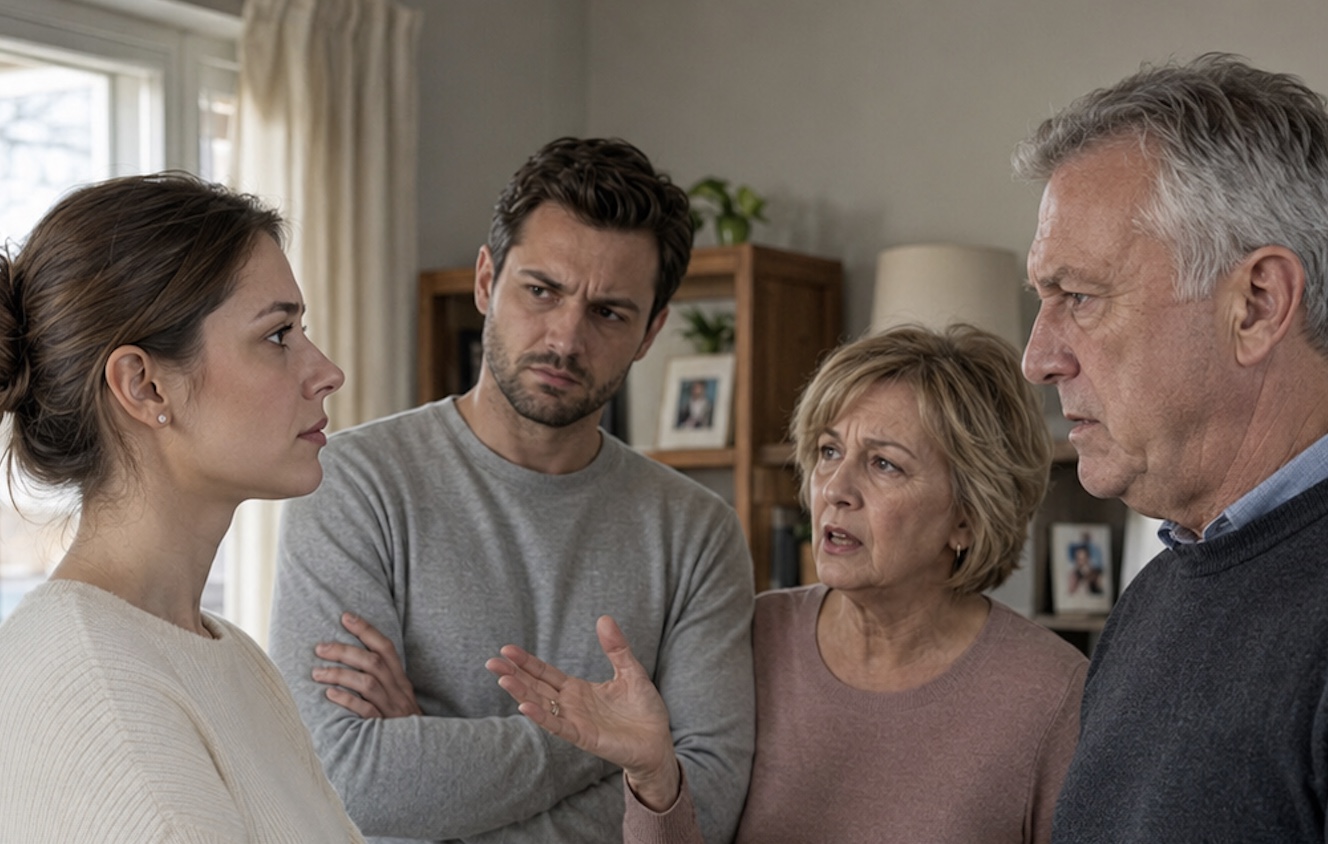
Her mother, Lyudmila Vasilyevna, had set the table. Her father, Sergey Nikolayevich, was sitting in front of the television, though the sound had been muted.
“Well, tell us how it went,” her mother said as she sat down.
“Nothing unusual. I signed the documents and received the certificate. I’ll be able to move in next month.”
“Move in?” her father asked, turning toward her. “Why would you move? You already have an apartment.”
“A one-bedroom apartment, Dad. Now I can live in a three-bedroom place.”
“A three-bedroom apartment…” Her mother shook her head thoughtfully. “Vika, haven’t you considered that such a large apartment might be excessive for one person?”
“Mom, I work and pay my own bills. How is that excessive?”
“It isn’t about the money,” her father interrupted. “It’s just that… you don’t have a family or children. Karina has two children living in one room. Artyom is getting older. He needs his own space.”
Vika put down her fork and looked at her parents.
“Dad, what exactly are you trying to say?”
“Nothing in particular. We simply think it would be fair if you… shared.”
“Shared? What do you mean?”
“Karina and the children could move in with you. There’s plenty of room. You could help your sister.”
Vika leaned back in her chair.
So the conversation was exactly what she had expected.
“Mom, Dad, Grandma left the apartment to me in her will. That was her decision.”
“Of course, of course,” her mother said quickly. “No one is disputing that. But you understand that Karina is in a difficult situation. The children are growing, and they don’t have enough space.”
“Karina has a husband. He can work, save money, and buy a larger apartment.”
“Viktoria!” her mother exclaimed. “How can you speak about your own sister that way?”
“I’m only telling the truth. Karina chose to get married and have children. That was her decision, and those choices come with responsibilities.”
“Children aren’t a responsibility. They’re a blessing,” her father said. “You would understand that if you had children of your own.”
“Dad, what do children have to do with this? We’re talking about an inheritance. An inheritance Grandma left to me.”
“Grandma gave you the apartment because you visited her,” her mother said. “But she couldn’t have known Karina would have housing problems.”
“Mom, Karina doesn’t have a housing problem. She has an apartment. She simply wants a larger one. That’s understandable, but it isn’t my responsibility.”
“Viktoria, a family isn’t merely a group of relatives. A family supports one another. When one family member suddenly has more opportunities, that person should help the others.”
“I’m not against helping. But I’m not giving away my apartment.”
“No one is asking you to give it away,” her mother said, waving her hand dismissively. “We’re only asking you to let them stay there. The apartment is large enough for everyone.”
“Mom, I want to live alone. I work, pay taxes, and take care of myself so that I can have an independent life.”
“An independent life…” her father said with a humorless smile. “At thirty-two, perhaps you should start thinking about having a family.”
“Dad, that isn’t what we’re discussing.”
“That is exactly what we’re discussing,” he replied, standing and pacing across the room. “You have no husband and no children. The apartment will be half empty. Karina has a family and growing children. Where is the logic in that?”
“The logic is that the apartment belongs to me. Grandma left it to me.”
“A will is only a legal formality,” her mother said. “Family is forever.”
“If family is forever, why can’t Karina continue living in her own apartment?”
“Because there’s no space!” her mother shouted, slamming her fist on the table. “The children sleep on the sofa. There’s nowhere to store their toys. Meanwhile, you’ll have three empty rooms.”
“I’m not planning to leave them empty. One will be my bedroom, one will be an office, and the third will be a living room.”
“An office?” her father asked, shaking his head. “What do you need an office for? You aren’t a writer.”
“For work. I sometimes work from home.”
“Vika, sweetheart,” her mother said, moving closer, “surely you understand that children are the future. Artyom and Nastya are your nephew and niece. Doesn’t it hurt you to know they’re growing up in such cramped conditions?”
“Of course it does. But that doesn’t mean I’m obligated to give up my apartment.”
“Not give it up. Share it. Temporarily. Until Karina and her husband solve their housing situation.”
“And what if they never solve it? What if they enjoy living in a spacious apartment in the city center?”
“Vika, what are you saying? Karina isn’t a stranger.”
“That’s exactly why I don’t want to ruin our relationship. First they’ll come temporarily, and then they’ll stay forever.”
“And what would be so terrible about that?” her father asked, sitting down again. “Would it really be so bad for the family to live together?”
“Dad, I don’t want to live with Karina, her husband, and their children. I want to live alone.”
“Selfishness,” her mother said quietly. “Pure selfishness.”
“Mom, it isn’t selfishness. It’s my right.”
“Your right…” Her father walked over to the window. “Yes, legally, you have the right to the apartment. But do you have a conscience?”
“Of course I do. But having a conscience doesn’t mean I should be forced to live with people I don’t want to live with.”
“People?” her mother cried, jumping to her feet. “That’s your sister and your niece and nephew!”
“Mom, I know exactly who they are. That doesn’t change the fact that I want to live alone.”
“You know what?” her father said, turning toward her. “Talk to Karina. Meet with her and discuss it. Maybe the two of you can reach some kind of compromise.”
“What kind of compromise?”
“I don’t know. Divide the apartment somehow. Make a schedule. Or perhaps Karina could contribute to the utility bills.”
“Dad, I don’t want a compromise. I want to live alone in my own apartment.”
“Then you’re selfish,” her mother said. “Grandma wouldn’t have understood you.”
“Mom, Grandma left the apartment to me. That means she wanted me to live there.”
“She wanted you to be happy. But how can you be happy knowing your own sister is suffering in a cramped apartment?”
“Mom, Karina isn’t suffering. She has a home, a husband, and children. She has an ordinary family life.”
“Ordinary?” her father laughed. “Four people in a one-bedroom apartment?”
“Dad, millions of families live in one-bedroom apartments with children. They manage.”
“But they don’t have wealthy relatives with spare rooms.”
“I’m not a wealthy relative. I simply inherited an apartment.”
“You inherited an apartment and immediately became arrogant,” her mother said. “You’ve forgotten that you have a family.”
“I haven’t forgotten anything. But family is not a reason to surrender my rights.”
“Rights, rights, rights…” Her mother waved her hand. “What about obligations? Don’t you have any responsibilities toward your family?”
“What responsibilities?”
“To help the people close to you. To support them. To share.”
“Mom, I’m willing to help financially if they truly need it. But I’m not willing to give them my apartment.”
“Money?” her father said with a scoff. “Karina has children, and you’re offering money?”
“I’m offering what I’m comfortable offering.”
“You could offer them a roof over their heads.”
“Karina already has a roof over her head.”
“A leaking roof in an old building on the outskirts.”
“Then they should repair it.”
“With what money? They don’t have any.”
“Then they can take out a loan.”
“And what if the bank refuses?”
“Then they should find better-paying jobs.”
“Vika,” her mother said, standing beside her, “I don’t recognize you anymore. You used to be kinder.”
“I’m still kind. But kindness shouldn’t turn into foolishness.”
“Helping your sister is foolishness?”
“Giving up control of my apartment would be foolish.”
“No one is asking you to give it up. We’re asking you to let them stay.”
“Mom, we’ve already discussed this.”
“We’ve discussed it, but you still haven’t made the right decision. Think about it again, Vika. Think very carefully.”
“I already have. My decision is final.”
“Final?”
“Final.”
Her parents exchanged glances. Vika saw disappointment in their eyes, along with something else.
Judgment.
“All right,” her father said eventually. “We’ll talk to Karina. Perhaps she can persuade you.”
“No one is going to persuade me.”
“We’ll see,” her mother said as she began clearing the table. “Karina is coming tomorrow. The two of you can talk honestly.”
“Mom, I don’t want to discuss this with Karina.”
“You’ll have to. She’s your sister.”
“That’s precisely why I don’t want to destroy our relationship.”
“Relationships aren’t destroyed by conversations. They’re destroyed by selfishness.”
Vika stood.
“I should go. It’s getting late.”
“Go,” her mother replied without turning around. “But remember, family isn’t only about rights. It’s also about obligations.”
“I remember, Mom.”
“Then behave accordingly.”
Vika left her parents’ apartment with a heavy feeling in her chest.
The conversation had unfolded exactly as she had expected. Her parents believed the inheritance should benefit the entire family, not one person.
Vika disagreed.
The apartment belonged to her—legally, morally, and fairly.
The following day, Vika was at work when Karina called.
“Hi, Vik. How are you?”
“Hi, Kar. I’m fine.”
“Listen, can I come over tonight? We need to talk.”
“About what?”
“Just family matters. Mom and Dad told me you received an inheritance.”
“Yes, I did.”
“Then we’ll talk about it. I’ll bring the children. They haven’t seen their aunt in a while.”
“Karina…”
“What? Am I not allowed to bring your nephew and niece?”
“You are. But if this conversation is going to be about what I think it is, it would be better not to bring the children.”
“And what do you think it’s about?”
“Mom and Dad want me to let your family move in with me.”
“Vik, what’s so terrible about that? We’re family.”
“Come alone, Karina. We’ll talk.”
“All right. I’ll be there at seven.”
Vika knew the evening would be difficult.
Karina was coming with a request that would be hard to refuse without causing resentment.
But Vika was going to refuse.
At exactly seven, the doorbell rang.
Karina stood on the landing holding a bouquet of flowers and wearing her usual friendly smile. She congratulated Vika on the inheritance, and the sisters sat down in the kitchen.
Karina immediately looked around and commented that Vika’s current apartment seemed rather small for a large family.
Vika suggested they get straight to the point.
Karina began describing her situation. Artyom was getting older and needed his own room. Nastya was no longer a baby either, yet the entire family lived in one room.
Soon, Vika would have a three-bedroom apartment in the center of the city. There would be plenty of space.
Karina carefully hinted that Vika did not appear interested in having children and that leaving such a large apartment half empty would be wrong.
Vika stood and walked over to the window.
The evening city hummed beyond the glass. Soon, she would be looking out over the city from the windows of her new apartment.
That brief pause helped her fully understand the scale of the problem.
If she gave in now, she would lose control over her own life forever. Karina and her family would settle into the apartment, while Vika would become the permanent sponsor of their problems.
Karina continued insisting that families were supposed to support each other.
Vika agreed—but support should not require one family member to sacrifice everything for the others.
When the conversation turned to Karina’s husband, the situation became even clearer.
Oleg worked as a security guard for only twelve hours a week. He preferred living on his wife’s salary and asking relatives for help.
Once Vika examined the family’s true motives, she understood that her parents were simply trying to transfer Karina’s financial problems onto her shoulders.
Vika began asking uncomfortable questions.
Who would pay the utility bills?
Who would buy food?
Who would pay for repairs and household expenses?
Karina claimed they would contribute, but with Oleg’s small security guard salary and Karina’s income as a kindergarten teacher—fifty thousand rubles a month—it was obvious they could not afford the expenses of a large apartment in the city center.
Vika would be expected to cover the difference.
Oleg’s behavior over the years confirmed that she was making the right decision.
During the five years Vika had known him, he had changed jobs ten times. Every workplace had supposedly been unfair, every manager impossible, every schedule unacceptable.
A person like that was unlikely to change.
The problems would only grow.
Why would Oleg make an effort when his wife had a sister with a free apartment?
Karina tried to suggest a compromise.
Perhaps they could rent a room from Vika and pay her each month.
But a room in the city center cost around fifty thousand rubles, and Karina’s family clearly did not have that kind of money.
That meant another family discount, another arrangement where Vika would be expected to subsidize their lifestyle.
At that moment, Vika made her final decision.
The apartment was her inheritance. She had received it legally. Her grandmother had left it specifically to her, not to the entire family.
The principle was simple: her property, her rules.
No one had the right to dictate how she should use her own home.
Karina eventually began insulting her personally, calling her greedy and accusing her of forgetting about her family.
But Vika expressed her position clearly.
Greed was taking something that belonged to someone else. Vika was not taking anything.
She was protecting what belonged to her.
A family should not survive at the expense of one person.
When Karina threatened that the family would not help Vika if she ever faced difficulties, Vika already had an answer.
She was used to relying on herself and solving her own problems.
The next day, after Karina left deeply offended, Vika’s parents called.
Lyudmila Vasilyevna was crying and describing how upset Karina had become.
Sergey Nikolayevich once again tried to pressure Vika by appealing to guilt, family loyalty, and duty.
But Vika refused to change her mind.
Her parents continued accusing her of selfishness, but Vika drew a clear distinction.
Supporting another person’s entire household was not family assistance.
It was sponsorship.
Her niece and nephew were not strangers, but they were their parents’ responsibility, not their aunt’s.
The family became offended and stopped calling.
A month later, Vika completed all the remaining paperwork and moved into her grandmother’s apartment.
The spacious home in the city center became everything she had dreamed of.
She created a comfortable bedroom, a cozy home office, and a large, welcoming living room.
No one ran through the hallway.
No one shouted.
No one constantly demanded her attention.
There was silence, peace, and personal space.
Sometimes Vika thought about her family, but she had no desire to call them.
The resentment was mutual.
Six months passed.
The apartment became warm and comfortable, decorated entirely according to her taste.
There were no compromises and no unwanted opinions.
Eventually, her parents came to visit.
They complimented the renovation, though they once again remarked that the apartment was too large for one person.
Vika had expected comments like that.
When they asked whether she regretted her decision, her answer was immediate.
No.
Her parents never raised the subject of Karina again.
Vika continued living alone in her apartment, and she was perfectly content.
Her grandmother’s inheritance had given her what she had always wanted—freedom and independence.
No one could force her to surrender either of them.
Eventually, Vika summarized her position in a single principle that became her rule for life:
She was not responsible for the fact that other people had failed to plan for their housing needs.
If the family wanted to help Karina, they could all contribute money toward renting her a better apartment.
But Vika’s inheritance would remain hers.
No one had the right to claim something that legally belonged to her.