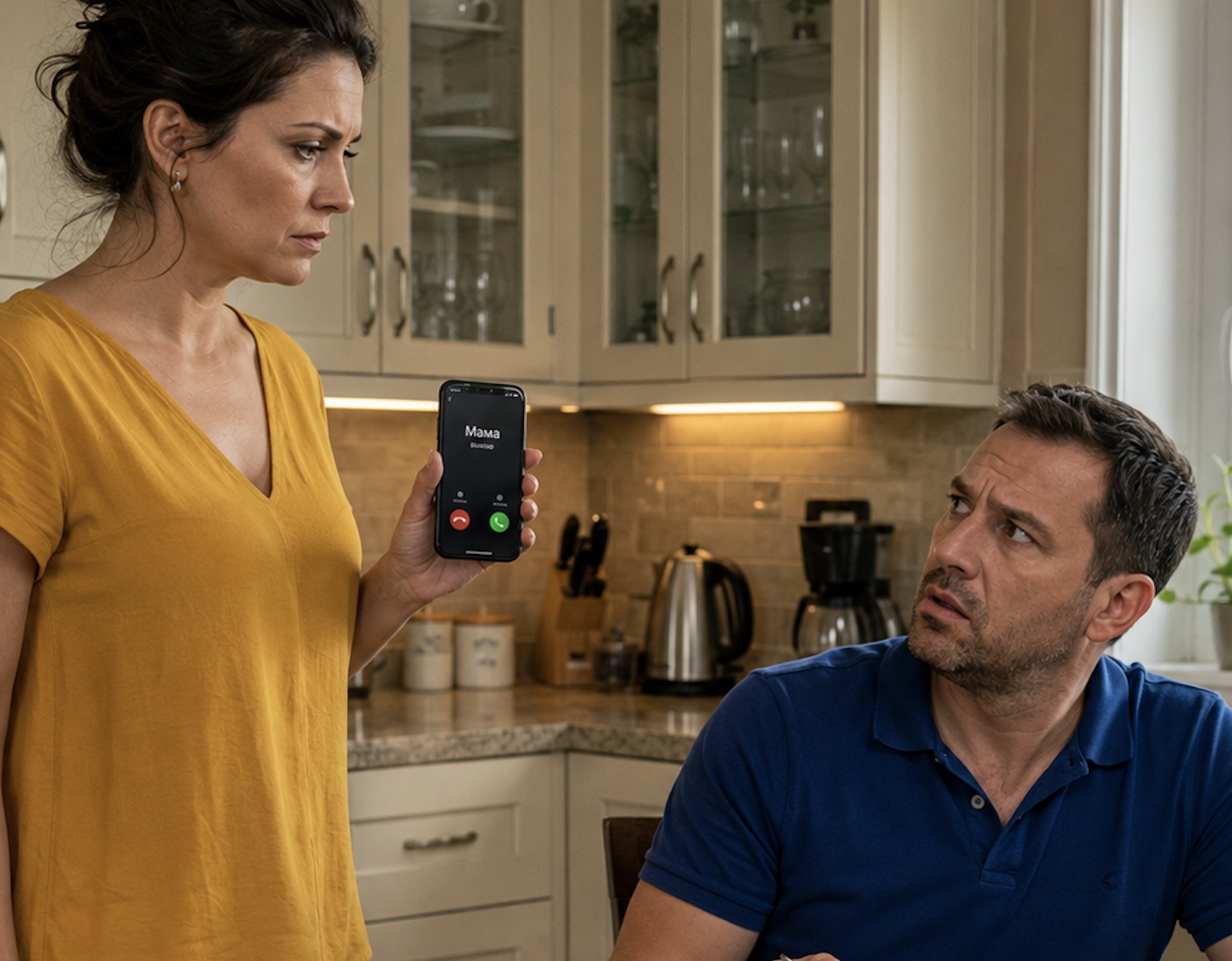
The phone rang at twelve thirty. Marina remembered the exact time because she had been looking at the clock above the stove, thinking that for the first time in three months she finally had a Saturday to herself. She could at last watch the series Lyuda from work had recommended.
“Marin, listen, Sasha and Lena are coming over, and so are Dima and his wife. They’ll be here in about two hours. Put something together for the table, the usual.”
Igor spoke in the same casual tone people used when talking about the weather or traffic on the ring road. In the background, Marina heard someone laughing and the sharp crack of a billiard ball being struck.
“Igor, are you serious right now?”
“What’s the big deal? We haven’t all met up in ages, so I thought…”
“You thought.”
“Well, yes. It’s nothing complicated. Make a little salad, put some meat in the oven. We had something in the freezer, didn’t we?”
Marina stood in her worn dressing gown, its stretched pockets holding a used tissue and the stub of a pencil. She looked around the kitchen. Yesterday’s porridge pot was soaking in the sink. An open jar of instant coffee stood on the table beside her half-eaten sandwich.
“Igor, I am not preparing a table for guests today.”
The silence lasted perhaps four seconds, but in those four seconds she had time to marvel at how easily the words had come out. As though she had not spent twelve years gathering the courage to say them. As though she had merely stated something obvious.
“What do you mean?”
“Exactly what I said. I’m resting today. You want guests, order food or cook yourself. You know where the stove and refrigerator are.”
“Marin, come on. They’ve already left!”
“Then you have two hours. You’ll manage.”
She ended the call and placed the phone face down beside her sandwich. For several seconds she stood there, listening to herself, waiting for the familiar heat in her chest, the guilt, the anxiety, the urge to call him back and say, Forget it, it’s fine, I’ll do everything.
But none of that came.
All she felt was a strange lightness and a little hunger.
She finished her sandwich, poured herself another cup of coffee, and went into the bedroom.
This incident with the guests was not the first or even the tenth. It was probably closer to the hundred-and-fiftieth, if she counted from the day she and Igor had married.
Marina had been twenty-four then, and she had genuinely believed that a good wife was someone whose home was always ready to welcome anyone at any time.
In the beginning, she had even been proud of it. Igor’s female friends praised her crab-stick salad and told their husbands, “See? And you say there are no decent women left.”
Marina would smile and offer them another helping. She had enjoyed it then, sincerely, without pretending.
The problem was not the cooking, or even the guests.
The problem was the way it happened every single time.
Igor never asked. He informed her.
Sometimes he gave her two hours’ notice. Sometimes forty minutes. Once, he called when the guests were already standing downstairs, and she could hear the echo of the stairwell through the phone.
She remembered that evening especially well.
It was a Friday. She had come home from work with a temperature of 37.4°C, taken some paracetamol, and gone to bed. Half an hour later, the doorbell rang.
Genka and Natasha were standing outside with a bottle of cognac. Igor was already opening the door and saying, “Come in, come in,” while Marina stood in the hallway in her pajamas, her temples damp with sweat.
Natasha looked at her as though Marina had fallen ill on purpose to ruin their evening.
Marina still put the kettle on and sliced sausage and cheese, because Igor had said quietly but clearly in the kitchen:
“Well, we can’t throw them out now. They’re already here.”
So she did not throw them out.
She even sat with them for an hour, though her head was splitting and all she wanted was to lie down and close her eyes.
The next morning, Igor said, “See? You were worried for nothing. We had a perfectly good evening.”
Marina said nothing. She went to check her temperature.
It had risen to thirty-eight.
At half past one, Igor called again.
Marina was lying on the bed with her laptop resting on her stomach, watching the first episode of the series. It was not particularly good, but she had no intention of getting up on principle.
“Marin, this is childish. People are on their way.”
“I heard you. You have money, a phone, and a delivery app. I installed it for you last year, remember?”
“What delivery? What am I supposed to tell them?”
“Tell them your wife is resting, so you ordered food. Then eat it together.”
“Marina!”
“Igor.”
“You’re doing this deliberately, aren’t you? To spite me?”
That was when she felt something inside her tilt toward the familiar place, toward the twelve-year habit of giving in because it was easier. Because an argument was worse. Because afterward Igor would refuse to speak to her for two days, and his silence could be heavier than any shouting match. He knew how to make the air in the apartment thick and uncomfortable without saying a word.
But she told herself no.
Then she said it to him.
“I’m not doing anything to spite you. I’m simply tired of being a restaurant that never closes and never gets advance notice. I’m tired, do you hear me? I am not cooking today.”
“You’re exaggerating!”
“You call me while I’m standing here in my dressing gown and announce that six people will arrive in two hours expecting to be fed. That is not an exaggeration, Igor. This is my Saturday. Enough.”
He ended the call first.
Marina rewound the episode to the point where she had been interrupted and continued watching.
Igor came home at three.
Alone.
No guests.
He entered, removed his jacket, and hung it on the hook Marina had repaired six months earlier after he had repeatedly promised to fix it and never did.
Then he went into the kitchen.
Marina heard him open the refrigerator, stand in front of it for about twenty seconds, and close it again.
A moment later, he appeared in the bedroom doorway.
“I cancelled everything.”
“All right.”
“I told them you were ill.”
Marina closed the laptop and looked at him.
He stood leaning against the doorframe, one shoulder pressed to the wood. He did not look angry or offended. He looked confused, like someone who had arrived at a shop only to discover it was closed and had no idea what to do next.
“I’m not ill, Igor.”
“I know. But I couldn’t exactly tell them my wife refused to cook.”
“Why not?”
“Because it’s… strange.”
“What exactly is strange? That I don’t want to do it, or that you don’t know how?”
He blinked.
She could see that the remark had struck somewhere other than where she had aimed. It had landed deeper, in a place he might not even have known existed.
For a second she felt sorry for him.
The feeling passed quickly.
“I know how,” he said. “I’m just used to you…”
“To me always doing it. Yes. I’m used to it too. Now I’m breaking the habit, and you’ll have to break yours.”
He remained in the doorway for another moment, then turned and went back to the kitchen.
She heard the refrigerator open again. This time he took something out, placed it on the table, shut the door, and switched on the kettle.
Five minutes later, he returned carrying two mugs of tea and a plate of badly cut sandwiches with cheese and sausage.
The sausage slices were about three times thicker than the cheese, and he had clearly used the small knife Marina normally used for peeling potatoes.
“Here,” he said, placing the plate on the bedside table.
Marina looked at the sandwiches and did not know whether to laugh or cry.
In twelve years of marriage, this was the first time Igor had brought her food in bed for no particular reason. Not on International Women’s Day, and not after her knee operation three years earlier.
“Thank you,” she said.
He sat on the edge of the bed. The springs creaked beneath him. He took a sip from his mug and said:
“I honestly didn’t realize this was such a big problem for you, Marish.”
At that moment, she could have said, Yes, it has been a problem for years.
Then they might have had the conversation she had rehearsed in her head a thousand times, complete with arguments, examples, dates, and facts. She could have laid everything out clearly while he listened, or pretended to listen, and afterward perhaps they would have made peace.
Or perhaps they would not.
But she did not do that.
Suddenly, she understood that she did not want to explain anything.
Everything that needed explaining had already become clear when Igor stood alone in front of the refrigerator, not knowing how to feed six people he had invited without asking her.
Instead, she said:
“Do you remember the time I had a fever and still sliced sausage for Genka and Natasha? I ended up taking antibiotics for a week because of complications.”
“When was that?”
“Four years ago, in November. The next morning you said, ‘We had a perfectly good evening.’”
Igor set his mug down on the bedside table. Tea spilled over the rim and onto a napkin.
“I don’t remember that.”
“I know you don’t. You don’t remember any of these things because to you they were normal. Guests arrived, your wife laid the table, everyone ate, everyone left, and your wife cleaned up. In twelve years, you never once asked yourself whether she wanted any of that on that particular Saturday.”
“You never said you didn’t!”
“And you never asked.”
He sat staring into his mug as though hoping the tea might tell him how to get through the conversation without losing anything.
But it was only tea. Black, with one spoonful of sugar, exactly the way he always drank it.
“All right,” he said at last. “So what happens now?”
“From now on, you warn me and discuss guests with me in advance. Not two hours before. At least two days. And you ask instead of announcing it. If I say no, it means no. It does not mean persuade me.”
“What if they invite themselves?”
“You say, ‘Let me check with Marina and call you back.’ Six words, Igor. You can handle it.”
He gave a quiet snort.
It was neither angry nor offended. It was the sound of someone being told something painfully obvious and wondering why he had never thought of it himself.
That evening they ate the same crooked sandwiches for dinner.
Marina refused to cook on principle. Igor refused to order delivery on principle.
So they sat in the kitchen, eating sausage and cheese and drinking tea.
It was probably the most ridiculous dinner they had shared in twelve years, but it was also the calmest.
They ate in silence.
For once, the silence was not oppressive. It was ordinary and domestic, the kind that settles between two people who have already said everything that needed to be said and are now digesting more than just their food.
When they finished, Igor stood up, collected the plates, and carried them to the sink.
Marina watched him the way someone might watch a solar eclipse.
In twelve years, Igor had carried plates to the sink perhaps five times, and each time it had felt like an event, almost an act of heroism.
“Stop looking at me like that,” he said.
“Like what?”
“Like I’m performing a magic trick.”
“Well, in a way, you are.”
He turned on the tap and began washing a plate.
He washed dishes the way people do when they only wash them twice a year: too much detergent, too little water, and with movements that suggested the plate was alive and might bite him.
“You’re holding it wrong,” Marina said.
“I know how to hold a plate.”
“You’re holding it like a steering wheel.”
“It’s round. A steering wheel is round. What’s the difference?”
She laughed.
Then he laughed too.
The plate almost slipped from his hands, but he caught it and placed it in the drying rack. He turned toward her, his hands wet, and for a brief second she saw the Igor she had married.
Marina realized with surprise that, for the first time in a very long while, he no longer looked like a man who understood exactly how the world worked.
He looked like someone who had just discovered there were things he did not know.
On Sunday morning, Dima called.
He was one of the friends who had been coming over with his wife the day before. He asked how Marina was feeling.
Igor answered the phone.
“She isn’t ill, Dim. I lied yesterday. She simply didn’t want guests, and I didn’t ask her. That’s the whole story.”
Marina stood in the hallway and heard every word.
Dima was silent for so long that she thought the call had dropped.
Then he said:
“Oh. Well, all right. My Svetka would have torn my head off long ago if I pulled something like that.”
“Exactly,” Igor said.
He looked at Marina.
What she saw in his expression was not deep remorse or some life-changing revelation. It was something more valuable: an ordinary human understanding that he had made a mess of things and was now trying to repair it, like the broken coat hook in the hallway, only much faster.
On Sunday evening, Igor sat down at the kitchen table with his phone.
“I’d like to invite Sasha and Lena next weekend. Is that okay?”
“When?”
“Saturday, around six.”
“Make it seven. I want to go to the hairdresser that afternoon.”
“Fine. What are we cooking?”
The word “we” hung in the air between them.
Marina caught it and examined it for a few seconds, the way one might hold a soap bubble carefully, afraid it could burst.
“We can make chicken with potatoes. It’s easy. Will you peel the potatoes?”
“I know how to peel potatoes.”
“Igor, you tried once and cut yourself.”
“That was seven years ago!”
“And you haven’t gone near a potato since.”
“I have. I’ve eaten them.”
She shook her head, but she was smiling as she wrote a shopping list on a piece of paper.
A few days later, Igor took the list and went to the supermarket alone.
He returned an hour later with three shopping bags, one of which contained a pineapple for some reason.
“Why did you buy a pineapple?” Marina asked.
“I don’t know. It looked nice. I thought you liked them.”
“I don’t like pineapple, Igor. You do.”
He looked at the pineapple, then at her, then back at the pineapple.
“Right,” he said. “Then I bought it for myself.”
He carried the groceries into the kitchen.
Marina could hear him moving jars around and calling out to ask whether the milk belonged on the top shelf or the middle one.
“The middle,” she replied.
Strangely, that conversation about refrigerator shelves felt like the most normal conversation they had had in years.
For the first time, it was not based on a division of roles in which one person gave orders and the other provided service.
It was simply two people putting groceries away and discussing where things belonged.
Sasha and Lena arrived at seven on Saturday.
Marina opened the door with her hair freshly styled from the salon.
“Oh, your haircut looks beautiful,” Lena said immediately.
“Thank you. I just came back from the salon.”
Igor appeared from the kitchen wearing an apron Marina had given him for Defender of the Fatherland Day six years earlier.
He had never worn it before.
It was too short for him and looked slightly ridiculous. The words “Best Cook” were printed across the front above a cartoon frying pan.
Sasha stared at him.
“Wait. Are you cooking?”
“I’m peeling potatoes,” Igor replied with the solemn dignity of a man announcing a rocket launch.
“Seriously?”
“What, you think I can’t peel potatoes?”
Sasha looked at Lena.
Lena looked at Marina.
Marina shrugged and went to change.
While she put on her dress, she could hear Igor in the kitchen explaining to Sasha that potatoes should be peeled away from the body, not toward it, while Sasha insisted that was nonsense.
Marina stood in front of the bedroom mirror fastening an earring.
She felt as though something inside the apartment had shifted.
As though all the furniture had been moved two centimeters to the side. Everything was still the same, yet the light fell differently.
During dinner, Igor got up twice to bring things he had forgotten to place on the table.
Both times, he went himself instead of asking Marina.
It was so unusual that Lena leaned closer and whispered:
“Did you two have a fight?”
“No. We came to an agreement.”
“About what?”
“Potatoes,” Marina said with a smile.
Lena did not seem to understand, but she did not ask again.
After the guests left, Marina washed the dishes while Igor dried them.
“That went well,” Igor said.
“The potatoes were raw in the middle.”
“That’s because you said forty minutes, but they needed fifty.”
“I said forty-five.”
“You said forty.”
“Igor!”
“Fine. Next time I’ll leave them in for fifty.”
She handed him a wet plate.
He took it with both hands, dried it, and placed it correctly in the rack, perfectly straight.
At that moment, Marina thought that perhaps this was what a normal life was made of.
Not beautiful gestures.
Not grand conversations about love.
Just the fact that someone had remembered which slot the plate belonged in and had put it there properly.