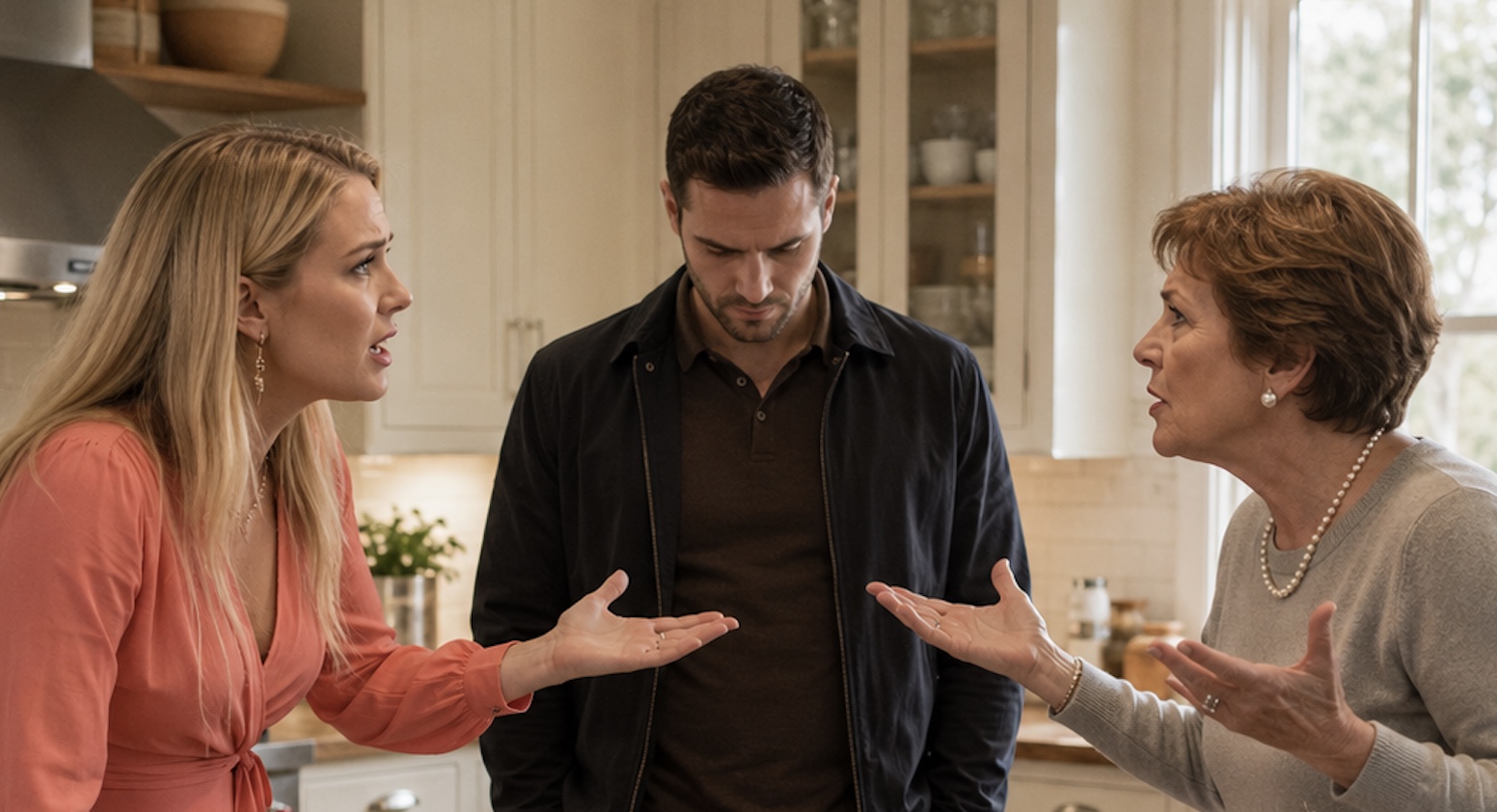
Anna was washing the dishes after dinner when the doorbell rang. Maxim went to answer it and found his mother, Valentina Petrovna, standing on the doorstep with a bag of groceries and a strained smile.
“Dear Anya,” her mother-in-law chirped as she walked into the kitchen. “I brought you some homemade soup. I know how tired you get from work.”
Anna raised an eyebrow in surprise. During the three years of their marriage, Valentina Petrovna had visited them no more than once every six months, usually only on major holidays. And now, all of a sudden, she had arrived with borscht and maternal concern.
“Thank you, Valentina Petrovna,” Anna replied cautiously.
“Oh, don’t mention it, sweetheart. We’re a real family now, after all. By the way, I’ve been thinking. Perhaps it’s time for you two to start considering children. Your biological clock is ticking, and later it may be too late.”
Maxim cleared his throat, visibly uncomfortable. His mother had never shown any interest in their plans for the future before. In fact, when he had announced their engagement three years earlier, she had responded rather coldly.
“It’s your decision, son. Just don’t come complaining to me later.”
And now she had suddenly appeared with soup and advice about having babies.
Everything had changed a month earlier, after Anna’s aunt, Klavdia Semyonovna, passed away. She had no children of her own and had left Anna a country house outside Moscow, along with a substantial amount of money in a bank account.
Anna still found it difficult to believe that such an inheritance had fallen into her hands. Her aunt had always lived modestly and worked as an accountant. No one had suspected that she had managed to save such a significant sum over the years.
“You know, Anya,” Valentina Petrovna continued, taking jars of homemade pickles from her bag, “I found a very interesting recipe for improving fertility. My friend Zinaida says her daughter-in-law had twins thanks to this exact remedy.”
“Mom,” Maxim tried to interrupt, “Anya and I aren’t ready yet.”
“And when exactly will you be ready?” his mother snapped, turning sharply toward him. “Anna is already twenty-eight. When I was her age, women already had three children.”
Anna listened in silence, increasingly certain that something was wrong.
Valentina Petrovna had always been an independent, even hard woman. She had worked as a chief engineer at a factory, divorced Maxim’s father when Maxim was ten, and raised her son alone. She had always treated Anna neutrally. There had never been much warmth between them, but there had not been open hostility either.
Now, however, her concern had become strangely intense.
Over the next few weeks, Valentina Petrovna began visiting more often. She brought pies, jam, and preserves, while constantly offering advice about household matters. She instructed Anna on how to iron Maxim’s shirts properly, which groceries to buy, and how to reduce their utility bills.
“My dear Anya,” she said one afternoon while inspecting the contents of their refrigerator, “why do you buy such expensive sausage? There’s another brand that’s perfectly good and costs half as much. And these yogurts are nothing but chemicals. You should make cottage cheese at home instead.”
“Valentina Petrovna,” Anna objected carefully, “Maxim and I both earn good salaries. We can afford these things.”
“Money must be protected, sweetheart,” her mother-in-law said sternly. “You have it today, but tomorrow, who knows? When I was young, I also believed I would always earn well. Then the crisis came, the factory closed, and I had to survive on almost nothing.”
Gradually, the advice became more intrusive.
Valentina Petrovna began criticizing the furnishings in the apartment. She suggested rearranging the furniture and throwing away things she considered unnecessary. She insisted that Anna sign up for handicraft classes “to develop her femininity.” She advised her on what clothes to wear and even which cosmetics to use.
“Anya,” she said one day while flipping through a furniture catalog, “this kitchen would be much more practical than yours. And cheaper too. The money you saved could be spent on something more important.”
“Such as what?” Anna asked.
“For example, a down payment on a larger apartment. Or the future education of your children. You have to think ahead, sweetheart.”
Maxim also began noticing the change in his mother’s behavior.
Previously, she had rarely interfered in their lives. Now she called every day and asked about the smallest details of their household. When he tried to speak to her about it, she simply brushed him off.
“Son, I’m only trying to help. Anya is a good girl, but she’s inexperienced. Life is complicated. Without wise advice, it’s easy to make serious mistakes.”
Meanwhile, the inheritance process was slowly nearing completion.
Anna visited the country house several times to inspect the property. It was in a beautiful place, surrounded by pine trees and located near a lake. The house needed renovation, but it was solidly built and had a strong foundation. Her aunt had clearly invested a great deal of care and money into it.
“We could spend weekends there,” Anna said dreamily to Maxim. “We could grow flowers, invite friends over for barbecues, and when we have children…”
“A country house would be wonderful,” Maxim agreed. “But first we need to fix it up.”
Valentina Petrovna also developed an unexpected interest in the property. She insisted on going there with them so she could inspect everything “with an experienced eye.”
“The house itself isn’t bad,” she said as she walked through the rooms, pressing her hands against the walls and peering into corners. “But there’s a lot of work to do. The roof needs replacing, the windows should be changed, and the electrical wiring must be updated. Do you have any idea how much all that will cost?”
“We’ll manage,” Anna replied confidently. “My aunt left a considerable amount of money.”
“Having money is one thing. Spending it wisely is another,” her mother-in-law lectured. “If I were you, I would fix the house properly before thinking about entertainment.”
She immediately began giving advice about repairs, recommending workers, and suggesting ways to cut costs.
Anna listened politely, but by then she understood that something strange was happening. Valentina Petrovna was clearly trying to take control of the situation.
The matter finally came to a head six months later, when all the inheritance formalities had been completed. Anna officially became the owner of the country house and received access to her aunt’s savings.
That evening, Valentina Petrovna arrived looking unusually solemn. She brought a cake and a bottle of champagne “for the occasion.”
“Well, Anya,” she said as she poured sparkling wine into their glasses, “you’re officially a wealthy heiress now. Congratulations.”
“Thank you, Valentina Petrovna,” Anna replied, already sensing a trap.
“You know, sweetheart,” her mother-in-law continued after taking a sip, “I’ve been thinking a great deal about your future and about how you should handle the inheritance. I’ve come to the conclusion that you need the help of someone experienced.”
“What exactly do you mean?” Maxim asked warily.
“I mean exactly what I said, son. Anya is intelligent, but she’s young. She doesn’t have enough life experience. Money is a serious matter. One wrong decision, and everything can disappear.”
Valentina Petrovna rose from her chair and began pacing around the room as if she were delivering a lecture.
“Take the country house, for example. You want to carry out expensive renovations and buy furniture and appliances. I’m telling you to wait. First, you need to study the market, find the best offers, and calculate every expense down to the last ruble. Otherwise, you’ll throw half the money away.”
“Mom,” Maxim tried to object, “we’re adults. We can handle this ourselves.”
“Adults?” Valentina Petrovna snorted. “Maxim, you’re thirty years old, and you’ve never handled serious money in your life. As for Anya, she grew up in an ordinary family where every penny had to be counted. Where exactly would either of you have gained financial experience?”
Anna felt anger beginning to burn inside her.
For six months, she had tolerated the intrusive advice and the constant attempts at control. But now she realized that her mother-in-law was crossing a line that no one had the right to cross.
“Valentina Petrovna,” she said evenly, “what exactly are you proposing?”
Her mother-in-law stopped and looked at her with patronizing severity.
“I’m proposing that you give me power of attorney to manage the inheritance.”
The room fell silent.
Maxim stared at his mother in disbelief, while Anna felt a chill run down her spine.
“What do you mean?” she asked slowly.
“It’s very simple, sweetheart. You authorize me to make decisions regarding the inheritance—what to sell, what to buy, and how to invest the money. As an experienced person, I’ll act in your best interests. Once you understand how these matters work, you can take control again.”
“Mom,” Maxim said in shock, “are you serious?”
“Absolutely,” Valentina Petrovna replied, straightening to her full height. “Live as long as I have, and then you can make serious decisions. Until then, I’ll be the one managing your inheritance.”
Anna slowly placed her glass on the table and stood up.
She looked at her mother-in-law for a long moment. There was something in her expression that made Valentina Petrovna take an involuntary step backward.
“Valentina Petrovna,” Anna said quietly, “let’s talk about life experience. Specifically, let’s discuss the serious decisions you have made in your own life.”
“Anya, don’t be insolent.”
“Don’t interrupt me. You are sixty-three years old. Tell me about your achievements. Let’s begin with your family. You married at twenty-two and divorced at thirty-two. Why?”
Valentina Petrovna’s face turned red.
“That is none of your business.”
“It became my business the moment you offered to become my financial adviser. So why did your marriage end? Was it because you spent your husband’s money on expensive clothes and cosmetics instead of thinking about the family budget? Maxim told me his father used to complain that you could spend half his monthly salary on useless things in a single day.”
“Maxim!” his mother exclaimed, turning toward him.
He lowered his head.
He remembered his father’s complaints about her careless attitude toward money.
“Let’s continue,” Anna said calmly. “After the divorce, you worked as a chief engineer. It was a respectable position with a good salary. You worked for thirty years. Where are your savings, Valentina Petrovna?”
Her mother-in-law remained silent, her lips pressed tightly together.
“You don’t have any?” Anna asked, raising an eyebrow. “That’s strange. After thirty years of earning a good salary, you could have bought a larger apartment, a car, or a country house. You could have traveled abroad. Instead, you live in a one-room apartment in an old Soviet building, wear clothes you bought ten years ago, and never traveled farther than Sochi before retirement.”
“I had… circumstances,” Valentina Petrovna muttered.
“What circumstances?” Anna asked sharply. “The time you nearly gambled away your apartment? Maxim told me you became obsessed with gambling in the nineties. Or perhaps you mean the large sum of money you lent to your lover, who disappeared along with it?”
Maxim raised his head and looked at his wife in surprise.
He had never told her those details.
Anna caught his gaze and smiled faintly.
“No, Maxim didn’t tell me. I found out myself. When Valentina Petrovna suddenly became so interested in our affairs, I decided to learn more about her own life. I spoke to her neighbors and former colleagues. The conversations were very educational.”
Valentina Petrovna sank into a chair, all her confidence disappearing.
“I also learned,” Anna continued, “that in 2007, you took out a loan to buy new furniture. An expensive Italian set you had always dreamed of. It was a five-year loan. After one year, you realized you didn’t have enough money to pay the installments and maintain the lifestyle you wanted, so you took out another loan. Do you remember?”
Her mother-in-law said nothing.
“And in 2010, you decided to go into business. You opened a small cosmetics shop without a business plan, without studying the market, and without understanding how retail worked. You did it simply because a friend told you that people would always need cosmetics. The shop failed within six months, and you lost everything you had invested. Is that the life experience you want me to trust?”
“Enough,” Valentina Petrovna whispered.
“I’m not finished. The most interesting part is your pension. It’s minimal because you spent half your career working unofficially to avoid paying taxes. You used to say, ‘Why should I feed the government?’ Now you receive almost nothing and complain about how difficult life is.”
Anna sat down beside her mother-in-law and looked directly into her eyes.
“Valentina Petrovna, I’m not trying to humiliate you. But you started this conversation. You are asking me to trust your life experience. What kind of experience do you actually have? The experience of a failed marriage? The experience of wasting money? The experience of making reckless decisions?”
Her mother-in-law sat silently, staring at the floor.
“Do you know what I think?” Anna continued. “You spent your whole life refusing to think about consequences. You spent money without saving for the future. You made decisions based on emotion instead of reason. Now, at sixty-three, you have no savings, no valuable property, and no stable income. Then you discovered that your daughter-in-law had inherited money, and you thought perhaps you could take control of it.”
“That isn’t true!” Valentina Petrovna finally snapped. “I only wanted to help.”
“Help?” Anna gave a bitter laugh. “Six months ago, you barely said hello to me. The moment I received an inheritance, you started bringing soup and offering advice. Is that what you call help?”
Maxim stood and walked over to the window.
He felt the familiar image of his mother—as a strong and independent woman—beginning to fall apart. Anna was right. His mother had never been wise with money.
“Mom,” he said without turning around, “you really have never known how to handle money. I remember eating nothing but pasta for an entire week because you spent your salary the same day you received it.”
“Maxim!”
“I remember you buying expensive things on credit and then complaining that there was no money. I remember all your brilliant money-making ideas that ended in failure.”
He turned to face her.
“And now you want to manage Anna’s money? Seriously?”
Valentina Petrovna stood up, struggling to preserve the last traces of her dignity.
“I only wanted what was best.”
“You know what, Valentina Petrovna?” Anna said more gently. “I believe you wanted what was best. But you wanted what was best for yourself, not for us. You saw money and thought perhaps you could finally have a chance to control it.”
Anna stood and took her mother-in-law’s hand.
“But money doesn’t fix a person’s character. If someone has spent an entire lifetime making bad decisions, more money will only make the consequences worse.”
“And you think you’re so clever?” Valentina Petrovna asked in one final burst of aggression.
“No,” Anna answered honestly. “I don’t think I’m more intelligent than you. But I learn from other people’s mistakes, including yours. That is why I will never give anyone control over my inheritance. Not you, not financial advisers, and not banks. I will learn to manage it myself, slowly and carefully.”
Valentina Petrovna headed toward the door, but stopped before leaving.
“And what if you make mistakes?”
“I probably will,” Anna replied calmly. “But they will be my mistakes, and I will take responsibility for them. If I gave the money to you, I would still have to answer for your mistakes, and I would have to live with the consequences for the rest of my life.”
After his mother left, Maxim and Anna remained silent for a long time.
“Weren’t you a little too harsh with her?” he finally asked.
“No,” Anna said, shaking her head. “It would have been worse to remain silent and let her control the inheritance. Then, after all the money was gone, we would have had to deal with the consequences. It’s better to establish boundaries immediately.”
“How did you know all those things about her life?”
Anna smiled.
“I really did speak to her neighbors and former colleagues. When your mother became so intensely involved in our lives, I understood that something wasn’t right. I decided to find out exactly who I was dealing with.”
Several days later, Valentina Petrovna called to apologize.
It was awkward and reluctant, but it was still an apology. She said she had “lost her temper” and had “only wanted to help.”
Anna accepted the apology, but her relationship with her mother-in-law remained distant.
Valentina Petrovna stopped bringing soup and offering advice. She occasionally called Maxim to ask about his health, but she no longer interfered in their affairs.
Anna gradually renovated the country house, invested her aunt’s savings cautiously, and learned how to manage the money herself. She learned slowly, through research, experience, and her own mistakes.
Most importantly, she was grateful that she had recognized the danger in time and prevented someone else from taking control of her future.
Even if that person was her mother-in-law.