Marina loved standing on the balcony of the old Stalin-era apartment building just as the city began sinking into twilight.
From the fourth floor, the view was magnificent. The broad central square stretched below her, car headlights forming smooth circles of light around it. Ancient linden trees rustled along the sidewalks, and across the square rose the sharp spire of a historic building.
The apartment itself was enormous by modern standards. It had ceilings more than three meters high, creaking oak parquet laid in a herringbone pattern, and narrow vertical windows not only in the wide corridor but even in the bathroom. Marina had always found those windows strangely beautiful.
The place smelled of old wood, lavender soap, and the dry dust of books.
Heavy oak shelves covered an entire wall of the living room, packed from floor to ceiling. Marina’s grandfather, whom she barely remembered, had spent years building the collection. There were leather-bound volumes, pre-revolutionary editions, and rare complete series. Her father had once mentioned casually that some of them were worth a great deal of money.
Yet all this luxury in the very heart of the city had come to Marina with a bitter weight attached to it.
A month earlier, her grandmother, Klavdia Petrovna, had died.
The apartment had gone to twenty-four-year-old Marina not by chance, but because that was exactly what her grandmother had wanted.
Klavdia Petrovna had never been an easy woman.
Sharp-tongued, rude, and armed with an icy stare that seemed to cut through people, she had never cared much about politeness. She could humiliate someone with a single sentence so precisely that they would feel wounded for days afterward.
Her relatives were openly afraid of her and, truthfully, quietly despised her.
For nearly fifteen years, her own children—Marina’s father and Aunt Natalia—had not crossed the threshold of the apartment. Marina’s brother and sister had called their grandmother “the witch” since childhood and rolled their eyes whenever Marina announced she was going to visit.
“Off to see your cobra again?” her mother would complain whenever Marina packed containers of homemade food into a bag before the weekend. “Go on, then. Let her pour another bucket of poison over you. You always seem happy to take it. Mark my words, Marina, that woman will drain every drop of blood from all of us. She tormented your father his entire life, treated me like dirt, and kept telling him to divorce me. Being alone is exactly what she deserves.”
Marina never argued.
She simply went anyway.
Yes, her grandmother had a terrible temper. Marina herself had left the apartment in tears more than once.
But she was probably the only person in the family who had inherited Klavdia Petrovna’s blunt, thorny honesty.
Marina knew how to answer back just as sharply, something her parents constantly criticized. Her grandmother, however, respected her for it.
For the last ten years, Marina had stayed close to her.
She bought groceries, cleaned the enormous dusty rooms, and fought her way through crowded pharmacies whenever Klavdia Petrovna’s heart condition worsened.
They could sit for hours on the balcony, secretly smoking thin menthol cigarettes where Marina’s mother could not see them, drinking strong tea from old porcelain cups with chipped gold rims, and discussing everything from politics to Marina’s boyfriends.
Her grandmother never fully opened her heart, but Marina could see the deep, silent pain hidden behind that harsh armor.
Klavdia Petrovna suffered because she no longer saw her grandchildren or great-grandchildren, even though she had played a major role in destroying those relationships herself.
Six months before her death, when the doctors had little left to offer except sympathy, she summoned a notary to the apartment.
She transferred everything to Marina in secret and ordered her to say nothing.
“I’m leaving it to you, Marinka,” the old woman said hoarsely, exhaling a thin stream of smoke through the open window. “Those vultures would tear it apart, sell everything, and scatter the money to the wind. You earned this place. You were the only one who wasn’t afraid to hold the witch’s hand when her fingers turned blue.”
Klavdia Petrovna died quietly in her sleep.
Three days after the funeral, when Marina had only just begun to recover from the shock, her mother called.
There was a restless excitement in her voice—the kind that overtakes people when they believe easy money is within reach.
“Marina, are you feeling a little better?” her mother asked quickly, barely pausing for an answer. “Anyway, your father, Aunt Natalia, and I sat down and worked everything out. Valya recommended a good real estate agent from her company. We need to put Klavdia Petrovna’s apartment on the market immediately, while the season is still good. You understand what a three-bedroom Stalin-era apartment in this neighborhood is worth, don’t you? Millions.”
Marina slowly lowered her cup onto the table.
Her heart began beating heavily as the first warning of a major family war rose in her chest.
“Mom, wait. What sale? What real estate agent? Grandma left the apartment to me. It is legally mine.”
There was a long, stunned silence on the other end.
Marina heard her mother breathe sharply through clenched teeth.
“What do you mean, she left it to you?” Her mother’s cheerfulness vanished instantly, replaced by a flat, hard tone. “Are you telling me my mother-in-law lost her mind in old age and you happily took advantage of it? That apartment should be divided between her actual children—your father and Aunt Natalia. Your father spent his whole life struggling financially because of that woman. We had to save every kopek. We already found a lovely summer house outside the city, and your father desperately needs a new car because the old one is falling apart. Natalia believes half the money belongs to her as compensation for the way Klavdia Petrovna treated her when she was young.”
“Grandma was completely lucid when she signed the documents,” Marina said, trying to keep her voice calm even though the hand holding the phone was trembling. “The notary confirmed that. I am not selling anything. This was her final wish.”
“So that’s how you’re speaking to me now?” her mother shrieked.
Marina heard rustling in the background, as though someone were trying to take the phone away.
“Her final wish? You stayed close to that old woman on purpose. You cleaned up after her and carried bedpans because you wanted the apartment. Now you’re robbing your own family. Your father is sitting right here, and his heart is hurting because of your selfishness.”
Marina ended the call.
Her whole body was shaking.
She walked into the living room and ran her fingers over the spines of her grandfather’s books.
The shelves stood silent, smelling of varnish and old paper, guarding the peace of the apartment.
But Marina knew that peace was already gone.
The crows had begun circling.
That same evening, the rest of the family joined the attack.
Marina’s phone filled with calls and messages.
Her brother sent only one line.
“You’re a disgusting rat, Marina. I never expected this from you.”
Her sister blocked her on every social network.
Worse still, Aunt Natalia and Marina’s father immediately began exploring legal options.
They had no intention of giving up. Too many imaginary millions were already shining before their eyes.
Close to eleven that night, someone knocked on the apartment door.
The sound was quiet but persistent.
Marina stiffened.
She approached the heavy oak door, looked through the peephole, and saw her father standing alone in the hallway. He was hunched in his old canvas jacket, both hands buried in his pockets.
Marina sighed and unlocked the door.
Her father stepped inside without removing his shoes.
He stared at the high ceilings and narrow corridor as though he were seeing the apartment for the first time, even though he had grown up there.
“Hello, daughter,” he said quietly, refusing to meet her eyes. “Your mother is at home screaming herself hoarse. But I didn’t come because of her. Listen, do whatever you want with the apartment. Fine. Keep it, if that’s what my mother decided before she died. But give me the books.”
Marina said nothing.
“Your grandfather collected them his whole life,” he continued. “I know someone who can sell them. Some of those editions are worth a couple million. Natalia and I could finally pay off our debts. What do you need those books for? You’re never going to read them.”
Marina looked at her father carefully.
He had entered the home of his recently deceased mother not to mourn her, not to remember her, but to take the last valuables he could still reach.
A cold wave of disgust rose inside Marina so sharply that it surprised even her.
“The books are staying here, Dad,” she said quietly and clearly. “Everything in this apartment was left to me. Go home. Please.”
Her father finally looked at her.
His expression was dark and hostile, the same expression Klavdia Petrovna had once used on him.
“All right, Marina,” he said through his teeth, stepping back toward the door. “But we’re not letting this go. You brought this on yourself.”
The next two months became a relentless campaign of emotional exhaustion.
Marina’s life split into two unequal halves.
At work, in the quiet office of an architectural firm, everything continued as usual—drawings, corrections, coffee from the vending machine.
But every evening, the moment she turned the key in her grandmother’s apartment, silence closed around her like a heavy blanket.
Sooner or later, the phone would ring.
Her relatives moved from direct threats to organized legal pressure.
Her father and Aunt Natalia hired a questionable lawyer who promised, in exchange for a generous advance, to find a loophole and challenge Klavdia Petrovna’s will.
Marina began receiving formal pre-trial notices written in exaggerated legal language.
The lawyer argued that strong heart medication had left her grandmother “unable to understand the consequences of her actions” and that she had been subjected to “improper influence from her granddaughter.”
The notary who had prepared the documents only shook his head sympathetically whenever Marina brought him another letter.
“Don’t worry, Marina,” he told her. “Their chances are almost nonexistent. Klavdia Petrovna sat in front of me like a fortress. I have a video recording, and she insisted on attaching a recent psychiatric evaluation to the file. It was as though she knew exactly what would happen. They won’t be able to sell the apartment or take possession of it, but they will make your life miserable until the inheritance process is officially complete. Be patient.”
Marina tried.
But the legal documents were not the worst part.
Her mother’s calls were.
The screaming stopped.
In its place came careful, calculated manipulation.
“Just think about it, Marina,” her mother would say softly while Marina sat on the corridor floor with her back against the cold wall. “Suppose you win. Suppose you keep every square meter. What happens then? Do you understand that you won’t have a family anymore? Your father refuses to speak to you. Your brother and sister won’t let you inside their homes. You are becoming exactly like that old cobra.”
Marina closed her eyes.
“She also believed she was smarter than everyone else,” her mother continued. “She drove people away. She fought with everyone. And how did she end her life? Alone in empty rooms. Like an owl in a ruin. You’ll be thirty before you know it. What happens when you get sick? Who will bring you a glass of water? Are these walls and ceilings really worth betraying your own parents?”
Then her mother would soften her voice even further.
“Sell the apartment in six months. Give your father and Natalia their shares. Keep a little money for yourself. Buy a small studio and live like a normal person, at peace with everyone.”
After those calls, Marina sometimes sat in the darkness for a long time, staring at the narrow bathroom window through which the pale glow of a streetlamp entered.
She was frightened.
The manipulation struck directly at her deepest fear—the fear of being completely alone and rejected by everyone in her family.
Disloyal thoughts began creeping into her mind.
Maybe she really should surrender.
Maybe she should tell a real estate agent to start looking for buyers in the autumn, divide the money, buy herself a small apartment, and restore peace.
But then she would enter the living room, switch on the old floor lamp with its fabric shade, and look at the rows of her grandfather’s books.
She remembered Klavdia Petrovna near the end, too weak to rise from bed, gripping Marina’s hand with thin blue fingers.
“Don’t give them anything, granddaughter,” she had whispered. “They’ll destroy this place. They’ll tear off the wallpaper, sell the books for nothing, and erase your grandfather’s spirit in a month. Hold your ground.”
The inheritance was not luck.
It was the final, deliberate wish of an old and deeply unhappy woman who had trusted Marina alone.
To betray that wish for the sake of false peace with relatives who had remembered Klavdia Petrovna only after her death would have been unforgivable.
Near the end of May, the calls stopped.
The family chats went silent.
It seemed as though everyone had accepted that they could not win in court and could not force Marina into surrender.
But Marina had inherited her grandmother’s instincts.
She knew this was not peace.
It was only the quiet before another attack.
The vultures had realized they could not sell the apartment, so they decided to approach from a different direction.
The silence ended on a hot, dusty Friday evening.
Marina stayed at work until seven to finish a difficult project involving the renovation of a country house.
The irony was not lost on her. All day, she had been designing perfect living rooms for strangers while thinking about her own, where every creak in the parquet now sounded like a warning.
When she emerged from the metro onto the central square, the sun was already setting.
The spire of the old building opposite her grandmother’s home glowed dark red in the fading light.
Marina entered the building, climbed to the fourth floor, and reached into her bag for her keys.
Then she froze.
The heavy oak door was open by several centimeters.
From deep inside the apartment came muffled but unmistakable sounds—footsteps, rustling plastic, and Aunt Natalia’s irritated voice.
Marina pushed the door open quietly and stepped inside.
Her heart was pounding in her throat, but she felt no fear.
The living room lights were on.
Large cardboard boxes from household appliances stood on the floor.
Her father was beside the bookcases, frowning and breathing heavily from the effort. Row by row, he was removing pre-revolutionary leather-bound volumes and carefully placing them into a box, wrapping them in old newspapers.
Aunt Natalia hurried around him, sealing full boxes with wide transparent tape.
The ripping sound of the tape filled the room.
Marina understood immediately.
They had used an old spare key Klavdia Petrovna had given her son years earlier for emergencies.
They knew the apartment could not be taken through the courts, so they had decided to steal the part of the inheritance that could be turned into cash quickly—the rare library.
They were certain that Marina, their quiet and obedient girl, would never dare report her own father to the police.
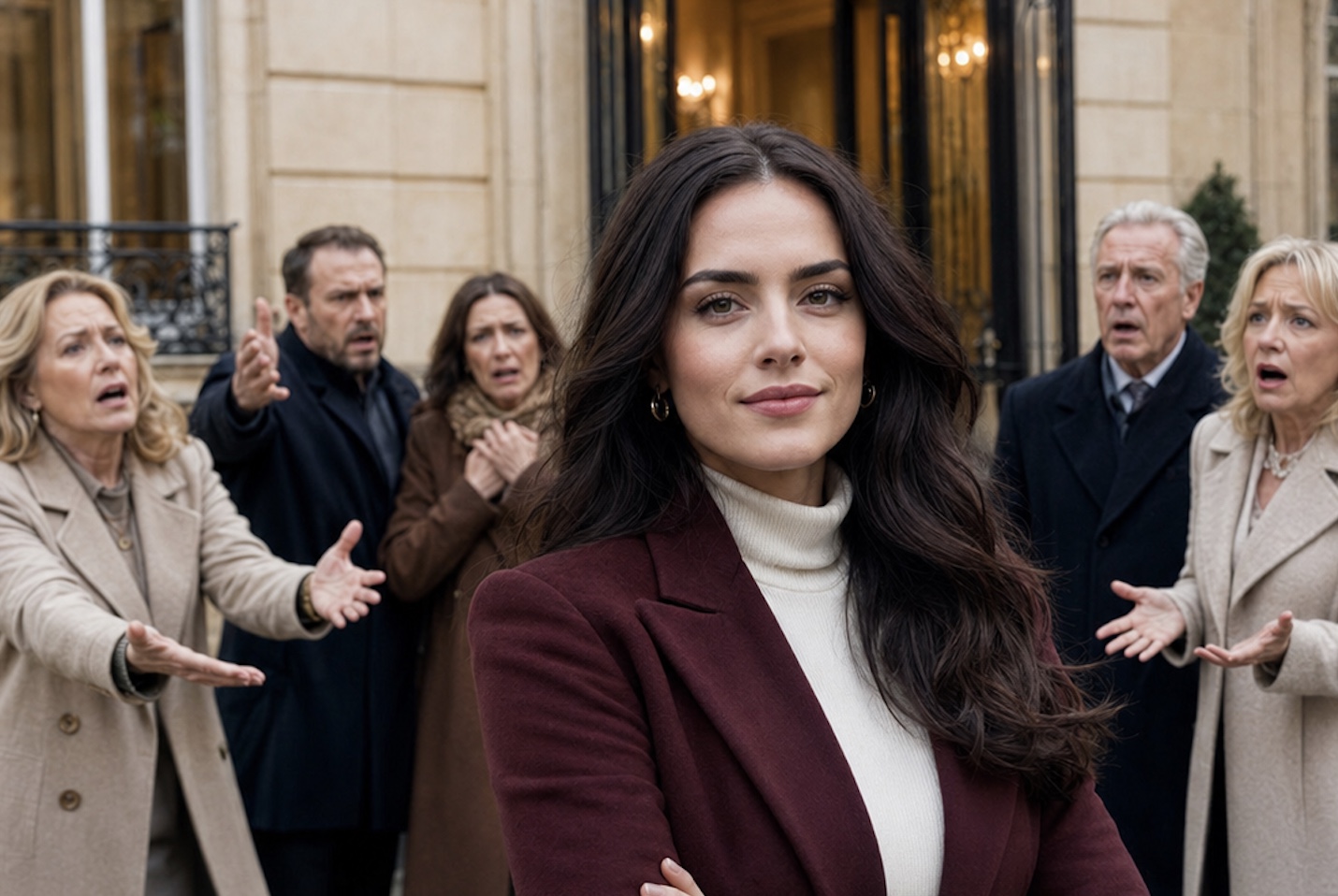
Marina stepped forward and stopped in the living room doorway.
She crossed her arms over her chest.
The tearing sound of tape stopped abruptly.
Aunt Natalia gasped and dropped the roll.
Marina’s father turned slowly, stiffly, as though made of wood.
In his hands was a rare nineteenth-century volume stamped with gold.
His face flushed deep red, but he immediately tried to take control of the situation by adopting the expression of an insulted parent.
“Oh, you’re back,” he muttered, unsure where to put the book, finally pressing it against his stomach. “We’re just cleaning up. Taking your grandfather’s books. You don’t need them. They’re gathering dust here, and Natalia and I already found a buyer—an antiquarian dealer. We need the money. Besides, these belonged to our father, not to your crazy grandmother.”
Aunt Natalia recovered quickly and pursed her lips.
“Don’t stand there like a statue, Marina,” she said in her usual poisonous, instructive tone. “We are taking what belongs to us by blood. You grabbed the apartment and now sit here in the city center like a queen while your parents count every penny on the outskirts. At least have some conscience. Your father needs to pay his debts. We’re loading these boxes and leaving, so don’t start one of your performances.”
Marina looked at them.
Inside her, the last childish illusion known as family loyalty finally died.
These were not loved ones.
]
This was not a caring father or a concerned aunt.
They were intruders who had entered her home to steal an inheritance while showing no respect for the memory of the people who had built it.
Against the high ceilings and dark shelves, they looked small, frantic, and pathetic.
Marina did not shout.
She did not cry.
She did not beg them to put the books back.
Instead, she calmly took out her phone, unlocked it, and entered three digits.
“Dad, put the book back on the shelf,” she said quietly.
Something in her voice made him flinch.
“Both of you, step away from the boxes. Right now. Otherwise I press call. A police unit from the central station can be here in four minutes. I will report a burglary and attempted theft at this table. I do not care that you are related to me. You have thirty seconds to leave with nothing. The time starts now.”
The room fell completely silent.
From the square outside, they could hear a bus trapped in traffic sounding its horn.
Aunt Natalia stood with her mouth half open.
A muscle began twitching in Marina’s father’s cheek.
They both stared at her in disbelief.
The obedient girl they could frighten with parental authority or manipulate with tears was gone.
In her frozen stare and the hard line of her mouth, they saw Klavdia Petrovna—the woman they had feared and hated all their lives.
“You would call the police on your own father?” he shouted hoarsely, his voice breaking. “You don’t have a heart. That old cobra poisoned you. You’re exactly like her.”
“Twenty seconds, Dad,” Marina said without blinking. “And I’m not joking. Put the book back carefully.”
Her father stood there another moment, breathing loudly.
Then he threw the old volume onto the leather sofa with such force that a small cloud of dust rose around it.
“Choke on your antiques and waste paper!” he spat, wiping his sweaty palms on his jeans. “Your mother was right. You’ll die here alone in these rooms, and no one will come. Come on, Natalia. I don’t care anymore. I have no daughter.”
Aunt Natalia grabbed her handbag and hurried toward the hall, throwing insults over her shoulder.
“You ungrateful little monster. You robbed the whole family. We’ll sue you. We’ll take this all the way to the highest court.”
Her father followed, stomping angrily across the old parquet.
In the entrance hall, they struggled with the door for several seconds.
Then the heavy oak panel slammed shut with a thunderous crash that echoed beneath the high ceilings.
Marina slowly lowered the phone.
Her knees weakened, and she sank onto the edge of the sofa beside the book her father had thrown.
Her heart was racing.
But instead of fear, an enormous sense of relief began spreading through her.
It was over.
She had survived the blow she had feared most.
She had protected her home and defended what she knew was right.
The next four months were unexpectedly peaceful.
Her relatives seemed to disappear.
No phone calls.
No messages.
No more legal notices.
Their lawyer had likely reviewed Klavdia Petrovna’s flawless documents and advised them not to waste money on a hopeless case.
Marina returned to a quiet routine.
She went to work, baked pies on weekends, cleaned years of dust from the enormous rooms, and carefully returned her grandfather’s books to their shelves.
Six months after her grandmother’s death, Marina left the notary’s office late in the afternoon.
Inside her handbag was the official certificate confirming her inheritance.
She was now the full and legal owner of the luxurious three-bedroom apartment in the center of the city.
When she returned home, she removed her shoes and walked, as always, onto the balcony.
The last pale autumn light was fading above the square.
Streetlights flickered on below. The old linden trees had shed almost all their yellow leaves, revealing neat lines of lamps along the sidewalks.
Marina stood quietly and thought about everything that had happened.
Her mother had been right about one thing.
Marina truly was alone in the enormous apartment.
Her family had erased her from their lives, choosing resentment and greed over love.
But as she looked down at the busy square and the familiar spire across from her, Marina suddenly realized something so clearly that it sent a shiver through her.
She was not afraid.
This loneliness was not a punishment.
It was freedom.
It was a blank page.
She was only twenty-four years old.
Her whole life was still ahead of her, and she intended to build it according to her own rules.
Justice had prevailed.
Klavdia Petrovna could rest peacefully.
Her final wish had been honored, and the home she had protected for so long was finally in safe hands.