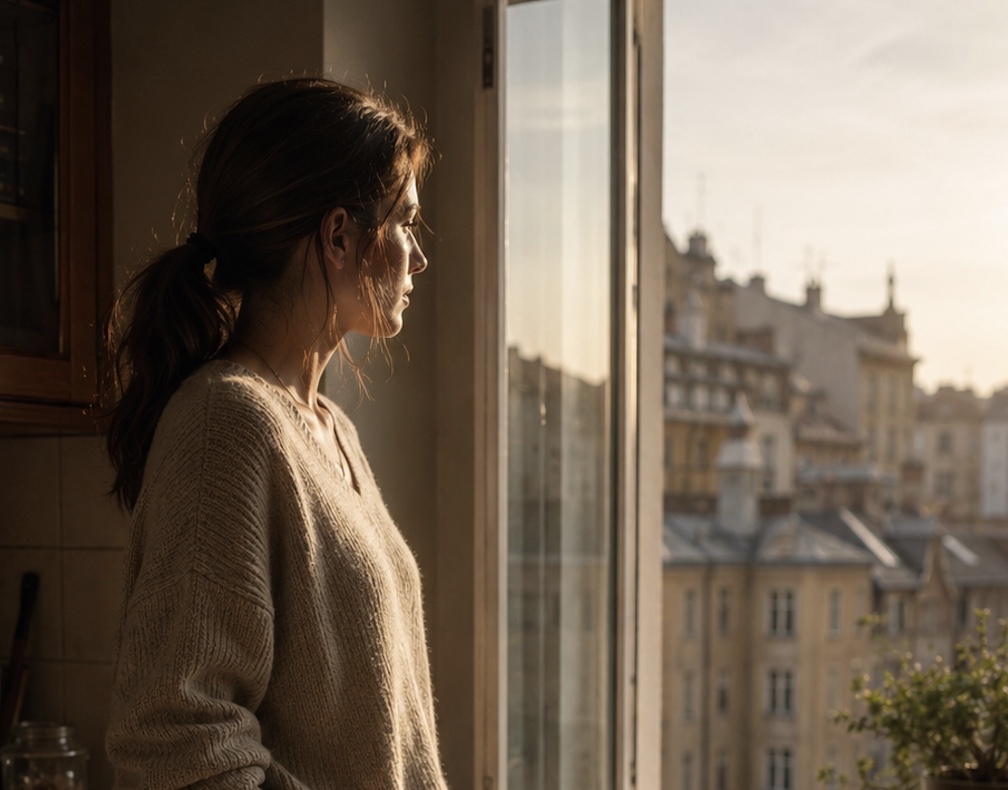
The parking space beneath the window had been empty for the third day in a row. Every morning, Galina looked down at it while the kettle boiled. Not because she was waiting. It was simply habit. Eleven years had soaked into her body the way the smell of borscht seeps into kitchen wallpaper.
Oleg had taken the silver Logan on Sunday. Along with the winter tires, the set of keys from the glove compartment, and his favorite lumbar cushion, the one he always placed on the driver’s seat. It was orthopedic, beige, with a small coffee stain in the corner. Galina herself had bought it two years earlier at an orthopedic shop on Komsomolskaya Street.
“I’m taking the car,” he had said then, standing in the hallway with two sports bags.
“Take it.”
“And don’t call me later saying you have no way to get to the dacha.”
“I won’t.”
He hesitated. He was waiting for something. Maybe tears. Maybe shouting. But she was holding a mug of chamomile tea and looking somewhere near his collarbone. Not into his eyes. She had stopped looking him in the eyes back in February, when she found a receipt from the Veranda restaurant for two people in the pocket of his jacket. She had never been to Veranda once.
The story of their marriage could have fit onto one notebook page if written in small handwriting. They met through mutual acquaintances. He worked at a car repair shop, and she worked in the accounting department of a construction company. Their wedding was modest, held in the Beryozka café for twenty-four guests. Galina was twenty-seven then, Oleg thirty. They spent their honeymoon at his mother’s dacha in the Kaluga region: mosquitoes, shashlik, and a river beyond the fence.
The first years passed evenly. Not happily, exactly, but evenly: no great highs, no terrible lows. Oleg fixed cars, and she counted other people’s money. In the evenings they watched TV series. On weekends they went to Auchan. Children never came, and with time they both stopped talking about it, the way people stop noticing a crack in the ceiling.
Galina began putting money aside in the third year of their marriage. Not out of greed. And not because she was planning to leave. It was just that one day her mother said over the phone, casually, somewhere between talking about seedlings and blood pressure:
“Gal, do you have anything of your own? Not shared. Yours?”
“What do you mean?”
“I mean exactly that. A stash. A cushion. Call it whatever you want.”
“Mom, everything is fine with us.”
“It was fine with us too. Until your father left.”
Her mother said it calmly, the way people talk about things they have long since survived and dried out like laundry on a balcony. Her father had left when Galina was fourteen. He took the garage, the Moskvich, and the savings book. Her mother was left with two daughters in a two-room Khrushchev-era apartment with a leaking roof and an empty fridge.
After that conversation, Galina opened a separate bank account. She did not connect a card to it. She installed the banking app on her work phone, which Oleg never touched.
She saved a little at a time. Three thousand a month. Sometimes five, if she managed to earn extra money on quarterly reports. Oleg brought his salary home in cash, and she received part of hers in cash too. Nobody checked. He was not interested in numbers at all unless they had something to do with car parts.
Eight years. With interest included, it had grown to four hundred seventy thousand. Not a million. But for a woman whose husband had left her with a rented apartment and an empty parking spot, it was money that smelled like freedom.
And it smelled of this: the possibility of not calling her mother-in-law to borrow money until payday. The possibility of calmly paying rent two months in advance. The possibility of buying winter boots instead of taking the old ones to be repaired for the third winter in a row.
But that came later. First there was Sunday, Oleg in the hallway with his bags, and silence ringing like an empty pot.
He had gone to Zhanna. Galina learned the name by chance a month after he left. Tamara, a former colleague of Oleg’s, called her. Tamara had a low voice and a habit of saying things exactly as they were.
“Gal, do you even know who he ran off to?”
“I don’t care.”
“Zhanna Viktorovna. From the car wash on Proletarskaya. She’s twenty-six. Fake eyelashes, pumped-up lips. A classic, Gal.”
Galina listened while peeling potatoes. The knife slid over the skins in long, even strips. She counted them. Seven. Eight. Nine.
“Are you listening to me?”
“I am, Tamar.”
“And?”
“I’m peeling potatoes.”
Tamara was quiet for a moment, then snorted.
“You’re made of stone, Galka.”
Galina was not made of stone. It was just that over eleven years she had imagined this moment so many times that when it finally arrived, her body already knew what to do. Continue. Peel potatoes, wash the floor, go to work, count other people’s invoices, come home, boil the kettle.
But inside, behind her ribs, something had shifted. Like furniture after someone rearranges a room: it is still the same room, but you keep bumping into corners.
During the first week without Oleg, Galina slept badly. Not from longing. From the silence. For eleven years he had snored beside her, and it had been background noise, like the hum of the fridge. Now the fridge hummed alone.
She turned on the radio in the kitchen, quietly, barely audible, and fell asleep to the murmuring of the night broadcast. Some man with a soft voice was reading stories. Once he read something about a woman who left her house barefoot and walked through wet grass all the way to the forest. Galina fell asleep before the end. In the morning she wondered: did the woman reach the forest or not?
At work, nobody noticed anything. Galina sat at her desk beside the ficus and the calendar and did the same things she always did: entered amounts into columns, checked acts and statements, drank instant coffee from a white mug with the words “Best Accountant” on it. They had given her the mug at a company party three years earlier. The inscription was almost worn away.
Two weeks later, Oleg called.
“Gal, I need the car documents. The vehicle registration certificate should be in the drawer.”
“Which drawer?”
“The dresser in the bedroom. Bottom one.”
She opened the drawer. Inside were an old passport, a warranty slip for the iron, a bag of buttons, and the vehicle document.
“Found it.”
“I’ll stop by and get it.”
“You can. I won’t be home before six.”
“Fine.”
He did not say thank you. She did not expect him to.
Oleg came while she was out. She knew it from the smell. The hallway smelled of his cologne. The same one she gave him every New Year because he could never remember its name. Donna Karan, black bottle, one hundred milliliters.
The smell lingered until evening. Galina opened the hallway window and stood there until her toes froze. November. The floor tiles were icy.
He had taken the car document. Next to it, in the same drawer, lay an old notebook where Galina had once written recipes. Oleg had not touched it. He did not know that between the pages with apple pie and borscht, there was a piece of paper with the login and password for the banking app.
Funny. If he had opened that notebook, he would have seen the four hundred seventy thousand his wife had saved over eight years. But why would Oleg need an apple pie recipe? He did not like apples.
Her mother arrived three weeks later. Without warning, as always. She called from the train station.
“I’m on the train. I’ll be there in forty minutes. No need to meet me, I’ll walk.”
Zoya Pavlovna was sixty-three, five feet two, with a short gray-streaked haircut that she dyed reddish with henna. Her hands were small, dry, with prominent veins. She always carried a bag of homemade food, even if she was only visiting for two hours.
“Here. Cabbage pies. And a jar of pickles, the last one.”
Galina took the bag. It was warm. The pies were hot, wrapped in a towel.
“Mom, why did you come?”
“Because. Am I not allowed to see my daughter?”
She went into the kitchen and looked around. Her gaze caught on the empty hanger where Oleg’s jacket used to hang.
“When did he leave?”
“Three weeks ago.”
“Where?”
“To a woman.”
“Young?”
“Twenty-six.”
Zoya Pavlovna nodded. She was not surprised. She sat down at the table and straightened a napkin.
“Put the kettle on.”
Galina did. Water began to rumble in the pipes. Her mother looked out the window at the empty parking space.
“He took the car?”
“Yes.”
“And the money?”
“What money, Mom?”
Zoya Pavlovna turned and looked at her daughter. Her eyes were light gray, with a yellow rim around the pupils. Galina had always been a little afraid of those eyes: they saw through walls.
“Those very same ones, Gal. The ones you were saving.”
“How do you know?”
“I gave birth to you. And I was the one who told you to do it. Did you think I forgot?”
Galina sat down across from her. Her hands reached for the edge of the tablecloth on their own.
“Four hundred seventy,” she said quietly.
“Thousand?”
“Yes.”
Zoya Pavlovna was silent for exactly five seconds. Then she took a pie out of the bag, broke it in half, and pushed one half toward her daughter.
“Eat. And tell me what you’re going to do.”
Galina did not yet know what she was going to do. The money was sitting in the account, untouched. Every evening she opened the app, looked at the numbers, and closed it. As if checking: is it still there? It was.
Meanwhile, Oleg was living with Zhanna. Galina knew this from Tamara, who knew it from Lyosha at the repair shop, who knew it from Oleg himself. The chain worked flawlessly.
“They say he’s doing renovations there,” Tamara reported over the phone. “In her apartment. On Proletarskaya. A two-room place. Changed the radiators, tiled the bathroom.”
“Let him tile.”
“Gal, he’s sinking his money into it. Your shared money, essentially.”
Galina did not bother explaining that they had not had “shared” money for a long time. Oleg spent his salary on car parts, beer on Fridays, and gasoline. She paid the rent. She bought the groceries. She covered the utilities, of course.
That was just how it had happened. No loud conversation, no boundaries, no agreement. It had settled quietly, like mold in the corner of a bathroom: invisible at first, then impossible to wash away.
In December, Oleg called again.
“Gal, I have a question.”
“I’m listening.”
“At work, you… well, they give you a winter bonus, right? Quarterly?”
“Why do you need to know?”
He hesitated. She could hear him breathing into the phone. Heavily, through his nose. He used to breathe like that when he lied.
“I need ten thousand. I’ll give it back in January.”
“No.”
“What do you mean, no?”
“No. I won’t give it to you.”
A pause. A long one. Then he laughed. Briefly, like a cough.
“All right. I understand.”
He hung up. Galina placed the phone on the table and looked at her hands. Her fingers were trembling. Slightly, barely noticeably, the way they do after you stand up too fast. She clenched them into fists, held them that way, then released them. She poured herself water. Drank it.
For the first time in eleven years, she had told him no and had not felt guilty.
Well, almost not guilty.
Winter dragged on. Without a car, getting to work took longer: bus to the metro, metro to Proletarskaya, then about fifteen minutes on foot past the car wash where Zhanna worked. Galina always quickened her pace on that stretch, though she never once saw either Zhanna or Oleg. But her legs sped up by themselves, and she only noticed afterward, when her breathing was already uneven.
In January, she got sick. An ordinary cold: temperature 37.4, blocked nose, scratchy throat. But there was nobody to go to the pharmacy. Nobody to put the kettle on. She lay on the sofa under two blankets and thought: strange, in eleven years Oleg had never once brought her tea in bed when she was sick. Not once. And each time, she had waited.
She called her mother.
“Mom, I’m sick.”
“Temperature?”
“Not high. But I feel awful.”
“Do you have lemon?”
“No.”
“Honey?”
“No.”
“Here’s what you’ll do. Order delivery. Lemons, honey, ginger. And chicken broth.”
“Mom, delivery is expensive.”
“Galina. You have four hundred seventy thousand in your account. Order the broth.”
She laughed. For the first time in two months, she laughed properly, so hard that she started coughing and spilled water on the blanket.
She ordered broth. And lemons. And honey. And also a pack of Yubileynoye cookies, because Oleg could not stand them and she loved them.
In February, Tamara had news.
“He left her.”
“Zhanna?”
“Well, yes. She threw him out. Or he left on his own. Depends who you ask.”
Galina stood by the stove, stirring rice. The wooden spatula moved in circles. One circle, another.
“And where is he now?”
“At his mother’s.”
At her mother-in-law’s. Zinaida Fyodorovna, a broad-shouldered woman with the habit of looking Galina up and down whenever they met. Her apartment was a one-room place on the ground floor, overlooking the garbage bins. Oleg had grown up there, and Galina had always wondered how such a large man had fit into such a tiny kitchen.
“Has he called you?” Tamara asked.
“No.”
“He will.”
“Maybe.”
The rice began to burn. Galina lowered the heat and added water. The grains hissed. Steam rose to the ceiling and settled on the glass of the extractor hood in tiny drops.
He did not call in February. He called in March. On the eighth, a Saturday. Galina was cleaning the apartment, wiping the hallway mirror, when his name lit up on her phone screen.
“Happy holiday,” Oleg said.
“Thank you.”
“How are you?”
“Fine.”
“Listen… can I come by?”
She was holding a cloth in her right hand. The cloth was wet. It dripped onto the floor. Drops fell onto the linoleum with a quiet tap, and Galina counted them while she thought.
“Why?”
“I want to talk.”
“About what?”
“Gal, why are you acting like this… Just to talk. I’m not a stranger.”
She looked at her reflection in the mirror. Thirty-eight years old. Dark circles under her eyes that no cream could hide. Hair pulled back with an elastic band. Gray sweater with pilling at the elbows.
“Not a stranger,” she repeated.
“Well, exactly.”
“No, Oleg. That’s exactly what you are. A stranger.”
She ended the call. Put the phone on the shelf. Finished washing the mirror. Her hands did not tremble. Not at all.
But he came anyway. Not that day. A week later. Without calling. He simply rang the doorbell.
Galina opened the door. He was standing on the threshold in the very jacket from whose pocket the Veranda receipt had fallen a year earlier. He had lost weight. There were shadows under his eyes, just like under hers. Two people with the same shadows beneath their eyes, standing on opposite sides of the doorway.
“Can I come in?”
“No.”
“Gal…”
“What do you want?”
He shifted from one foot to the other. His boots were dirty, marked with white traces of road salt.
“I understood everything, Gal. I made a mistake. I messed things up. But I want to come back.”
She said nothing. She looked at the salty streaks on his boots.
“Zhanna, that was… a moment of madness. The devil got into me. I feel bad without you.”
She remained silent.
“Living with my mother is impossible. Every day she tells me what an idiot I am.”
“She’s right.”
“Well, see. Everyone says so. So it must be true, I’m an idiot. Give me another chance, huh?”
Galina leaned against the doorframe. It was cool, wooden, with a small dent at the level of her shoulder. Oleg had made that dent while carrying in a wardrobe six years earlier. She had told him then to be careful. He had not listened.
“You took the car,” she said.
“Well… yes. I can bring it back if you want.”
“I don’t need the car.”
“What do you need?”
She thought. Not for a second. Not for two. For a long time. He stood and waited, and she could see how nervous he was: his fingers kept tugging at the zipper of his jacket, back and forth, back and forth.
“I need you to leave.”
“What do you mean?”
“I mean exactly that. Leave.”
“Gal, I’m serious.”
“So am I.”
She closed the door. Quietly, without slamming it. Turned the lock. Twice. Then she leaned her back against the door and stood there until she heard his steps moving away down the stairs. He walked slowly. He was waiting for her to open the door.
She did not.
That evening she called her mother.
“Mom. He came.”
“And?”
“He asked to come back.”
“And you?”
“I refused.”
Silence. Then her mother sighed. Not heavily, not tragically. The kind of sigh people make when something finally falls into place.
“You did right, Gal.”
“I don’t know.”
“You do know. You’re just still afraid to know it.”
Galina closed her eyes. Outside, a car drove past, its headlights sliding across the ceiling in a yellow stripe. Not a silver Logan. Some other car.
“Mom, I want to take a course.”
“What kind?”
“Driving.”
“But you have a license.”
“I do. But I haven’t driven in five years. He always drove.”
“Then go. What will you use for the lessons?”
“My own money.”
Zoya Pavlovna snorted. That same sound Galina had known since childhood: approval mixed with I told you so.
“Then go.”
In April, Galina signed up for refresher driving lessons. Three times a week, an hour and a half each, at a driving ground on the edge of the city. The instructor turned out to be a man around fifty, with a mustache and a habit of saying “right then” before every sentence.
“Right then, left foot on the clutch. Smoothly.”
She pressed the clutch and felt the training Lada Granta shudder beneath her. It smelled of rubber and someone else’s perfume from the previous student. The steering wheel was warm and slightly sticky.
“Right then, turn. Turn your head. Not the wheel, your head.”
After the third lesson, she stopped mixing up the gears. After the fifth, she began to feel the size of the car. After the eighth, the instructor said:
“Right then, you actually drive well. Why did you come?”
“I forgot.”
“Forgot what?”
“That I could.”
He looked at her, chewed his mustache, and nodded. He did not ask again.
Galina did not touch the money in the account until May. Then she withdrew eighty thousand. The down payment for a used Kalina, a white 2021 model with one hundred fourteen thousand kilometers on it. They agreed she would pay off the rest in installments over six months.
The car was brought to the yard on Thursday morning. Galina stood at the window with a mug of tea and watched as the white Kalina took the same parking space where the silver Logan had stood for eleven years.
The car was smaller. And not as shiny. But it was her car. Bought with her money. The money Oleg had not known about.
She finished her tea. Put on her jacket. Went down into the yard.
Inside the car, it smelled of pine-tree air freshener and something chemical from the new floor mats. The steering wheel was cold, but comfortable. The mirrors had been adjusted for someone else. She corrected them. Moved the seat forward.
The engine started on the first try. Quietly, evenly.
She pulled out. Carefully, the way she had been taught. Left turn signal, check the mirror, leave the yard.
She chose her first route at random. Or perhaps not at random. She drove to her mother’s in Stupino. One hundred twenty kilometers. Earlier, she and Oleg had driven there together, he behind the wheel, she beside him with the phone in her hands, giving instructions from the navigator.
Now the navigator was speaking to her. Only to her.
The highway was open. A May morning, low sun, the asphalt still damp after the night rain. She turned on the radio. The same nighttime voice that had read stories in winter did not work during the day. Instead, something cheerful and unfamiliar was playing. Galina lowered the volume and listened to the engine.
It ran smoothly.
Just like her.
Zoya Pavlovna came out to the gate when she heard the engine. She stood there in her eternal apron with sunflowers, watching as her daughter parked by the fence.
Galina turned off the engine. Got out. Her hands smelled like the steering wheel.
“Mom.”
“I see.”
Her mother walked around the car. Touched the hood. Looked inside. Opened the trunk and checked it for some reason.
“White,” she said.
“White.”
“A Kalina?”
“A Kalina.”
“How much?”
“Three hundred twenty. I paid eighty right away, the rest in installments.”
Zoya Pavlovna closed the trunk. Straightened up. Looked at her daughter with those gray-yellow eyes.
“Do you remember when I called you eight years ago?”
“About the stash?”
“About the stash.”
They stood in silence. Between them was the white Kalina with one hundred fourteen thousand kilometers on it, smelling of pine-tree air freshener.
“Are there pies?” Galina asked.
“What do you think?”
They went into the house. Her mother ahead, Galina behind her. Near the porch stood a basin with soaking laundry. Towels were drying on the line. From the kitchen came the smell of cabbage and something sweet, maybe jam.
Galina crossed the threshold and thought: there it is, the smell of home. Not the apartment where she had lived for eleven years with a man who had never once brought her tea in bed. But home.
Oleg called one more time. In June. His voice was different: dull, like a bulb about to burn out.
“Gal, Lyokha told me you bought a car.”
“Yes.”
“Where did you get the money?”
She was silent. He waited. She could hear his breathing through the phone and thought: once, that sound had been the most familiar sound in the world. His breathing in sleep, his snoring, his sighs. Now it was the sound of a stranger.
“Gal? Where from?”
“That is none of your business, Oleg.”
“How is it none of my business? We were married.”
“Were.”
He fell silent. She imagined him sitting in his mother’s tiny kitchen, at a table that still remembered Soviet oilcloth. Squinting, trying to understand where she had gotten money. He would be turning over options in his head: did relatives give it to her? Did she take out a loan? A new man?
None of the options matched the truth. The truth was in a recipe notebook, between apple pie and borscht. But he did not like apples. And he had never been interested in her notes.
“If you had money, you should have told me,” he said. “That wasn’t fair.”
“Not fair, you say?”
She paused. Outside, children were kicking a ball around the yard. Thud, thud, laughter.
“And Veranda for two people, was that fair?”
He did not answer. She hung up.
In July, Galina filed for divorce. Officially, they had remained married until the papers arrived. Oleg signed without argument. There was no property to divide: a rented apartment, IKEA furniture that had turned into junk over eleven years, and the car he had taken back in November. As for the account, he did not know about it.
In court, they sat on the same bench, but with two spaces between them. Galina looked at the judge, a woman with short bangs and a tired voice. Oleg looked at the floor.
“No property claims?” the judge asked.
“No,” they both said at the same time.
That was the last thing they ever said together.
After court, she stepped outside. July heat. The asphalt seemed to melt. She found her Kalina in the parking lot by the courthouse. Got behind the wheel. Turned on the air conditioner. It blew weakly, but it blew.
Her hands rested on the steering wheel. Naturally. As if it had always been this way.
Her phone beeped. A message from her mother: “Well?”
She typed back: “That’s it. We’re divorced.”
Her mother replied a minute later: “The pies are getting cold. Come over.”
Galina started the engine. Switched on the turn signal. Looked in the mirror.
In the mirror was her face. Thirty-eight years old. The dark circles a little lighter than in winter, her hair loose. She could not remember the last time she had worn her hair down.
She drove onto the highway. The radio muttered something about the weather. She changed it to music.
Behind her remained the city, the court, the parking lot, eleven years, and the silver Logan.
Ahead lay one hundred twenty kilometers to her mother’s house, a white Kalina with mileage that now grew every day, and cabbage pies.
That was enough.