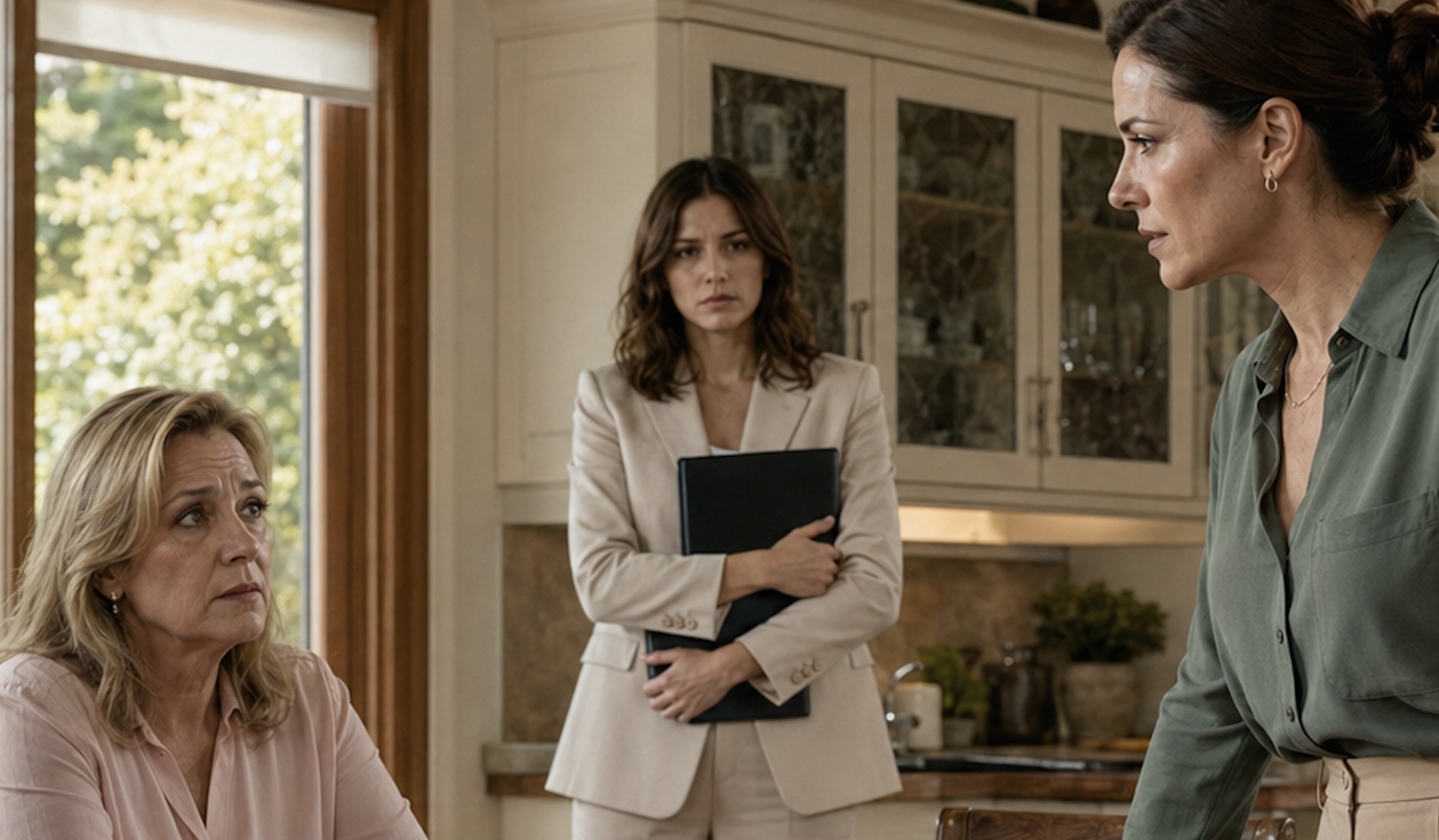
“We’ve decided to transfer the country house to your sister. You live in the city anyway,” her father said calmly, as if he were talking about buying a new television.
Elena did not answer right away. She was holding her cup by the handle, but her fingers did not tremble. Only her gaze became more attentive, sharper. Slowly, she set the cup down on the table and looked first at her father, then at her mother.
“You decided?” she clarified.
“Yes,” Nikolai Semyonovich nodded. “Your mother and I talked it over. Olesya will be closer to the house. She needs it more.”
“Interesting,” Elena said, pushing her saucer slightly away. “And when exactly did you talk it over?”
Her mother, Raisa Pavlovna, immediately straightened in her chair. Her face looked as if she had prepared in advance for her eldest daughter’s displeasure and was now waiting for Elena to prove all her worst expectations right.
“Lena, don’t turn everything into a tragedy right from the start,” she said. “The house is ours. We can leave it to whoever we want.”
“Of course,” Elena agreed calmly. “I’m only asking when you made that decision. Before I paid for the drainage project last month, or after?”
Her father coughed and looked out the window. Her mother frowned.
“There you go again. We never asked you to pay for anything.”
Elena tilted her head slightly.
“Really? Then who called me at eight in the morning saying the yard was flooded after the rain, the contractor needed an advance payment, and nobody in your village could find a proper specialist?”
“I said we needed help,” Raisa Pavlovna replied irritably. “That doesn’t mean you can start sending us bills now.”
“I’m not sending anyone bills yet, Mom. I’m putting the whole picture together.”
The silence made the kitchen feel smaller.
The old family house had always smelled of wood, apples from the pantry, and something warm and lived-in. Elena had known every corner since childhood: the floorboard near the door that creaked, the cabinet handle that always stuck, the place where her father kept his tools even though he always insisted everything was stored “according to a system.”
The house had been built slowly. First, there had been a small summer cottage, then an extension, then a second floor, then a veranda. Her parents had put their strength, time, and stubbornness into it. Elena and Olesya had spent every summer there as children, running barefoot through the grass, carrying water in little watering cans, hiding in the attic from the heat.
But in adulthood, the house had mostly lived on Elena’s shoulders.
She was not the type to complain. She simply came. On Friday evenings after work, she would get in the car and bring groceries, medicine, batteries, new hoses, documents to sign, printed forms from government offices, things her mother had forgotten to buy, and things her father had promised to fix “during the week” but had left untouched for months.
On Saturdays, she called repairmen, checked estimates, spoke with neighbors, drove her parents on errands, sorted out bills, made medical appointments for her father, and took her mother into the city for paperwork. On Sunday evenings, she returned to her own place with heavy arms and an empty head.
Olesya lived in a nearby district of the city but rarely appeared. Either she had work, or her child was sick, or her husband was tired, or the car would not start, or “we would have come, but now it’s already late.” Yet their mother always spoke of the younger daughter gently, almost apologetically: things were hard for Olesya, Olesya was sensitive, Olesya was not as strong-willed as Lena.
Elena had gotten used to it. Not accepted it — gotten used to it. There was a significant difference.
“Lena, you’re independent,” her mother began in that voice that had made Elena want to leave the room even as a child. “You have an apartment, a job, everything is settled. But Olesya and her family are renting all the time. They need something stable. A child should have fresh air, a yard, proper summers.”
“So you’re transferring the house to Olesya because she has a child?”
“Not only because of that.”
“What else, then?”
Her father rubbed the bridge of his nose.
“You turn everything into an interrogation.”
“No, Dad. An interrogation is when someone doesn’t know why they’re being questioned. I know exactly why. I want to understand your logic before the next time you ask me to pay for the roof, find a stove specialist, or drive you to the district center.”
Raisa Pavlovna sharply placed her palm on the table.
“Helping your parents and property are two different things.”
Elena looked at her hand, then back at her face.
“Completely different. At last, we agree on something.”
Her mother did not immediately understand what her daughter had just said. Her father understood faster. His shoulders visibly tensed.
“What are you trying to say?”
“I’m saying that you have the right to do whatever you want with your house. And I have the right to do whatever I want with my time, money, and weekends.”
“So you’re not going to help us anymore?” her mother’s voice immediately rose.
“I will. When I can. When I want to. And when it makes sense. But the main responsibility for the house should go to its future owner. That’s fair.”
“Olesya won’t be able to handle all of it,” her father blurted out.
Elena smiled almost imperceptibly.
“Then it’s strange to give the house to someone who can’t handle it.”
That sentence landed on the table heavier than any argument could have. Raisa Pavlovna opened her mouth but said nothing. Nikolai Semyonovich turned toward the window, where the garden beds and the low greenhouse were damp behind the glass — the same greenhouse Elena had ordered three years earlier because the old one had collapsed under the snow.
Before, she would have started explaining. Proving that she was hurt. Reminding them how many times she had come. How many trips, meetings, and plans she had canceled. How many times she had listened to the phrase, “Lena, you understand, don’t you?” over the phone.
But now something suddenly became clear to her: they did not need explanations. They already knew everything. They had simply assumed the eldest daughter could endure it.
Elena took her phone out of her bag.
“What are you doing?” her mother asked cautiously.
“Writing to Olesya.”
“Why?”
“To congratulate her on her future house. And add her to the chat with the drainage contractor. He’s supposed to send the final estimate tomorrow.”
Raisa Pavlovna straightened even more.
“Don’t drag Olesya into this right now. She has enough problems at home.”
“Now she’ll have a house too.”
Elena typed a short message:
“Olesya, our parents said they’ve decided to transfer the house to you. Congratulations. In that case, I’m connecting you to all matters involving the yard and repairs. Tomorrow the drainage contractor will send the estimate. You can handle it with him yourself.”
The reply came almost immediately.
“What do you mean, transfer it to me?”
Elena looked up at her parents.
“Funny. The future owner doesn’t know.”
Her mother flushed.
“We wanted to talk to you first!”
“You didn’t talk. You informed me.”
The phone vibrated again.
“Lena, what are you starting? I didn’t ask for anything.”
Elena quickly answered:
“Neither did I.”
After that, she stood up, took her bag, and walked into the hallway. Her mother rose after her.
“Where are you going?”
“Home.”
“But you promised to take your father to buy the pump tomorrow.”
Elena zipped up her jacket.
“Now I’m not promising.”
“Lena!”
She turned around. Her mother’s face showed outrage, but behind it, anxiety had already begun to appear. For the first time, Raisa Pavlovna saw that her eldest daughter was not shouting, not crying, not slamming doors. She was simply changing the rules.
“Mom, I said it very clearly. The house is yours. The decision is yours. The consequences are yours too.”
“You’ve become cruel.”
“No. I’ve started counting.”
Elena stepped out onto the porch. The rain had almost stopped, but the air was heavy and damp. She walked to her car without hurrying. Behind her, the front door opened — her father had followed her outside.
“Lena.”
She stopped.
“What?”
Nikolai Semyonovich stood on the top step in his old sweater. Older, stubborn, confused. He was not a bad man. But he had lived for too long with the certainty that Elena would understand everything, smooth everything over, and carry everything.
“You’re not really upset because of the house.”
“Of course not.”
“Then because of what?”
Elena looked at the wet porch boards, then at her father.
“Because you decided I was strong enough to be ignored completely.”
Her father lowered his eyes.
“We didn’t mean it that way.”
“Whether you meant it or not doesn’t matter. That is exactly what you did.”
She got into the car and drove away without turning on the music. The drive to the city took less than an hour, but in that time Elena managed not just to feel hurt — she made a plan.
First, she opened her banking app and downloaded all the transfers related to her parents’ house for the last four years. Not for court. Not for a scandal. For herself.
Then she pulled up messages with contractors, receipts for materials, the greenhouse contract, invoices for gravel delivery, payment to the surveyor, and correspondence with the electrician who had replaced the fuse box. Separately, she saved a list of trips: hospital, government service center, notary office, car service, construction supply store, village administration.
By midnight, she had a neat spreadsheet. No emotions. No exclamation marks. Date, action, amount, time, comment.
Elena looked at the screen and, for the first time in a long while, gave a quiet laugh.
In that spreadsheet, her love for her parents looked like a second job.
The next day, she did not go to buy the pump. At ten in the morning, her father called. She did not answer. Five minutes later, her mother called. Elena did not answer that either. Then a message arrived:
“There’s water in the basement. Your father is nervous.”
Elena wrote back:
“Call Olesya. I’m busy today.”
Her mother did not reply right away. Then she sent:
“Olesya isn’t answering.”
Elena put her phone face down and went about her day. For the first time in many months, Saturday belonged entirely to her. She got a haircut, bought herself new boots, stopped by a bookstore, cooked dinner peacefully at home, and felt no guilt.
By evening, her phone was exploding with calls from her mother, father, and Olesya. She answered only her sister.
“What have you done?” Olesya’s voice was angry and frightened at the same time.
“Nothing. I’m transferring responsibility to the future owner.”
“I’m not any kind of owner! They decided that themselves!”
“Then discuss it with them.”
“Lena, don’t be like this. You know Mom. She just blurted something out, and now you’re punishing everyone.”
Elena walked to the window. In the courtyard, a delivery van moved slowly past, its headlights sliding across the wet pavement.
“Olesya, Mom didn’t just blurt it out. Dad said the same thing. They decided to transfer the house to you. You can refuse. You can agree. But I am no longer going to be the unpaid manager of someone else’s future property.”
“You sound like a stranger.”
“No. I sound like someone who has finally read the terms of the deal.”
“What deal?”
“A very simple one. I invest time, money, and energy. You get the house. Our parents get my help and your name on the documents. Before, I didn’t see the agreement. Now I do.”
Olesya fell silent. She was not stupid. Spoiled, yes. Used to her older sister solving the difficult things, yes. But not stupid. So she quickly understood that the usual “Lena, please help” might not work this time.
“So what do you want? Half the house?”
“I want honesty.”
“Does that mean half the house?”
“It means if the house is transferred to you, you take care of the house. If our parents want me to continue taking care of it under the old conditions, then we discuss that separately and put in writing that my expenses will be reimbursed. If they need help with health or urgent matters, I’m not refusing. But repairs, the yard, maintenance, paperwork, contractors — that goes to the future owner.”
“You seriously want to take money from our parents?”
“From you, if the house becomes yours.”
Olesya exhaled sharply.
“Wow.”
“Yes. Adult life can be impressive sometimes.”
After that conversation, two weeks of demonstrative family chaos began. Her mother sent long messages about ingratitude. Her father called less often, but every time he spoke heavily, with pauses, as if hoping silence would soften Elena. Olesya first tried to argue, then went to visit their parents herself.
One day was enough.
By evening, Elena received a message from her sister:
“It’s impossible there. Dad keeps putting everything off, Mom gives orders, the contractors don’t show up, the neighbor keeps sticking her nose in. How did you deal with all this?”
Elena replied:
“On weekends. For years.”
Olesya wrote nothing back.
A few days later, their parents asked Elena to come over and “talk calmly.” She agreed, but immediately set a time: Saturday from eleven to two. Not the whole day. No overnight stay. No automatic list of errands after the conversation.
All four of them sat in the kitchen. Olesya had come with a folder where she had apparently gathered some papers, but she looked as if she already regretted getting involved. Raisa Pavlovna was tense. Nikolai Semyonovich silently turned a pencil in his hands.
Elena placed the printed spreadsheet on the table.
“What is this?” her mother asked.
“My contribution over the last four years. Only what can be confirmed by transfers, receipts, and messages. Not including gas, time, ruined weekends, calls to contractors, or trips for errands.”
Olesya picked up the sheet first. She scanned it and visibly changed expression.
“Lena, this is a lot.”
“I know.”
Her mother reached for the sheet, but Elena covered it with her palm.
“First, let’s agree on the main point. I am not demanding the house from you. I am not demanding a share. I am not pressuring you. But from today on, my help stops being invisible.”
“We raised you,” Raisa Pavlovna said. “Are you really going to measure everything now?”
Elena nodded.
“Yes. Everything that involves property and expenses, I will measure. Care is not a reason to pretend my resources are endless.”
Her father raised his eyes.
“And if we really need help?”
“With health, urgent situations, documents that concern you personally — I’ll help when I can. With the house that you plan to pass on to Olesya — go to Olesya.”
Olesya sharply put her folder on the table.
“I’m not ready to take the house if this whole nightmare comes with it.”
Her mother turned toward her so quickly that the chair creaked.
“What nightmare? This is our family home!”
“Mom, a family home is when you come in summer, grill some food, and leave. But here there’s the roof, water, the yard, taxes, neighbors, the fence, contractors, your trips, Dad’s tools that he loses every two days, and you turning every little thing into an emergency.”
Raisa Pavlovna pressed her hand to her chest.
“So that’s how you talk now.”
“How should I talk? Do you want to transfer the house to me because I’m the favorite, or because Lena is reliable?”
The question hit exactly where it needed to. Her mother fell silent. Her father placed the pencil on the table.
Elena looked at her sister with unexpected interest. For the first time, Olesya was not hiding behind soft phrases. Perhaps one day in the role of responsible owner had done more than years of conversations.
“We wanted the house to stay in the family,” her father said.
“It will stay in the family anyway,” Elena replied. “The question is who is responsible for it and under what conditions.”
“What conditions are you proposing?” Nikolai Semyonovich asked.
Elena took out a second sheet.
“Option one. The house stays in your names. You don’t gift it to anyone right now. All major expenses are discussed in advance. If Olesya or I pay for something, you record whether it is a debt or a voluntary gift. Honestly, in words. No ‘we’ll figure it out later.’”
Her mother grimaced but stayed silent.
“Option two. You transfer the house to Olesya. Then she takes responsibility for all household matters. I help only with things concerning you personally, not the house. If Olesya asks me to organize repairs, she pays for my time or at least covers every expense without arguments.”
“You’re going to send bills to your own sister?” her mother could not hold back.
“If my sister receives the house I maintained for years — yes.”
Unexpectedly, Olesya did not object. She was still looking at the spreadsheet.
“And the third option?” she asked.
Elena gave a faint smile.
“There is a third. You transfer the house to both of us in equal shares, if we both agree. Then we both participate in expenses and decisions. But I’ll say this right away: I don’t need the house at any cost. I won’t fight over walls. I need a clear system.”
Nikolai Semyonovich was silent for a long time. Then he said:
“We didn’t want to hurt you.”
“That’s not an argument, Dad. When someone steps on another person’s foot, it doesn’t hurt less because they didn’t mean to.”
Her father nodded. It was unpleasant for him, but he was listening. Raisa Pavlovna listened worse. Her face shifted between offense, indignation, and confusion. It was hard for her to accept that her eldest daughter was not asking for love, not crying, not proving she was worthy too. Elena was speaking the language of terms, and the usual maternal sighs were useless against it.
“I need to think,” her father said.
“Think. I’m not rushing you.”
“And the pump?” her mother suddenly asked.
Elena looked at her without smiling.
“This is actually a perfect moment to practice. Olesya, you have the contractor’s phone number. The pump is needed for the house. The house was supposed to be yours. Handle it.”
Olesya opened her mouth, but Elena raised a hand.
“Don’t look at me. I already looked after everything for everyone for four years.”
Her sister slowly took out her phone.
That conversation did not end with a final decision. Their parents took a pause. Olesya ordered the pump, chose the wrong model, and then had to deal with the return herself. The contractor only arrived three days later because she had not confirmed the address. Their mother was outraged, their father grumbled, but Elena did not interfere. She only answered specific questions that concerned her parents personally.
When Raisa Pavlovna wrote, “We have another electrical disaster,” Elena asked, “Is it dangerous? Sparks? Smell of burning?”
Her mother replied, “No, the light in the shed just won’t turn on.”
Elena wrote, “That’s not urgent. Tell Olesya.”
After a month, the family was noticeably tired of the new reality.
But Olesya changed faster than anyone. At first, she was angry. Then she began to understand the scale of it all. Then one day she called Elena without the usual pressure in her voice.
“I found the documents for the old extension, but everything is confusing. Can you tell me where to look? Not do it for me — just tell me.”
Elena appreciated the wording.
“Take photos and send them. I’ll tell you what questions to ask the specialist.”
“Thank you.”
“And one more thing, Olesya.”
“What?”
“If you want to refuse the house, say it now. Not after it’s transferred.”
Her sister was silent for a few seconds.
“I already told Mom. I don’t want the house to be only mine. Not because I don’t love it. Because it isn’t fair. And it’s scary.”
“That’s reasonable.”
“She said you turned me against her.”
“Of course. It’s more convenient to think you don’t have a brain of your own.”
Olesya laughed quietly.
“I really used to think you just liked bossing everyone around.”
“I like it when complicated things aren’t turned into a mess.”
“I see that now.”
At the end of the summer, their father invited both daughters for a conversation. This time there were no speeches from their mother and no phrases about who was independent and who needed help. Nikolai Semyonovich placed a folder with documents on the table.
“We’ve decided not to transfer anything for now,” he said. “The house will remain in your mother’s and my names. Later we’ll decide through a will, but only after consulting a notary and talking to both of you.”
Raisa Pavlovna sat beside him with a stone face, but she did not interrupt.
Elena looked at her father.
“That is your right.”
“Yes. But I want to say something else. We got used to you carrying everything. It was convenient. Wrong, but convenient.”
Her mother turned her head sharply toward him.
“Kolya…”
“No, Raisa, let me finish. Lena is right. We decided for her that she was strong and could handle it. And we decided Olesya should be spared. In the end, we loaded one daughter down and made the other helpless.”
Olesya sat quietly, but her eyes shone. She quickly lowered her gaze to the table and began smoothing the edge of a sheet of paper.
Elena did not soften outwardly. She did not rush to thank him for admitting it. She simply nodded.
“It’s good that you understood that.”
Raisa Pavlovna could not hold back.
“Do you have any idea how painful it was for me to listen to your spreadsheet? My own daughter sitting there counting everything.”
Elena turned to her mother.
“And did you think about what it felt like for me to make it?”
Her mother fell silent. For the first time, her face showed not outrage, but something close to shame.
“I didn’t want you to feel used,” she said dully.
“But I did.”
“And what now?”
“Now you ask instead of assigning. You request instead of demanding. And if the help concerns the house, you discuss it with both of us. You stop pretending my weekends cost nothing.”
Her father nodded.
“I agree.”
Olesya raised her hand as if they were in a meeting.
“I agree too. And I’m ready to take on part of the responsibilities. But without this ‘Lena knows better’ business. If I’m doing it, then I’m doing it.”
Elena looked at her sister.
“You’ll make your own mistakes.”
“I’ve already started.”
“Then you’re doing fine.”
From that day on, things really changed. Not perfectly, not immediately, and not without setbacks. Raisa Pavlovna still called Elena first out of habit several times, but Elena calmly asked, “Is this a question for me or for Olesya?” Sometimes her mother got irritated and hung up. Then she would call back more quietly.
Olesya began coming more often. She did not become a perfect household manager in a week, but she learned how to call contractors, check receipts, refuse the first price, speak with neighbors without panic, and tell the difference between an urgent problem and an ordinary household inconvenience.
Nikolai Semyonovich grumbled that “the girls have turned everything into accounting,” but one day he himself sent a photo of the broken gate to the family group chat and wrote, “This needs to be handled. Not urgent. Waiting for suggestions.”
Elena read the message and smiled with satisfaction.
The most interesting thing happened in the autumn. Raisa Pavlovna called her eldest daughter one evening.
“Are you home?”
“I’m home.”
“I wanted to ask… Can your father and I come over on Sunday? Not for help. Just to visit.”
Elena was silent for a second. Her parents almost never came to her just like that. Usually, their visits turned into requests: print something, drive somewhere, order something, figure something out. The word “just” sounded unfamiliar.
“Come.”
On Sunday, they arrived with apples and a jar of honey from the neighbors. Her mother entered the apartment, looked around, and for the first time did not start advising what would “look better” where. Her father sat at the table and spent a long time looking at the photographs on the shelf: Elena in Karelia, Elena at an exhibition opening, Elena with a friend by the sea.
“You’ve been to a lot of places,” he said.
“Yes.”
“And somehow we always thought you just worked and came to us.”
Elena placed a plate of fruit on the table.
“That’s exactly why I stopped coming every time.”
Her mother ran a finger along the edge of her cup.
“Lena, when I said that about Olesya, it wasn’t because I love you less.”
Elena sat across from her.
“I know.”
Raisa Pavlovna raised her eyes.
“Really?”
“Yes. You just got used to the idea that I didn’t need to be spared.”
Her mother turned pale. Not dramatically, not sharply, but like a person who had finally been shown a mirror in daylight.
“That’s worse, isn’t it?” she asked quietly.
“It’s more honest.”
Her father sighed heavily.
“We’ll try to do better.”
“Don’t make beautiful promises. Just do it.”
Raisa Pavlovna nodded. And for perhaps the first time in a long time, she did not argue.
A year later, the house still belonged to the parents. No rushed gift transfer had happened. Her father had put together a proper folder with documents. Her mother had learned to write requests in the family group chat instead of calling Elena with an anxious “urgent” whenever a handle fell off in the shed. Olesya took responsibility for the yard and some of the trips. Sometimes she complained, sometimes she forgot, sometimes she did things differently from how Elena would have done them. But she did them.
Elena helped. She did not disappear, did not punish her parents with silence, did not cut off her sister. She simply stopped being the family service department with no days off.
One summer evening, they were all sitting in that same kitchen. The garden was darkening outside the window, baked fish was cooling on the stove, and Misha, Olesya’s son, was running around the yard with a flashlight, looking for beetles.
Raisa Pavlovna suddenly said:
“It’s good we didn’t transfer the house back then.”
Olesya snorted.
“Mom, you’re only realizing that now?”
“Don’t be clever.”
Nikolai Semyonovich looked at Elena.
“You really hit us hard that day.”
“Carefully,” Elena corrected.
“No, hard.”
“But effectively.”
Her father grunted, then unexpectedly laughed. Olesya laughed after him. Even their mother smiled, though she still pretended to be annoyed.
Elena picked up her cup but did not drink. She looked at her parents, at her sister, at the familiar kitchen where they had once told her that her contribution could be ignored because she “lived in the city anyway.”
Back then, she could have thrown a fit, slammed the door, and carried the resentment inside her for years. But she had chosen something else: not to prove her love, but to set boundaries. Not to beg for fairness, but to create conditions where unfairness became too visible to keep calling it care.
The house remained the same. The same floorboards, the same view of the garden, the same old kitchen lamp above the table.
The people around that table had changed.
Now, when Raisa Pavlovna said, “Lena, can you help?” there was finally a question in the words.
Not an order disguised as family closeness.
And sometimes Elena helped.
And sometimes she answered calmly:
“No. I have my own plans this weekend.”
And the most surprising thing was that after those words, the world no longer fell apart.