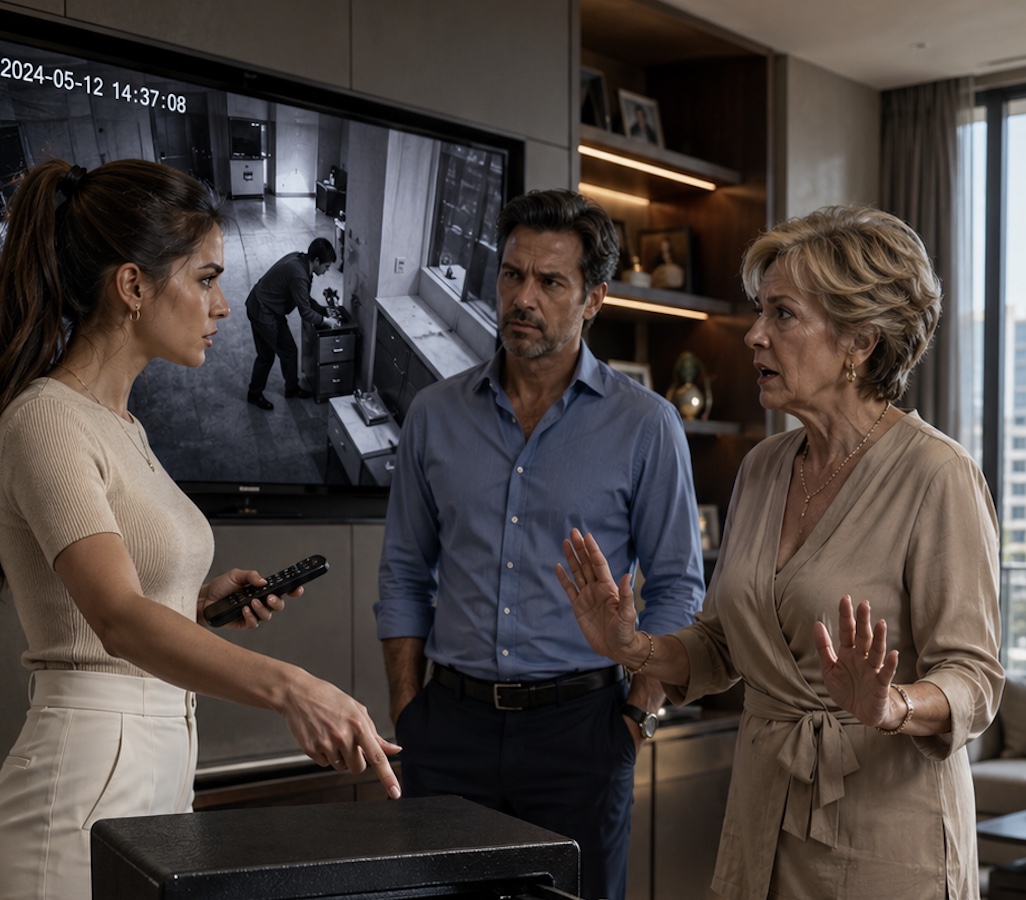
“The cameras recorded everything. Now we’ll watch together and see who was so interested in someone else’s money,” Darya said calmly, placing her phone on the table.
The room seemed to shrink. Ilya froze beside the document cabinet. Valentina Andreevna stopped nervously twisting the handle of her handbag, and Svetlana looked at her mother a little too quickly. That brief glance said so much that Darya was now almost certain: she had turned on the recording for a reason.
“What cameras?” her mother-in-law recovered first. “Have you lost your mind? Setting up surveillance in your own family?”
Darya sat down across from them and folded her hands on the table.
“In my own apartment, I was trying to find out why money kept disappearing from my safe.”
“Again with your safe,” Ilya said irritably, running a hand over his face. “Maybe you moved the money yourself and forgot.”
Darya looked at her husband carefully. Before, she would have started explaining, showing him her notebook records, defending her own accuracy. But over the past few weeks, she had grown tired of proving the obvious to a man who only heard her when the conversation had nothing to do with his relatives.
“I didn’t forget anything,” she said. “And now everyone will see that.”
Svetlana smirked, though the corner of her mouth twitched.
“Oh, go ahead and start your little show. I’m tired of listening to you make thieves out of us.”
“Fine,” Darya nodded. “Then let’s watch.”
She tapped the screen.
Only a month earlier, Darya could never have imagined herself sitting at her own table, showing her husband’s relatives a video of one of them getting into her safe. It had all begun so quietly that, at first, she had been angry with herself.
At the end of May, she was counting the money she had set aside for her mother’s treatment. Her mother lived in another district, had recently undergone surgery, and now needed regular paid checkups. Darya didn’t like keeping large amounts of cash at home, but she kept part of it there anyway. Sometimes the doctor asked for immediate payment, sometimes medicine had to be bought quickly, and sometimes her mother needed money to pay the woman who helped her with groceries. Darya wrote down every transaction in a separate notebook. Not out of greed, but because she was used to keeping control over anything that might suddenly become necessary.
The safe was small, built into the lower part of a cabinet in her study. Darya kept the key in a desk drawer, inside a closed pencil case with flash drives. She had never set a combination lock. The apartment was hers, strangers did not come there, and she trusted her family.
The first time, a small amount didn’t add up. Darya counted twice, then opened the notebook, frowned, and ran her finger along the lines. The money should have been there. She hadn’t given it to anyone, hadn’t spent it herself, and hadn’t touched the labeled envelope.
“I must be tired,” she told herself then and closed the safe.
That evening, Ilya came home late. He ate dinner and told her his mother wanted him to stop by over the weekend because Svetlana was having some kind of trouble again. Darya listened only halfway, her thoughts constantly returning to the safe. The missing sum wasn’t large enough to start an argument over, but it was noticeable enough to catch her attention.
A week later, it happened again. This time, the missing amount was larger. Darya sat on the floor beside the cabinet, holding the notebook on her knees and staring at the neat records. The room was quiet. Only the sound of running water came from the kitchen: Ilya was washing the cup his mother had used earlier.
Valentina Andreevna had visited during the day. She had brought a bag of apples, sat in the kitchen, complained about a neighbor, and then wandered around the apartment for a long time, supposedly choosing which blanket she wanted to borrow from Darya for the country house. Svetlana had dropped by in the evening while Darya was still home. She had asked for a charger, then suddenly became interested in the study.
“It’s like a director’s office in here,” she said, looking around the desk. “Everything is in its place. I’m almost afraid to touch anything.”
Darya hadn’t paid attention to those words at the time. Now she remembered them and tensed.
In their family, Svetlana had always behaved as though the whole world owed her a little accommodation. Ilya’s younger sister was thirty-four, bright, loud, and always full of new plans. One month she was going to sell handmade jewelry, then she wanted to run a style blog, then she planned to open a small showroom with a friend. Every idea began loudly, ended quietly, and usually required help from relatives.
Ilya helped without question. He drove her around, paid for deliveries, repaired her laptop, or gave her money “until next week.” At first, Darya didn’t interfere. Then she noticed that next week never came for Svetlana.
“She’s my sister,” Ilya would say. “She’s going through a hard time.”
“She’s been going through a hard time for five years,” Darya once snapped.
Ilya took offense, as if she had insulted not Svetlana, but him personally. After that conversation, Valentina Andreevna called her son for two days, sighing so loudly that Darya could hear her voice even without speakerphone.
Darya was not against helping. But helping someone and letting them live at everyone else’s expense were two different things. And now someone was getting into her money, carefully, little by little, hoping she would blame it all on forgetfulness.
The third incident became the breaking point. Darya came home earlier than usual because a meeting with contractors at the cultural center had been canceled. No one was in the apartment, but there was a pen lying on the desk in the study — a pen she knew she had put back in the holder that morning. The desk drawer was closed. So was the safe. Outwardly, everything was in order. But Darya no longer trusted outward order.
She counted the money. Again, some was missing.
This time, she didn’t call Ilya. She didn’t ask questions. She didn’t stare at his relatives during the next visit, looking for guilt on their faces. Accusations without proof would quickly turn into a conversation about her “suspicious nature” and “difficult personality.”
That same evening, Darya ordered a small camera with memory-card recording and phone control. Not to spy on people, but to protect her belongings in her own apartment. She fixed the camera on the top shelf of the bookcase in the study so that the lens faced the desk and the safe door. It didn’t stand out: boxes of documents and an old desk lamp stood beside it.
She left the safe key in its usual place. On purpose. The pencil case with the flash drives stayed in the desk drawer, just as always. Darya didn’t want to provoke anyone into a trap, but she understood one thing: if the key had already been found once, it would be found again.
For the first two days, nothing happened. Ilya came into the room for a charger. Valentina Andreevna brought a jar of honey and, as usual, looked around the apartment with the gaze of a housekeeper inspecting her property. Svetlana sent a message saying she would stop by later, but never came.
On the third day, Darya was delayed at her mother’s. On her way home, she opened the app and saw a motion alert. The recording lasted just over eight minutes.
At first, Svetlana appeared on the screen. She entered the room cautiously, but not stealthily — more like a person who had already decided she had the right to be there. She wore a light jacket, her hair pinned back with a clip, and a phone in her hand. She listened for a moment, then approached the desk. She opened the top drawer. She didn’t rummage for long: she immediately took out the pencil case with the flash drives, opened it, and removed the key.
Darya watched the screen in her car outside the building and didn’t immediately realize she was gripping the steering wheel so tightly that her fingers had turned white.
Svetlana crouched by the safe, opened the door, took out an envelope, and began counting the money. She didn’t panic. She didn’t glance around every second. She acted confidently, as though she had done it before. Then she set aside part of the bills, slipped them into the side pocket of her bag, put the envelope back, closed the safe, and carefully returned the key to the pencil case.
Before leaving, she even adjusted the pen on the desk. It was exactly because of such small details that Darya had noticed someone’s presence before.
The recording ended.
Darya sat in the car for several more minutes. In the courtyard, a woman with a small dog was trying to persuade the animal to go home. A teenager wheeled a bicycle toward the entrance. Somewhere, a door slammed. Ordinary life had no intention of stopping just because Darya now had proof of family theft on her phone.
Her first impulse was to call Ilya immediately. Then she imagined his voice: “That can’t be,” “You misunderstood something,” “Sveta would never do that,” “Why did you put up a camera in the first place?” So she put the phone back into her bag.
That evening, she greeted her husband calmly. She asked how his day had gone, served dinner, and listened to him talk about a broken printer at work. Ilya noticed nothing. In general, he rarely noticed anything that wasn’t happening directly to him.
“Did Sveta come by today?” Darya asked, pouring herself some water.
“Yes, I think she stopped by Mom’s first and then came here. I gave her the keys in the morning. She said she’d forgotten her hair dryer here last week.”
Darya slowly set the glass on the table.
“You gave her keys to our apartment?”
“Well, yes. What’s wrong with that? She isn’t a stranger.”
“How long has she been coming here when I’m not home?”
Ilya frowned.
“Dasha, don’t start. She sometimes drops in if she needs something. Mom can come by too. You know that.”
“I didn’t know my apartment had become a public hallway.”
“Your apartment?” Ilya immediately stiffened. “We’re married, in case you forgot.”
“The apartment is mine. It was mine before the marriage. You know that.”
He pushed his plate away. He didn’t like the conversation. Whenever boundaries came up, Ilya always put on the face of an offended man, even though no one had offended him.
“Formally yours,” he said.
Darya raised her eyebrows.
“Not formally. Legally and factually. And you handed out keys to it without my consent.”
“To my mother and sister, not random people.”
“That was enough to give them access to my things.”
Ilya opened his mouth to answer, then stopped. Apparently, something in her voice made him wary.
“Did money disappear again?” he asked.
“Yes.”
“And you suspect Sveta?”
Darya looked at him and understood: he had already chosen his defense. Before the evidence. Before the question. Simply because Svetlana was his sister, while Darya, apparently, was supposed to be more convenient than the facts.
“I think we will all talk tomorrow,” she said.
“All of us means who?”
“You, your mother, Svetlana, and me.”
Ilya stood up sharply.
“No. Don’t turn this into a trial.”
“A trial is what happens without proof. I have proof.”
He froze.
“What proof?”
“You’ll see tomorrow.”
The night passed almost without sleep. Darya lay facing the window and listened as Ilya got up several times, went to the kitchen, and came back. He clearly wanted to ask more, but didn’t dare. In the morning, he left earlier than usual and said dryly, “I’ll talk to Sveta myself.” Darya replied, “No. The conversation will happen with me present.” That was how they parted until evening.
Her mother-in-law arrived first. Valentina Andreevna was a strong, well-groomed woman who was convinced that her children’s lives concerned her directly. She took off her shoes in the hallway, walked into the living room, and began immediately.
“Darya, I don’t know what has happened between you two again, but Ilya is not himself. You can’t drive your husband to such a state.”
Darya closed the front door and calmly took the spare key from her mother-in-law — the one she had automatically placed on the cabinet along with her gloves.
“This key stays with me.”
Valentina Andreevna turned sharply.
“On what grounds?”
“On the grounds that this is my apartment.”
“That song again.”
“Not a song. Property rights.”
Her mother-in-law tightened her lips, as if her own righteousness had suddenly become uncomfortable, and walked into the room. Svetlana appeared ten minutes later. She came in cheerfully, even too cheerfully.
“So, who are we executing today?” she asked, taking off her jacket.
“No one yet,” Darya replied. “No one has confessed.”
Svetlana shot her a quick glance.
Ilya arrived last. He looked tired and angry. Apparently, he had spent the day not working, but trying to come up with an explanation that would save everyone except Darya.
They sat at the table. Darya placed her phone in front of her.
“For several weeks, money has been disappearing from my safe,” she began. “The amounts were different. I wrote everything down, checked everything, and at first thought I might have made a mistake. Then I realized I hadn’t.”
“Maybe you’re paying for your mother’s treatment and forgetting how much you take,” Valentina Andreevna said.
“I don’t forget.”
“Money ruins people,” her mother-in-law sighed. “Because of it, relatives become enemies.”
“No,” Darya looked at her. “Theft is what turns relatives into enemies.”
Svetlana smirked sharply.
“You should be more careful with your words.”
“I am careful. That’s exactly why I didn’t accuse anyone right away.”
“But you installed a camera,” Ilya said.
“Yes. In my study. Pointed at my safe. And now we don’t have to guess.”
Svetlana leaned back in her chair.
“And what if I say I don’t want to watch your illegal recordings?”
“You don’t have to,” Darya replied. “Then I’ll watch the recording with a police officer.”
Valentina Andreevna flared up.
“You’re going to call the police on your husband’s own sister?”
“If the money isn’t returned and people continue telling me I imagined everything, yes.”
Ilya slammed his palm on the table.
“Dasha!”
“Don’t raise your voice,” she said quietly. “I wasn’t the one taking money from Svetlana’s home.”
That sentence struck harder than shouting. Ilya sat back down. Svetlana turned pale, but quickly hid behind irritation.
“Play it already.”
Darya pressed play.
The study appeared on the screen. Empty. Then the door opened, and Svetlana walked in. In real life, she sat across from them, motionless, her back straight. On the recording, she approached the desk, took out the pencil case, and removed the key.
Valentina Andreevna frowned at first, as if trying not to understand what was happening. Then her gaze hardened. Ilya leaned closer to the phone. Svetlana’s breathing became uneven; it was visible from the way her shoulders rose.
On the video, she opened the safe.
“This isn’t what you think,” Svetlana said quickly.
Darya paused the video.
“And what do we think?”
“I… I was just looking.”
“You were just looking at the bills you put into your pocket too?”
Svetlana jumped up.
“How much was even there? You’re talking as if I emptied your whole apartment!”
Valentina Andreevna instinctively reached toward her daughter, but didn’t put her hand on her. She couldn’t find a way to defend her.
“So you admit you took it?” Darya asked.
“I was going to return it.”
“When?”
“When I could.”
“You took money several times.”
Svetlana turned toward the window, but there was no escape there.
Ilya rose so sharply that his chair scraped backward.
“Sveta, is this true?”
“Don’t yell at me!” she snapped. “It’s your fault! Both of you! You sit here with your order, your safes, your notebooks. And my life is falling apart!”
“What life?” Darya asked.
Svetlana turned on her. Red patches appeared on her face. Mascara under one eye had smudged slightly, even though she wasn’t crying.
“You wouldn’t understand. Everything is arranged for you. An apartment, a job, money for your mother, plans. I was trying to survive however I could.”
“Survive by taking someone else’s money?”
“I borrowed it!”
“Without asking, that’s not borrowing.”
Valentina Andreevna finally found her voice.
“Svetochka, why did you do it? You could have told me.”
Svetlana laughed sharply.
“You? Mom, you’d call Ilya afterward. And Ilya would lecture me. And Darya would look at us as if we were beggars standing at her door.”
Darya slowly put the phone away.
“I look that way at people who think my money is available without my permission.”
Ilya turned to his sister.
“How much did you take?”
Svetlana said nothing.
“How much?” he repeated.
“I don’t remember.”
Darya opened her notebook and placed it in front of him.
“I remember. Here are the dates. Here are the amounts. Altogether, this much.”
She named the sum. The silence in the room became suffocating. Valentina Andreevna sat down on the edge of a chair and pressed a hand to her chest. Ilya looked at his sister as if, for the first time, he saw not little Sveta, who needed help, but an adult woman who had calmly opened someone else’s safe.
“Why?” he asked.
Svetlana sank back into her chair.
“I have a debt.”
“To whom?”
“Not a bank. People.”
Darya looked at her carefully. That was something she had not expected.
“What kind of people?”
“A friend invested with me in a shipment of goods. I promised to return her part, then everything fell through. The goods got stuck, part of them were damaged during delivery, and I wasn’t the one handling the paperwork. My friend started demanding the money. Then her brother got involved. He’s not a pleasant man. I got scared.”
“And decided the safest option was to steal from me?” Darya asked.
Svetlana covered her face with her hands, but not for long. She was ashamed, but not ashamed enough to stay silent.
“I thought I’d take a little and then cover it. Then a little more. I wasn’t going to keep it forever.”
“Where did you see the key?” Darya asked.
Svetlana was silent.
“Sveta,” Ilya said dully.
“That day when Dasha opened the safe in front of me. I asked for a charger, and she went to get some documents. I saw the pencil case. Later I checked.”
Darya remembered that day. Svetlana had stood by the door, chatting about a new handbag and supposedly not looking toward the desk. Everything had turned out to be simpler and uglier.
“Ilya,” Darya said, still looking at Svetlana. “Take the apartment keys from her. Now.”
“Dasha…”
“Now.”
Svetlana raised her head.
“What keys? I’m not planning to come here!”
“Then you don’t need them.”
Ilya stood still for several seconds. Then he extended his hand.
“Sveta, give them to me.”
“Are you serious?” She looked at her brother with such offense, as if something rightfully hers were being taken away.
“Give me the keys.”
Svetlana jerked open her bag, pulled out the keyring, and threw it onto the table. The keys hit the wood and slid toward Darya. She took them immediately.
“Your mother’s too,” Darya added.
Valentina Andreevna went pale.
“What do I have to do with this?”
“You knew Svetlana had keys?”
“Well, yes.”
“You knew she came here without me?”
“She’s my son’s daughter.”
“That’s not an answer. The key.”
Her mother-in-law stared at her for a long time. In the past, Darya would have given in at such a moment to avoid ruining the relationship. Now she simply waited. Valentina Andreevna slowly took the key from a small pocket of her bag and placed it on the table.
“You’re pushing us out of the family,” she said.
“No. I am closing access to my apartment to people who don’t understand boundaries.”
“Because of money?”
“Because of trust. The money simply showed where it ended.”
Ilya sat down as if all strength had suddenly left him.
“Sveta will return it,” he said. “I’ll make sure of it.”
Darya turned to him.
“No. You won’t make sure of anything. Svetlana will write a statement saying she took money from me and agrees to return it by a specific date. With dates and the amount. I have her passport details because I once helped her arrange a delivery. If she doesn’t return it, the video and the statement go further.”
Svetlana jumped up again.
“You want to turn me into a criminal?”
“You decided to get into the safe. I want my money back.”
“Blood is more important than money!” Valentina Andreevna shouted.
Darya turned to her.
“My mother is being treated with that money. To me, those are not just pieces of paper for someone else’s debts.”
Her mother-in-law closed her mouth. For the first time that evening, she had nothing to say.
It took Svetlana almost twenty minutes to write the statement. She tore up the sheet, complained that the wording was humiliating, demanded to write that she had “borrowed” the money, but Darya calmly repeated:
“You didn’t borrow it. You took it without my consent. Write the truth.”
Ilya sat beside them with a stone face. When Svetlana finally finished, Darya checked the text, the date, the amount, and the signature. Then she put the paper into a folder.
“Now leave,” she said.
“Dasha, maybe not like this right away,” Ilya said quietly.
“I wasn’t talking to you. Your mother and sister are leaving now.”
Valentina Andreevna stood first. Svetlana grabbed her bag. At the door, she turned around.
“Are you happy now? You destroyed the relationship.”
Darya opened the front door.
“No, Svetlana. I simply played the video.”
After they left, the apartment became quiet. Ilya stood in the hallway, not knowing what to do with his hands. Darya locked the door and put the set of keys into a drawer.
“I’m changing the locks tomorrow,” she said. “I’ll call a locksmith.”
“You think they’ll come?”
“I don’t want to wonder who else might have made copies.”
Ilya winced.
“So now you suspect me too?”
Darya looked at him tiredly.
“I don’t suspect you. I no longer trust your way of handling family problems.”
“I didn’t know.”
“But you immediately started defending them from me.”
He wanted to object, but couldn’t. His face turned gray.
“They’re my mother and sister.”
“And who am I?”
The question hung between them. Ilya opened his mouth, closed it, then sat down on the bench by the door. He looked as if, for the first time, he understood that his wife was not supposed to stand last in line behind all his relatives.
“You’re my wife,” he finally said.
“Then act like that means something.”
The next day, Darya really did call a locksmith. Of course, she didn’t file a police report. She simply chose a reliable lock, waited for the technician, and received new keys. She kept one for herself and put the second into a separate envelope. She did not give Ilya a key immediately.
“Are you serious?” he asked when he came home and realized his wife had opened the door for him.
“Yes.”
“I live here.”
“Yes. But yesterday you saw no problem with handing out keys without my permission. I need to understand that it won’t happen again.”
Ilya ran a hand over the back of his head. He wanted to flare up, but restrained himself.
“I understand.”
“No, Ilya. Understanding doesn’t mean saying the right word. Understanding means giving me back the feeling of safety in my own apartment.”
He nodded. This time, without arguing.
The next few days were strange. Valentina Andreevna called her son several times a day, but Darya did not listen to their conversations. Svetlana sent long messages: first asking Darya to delete the video, then accusing her of cruelty, then promising to return everything if Darya would “stop pressuring her.” Darya answered only about practical things: the date, the amount, and the method of repayment. No justifications. No discussions of character.
A week later, Svetlana returned the first part of the money. Not personally — she transferred it through Ilya — but Darya insisted that the payment note clearly state: repayment under written statement. At first, Ilya tensed, then he himself told his sister to do it properly. It was a small step, but Darya noticed it.
Two weeks later, Valentina Andreevna came over. Without warning. She rang the doorbell and stood on the landing with a bag of apricots and a flushed face.
Darya opened the door, but did not invite her in.
“I need to talk to my son,” her mother-in-law said.
“Ilya is at work.”
“Then I’ll wait.”
“No.”
Valentina Andreevna looked so surprised it was as if the door had refused to be a door.
“I’m his mother.”
“I remember.”
“You won’t let me across the threshold?”
“Not today.”
Her mother-in-law lowered the bag to the floor, then picked it up again.
“You’ll make Ilya leave you.”
Darya tilted her head slightly, studying the woman who was still trying to press the same old buttons.
“If Ilya leaves because I protect my money and my apartment, then the lock was never the real problem.”
Valentina Andreevna gripped the handles of the bag.
“You’re cruel.”
“No. I’m done being convenient.”
Darya closed the door without slamming it. Simply closed it. Then she wrote to Ilya: “Your mother came without warning. I didn’t let her in. Please explain to her that visits must be agreed on in advance.”
He called back a minute later. Darya prepared herself for an argument, but heard something else.
“I understand. I’ll tell her myself.”
“Good.”
“Dasha… I really will.”
He did. That evening, Valentina Andreevna sent a short message: “I’ll warn you in advance.” No apology, but no threats either. For her, that was almost an impossible acknowledgment of a boundary.
By the end of the month, Svetlana returned the entire amount. Darya didn’t ask where she had gotten the money. She was not interested in someone else’s drama after her safe had stopped being someone else’s opportunity. She did not tear up the statement. She put it in a folder together with a copy of the video. Not for revenge — for memory.
Things with Ilya were more complicated. The money returned faster than trust. He tried to be more attentive: he asked whether she needed him to stop by her mother’s place, offered to pay for medicine delivery himself, and stopped discussing their private matters with Valentina Andreevna. But Darya could see that he was not simply correcting his behavior — he was relearning where helping relatives ended and betraying his wife began.
One evening, he sat down across from her in the kitchen.
“I thought that if I didn’t notice the conflict, I was keeping the peace,” he said.
Darya looked up.
“You weren’t keeping peace. You were preserving convenience for yourself.”
He nodded. He didn’t argue.
“I was afraid of choosing between you.”
“You didn’t have to choose between me and your relatives. You had to choose honesty.”
Ilya looked at his hands for a long time.
“I know.”
After that conversation, Darya gave him the new key. One key. No copies for his mother, no spare versions “just in case.” Ilya took it silently, as if accepting not a piece of metal, but a condition.
Svetlana no longer appeared in their apartment. At first, her silence was demonstrative. Then Ilya said his sister had gotten a job at a pickup point and was gradually paying off her debts. Darya didn’t comment. She didn’t want to triumph or pity her. A grown woman had finally faced consequences — and that was not punishment, but the normal order of things.
Two months later, Zoya Pavlovna, Darya’s mother, had another checkup. Darya took her to the clinic, waited for the results, and for the first time in a long while, left the doctor’s office without a heavy stone in her chest. The progress was good. They needed to continue monitoring, but the threat they had feared had not been confirmed.
In the car, her mother noticed that Darya was staring at the road too intently.
“Have things settled down at home?” she asked.
Darya didn’t answer right away.
“The money was returned.”
“I’m not asking about the money.”
Darya stopped at a traffic light. In the next lane, a man was transporting a huge ficus in his car, its leaves pressed against the glass and trembling comically in the air from the fan.
“I don’t know, Mom. Maybe not everything is fixed. But it has become more honest.”
Zoya Pavlovna nodded.
“More honest is sometimes better than peaceful.”
Darya smiled faintly.
“You should have heard how peacefully they all sat before the video.”
“I can imagine.”
“No, you can’t. It was so quiet I could hear Svetlana scraping her nail against her handbag.”
Her mother laughed for the first time that day. Darya smiled too. The laugh was short, but alive.
That evening, Darya opened the study. The camera was still on the top shelf. She took it down, turned it in her hands, and put it into a box. She closed the safe and moved the key to a different place. Not because she was now afraid of everyone. Just because her old carelessness was over.
Ilya entered the room and stopped at the doorway.
“May I?”
“Yes.”
He looked at the safe, then at the box with the camera.
“You’re putting it away?”
“Yes. I don’t need it for now.”
“And if you need it again?”
Darya looked at him calmly.
“Then I’ll set it up again.”
Ilya accepted that without offense. He came closer, but did not hug her without asking, the way he used to when he wanted to quickly end an unpleasant conversation. He simply stopped beside her.
“I don’t want you to live with me as if I’m someone who needs to be checked.”
“Then don’t make me check.”
“I’ll try.”
“Don’t try. Do it.”
He nodded.
And there was no beautiful instant resolution in that. A marriage cannot be repaired with one conversation, the way a door lock can be replaced. Trust does not return simply because a guilty relative signs a statement. But for the first time, their home had rules that were not shameful to say out loud: don’t take what isn’t yours, don’t hand out keys, don’t put your wife behind everyone else, and don’t treat money for medical treatment as a family reserve for other people’s mistakes.
Six months later, Darya accidentally met Svetlana near a pharmacy. Svetlana had lost weight and dressed more simply now, without her former flashy shine. When she saw Darya, she first wanted to pass by, but stopped.
“Hi.”
“Hi.”
They stood near the entrance while people walked around them with bags and umbrellas. A fine rain was falling, darkening the asphalt in patches.
“Back then…” Svetlana swallowed and adjusted the strap of her bag. “I said a lot of awful things to you.”
Darya was silent.
“I returned the money, but I understand now that it wasn’t only about the money.”
“Yes.”
Svetlana nodded, as if that short answer was exactly what she had feared.
“I’m not asking you to forget.”
“That’s good.”
She smiled crookedly.
“You’re still the same.”
“No. Before, I would have said everything was fine.”
“And now?”
“Now I’ll say it as it is: it wasn’t fine. But if you don’t get into other people’s lives and other people’s belongings again, we won’t have to fight.”
Svetlana looked at her for several seconds, then nodded.
“I understand.”
They parted without hugs or promises. Darya bought the medicine, stepped out into the rain, and opened her umbrella. Her heart did not feel festive. But it felt steady. Sometimes justice looks exactly like that: not a loud victory, not the fall of an enemy, but the calm ability to move forward without glancing back at an unlocked safe.
At home, Ilya met her in the kitchen. Two plates lay on the table, with forks and napkins neatly placed beside them. He had learned not to throw his things around and not to turn everyday life into proof of his exhaustion. A small detail, but Darya noticed such details.
“Mom called,” he said.
Darya took off her coat.
“What did she want?”
“She invited us over on Sunday. I said I’d ask you first.”
Darya looked at him. Ilya held her gaze.
“On Sunday, I’m going to see my mother,” she said. “If you want, you can visit yours afterward. I’ll go another time.”
“Okay.”
Before, after an answer like that, he would have started explaining that Valentina Andreevna would be offended. Now he simply nodded. And that was more important than any apology.
Darya went to the study, opened the cabinet, and checked the safe. Not because she doubted anything. Out of habit. The money was in place. So were the documents. She closed the door and kept her palm on the cold metal for a moment.
Once, she had thought trust meant not needing to lock things. Now she understood it differently. Trust is when a person knows where the key is and still does not take what belongs to someone else. And if someone believes family ties give them permission to access your money, your apartment, and your patience, then that is not family — it is a convenient legend for people who are used to taking.
Darya turned off the light in the room and returned to the kitchen.
“Everything okay?” Ilya asked.
She sat down at the table, looked at him, and answered honestly:
“Better now.”
And that was true. Not a complete victory. Not a fairy-tale reconciliation. Just a new order in which her peace was no longer sacrificed to other people’s debts, other people’s resentment, and other people’s habit of opening any door without asking.