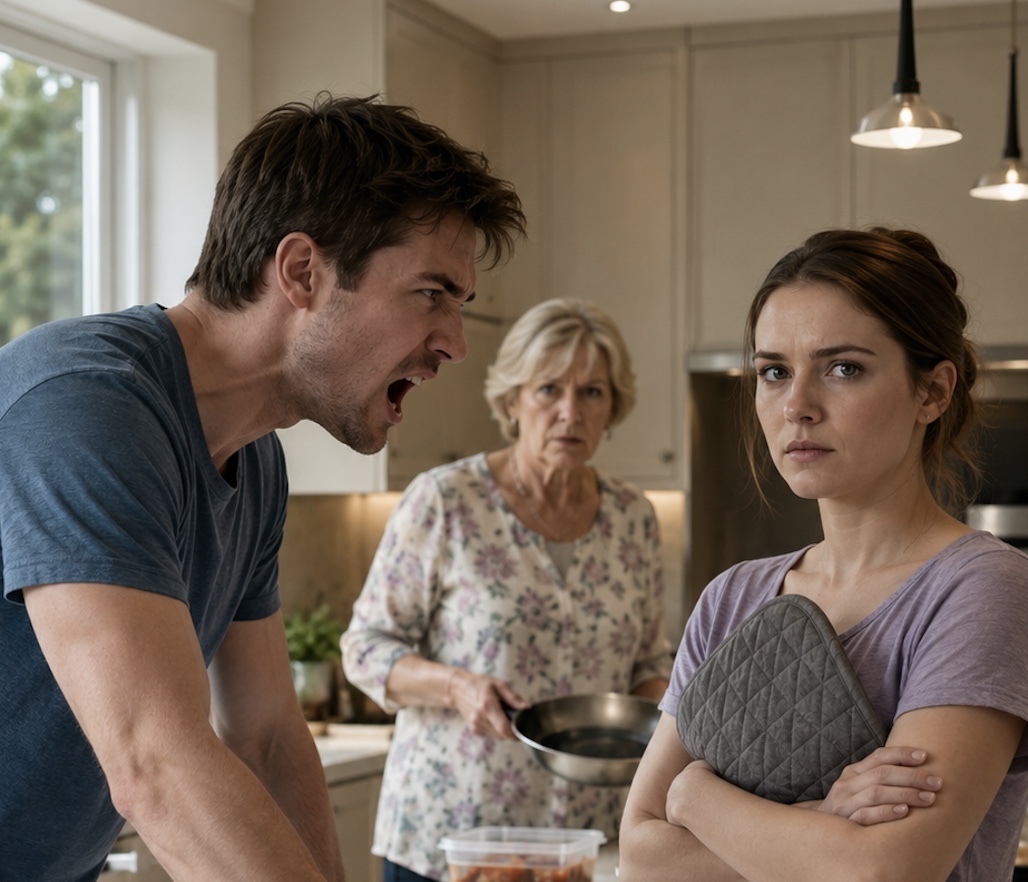
“Mom is disgusted by your cooking, Vera,” Denis said so loudly that the oven mitt trembled in my hand. “And since you’re making a scene again over an ordinary dinner, you’re going to sign this agreement. That way Mom can come to my place — to our apartment — without needing your permission.”
On the edge of the kitchen table lay a sheet of paper that had not been there that morning. Across the top, in large letters, it said: “Agreement on Family Use of the Apartment.” Below it were already my details, Denis’s details, and a separate line about Raisa Lvovna, his mother. According to that paper, she was to have the right to come and stay “in cases of family necessity.”
Raisa Lvovna sat across from me, having carefully pushed away her plate of buckwheat, turkey, and salad. She had brought her own food in containers and placed the bag directly on my chair. She did everything calmly, even politely, but the meaning needed no explanation: she did not like my kitchen, my food did not suit her, and now my apartment was supposed to become convenient for her too.
“We’re not taking anything away,” my mother-in-law said in a soft voice. “We’re solving this like a family. Denis lives here. He’s your husband. A husband’s mother shouldn’t have to stand outside the door waiting to see whether she’ll be allowed in or not.”
Denis pushed the paper toward me.
“Sign it. Stop acting like you’re running a dormitory.”
I looked at him, then at Raisa Lvovna. Three months earlier, it had all started with little things. She would come “just for an hour,” rearrange my jars of grains, bring her own towels, inspect the refrigerator, and tell Denis there was no proper food in the house. At first, he laughed. Then he started agreeing with her. Later, he began repeating her words as if they were his own complaints.
“I’m not signing anything,” I said, placing the oven mitt on the table beside the paper. “This apartment is mine. Your mother is not registered here and has no right to live here.”
Denis smirked.
“There it is again — your apartment. How long are you going to keep throwing that in my face?”
“As long as you keep bringing me papers like this.”
Raisa Lvovna slowly removed the napkin from her lap.
“Vera, if I were you, I’d be ashamed. Your husband has been living with you for quite some time now. You registered him. You’re a family. You can’t keep a man on a leash made of documents forever.”
“And you can’t try to claim access to someone else’s apartment under the disguise of family convenience,” I replied.
Denis stood up abruptly. His spoon clattered against the plate.
“What did you just say?”
“I said exactly what’s written on this paper. You want me to give your mother the right to come here whenever she wants and stay if she decides there’s some family necessity.”
“She’s my mother.”
“I remember. But she is not the owner.”
Raisa Lvovna gave a short laugh, opened her container, and took out a cutlet. She did it deliberately, without hurrying, as if the food I had served at my own table were something indecent.
“We don’t eat things like this in our family,” she said, looking at the salad. “Denis has been used to proper cooking since childhood. Everything you make tastes like food from a factory cafeteria.”
I worked as a food production technologist, so I was used to comments like that. But it was one thing to hear jokes from colleagues and another to have a woman sitting in my kitchen who was already trying on her own rules for my apartment.
“Raisa Lvovna, if you don’t like the food, you don’t have to eat it,” I said. “But you will not discuss my hands, my work, or my apartment here.”
Denis jabbed his finger at the paper.
“You’ll sign it, and everything will go back to normal. Mom will stop being nervous, I’ll stop listening to your arguments, and you’ll stop giving orders.”
“Denis, I’m not giving orders. I’m refusing to sign a document that worsens my position in my own apartment.”
He looked at me as though I had said something ridiculous.
“Have you been watching too many legal videos?”
“No. I just know how to read.”
After that phrase, there was no bringing the evening back to dinner. Denis picked up the paper, crumpled it halfway, and threw it near the microwave. Raisa Lvovna closed her container and stood up.
“I told you long ago, Denis,” she said without looking at me. “A man shouldn’t live somewhere he is constantly being put in his place.”
“Mom isn’t going anywhere,” Denis snapped. “This is my home too.”
“No,” I replied. “This is my apartment. You are registered here, but you do not own any share of it.”
He turned sharply toward me.
“We’re family.”
“A family doesn’t shove an agreement in someone’s face while shouting about her cooking.”
Raisa Lvovna left first. Denis stayed in the kitchen and spent another ten minutes pacing from the table to the refrigerator, opening the door, closing it, checking his phone. Then he said that in the morning I would apologize to his mother. I said nothing and put the dinner away in containers. They left their paper on the table, and that was their mistake.
The next day, April 18, 2026, I did not go straight to work. First, I gathered my documents: the gift agreement from my aunt, Lidia Semyonovna; the extract from the property register; our marriage certificate; Denis’s registration certificate; utility payment receipts; and messages where he had written several times that his mother “had the right to come whenever she wanted” because “that’s normal in a family.”
I made copies and stored the originals away from home. After the previous night’s paper, it no longer seemed excessive to keep my documents far from the kitchen, where Denis could at any moment organize another “family council.”
In the morning, he came into the hallway with his phone in his hand and asked where I was going. His voice was no longer like the night before. It was businesslike, almost calm.
“I have things to do,” I answered.
“Mom is waiting for an apology. She was upset all night.”
“I owe her nothing.”
“Do you even hear yourself? She’s an older woman. She’s your husband’s mother.”
“She tried to gain access to my apartment through a paper you both didn’t even let me read properly.”
Denis blocked my way, though not too closely. He knew how to apply pressure in a way that would later let him say he had done nothing special.
“Vera, don’t start. You won’t achieve anything. I’m registered here.”
“Registered.”
“What difference does it make?”
“In court, it makes a difference.”
He smirked, but his eyes became more alert.
“Are you trying to scare me?”
“I’m warning you. I won’t change the locks, throw out your things, or create a scandal. I’ll do this legally.”
I went to a legal office on April 21, 2026. Yulia Igorevna carefully read the gift agreement, the property extract, the registration certificate, and the messages. Then she asked to see the very paper about family use of the apartment. I took it out of the folder. Denis had crumpled it carelessly, but the text was still readable.
“It’s good that you kept this,” the lawyer said. “It doesn’t give them any rights since you didn’t sign it. But it shows intent.”
“Do I need to evict him?”
“At first, don’t use dramatic words when speaking to him. You need two tracks: divorce and termination of his right to use the apartment after the divorce. He is registered as a family member of the owner, but he is not an owner himself. If there is no agreement granting him permanent residence, then after the family relationship ends, you can go to court.”
She spoke calmly, without promising quick miracles. She explained that Denis could object, ask for time, and argue that he had nowhere to move. But none of that would turn him into an owner, and none of it would give his mother the right to appear in the apartment whenever she wanted.
“Should I write about the food?” I asked.
Yulia Igorevna shook her head.
“Only as background, if it becomes necessary to explain the conflict. The court will care more about the documents: ownership, registration, lack of a share, lack of an agreement, and termination of the marriage. You don’t need to prove that you cook well. That is not the subject of the dispute.”
That sentence sobered me more than any conversation could have. For the past few months, Denis and Raisa Lvovna had forced me to defend myself over the most absurd things: why the salad was like that, why the grains stood in the wrong place, why the towel hung on the wrong hook. But in the lawyer’s office, everything became simpler. I was the owner. He was a husband with no share. His mother was a guest I no longer invited.
When I returned home, Denis was already prepared. Raisa Lvovna was sitting in the kitchen again, this time without a plate in front of her. A new sheet of paper lay on the table, written more neatly. At the end, they had even left a space for my signature.
“We don’t want to fight,” Denis said. “Just sign that Mom can come to see me. It’s not like we’re selling the apartment.”
“Of course not,” Raisa Lvovna added. “We’re simple people. All we need is respect.”
I picked up the paper, read it, and placed it back on the table.
“No.”
Denis pressed his lips together.
“You’re not even thinking about it.”
“I already have.”
“You’re going to divorce me over dinner?”
“No. I’m going to divorce you because, under the cover of dinner, you’re trying to establish rules in my apartment that I never agreed to.”
Raisa Lvovna stood up and adjusted the bag on her shoulder.
“Denis, I don’t understand how you live with her. A woman should keep a home, not wave papers around.”
“A woman should only sign what she believes is safe,” I replied.
After that, Denis stopped pretending we were having a peaceful conversation. For several days, he barely bought groceries, brought ready-made food only for himself, left the packaging on the table, and said that since I was so independent, I could cook for myself and clean everything myself too.
So I did. I washed my own dishes, cleaned up after myself, paid the utility bills, and saved every message where he called my apartment “our home” and demanded that I “stop making a circus out of Mom.”
Raisa Lvovna came almost every day. Sometimes Denis opened the door for her when I was not home. I would return and see her slippers in the hallway, her bag on the kitchen chair, her containers in the refrigerator. Once she placed another one of her towels in the bathroom, and I calmly folded it into a bag along with her other belongings.
“You have no right to throw my mother out,” Denis said when he saw the bag.
“I have the right not to store her things in my apartment.”
“She comes to see me.”
“Meet her outside the apartment.”
“You are a wife here, not the owner.”
I took a copy of the property register extract from my folder and placed it on the hallway cabinet.
“In this apartment, I am the owner. That is not an insult. It is a fact.”
Denis did not even pick up the paper. He was used to winning arguments with his voice, but the document did not argue. It simply lay on the cabinet and made his words empty.
On May 6, 2026, I filed the documents with the court electronically. The statement did not contain long explanations about cutlets, salads, or his mother’s containers. It included the gift agreement, the property register extract, marriage documents, Denis’s registration certificate, copies of utility bills, messages, and the unsigned paper about family use of the apartment.
That evening, Denis received the notification. He stood in the kitchen with his phone and reread the screen for a long time.
“You really filed?” he finally asked.
“Yes.”
“For divorce?”
“Yes.”
“And eviction?”
“For termination of the right to use the residential premises, eviction, and removal from the registration records.”
I deliberately said the full phrase. Not to sound impressive, but because that was the correct name for what he had called my whim the day before.
Denis called his mother. The conversation was short, but I heard enough. At first, he spoke confidently. Then he began making excuses. Raisa Lvovna, apparently, was demanding that he immediately “put me in my place,” but now that place was determined not by her voice, but by documents.
Denis came to the first hearing in a new shirt. Raisa Lvovna came too and waited in the hallway, even though she was not a party to the case. She looked at me as if I had taken something shared from the family, although there was nothing shared between her and me in that apartment.
Before we entered, Yulia Igorevna reminded me:
“Don’t argue about domestic matters. Answer the questions. The court doesn’t need to know who cooks what. The court needs to understand who the owner is and whether there are grounds to require him to vacate the apartment.”
During the hearing, Denis talked a lot. He said I had registered him myself. That he had considered the apartment our family home. That he had installed two shelves and bought groceries. That it would be difficult for him to move out quickly. That his mother was worried about him.
When the judge asked whether he had a share in the apartment, he first began explaining about marriage and relationships, but eventually he still answered:
“No, I don’t have a share.”
“Did you conclude an agreement granting you the right to permanent residence?” the judge clarified.
Denis looked at me and answered more quietly:
“No.”
In the hallway, Raisa Lvovna tried to stop me near the document counter.
“Vera, you are ungrateful. He gave you his youth.”
“Denis is thirty-nine,” I said. “He didn’t give me his youth. He simply lived in my apartment.”
“I won’t abandon my son,” she snapped, but almost immediately added, “But he can’t come to me. I have my own habits, little space, my routine.”
I did not argue. Everything was in that sentence. As long as it was necessary to put pressure on me, Denis was her son who needed comfort and support. But the moment space for his belongings became necessary, Raisa Lvovna suddenly had habits and a small apartment.
On June 19, 2026, the marriage was dissolved. That evening, Denis came home late, dropped his keys on the cabinet, and asked whether I was satisfied. I replied that the apartment issue had not been resolved yet. He said he would live there anyway because he was registered. I did not argue. I simply reminded him that the process was ongoing.
After the divorce, he became quieter. Not kinder. Not more honest. Just more careful. Raisa Lvovna came less often. More often, she called him from downstairs, and he went down to the courtyard. Sometimes he returned with a bag of food and an irritated face, but he no longer demanded that I surrender the kitchen to his mother.
I lived by a list. I paid the utility bills. I kept the documents away from home. I labeled my food containers for myself. I removed Raisa Lvovna’s magnet from the kitchen — the one about a “cozy family” — and put it into the bag with her belongings. Denis saw the bag, but he no longer made a scene. Apparently, he understood that each of his messages and every attempt at pressure could now become part of the case.
On July 30, 2026, the court announced its decision. My claims were granted. Denis’s right to use the apartment was not preserved after the termination of family relations. He was ordered to vacate the residential premises, and after the decision entered into force, it became the basis for removing him from the registration records.
Denis was given time to move his belongings. Not one day, not “right now,” as he later tried to tell acquaintances, but a normal period, which Yulia Igorevna explained to me. But for him, the wording itself was worse than any argument: he could no longer hide behind the phrase “I’m registered here.”
In the courthouse hallway, Raisa Lvovna asked him what had happened. Denis walked past her and said he would explain later. Then she turned to me.
“You destroyed the family.”
“I legally formalized what you had long been trying to call family instead of pressure.”
“Where will he live?”
“That is a question for an adult man to ask himself.”
“You are obligated to give him time.”
“The court did.”
Yulia Igorevna touched my elbow, and we left the courthouse. I carried the decision in a folder, and for the first time in a long while, I did not feel that I had to explain to anyone why my apartment should not become an open passageway for someone else’s authority.
At home, Denis was sitting in the kitchen. Store-bought food stood in front of him, but he had not touched it.
“Are you really going to take this all the way?” he asked.
“I already have.”
“Vera, don’t be so stone-hearted. I lost my temper back then. Mom went too far too.”
Before, I would have grabbed onto those words and started asking what exactly he had understood. Now there was no point. An admission spoken after a court decision did not return to him the right to give orders in my kitchen.
“You have a deadline to move out,” I said. “If you don’t leave, I’ll get a writ of execution.”
Denis smirked, but without his former confidence.
“You know everything now.”
“Enough not to argue in the kitchen anymore.”
In August, the apartment turned into a storage space for his boxes. He packed in bursts: first folding clothes, then taking them back out, then saying he would stay with a friend, then sending me long messages from the next room. In them, he called me cold, petty, and ungrateful. I did not reply. If something needed to be discussed about the apartment, I wrote briefly and to the point: date, keys, gate pass, list of belongings.
Raisa Lvovna came once. No containers, no slippers, just a small bag in her hands. I did not let her past the hallway.
“Vera, let’s settle this peacefully,” she said. “Denis is sharp-tempered, but he isn’t a bad man.”
“That no longer matters.”
“It’s hard for him to start over.”
“I understand.”
“Then let him stay at least until New Year. You have so much space here alone anyway.”
There it was — the real reason behind all the talk about family. It was not love for her son, not concern for me, not offense over dinner. It had simply been convenient for them to treat my home as a spare family resource.
“No,” I said.
Raisa Lvovna pressed her lips together.
“What if you had a son?”
“I have an apartment and a court decision.”
She stood there for a few more seconds, as if waiting for me to start justifying myself. I did not. Without my table, my kitchen, and Denis behind her back, her power did not work. She said she had never wanted anything bad. I answered that she had wanted what was convenient. That was the end of the conversation.
On September 5, 2026, Denis moved his things out. First his clothes, then boxes of electronics, then tools that had spent years lying in the storage room, supposed to symbolize that there was a man of the house. I stood in the hallway with a list and checked off what he took.
“Petty,” he said when I asked for the second key.
“The second key, Denis.”
He took it out of his pocket and placed it on the cabinet. Then, just as silently, he handed over the gate pass. He paused at the door for a second and said his mother had been right: it was impossible to live with me.
“Then the court decision helped both of us,” I replied.
He picked up the last box and left. The door closed with an ordinary sound. No scene. No attempt to claim the last word.
On September 12, 2026, I received confirmation that Denis had been removed from the registration records. I printed it and placed it in the folder beside the court decision, the gift agreement, and the property register extract. Not as a trophy, but as a document that ended a long household quarrel disguised as family values.
That evening, I cooked buckwheat, turkey, and salad. The same simple dinner that had started Denis shouting about his mother being disgusted.
There were no strangers’ containers on the table. No towels belonging to Raisa Lvovna hung in the bathroom. Denis’s jacket was not lying over the chair. In the refrigerator stood my labeled containers of food for two days, exactly where I had left them.
I ate at my own table, in my own kitchen, without a committee and without anyone else’s rules.
Food was just food again.