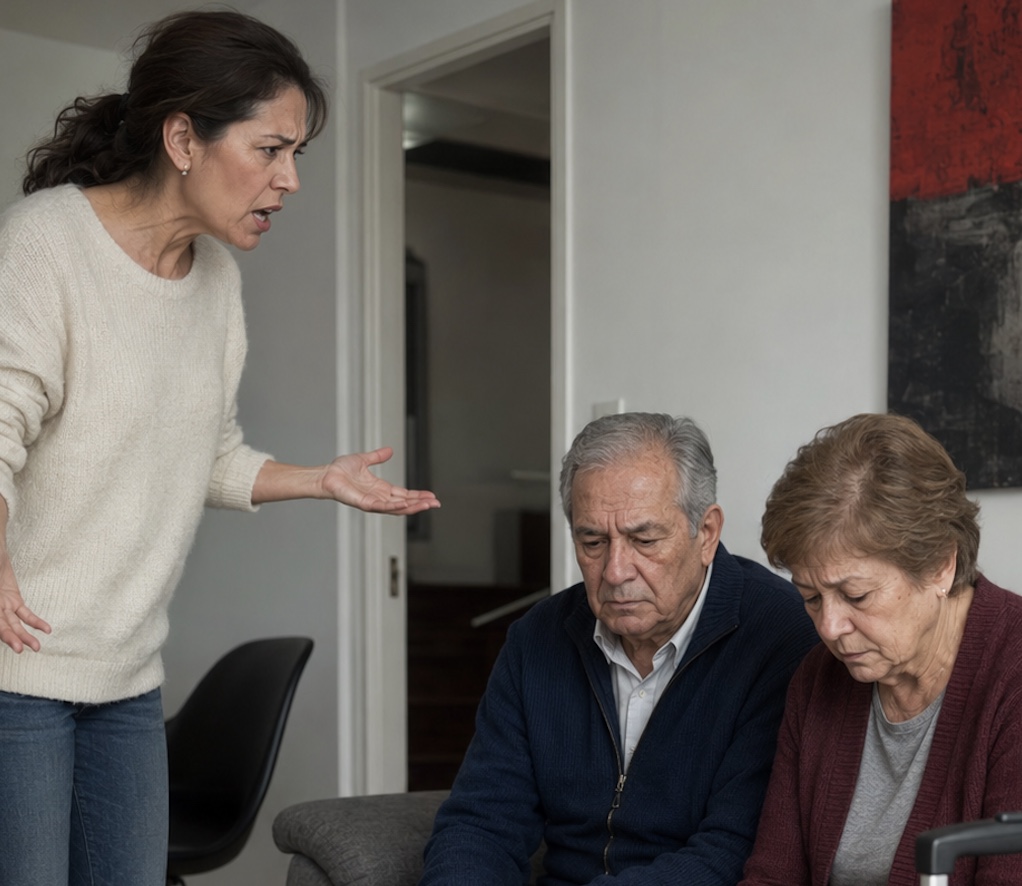
Liza saw them through the peephole, and something inside her tightened into a hard, painful knot. Her mother was standing there, leaning on a cane, while her father supported her by the elbow. They had both aged so much that it felt as if not three years had passed, but an entire lifetime.
“Lizonka, please open the door,” her mother said, her voice trembling. “We need to talk.”
Liza’s hand rested on the door handle, but she froze. She closed her eyes, remembering the last conversation after which she had decided she would never see these people again.
“You are no daughter of ours anymore. If you feel sorry for your own sister because of money, then this family means nothing to you.”
Those words had sounded like a sentence. Her mother had hung up first, and the long, drawn-out beeps on the line had felt like a funeral march for their relationship.
“Lizonka, we know you’re home. Your car is in the yard.”
The door opened sharply. Liza stood in the doorway in a house robe, her hair tied up in a messy bun, her face bare of makeup. Her parents looked at her with hope, and somehow that almost felt insulting.
“So why have you crawled back to me?” she said. “You disowned me, didn’t you? You have another daughter, the one you gave everything to!”
Her mother tried to say something, but Liza raised her hand, stopping her.
“Three years of silence. Three years you managed perfectly well without me. And now you suddenly remembered I exist?”
“Daughter, we were wrong,” her father said hoarsely. “We need your help.”
“Help,” Liza repeated with a bitter smile. “Of course. Whenever you needed something from me, I was your daughter. But the moment I dared to say no, I became a stranger.”
She let them into the apartment not because she had softened. The neighbor had already peeked out from behind her door, and Liza had never been the kind of person to put family scandals on public display. Even when the pain was unbearable, she kept it inside.
Her parents sat awkwardly on the sofa, as if they were in this apartment for the first time, although they had been here before. But always briefly. Always in a hurry to get back to Anya, who needed attention, support, and money.
“Liza, your father has heart problems,” her mother began, nervously twisting the edge of her scarf. “He needs surgery. The doctors say it’s serious. And expensive.”
“And Anya?” Liza sat across from them, folding her arms over her chest. “Where is your beloved daughter, the one you cared about so much all these years?”
Her mother looked away.
“Anya… she is going through a difficult time right now. She can’t help.”
“Can’t, or doesn’t want to?”
“She can’t,” her mother repeated more firmly. “She has debts of her own.”
Liza laughed, and the sound came out hard and sharp.
“Debts. Of course. How many years did she spend looking for a rich husband? Ten? Twelve? And what, she still didn’t find one?”
“Liza, don’t,” her father said, wincing and pressing a hand to his chest.
“Don’t? And what should I do, Dad? My whole life, that’s all I heard. Don’t complain. Don’t ask. Don’t be offended. I grew up hearing the same thing over and over: don’t get in the way, don’t distract us, we’re busy with Anya. Anya has problems at school. Anya has exams. Anya needs a tutor. Anya needs new clothes to meet another boyfriend.”
Her mother sobbed quietly.
“We never wanted you to feel that way.”
“You didn’t want to?” Liza stood up and began pacing the room. “Or you simply never thought about it? It was convenient for you that I handled everything myself. I studied on my own, worked on my own, rented apartments on my own. And meanwhile, you sold the car so Anya could spend another year ‘finding herself’ instead of getting a job.”
“We thought she would marry a good man,” her mother said more quietly. “That she would settle down.”
“Get married,” Liza repeated bitterly. “As if that’s the only way to build a life. And what about me? Was I not your daughter too? Why was there no care for me? No hope for me?”
“You were always strong,” her father tried to explain. “You managed. But Anechka…”
“Anechka was weak, I know,” Liza cut him off. “You told me that since childhood. Anechka isn’t as capable. Anechka needs support. Anechka must be protected. And what about me? Was I just supposed to understand everything and stay silent?”
She remembered winning school competitions while her parents failed to attend the ceremonies because Anya had a kindergarten performance that day. She remembered graduating with honors and receiving only distracted nods from them because Anya had just broken up with yet another boyfriend and was crying in her room. She remembered buying her first car with her own money, and her mother saying, “That’s good, daughter,” only to add a minute later, “Couldn’t you help Anechka? She’s short on money for driving school.”
There was always something missing. Anechka always lacked something.
“When you called three years ago and asked for money for her business project, I agreed,” Liza said evenly, though a storm raged inside her. “I gave you a large amount. You promised it would be the last time. And then I accidentally found out it wasn’t the first time at all. For years, you took money from me, saying you needed it for medicine, repairs, living expenses. But you gave it all to Anya.”
Her mother began to cry openly.
“We were afraid you would refuse.”
“And you were right to be afraid!” Liza’s voice broke into a shout. “Because I would have refused! Not because I was greedy, but because it was wrong! You raised Anya to be helpless, and then you kept saving her from the consequences of her own childishness!”
“She is our daughter,” her father said wearily.
“And who am I?” Liza stopped in front of them. “I am your daughter too. Or was I only your daughter when I was useful?”
A heavy, sticky silence filled the room. Outside the window, an ambulance siren passed by, and Liza thought how cruel irony could be.
“We loved you,” her mother said, wiping away her tears. “It’s just… you were born when we were so young, so immature. I was twenty, your father was twenty-two. We were children ourselves. And when Anya was born, we already knew what we wanted, how to raise a child.”
“And you decided to make up for your mistakes at my expense?”
“No!” her mother shook her head. “We just… saw that you could manage. You always did everything right without being told. You studied well, helped around the house, found work. You were smart, responsible. And Anya…”
“Anya was your attempt to become good parents,” Liza finished for her. “I understand. But the question is different: why was I the one who had to pay for it?”
Her father slowly rose from the sofa and walked to the window.
“When we sold the country house, I thought about you,” he said, looking down. “You loved being there. Do you remember how you and I built the bathhouse? You handed me tools, so serious, so focused. You were twelve.”
“I remember,” Liza said, feeling a lump rise in her throat. “I thought it was our project. Yours and mine. And then you sold the house, and I found out by accident from the neighbors.”
“Anya needed money,” he turned around. “She owed rent on her apartment. They were threatening to evict her.”
“And you preferred to give up the country house rather than let a grown woman face the consequences of her irresponsibility.”
“She is our child!”
“So am I!” Liza shouted, and the tears finally broke through. “I am your child too! Why could you never understand that?”
She cried, and it felt like a release. Years of silent resentment, swallowed words, and buried pain poured out in broken sobs. Her mother tried to stand, tried to hug her, but Liza stepped away.
“No. Not now.”
She took some tissues from the table, wiped her face, and drew in a deep breath.
“I will give you the money for the operation,” she said quietly but firmly. “But this will be the last time. The last time you come to me for anything. After this, we part ways for good.”
“Liza, daughter…”
“I am not your daughter. I was your daughter when I was five and brought you drawings, and you brushed me off because Anya was crying. I was your daughter when I was fifteen and dreamed you would come to my graduation, but you stayed home with Anya because her stomach hurt. I was always your daughter when it suited you.”
Liza went into the bedroom, took an envelope from the safe, and returned. It was the payment she had received the day before from a major client. She placed it on the table.
“There is enough here for the surgery and rehabilitation. Take it.”
Her father picked up the envelope with trembling hands.
“Thank you, daughter. We’ll pay you back…”
“Don’t pay me back,” Liza interrupted. “And don’t call. Don’t write. Don’t come here. Consider that you gave everything to the right daughter. The one you loved. And I… I will live my life. Without you.”
“You can’t do this,” her mother clutched at her chest. “We are family.”
“Family?” Liza smiled sadly. “Family is when all children are loved equally. When every child’s success is valued. When you support not only the weak one, but the strong one too, because strong people also get tired. It was hard for me my whole life, but you never saw it. Because you didn’t want to see it.”
She opened the door.
“Leave. Please.”
Her parents gathered themselves slowly. Her mother sobbed. Her father said nothing. At the threshold, her mother turned back.
“And if Anechka comes to you? If she asks for help?”
Liza looked at her for a long moment.
“Tell Anya she has no older sister. That will be more honest. For her and for me.”
The door closed behind them softly, without a slam. Liza leaned her back against it and slowly slid down to the floor. She sat there with her arms wrapped around her knees for a long time, until it began to grow dark outside.
Her phone vibrated.
A message from her mother: “Thank you. Forgive us. We loved you, we just didn’t know how to show it.”
Liza did not reply. She stood up, washed her face with cold water, and made tea. Then she sat by the window, looking at the city lights.
Somewhere out there lived Anya, spoiled, helpless, used to her parents solving every problem for her. Somewhere out there lived her parents, who had made their choice many years ago and only now understood what it had cost them.
And Liza sat in the apartment she had bought herself. In the silence she had created herself. In the life she had built herself. And for the first time in many years, what she felt was not relief from loneliness, but an aching emptiness.
Her phone vibrated again.
This time, it was Anya calling.
Liza stared at the screen until the call ended. Then she blocked the number.
Some bridges must be burned so you can stop hoping that someone will cross them to reach you. So you can learn to live on your own side of the river without looking back.
The tea cooled in the cup. The city glowed with lights. And Liza thought that freedom sometimes smelled of bitterness.
But it was still freedom.
And she had chosen it herself.
Just as she had chosen everything in her life.
From the very beginning.