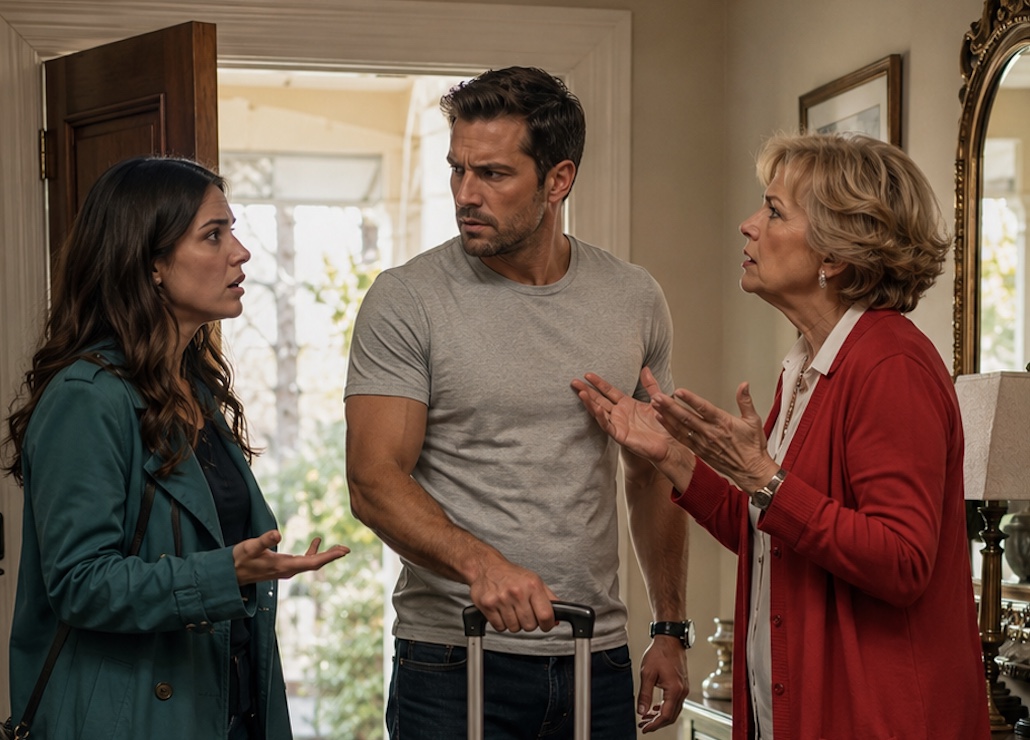
Valeria stopped at the front door before she had even managed to take off her coat. Her fingers tightened around the strap of her bag on their own. The hallway, which had still felt spacious that morning, was now filled with three large suitcases, two plaid travel bags, a cardboard box from some appliance, and several tightly knotted plastic bags.
On top of the upper suitcase lay Raisa Pavlovna’s familiar brown coat. The very same coat she had worn the previous autumn, when she had visited them and spent three days complaining that the city air was “wrong,” the water was “dead,” and people walked around “as if everyone had been cheated.”
At first, Valeria thought Kirill’s mother had come for a few days. She had those sudden visits sometimes: she would call her son in the morning, and by evening she would already be standing on the doorstep with jars, bundles, and a displeased look on her face. Valeria had almost gotten used to it. She did not enjoy it, but she endured it.
But this time, everything looked different.
There were too many things. Not for a weekend. Not for a week. Not even for a month.
Raisa Pavlovna’s voice came from the kitchen.
“I’ll put my little pots in the lower cupboard. You only have empty boxes there anyway. And the grains should be moved to another drawer. Lera has everything arranged so inconveniently. And where should I put my towels? There isn’t enough room in the bathroom. One shelf will have to be cleared.”
Valeria slowly turned her head toward the kitchen. Then she looked back at Kirill.
He was holding another suitcase by the handle. His face was calm, a little tense, but not guilty. It was more like the face of someone who had expected an unpleasant conversation, prepared for it in advance, and decided not to back down.
“What is going on?” Valeria asked.
Her voice sounded even. Too even.
Kirill placed the suitcase on the floor. Its wheels knocked dully against the tile.
“Mom is going to live with us now.”
He said it so casually, as if he were telling her he had bought bread or picked up a parcel.
Valeria took off her coat and hung it on the hook. She did it slowly, so she would not say something too soon. In her mind, the facts quickly lined up: the suitcases, the boxes, her mother-in-law in the kitchen, Kirill looking like the master of the situation.
“Did anyone discuss this with me?” she asked.
“What is there to discuss?” Kirill frowned irritably. “Mom has a situation. It’s hard for her to live alone.”
Raisa Pavlovna went silent in the kitchen. Valeria could almost physically feel her listening. Even the kettle seemed to stop making noise, as if it had decided not to interfere.
“What situation?” Valeria turned fully toward her husband. “She has a house in the village. Everything is registered in her name. Two months ago, she herself said she would never leave it.”
“The house is old.”
“It was old two months ago too.”
“Lera, don’t start.”
“I haven’t even started yet.”
Kirill exhaled loudly and ran his palm over his face.
“Mom is tired. She needs to live in normal conditions. The hospital is nearby, the shops are nearby, I’m nearby. What don’t you understand?”
Valeria looked at the things in the hallway. Among the bags, she noticed the corner of an icon in a wooden frame, a narrow box of dishes, a roll of oilcloth, a pair of slippers, and a sack of bedding.
“What I don’t understand,” she said, “is why my apartment is already full of the belongings of someone who decided to move in here, while I’m the last person to find out.”
Kirill raised his eyes sharply.
“Your apartment?”
Valeria froze. There it was. The word that had finally come out. Not by accident. Not by mistake. He had been carrying it inside for a long time and had only been waiting for the right moment.
“Yes, Kirill. Mine. The apartment belongs to me. I inherited it from my father. We discussed this before the wedding.”
“Legally, maybe it’s yours,” he snapped. “But we live here together. I’m your husband, not some tenant.”
“A husband does not have the right to move his mother in without his wife’s consent.”
“Don’t start talking to me about rights.”
“Then what should we talk about? The fact that I came home from work and found a full move-in?”
Raisa Pavlovna came out of the kitchen. She was tall and heavyset, with carefully styled gray hair. She was wearing Valeria’s house robe. The very light-colored robe that had been hanging behind the bathroom door.
Valeria’s eyes lingered on the robe.
Raisa Pavlovna noticed and lightly ran her hand over the sleeve.
“I changed clothes. It was a long trip. I couldn’t stand around in my outdoor clothes.”
“Do not take my things,” Valeria said calmly.
Her mother-in-law widened her eyes.
“Good Lord, she’s begrudging me a robe. Kirill, do you hear this? I came to my son’s home, and she’s already counting robes.”
“Raisa Pavlovna, you did not come to your son’s home. You came to an apartment that does not belong to you.”
Kirill stepped forward.
“Lera, enough.”
“No, not enough. I want to understand who decided that decisions can now be made here without me.”
Her mother-in-law crossed her arms over her chest.
“My son decided. He is the man of the house.”
Valeria looked at Kirill. Not angrily. Not helplessly. Carefully. The way one looks at a person one has known for many years and then suddenly sees something unfamiliar in him.
“A man of the house speaks to his wife first. He does not bring his mother with suitcases while his wife is at work.”
Kirill clenched his jaw.
“Mom is staying here. She has nowhere else to go.”
“She has her house.”
“I told you, the house is old.”
“An old house is not the same as no home.”
Raisa Pavlovna gave a short laugh.
“You can tell at once that you never had a proper mother around. A loving wife would say, ‘Of course, Mother, stay as long as you need.’ But you start talking about documents the moment you walk in.”
Valeria’s face hardened. She put her bag on the cabinet, took off her shoes, and went into the room. Not because she was retreating. She simply needed to see how far things had gone.
In the bedroom, her mother-in-law’s belongings were lying on Valeria’s chair. A cosmetic bag stood on the dresser. Near the bed was a bag of medicine. The wardrobe door was open, and inside, on the free rail, Raisa Pavlovna’s dresses were already hanging.
Valeria slowly took one dress off its hanger, then a second. She folded them neatly on the bed.
Kirill followed her in.
“What are you doing?”
“Clearing out my wardrobe.”
“Don’t make a scene.”
“You made the scene. I’m just putting things back in order.”
Raisa Pavlovna appeared in the bedroom doorway.
“Kirill, tell her not to touch my things. My heart can’t take this kind of treatment.”
Valeria turned.
“If you feel unwell, we’ll call an ambulance. If you feel fine, change back into your own clothes and pack your things.”
Her mother-in-law pressed a hand to her chest, but her eyes remained dry and sharp.
“Do you hear her, Kirill? She’s throwing me out. Her husband’s own mother. From her son’s home.”
Valeria gave a quiet, bitter smile.
“From my home.”
Kirill struck the doorframe with his palm. Not hard, but hard enough to show force.
“How many times are you going to repeat it? Mine, mine, mine! After all these years, have you still not understood that marriage is not just paperwork?”
“And after all these years, have you still not understood that marriage is not permission to control someone else’s property?”
He turned sharply to his mother.
“Mom, leave us for a minute.”
“No,” Raisa Pavlovna said. “I want to know where I am supposed to live. Since my daughter-in-law has decided to throw me out onto the street.”
“Nobody is throwing you onto the street,” Valeria said, taking another bundle from the back of the chair. “You are going back to your house. Or Kirill can rent a separate place for you. Or he can go with you himself. There are options. But I do not consent to you living here.”
Kirill gave an unpleasant, short laugh.
“Rent? Nice idea. Maybe I should ask your permission on how to spend my money too?”
“For your own decisions, no. For moving people into my apartment, yes.”
“You’ve become unbearable, Lera.”
“No. I’ve started listening to what you’re actually saying.”
He stepped closer.
“Mom sold some of her things. She took apart part of the house. She already prepared herself for this. Do you want an elderly woman dragging herself back with suitcases?”
“She came here without my consent.”
Raisa Pavlovna threw up her hands.
“There you go again: consent, consent! I’m not some strange woman from the train station. I am your husband’s mother.”
“Exactly. Your husband’s mother. Not the owner of this apartment, and not my dependent.”
Her mother-in-law straightened.
“Kirill, I told you. She will never accept me. She only needed you as a convenient man in the house. Your mother is in her way.”
Valeria looked at her closely.
“The convenient man in my house just told me where the door was if I didn’t like his tyranny.”
Raisa Pavlovna quickly looked away.
Kirill, on the other hand, grew even more rigid.
“What else was I supposed to say? You don’t even want to listen.”
“You didn’t come to talk. You already brought in the suitcases. That is a huge difference.”
Valeria left the bedroom and went to the kitchen. The scene there was even more telling. On the counter lay her mother-in-law’s bags of grains, jars, and medicines. Her towels had already been placed in one drawer. On the windowsill stood a small box with thread, glasses, and a notebook.
Raisa Pavlovna had truly not come for a visit.
She had moved in.
Without asking. Without shame. With her son’s support.
Valeria opened the drawer, took out her mother-in-law’s towels, and placed them back in a bag. She did not throw them. She did not crumple them. She simply returned them to where they had come from.
“Don’t touch those!” Raisa Pavlovna snapped. “I just put them away.”
“You can put them away at home.”
“I am already home.”
Valeria turned to her.
“No.”
One word came out so firmly that even Kirill lost his force for a second.
“Lera, you’re going too far,” he said more quietly.
“You went too far when you decided you could confront me with a finished decision.”
“I counted on you understanding the situation.”
“People understand a situation when they are asked. When suitcases are carried into an apartment and the owner is shown the door, that is no longer a request.”
Raisa Pavlovna smirked.
“Owner, she says. Look at her. Daddy gave her an apartment, and now she gives orders. She should try earning one herself.”
Valeria nodded slowly.
“So you dislike my apartment, but you still want to live in it.”
Her mother-in-law’s face flushed in patches.
“That’s not what I meant.”
“That is exactly what you meant.”
Kirill took out his phone.
“That’s enough. I’m calling a taxi for the rest of the things. Mom is staying, and then you and I will talk calmly.”
Valeria walked up to him and placed her hand on the phone without snatching it or pushing him.
“The rest of the things are not coming here.”
“Move your hand.”
“They are not coming here, Kirill.”
He looked at her as if he were understanding for the first time that she would not argue herself hoarse, would not cry, would not leave for another room. She would act.
“You’re forcing me,” he said.
“No. You are choosing.”
“I will not abandon my mother.”
“I am not asking you to abandon her. I am saying she will not live here.”
Raisa Pavlovna sat down on a chair and sighed loudly.
“Son, I feel ill. My heart is racing. Everything is swimming before my eyes.”
Kirill immediately rushed to her.
“Mom, what is it? Where are your pills?”
“In the bag… the blue one… Or maybe in the purse… I don’t remember.”
Valeria opened the bag with medicine, took out the pills, and placed them on the table.
“Should I check your blood pressure?”
Her mother-in-law glanced at her and turned away.
“No. No medicine can help against your attitude.”
“Then should I call an ambulance?”
“I don’t need an ambulance!” Raisa Pavlovna snapped, forgetting her weak voice.
Valeria silently closed the bag.
Kirill noticed and grimaced.
“Why are you provoking her?”
“I offered help. She refused.”
“You twist everything.”
“No. I record reality.”
Raisa Pavlovna stood up again. Her weakness had disappeared surprisingly quickly.
“Kirill, are you really going to let her treat me like this? I raised you all my life, didn’t sleep nights, never spared myself. And now there is no place for me?”
“Mom, calm down.”
“No, I will not calm down. Let her say it directly: her husband’s mother is unnecessary to her.”
Valeria looked at her mother-in-law without her former polite softness.
“You are unnecessary in my apartment when you move in without asking. That is true.”
For a moment, Raisa Pavlovna was speechless.
Kirill went pale with anger.
“You are going to regret what you’re saying.”
“I have already come to an agreement. With myself. I will no longer live in a home where I am treated as an attachment to square meters.”
That sentence hit Kirill’s pride like a blow. He threw his phone onto the table.
“Oh, so that’s how it is? So I’m nobody here?”
“You are my husband. For now. But you are not the owner of my apartment.”
“Fine. Now everything is clear.”
He went into the hallway and began unzipping one of the suitcases.
“What are you doing?” Valeria asked.
“If Mom is staying, her things need to be unpacked. She is not going to sit on her bags because of your tantrums.”
Valeria took out her phone.
“Then I’m calling the police.”
Kirill straightened sharply.
“Have you lost your mind?”
“No. Someone is trying to move into my apartment without my consent. I have the right to demand that an outsider leave the premises.”
Raisa Pavlovna cried out.
“Outsider? I’m an outsider?”
“For the right to live here, yes.”
Kirill stepped toward Valeria.
“Just try.”
She looked at him calmly. So calmly that he became uneasy.
“I already am.”
And she pressed the call button.
While Valeria spoke to the dispatcher, Kirill paced around the hallway, grabbing a suitcase handle and then letting it go. Raisa Pavlovna sat on the edge of the cabinet and began lamenting, but without tears. Valeria gave the address and explained that there was a person in her apartment whom she had not invited to live there, and that her husband was preventing that person from leaving.
“Yes, I have the apartment documents. Yes, my passport too. Yes, there were verbal threats. No, there has been no physical violence.”
Kirill listened, growing darker by the second.
“You’re humiliating me in front of the neighbors.”
“You took this beyond a normal conversation yourself.”
“What is abnormal about it? My mother will live with us!”
“You still don’t understand.”
“And you still don’t understand that family is not just your comfort.”
Valeria put her phone away.
“Do not use big words where the real issue is abuse of control.”
Raisa Pavlovna suddenly stood up sharply.
“It’s all because of the apartment. I understood that from the beginning. If the apartment had been his, you would have sat quietly.”
Valeria looked at her.
“If the apartment had been his, I would not have had the right to throw you out. But I also would not have stayed there after those words. There is a difference.”
Kirill snorted.
“Of course. So proud.”
“No. I simply have boundaries.”
They waited nearly twenty minutes for the officers. During that time, Raisa Pavlovna managed to say three times that she felt unwell, asked her son once to find her slippers, accused Valeria twice of heartlessness, and walked around the apartment once more as if checking what she had managed to occupy.
Kirill tried to lock the door from the inside when the intercom rang. Valeria reached it first and opened it.
“Don’t even think about making a show,” he hissed.
“Too late. The show started without me.”
There were two police officers. A tall young man and a middle-aged woman with a tired but attentive face. Valeria showed her passport, the apartment documents in electronic form, and a paper copy from the folder she kept in the dresser.
“The apartment belongs to you?” the female officer asked.
“Yes.”
“Is this citizen registered here?”
“No.”
“Was there an agreement for her to live here?”
“No. I found out about the move today when I came home.”
Kirill interrupted.
“This is my mother. I’m her husband. I live here.”
The male officer looked at him.
“Are you the owner?”
“No, but I’m her husband.”
“Are you registered here?”
Kirill hesitated.
“I had temporary registration. It expired. We didn’t renew it because we’re husband and wife anyway.”
For the first time that evening, Valeria looked at him with genuine surprise. She knew they had not renewed the registration, but until now it had not mattered. Now it turned out that Kirill himself had deprived himself of even a formal basis for pressure.
The female officer turned to Raisa Pavlovna.
“Your documents.”
Her mother-in-law slowly took her passport from her bag.
“I came to my son.”
“You are being asked to leave the premises.”
“Where am I supposed to go at night?”
“Do you have housing?”
Raisa Pavlovna hesitated.
“I have a house. But it is far away.”
“Your son can arrange a hotel or a taxi for you,” the officer said calmly. “But you cannot remain in the apartment of the owner against that owner’s will.”
Kirill flared up.
“So you are throwing an elderly woman out onto the street?”
“Nobody is throwing anyone onto the street. The owner is asking her to leave the apartment. Resolve the housing issue legally.”
Valeria stood nearby and said nothing. She did not want to finish anyone off. She only wanted it to finally end.
Raisa Pavlovna suddenly looked at her son, not with authority now, but with demand.
“Kirill, tell them! You are the husband! You live here!”
Kirill opened his mouth, but the female officer interrupted him.
“Marital status does not give you the right to move in third parties without the owner’s consent.”
The sentence sounded so ordinary that Kirill seemed to deflate. All his confidence had rested on the idea that Valeria would get scared, give in, and start justifying herself. But when a stranger in uniform said the same thing, arguing became harder.
“Fine,” he said through his teeth. “Mom will go to a hotel. Tonight. And tomorrow we’ll decide.”
“Tomorrow you will not be deciding anything here,” Valeria said.
He turned sharply.
“What is that supposed to mean?”
“It means you are packing your things too.”
Raisa Pavlovna gasped.
“There! Look at her! Throwing her own husband out!”
Valeria looked at her.
“You can take your son with you. You have enough suitcases.”
Kirill stepped toward her.
“Lera, don’t cross the line.”
“You carried that line across the entire apartment today together with your mother’s bags.”
The policewoman watched them carefully.
“The citizen has the right to ask anyone without a right of residence to leave the property. If there is a marital dispute, resolve it through the proper legal process. Right now, the conflict needs to be avoided.”
Kirill was breathing heavily. Red blotches spread across his face. Valeria knew that look: he wanted to say something cruel to restore his superiority. But there were witnesses nearby, so he held back.
“I’ll pack things for a couple of days,” he said. “Then we’ll talk.”
“Pack the essentials. You can collect the rest later by agreement.”
“Are you serious?”
“Yes.”
Raisa Pavlovna went to the bedroom to get her dresses. Valeria followed her.
“I’ll take them myself,” her mother-in-law snapped.
“I’ll watch.”
“Afraid I’ll steal something?”
“After today, I prefer to see what you take.”
Raisa Pavlovna grimaced.
“How low.”
“Was secretly moving in higher?”
Her mother-in-law said nothing.
Packing took almost an hour. Kirill booked his mother a room in a cheap hotel nearby. At first Raisa Pavlovna refused, saying it would be “easier to die there,” then demanded that her son go with her, then declared she would return in the morning to “talk properly.” Valeria did not react.
She placed everything her mother-in-law had managed to unpack into a separate bag: towels, medicine, slippers, a jar of coffee, the box with thread, the cosmetic bag. She checked the bathroom. She took back her robe and gave Raisa Pavlovna her own clothes.
“Leave the robe in the bathroom,” she said.
Her mother-in-law removed it with an expression as if Valeria were taking from her the last memory of a happy life.
“You’ll be disgusted to wear it after me?”
“I’ll wash it.”
“You are so cold, Lera.”
“Today that helps.”
When the things were carried into the hallway, Kirill reached into his pocket for his keys.
Valeria held out her hand.
“The apartment keys.”
He looked at her palm.
“Are you mocking me?”
“No. The keys.”
“I live here.”
“Today you yourself told me where the door was if I didn’t like your mother. Now you are the one using the door.”
The male officer coughed, clearly signaling that there was no point dragging this out.
Kirill took out the keyring and removed two keys. He placed them in Valeria’s palm with such pressure that it seemed he wanted to leave a mark.
“You will regret this.”
“Maybe. But not today.”
“I’ll come tomorrow.”
“You’ll call first.”
“This was my home too.”
Valeria looked at him tiredly.
“If it had been a home, you would have protected it. Not tested how much of someone else’s decision I could endure.”
Those words hit Kirill harder than shouting would have. He looked away, grabbed one of his mother’s suitcases, and left. As Raisa Pavlovna passed Valeria, she paused.
“You think you’ve won? You threw out your man and humiliated his mother. You’ll end up alone.”
Valeria opened the door wider.
“Better alone than with people who enter my home as if they own it.”
Her mother-in-law wanted to answer, but the officer gently reminded her:
“Please go.”
The door closed.
Silence did not fall immediately. For several more minutes, Valeria could hear suitcase wheels, voices, Raisa Pavlovna’s angry whispering, and then the elevator door slammed. Only after that did the apartment become truly empty.
Valeria stood in the hallway and looked at the floor, where dirty marks from the wheels remained. She did not cry. She had neither the strength nor the desire. Her hands trembled from tension, so she clasped her fingers together and took several deep breaths.
Then she went to the bathroom, took the robe off the hook, and threw it into the laundry basket. She returned to the kitchen. She took from the drawers everything Raisa Pavlovna had managed to rearrange and put her own things back in place. In the bedroom, she aired out the room, removed the empty hangers from the wardrobe, and closed the doors.
Each action returned the apartment to her.
Not comfort. Not peace.
The right to be the owner of her own home.
The next morning, Kirill called at nine. Valeria did not answer. He sent a message:
“We need to talk. Mom didn’t sleep all night.”
Valeria read it and put the phone aside.
An hour later, another message came.
“You went too far. I was emotional.”
Then:
“I wasn’t going to throw you out. I just wanted you to understand how serious the situation was.”
Valeria smiled bitterly.
He had not meant to throw her out. He had only pointed to the door in her own apartment. He had not meant to pressure her. He had only brought his mother in with suitcases. He had not meant to humiliate her. He had only decided everything for her.
By lunchtime, Kirill’s older sister, Svetlana, called. At first Valeria did not want to answer, but then she picked up.
“Lera, what have you done?” Svetlana began without greeting. “Mom’s blood pressure is up, Kirill is a wreck. Did you really throw them out at night?”
“Svetlana, your mother came to live in my apartment without my consent. Kirill confronted me with a finished decision.”
“So what? You could have endured it. Mom isn’t a stranger.”
“She isn’t a stranger to you. So you can take her in.”
There was silence on the other end.
“I have two children and a husband.”
“And I have one apartment and the right to decide who lives in it.”
“You were always selfish.”
“Today that helped a lot.”
Svetlana raised her voice.
“Do you understand that you’re destroying your marriage?”
Valeria walked to the window. In the yard, a groundskeeper was gathering wet leaves into a sack. An ordinary day continued as if nothing had happened the night before.
“The marriage did not start falling apart yesterday. Yesterday, I was simply handed the proof in suitcases.”
“Kirill wanted the best.”
“For whom?”
Svetlana fell silent.
“Lera, Mom was planning to sell the house,” she suddenly said more quietly.
Valeria straightened.
“What?”
“She had been saying for a long time that the house was too hard for her to maintain. Kirill said that if she moved in with you, the house could be put up for sale. The money would later… well… come in handy.”
Now Valeria truly froze. Not from fear. From how neatly the pieces had fallen into place.
The house was not simply old. Raisa Pavlovna was not simply tired. The move was not temporary help. It was a plan.
First, move his mother into Valeria’s apartment. Then sell her house. Then make sure she had nowhere to return. And after that, the three of them would live together, gradually pushing Valeria aside in her own home.
“Svetlana, you just said something very important.”
“I didn’t say anything like that.”
“You did.”
“Just don’t tell Kirill that I…”
“Don’t worry. I’ll speak to him myself.”
Valeria ended the call and opened her chat with Kirill.
“The conversation will happen today. At the café near the house at 6 p.m. You do not enter the apartment.”
His reply came almost immediately.
“What kind of circus is this?”
She wrote:
“This is the condition.”
Kirill typed for a long time, erased, typed again. Then he sent:
“Fine.”
He arrived at the café early. He was sitting by the window, tapping a finger against his cup. He looked worn out and angry. Valeria sat opposite him.
“Well?” he said. “Are you satisfied?”
“No.”
“Then why all this?”
“So you can answer honestly. Were you and your mother planning to sell her house?”
Kirill looked away. That was enough.
“Svetka talked?”
“So you were planning to.”
“Mom wanted it herself. It’s hard for her there.”
“And she was supposed to live with me?”
“With us.”
“Kirill.”
He went silent.
“Do you understand what you did? You wanted to move your mother in, then take away her ability to go back, and make the situation final for me.”
“Don’t dramatize. Nobody was going to sell the house immediately.”
“But there was a plan.”
“The plan was to help Mom and avoid unnecessary expenses.”
“So separate housing for your mother is unnecessary. And my apartment is the free solution.”
Kirill frowned.
“Counting money again?”
“Yes. My money. And my space. And my nerves.”
“How can anyone live with you if you divide everything?”
“Anyone can live with me if they do not bring people into my apartment without consent.”
He leaned back in his chair.
“Mom is getting old. She needs help. I thought you would understand.”
“I would have understood if you had come to me and said, ‘Lera, Mom is having a hard time. Let’s think about it. Maybe we can help repair the house. Maybe we can find her a place nearby. Maybe we can arrange a visiting schedule.’ But you chose a different path.”
“Because I knew you would refuse.”
“You knew what you were doing was wrong.”
Kirill opened his mouth and closed it again. This time he had nothing to hide behind.
“I don’t want a divorce,” he said after a pause.
“And I don’t want to return to the old version of our family, where my boundaries exist only as long as they are convenient for you.”
“So what now?”
“For now, you live separately. You do not come to the apartment without agreement. You collect your things on the weekend when I’m home. Your mother does not come to me at all.”
“You’re setting conditions?”
“Yes.”
“And if I don’t agree?”
Valeria looked at him carefully.
“Then we resolve the issue through court. We have no minor children. But there is a marriage and a conflict. I am not going to pretend nothing happened.”
Kirill cursed quietly and turned toward the window.
“You changed.”
“No. It’s just that before, I didn’t have to defend myself from you in my own hallway.”
He ran a hand over his face.
“Mom pressured me. Svetka refused to take her. I thought we had more space.”
“We have a two-room apartment. One bedroom and a living room. Where was she supposed to live? In the living room? Was I supposed to walk past her folding bed every day?”
“Well, temporarily…”
“After the house was sold?”
Kirill was silent again.
Valeria stood.
“On Saturday, from twelve to two, you can collect your things. Alone. If you come with your mother, I won’t open the door.”
“Lera…”
“The conversation is over.”
She left the café and, for the first time in twenty-four hours, felt the air stop pressing on her chest. Nothing had been decided completely, but the most important thing had already happened: she had stopped explaining the obvious to people who benefited from not understanding.
On Saturday, Kirill came alone. Valeria had already packed his things in the hallway: clothes, shoes, documents from the shared drawer, tools, his razor, and several books. She had not thrown anything away, damaged anything, or hidden anything. Everything was neatly collected.
He entered after ringing the bell and stopped at the threshold.
“Can I come in?”
“Everything you need for now is in the hallway. If there’s anything else, tell me and I’ll find it.”
“I’m not a thief, Lera.”
“I didn’t say you were.”
“But you’re acting like I am.”
She looked at him calmly.
“I am acting like a person who no longer gives access to her apartment to people who have already taken advantage of her trust once.”
Kirill lowered his eyes to the bags.
“I rented Mom an apartment for a month.”
“Good.”
“She’s not selling the house for now.”
“Even better.”
“Is that what you wanted?”
“I wanted decisions to be made honestly.”
He was silent for a long time, then unexpectedly asked:
“What if I really understood?”
Valeria did not answer at once. In front of her stood a man she had lived with for six years. A man with whom she had chosen dishes, traveled to the lake, been ill, laughed, and made plans. And the same man had considered it possible yesterday to show her the door in her own home.
Both versions of Kirill were real. One had simply hidden the other for a long time.
“Understanding is proven by actions,” she said. “Not words.”
“Can I come back?”
“No.”
He lifted his head sharply.
“Forever?”
“Right now, no. We’ll see later. But you will no longer have keys.”
“So you’ve crossed me out?”
“No. I have crossed out your right to enter this place like an owner after what you did.”
He tightened his grip on the handles of the bags.
“Mom says you turned me against her.”
“Your mother is a grown woman. You are a grown man. Do not put me between you.”
“She thinks you destroyed the family.”
“A convenient version.”
Kirill gave a joyless smile.
“And your version?”
“My version is simple. Yesterday, you were not choosing between me and your mother. You were choosing between respect and pressure. You chose pressure.”
He wanted to say something, but at that moment his phone rang. The screen showed: “Mom.”
Kirill looked at the call and declined it.
Valeria noticed, but said nothing.
“I’ll collect the rest later,” he said.
“Write in advance.”
“Fine.”
He left. Valeria closed the door and immediately called the locksmith whose number she had found in the neighborhood chat. No official statements, no invented procedures. She simply arranged for the lock cylinder to be replaced. Two hours later, the locksmith arrived, changed everything quickly, checked the keys, and left.
Valeria held the new set of keys in her palm and understood: this was not about metal. It was about a decision.
That evening, a message came from Raisa Pavlovna.
“You will regret this. A son will not stay without his mother.”
Valeria read it, blocked the number, and placed the phone face down.
A week later, Kirill asked to meet again. This time Valeria agreed, but she chose a park near the house, a public place. He came with the rental agreement for his mother’s apartment and showed it to her.
“I signed it in my name,” he said. “She really isn’t selling the house for now. I insisted.”
“Good.”
“I understand that I messed everything up.”
Valeria looked at him. He did not look defeated. He looked tired. Without his former self-assurance.
“Kirill, this is not only about your mother. It is about the fact that you decided if I didn’t agree, you could force me. That is the main thing.”
“I was afraid you would refuse.”
“And so you made it worse.”
“Yes.”
For the first time, he did not argue.
“I talked to Mom. She is convinced you were obligated to take her in. I told her you weren’t.”
Valeria raised her eyebrows slightly.
“Yourself?”
“Myself.”
“And how did she take it?”
“She shouted. Then she said I was a traitor.”
“Did you handle it?”
“I don’t know. So far, yes.”
They walked a few steps in silence.
“I won’t ask you to let me come back right away,” Kirill said. “But I want to try to fix this.”
“Fixing this does not mean coming back with a bag and pretending it’s over. Fixing this means proving for a long time that you no longer treat my silence as agreement.”
“I understand.”
“I don’t know if you understand. But you’ve heard me. That is something.”
She did not promise reconciliation. She did not say everything would be all right. Stories like this are not repaired by one correct sentence in a park.
A month passed. Kirill lived separately. Raisa Pavlovna rented an apartment near the clinic, but it quickly turned out that she liked city life far less than she had claimed. In her village house, a neighbor suddenly appeared who was willing to help with shopping, a handyman who could repair the porch, and an acquaintance who worked as a medical assistant and could come when needed.
Once it became clear that living at Valeria’s expense would not work, the tragedy noticeably shrank.
One day Svetlana called and said dryly:
“Mom decided to go back home. Kirill will take her.”
“Good,” Valeria replied.
“Are you satisfied?”
“I am calm.”
“You’re harsh.”
“I simply didn’t let you decide my everyday life without me.”
Svetlana snorted and hung up.
Valeria did not call back.
She and Kirill had not divorced yet. But they were not living together either. Sometimes he came to talk, brought documents, collected the remaining things, and asked whether he could help around the house. Valeria did not always agree. It was important for her not to confuse help with an attempt to become indispensable again.
One day he brought groceries and, out of habit, reached for a key to open the door. Then he remembered he no longer had one and rang the bell. Valeria opened the door.
He smiled awkwardly.
“I’m still getting used to it.”
“Get used to it.”
There was no mockery in that short phrase. Only a new reality.
Kirill left the bag in the kitchen and did not go farther without being invited. Valeria noticed. She did not praise him or soften aloud, but she noticed.
“Mom asked me to tell you she isn’t selling the house,” he said.
“That is her business.”
“And also… she wanted to apologize, but she still can’t force herself to.”
Valeria smiled faintly.
“Then let her not force herself. I don’t need apologies squeezed out under pressure.”
“I’ll tell her.”
“Don’t. That is her business too.”
He nodded.
Valeria looked at him and suddenly understood: the old family would never return. Not because love had disappeared in one evening. But because that evening had revealed the foundation. Where the cracks were, where the empty spaces were, where each of them had silently built a version that was convenient for themselves.
But that did not mean there was nothing ahead. It only meant everything would be different. With clear boundaries, tested words, and the right to say “no” before someone else’s suitcases appeared in the hallway.
Two months later, Kirill suggested filing for divorce through the court if Valeria had definitely decided not to continue the marriage. They had no children, but he understood that her agreement could not be bought with promises. She took time to think. Not out of weakness. Out of honesty.
She did not want to cut everything off only out of pride. But she also had no intention of returning to a man who had once shown her the door in her own home without serious proof of change.
Raisa Pavlovna never appeared at her door again. Once, she sent a jar of jam through her son with a note that said, “For Lera.” Valeria did not accept the jar.
“I don’t want to exchange boundaries for sweet gestures,” she told Kirill.
He did not argue.
And that was the first sign that he was truly beginning to understand.
Valeria lived alone in her apartment. Not as the winner of a loud story. Not as an unfortunate woman abandoned between her husband and her mother-in-law. She simply lived in her own home again.
In the evenings, she came back from work, opened the door with her new key, entered the quiet hallway, and every time saw the empty space by the wall where the suitcases had stood that evening.
The empty space did not irritate her. On the contrary, it reminded her: sometimes order begins not with cleaning, but with one firm refusal.
That evening, when Kirill carried in his mother’s suitcases and told her she knew where the door was, he was sure he was putting a full stop.
But it was Valeria who put the full stop.
Not with shouting. Not by running away. Not by giving in.
She simply refused to walk out of her own life while others tried to unpack someone else’s belongings inside it.