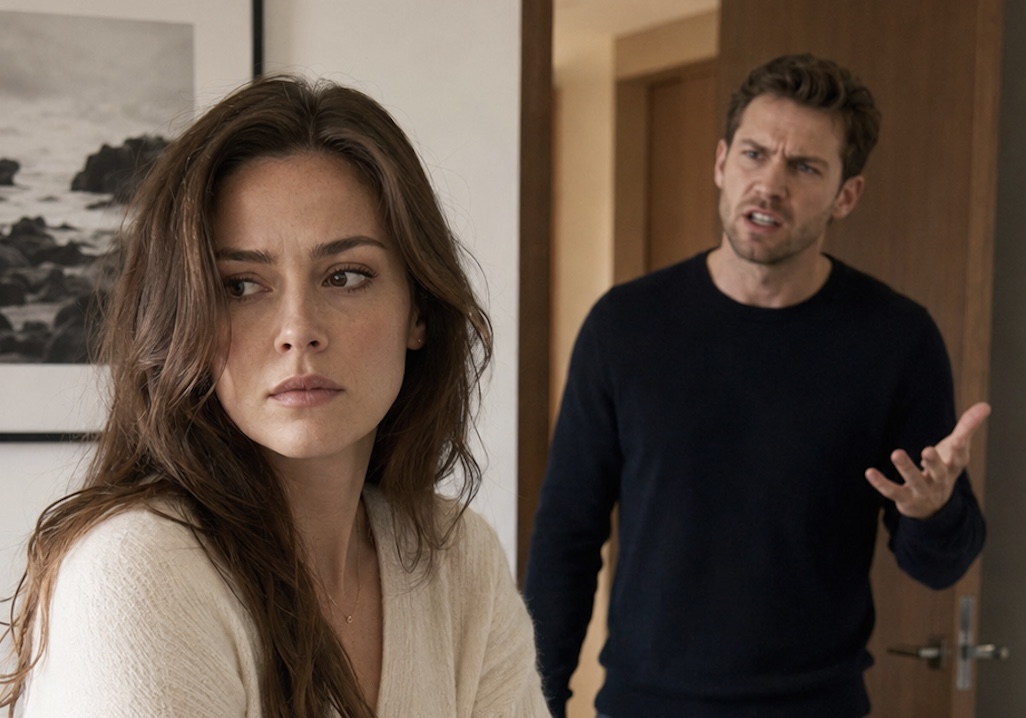
“I’ve already made the decision, Vika. Either you stay home, or you can forget about our family,” her husband said coldly, the evening before his sister’s wedding.
Vika was fastening her second earring in front of the hallway mirror. At first, she did not even turn around. Only her fingers paused at her ear, as if the tiny clasp had suddenly become too small and awkward. On the narrow shelf beside her lay her train pass, a folder of documents for her business trip, her car keys, and a neatly folded dark jacket.
“Say that again,” she said quietly.
Pavel stood in the doorway of the room with his arms crossed. He was wearing a house T-shirt, sweatpants, and the expression he always had when he was not arguing to hear another opinion, but to force his own decision through. Over the past week, Vika had already seen that look several times: when he said his mother was “really counting on her,” when he reminded her that Ksyusha was getting married “only once in her life,” when he asked, offended, whether a work trip was really more important than family.
Now he was not even trying to soften his tone.
“You heard me perfectly. Tomorrow you are not going anywhere. You’re staying home to help Mom and Ksyusha. After the wedding, you can go wherever you want.”
Vika slowly removed the earring, placed it on the shelf, and turned to face him. In the mirror behind her, the hallway was reflected: bright, clean, with the wooden bench she had bought long before the marriage, and Pavel standing there so confidently, as if this apartment, this evening, and Vika herself had long ago become things he could command.
“Pavel, tomorrow I’m going to Nizhny Novgorod to inspect equipment. The tickets are bought, the hotel is paid for, the documents are signed. My department, the contractors, and the branch director are counting on me. I can’t cancel a business trip overnight just because your mother decided she needs free help.”
Pavel sharply exhaled through his nose.
“Don’t start again with your work. Everyone has work. But normal people understand when family comes first.”
Vika ran her palm over her jacket, smoothing out a crease. The movement was calm, almost businesslike, but something in her face changed. Her gaze became sharper, her shoulders straightened, and her chin lifted slightly.
“Family doesn’t give ultimatums.”
“And you shouldn’t put yourself above everyone else,” he snapped. “Mom has been nervous all week. Ksyusha cries every other day. Nikita and his relatives aren’t managing anything. Someone needs to check the seating plan, pick up the gift boxes, meet the aunt, prepare the apartment…”
“What apartment?” Vika frowned.
Pavel fell silent for a second. Only a second, almost unnoticeably. But Vika caught the hesitation. He glanced toward the front door, then looked back at his wife, now with irritation.
“Ours. Where the aunt and cousin will spend the night. You know we have enough space.”
“We have a two-room apartment, Pavel. We sleep in the bedroom. The second room is my office. It has documents, equipment, and samples that no one is allowed to touch. Where exactly, according to your mother’s plan, are your relatives supposed to sleep?”
“On a folding bed and on the sofa. Why are you acting like a child? It’s only two days.”
Vika blinked slowly. She understood now that the conversation, which had seemed all week to be about helping with the wedding, was much bigger than that. Her business trip was not simply interfering with “family support.” Her absence was ruining plans that had already been made without her.
“So your aunt and her daughter were promised my apartment, and everyone forgot to tell me?”
“Not yours. Ours,” Pavel corrected harshly.
Vika looked straight at him.
“I bought this apartment before we were married. You know that. It didn’t become yours just because you live here.”
Pavel grimaced as if she had said something obscene.
“There it is. My apartment, my keys, my business trip. It’s impossible to build a normal life with you because you divide everything.”
“I only divide what you’re trying to take without asking.”
He stepped closer.
“No one is taking anything. Mom asked for help. Ksyusha asked. I asked. And you decided to make a scene.”
Vika gave a joyless smile.
“You asked? You just said either I stay home or I can forget about your family.”
“Because you don’t hear it any other way.”
“No, Pavel. I heard you perfectly.”
She picked up the earring, fastened it again, and looked at herself in the mirror. Her face was paler than usual, but her hands no longer trembled. It was strange how quickly hurt could give way to clarity. A week ago she was still trying to explain, choosing careful words, smoothing things over. But now every word Pavel said seemed to remove something unnecessary from the picture, leaving only the truth.
He did not want an agreement.
He wanted to make her convenient.
Vika worked as a quality engineer at a packaging equipment factory. This trip mattered. She had to inspect a production line after modernization, check the paperwork, sign reports, and record any defects. She had been preparing for the trip for almost a month. Cancelling at the last minute would not only damage her reputation but also let down the people who depended on her approval.
Pavel knew that perfectly well.
But his younger sister Ksyusha’s wedding had suddenly become a test of how far he could push Vika.
First, her mother-in-law, Larisa Petrovna, had called. Her voice was soft, but her words had hooks in them.
“Vikulya, you’re so organized. I could really use you for a couple of days. We need to check the guest lists, arrange those modern little boxes of yours, pick up the flowers. You’re good with paperwork.”
Vika had calmly replied that she was leaving on a business trip.
Larisa Petrovna paused, then spoke more dryly.
“How strange. In our family, people don’t abandon events like this.”
Then Ksyusha started texting. First emojis, then requests, then short offended messages: “I get it, you don’t care,” “Fine, I won’t bother you,” “I just thought you were like a sister to me.”
Ksyusha was twenty-four. Vika treated her evenly, even warmly, but they were not close friends. The girl was used to everyone fussing around her. Especially her mother and Pavel. If Ksyusha wanted someone to drive across the city for a box of ribbons, someone drove. If she urgently needed to choose the shade of napkins, the whole family sat in the group chat and voted as if deciding a matter of national importance.
Vika barely participated in that chat. She had been added without being asked and bombarded with photos of the restaurant hall, bouquets, seating plans, and requests to “quickly take a look.” She helped a couple of times: fixed the guest list spreadsheet, noticed a mistake in the groom’s surname, suggested how not to lose the photographer’s deposit. But when the requests turned into constant duty, she stepped back.
That was when Pavel changed.
He stopped asking whether something was convenient for her. He began saying, “It needs to be done.” First calmly, then irritably, then almost like an order.
Vika could tell he had not invented those phrases himself. They smelled of Larisa Petrovna: “a woman must support her husband’s family,” “a daughter-in-law must be there,” “a celebration shows your real attitude.” Pavel seemed to carry his mother’s phrases inside him and pass them off as his own opinion.
But tonight’s “I’ve already made the decision” belonged to him.
“So here’s what will happen,” he said when the silence stretched too long. “I’m calling Mom now and telling her you’re staying. Tomorrow morning we’ll go to her place. Lists, groceries, meeting guests. In the evening we’ll bring the aunt here. The day after tomorrow is the wedding. That’s it.”
Vika picked up her phone from the shelf and put it in her bag.
“You can call whoever you want. My train leaves in the morning.”
Pavel lowered his arms. Confusion appeared on his face, but he quickly covered it with anger.
“So you’re really choosing work over me?”
“I’m choosing self-respect.”
“That sounds beautiful. Just don’t be surprised when no one is left beside you.”
Vika bent down, zipped her bag, and asked calmly:
“And who is beside me now, Pavel? A husband who promises my apartment to his relatives without my consent? A husband who demands that I ruin a business trip? A husband who threatens me with losing his family two days before his sister’s wedding?”
His cheek twitched.
“You’re twisting everything.”
“No. I’m finally calling things by their names.”
At that moment, Pavel’s phone rang. The screen showed “Mom.” He looked at Vika as if she was supposed to fall silent, then answered.
“Mom, yes… No, we’re still talking… I told her… No, she doesn’t want to understand…”
Vika stood nearby and could hear Larisa Petrovna’s sharp voice even without speakerphone.
“Tell her to stop being difficult! Tomorrow is Ksyusha’s last day before the wedding, and she’s going on about her trip! Pavel, are you a man or what? Be firm with her!”
Vika slightly turned her head, studying her husband. He was not embarrassed. He did not step into another room. He did not tell his mother that he and his wife would handle it themselves. He just listened and nodded, even though Larisa Petrovna could not see him.
“Mom, I’m handling it,” he said. “Yes. If needed, I’ll take her ticket back myself.”
Vika held out her hand.
“Give me the phone.”
Pavel stepped back.
“Why?”
“I want to answer your mother directly.”
“Don’t make a scene.”
“You already made one. I’ll only save time.”
He hesitated, then turned on speakerphone. Apparently, he thought his mother would support him and finally corner Vika.
“Larisa Petrovna,” Vika said evenly. “I’m leaving for my business trip tomorrow. Your relatives will not stay in my apartment. I am not giving anyone my keys. I will come to the wedding if I manage to return in time for the ceremony or the banquet. If I don’t, I’ll congratulate Ksyusha separately.”
For a second there was silence on the other end. Then her mother-in-law spoke in the tone people use when scolding a cashier over a mistake on a receipt.
“Vika, do you hear yourself? This is Pavel’s family. Now it is yours too. Is it really so hard to be a normal wife for two days?”
“A normal wife is not free labor and not a hotel for guests.”
“Oh, so that’s how it is. My relatives are strangers to you?”
“When it comes to sleeping in my office without asking me, yes.”
Pavel abruptly switched off the speaker.
“Enough!”
Vika looked at him calmly, almost tiredly.
“That is exactly why I no longer want to communicate through you. You all decide everything among yourselves and then present it to me as a fact.”
His fingers tightened around the phone until his knuckles went white.
“You humiliated my mother.”
“No. I refused to obey.”
Pavel went into the kitchen, loudly opened a cabinet, then slammed the door shut. Vika did not follow him. She stayed in the hallway and slowly checked her documents: passport, tickets, company authorization, folder with reports, charger. She wanted to act clearly, without unnecessary movement. When someone nearby tries to create a storm, order in small things helps you not fall into someone else’s hysteria.
A few minutes later, Pavel returned.
“Fine,” he said more quietly. “Let’s say you go. Then don’t bother coming back to the wedding. I don’t want a woman beside me who spat on my sister.”
“Pavel, I did not spit on your sister. I refused to cancel my work and turn my apartment into guest accommodation.”
“It’s all the same.”
“To you, yes. To me, no.”
He laughed shortly and unpleasantly.
“You’ve always known how to twist words.”
Vika looked at the clock. Less than twelve hours remained before the train. She needed to sleep at least a couple of hours, but sleeping in this apartment beside this version of her husband already felt strange. Not frightening. Strange. As if Pavel had become someone she had known on paper for a long time but was seeing in real life for the first time.
“Where will your aunt and her daughter sleep?” she asked.
“What does it matter now?”
“It matters a lot. Have you already given them our address?”
He was silent.
“Pavel.”
“Mom said she’d handle it.”
“So she gave them the address.”
“She might have. So what? People shouldn’t sleep on the street.”
Vika took the spare key from the small metal bowl where guest keys were kept and put it in her bag. Then she removed the second spare set from the hook, the one Pavel sometimes used when he forgot his own.
“What are you doing?” he asked warily.
“Taking the spare keys to my apartment.”
“Are you serious?”
“Completely.”
“I live here!”
“You live here as my husband. Not as the manager of someone else’s property.”
Pavel stepped toward her, but Vika raised her hand.
“Don’t. I’m not arguing now. I’m setting boundaries. Your key stays with you. But the spare sets will be with me. If any of your relatives show up at my door with suitcases, I will call the police and say strangers are trying to enter my apartment.”
“Have you lost your mind?”
Vika narrowed her eyes slightly.
“Be careful with your words.”
For the first time that evening, Pavel stepped back. Not because he was afraid, but because he had not expected that tone. Vika rarely spoke harshly. Usually she explained, softened, chose her phrasing. Now she spoke briefly, clearly, without pleading.
Morning began without conversation.
Vika got up early, washed her face, tied up her hair, and put on a comfortable trouser suit. Pavel lay with his back to her and pretended to sleep. When she entered the bedroom for her travel bag, he did not turn around. Only the fingers of his hand tightened around the edge of the blanket.
“I’m leaving,” she said.
He said nothing.
“Pavel, I’m leaving you the chance to think. Not your mother. Not Ksyusha. You.”
He sat up sharply.
“And what are you leaving me? An empty apartment and shame in front of my relatives?”
“I’m leaving you the chance to understand that a wife is not an object you can move from place to place according to a family schedule.”
He wanted to answer, but Vika had already taken her bag and left.
The stairwell smelled of wet asphalt and morning coolness. Vika locked the door, checked it twice, then went downstairs to the car. Her train left from Moscow Station, but she decided to take a taxi there so she would not have to leave the car in the station parking lot. She had moved her own car to a secured lot near a neighboring building during the night, after Pavel fell asleep. She had done it almost automatically, after realizing that his relatives were far too confident about using things that did not belong to them.
On the train, Vika sat by the window and took her first deep breath in a full day. Platforms, gray buildings, warehouses, and billboards slowly slid past the glass. Her phone began vibrating almost immediately.
First Pavel: “Are you happy? Mom is crying.”
Then Larisa Petrovna: “I never expected this attitude from you. Ksyusha is a wreck because of you.”
Then Ksyusha: “Thanks for ruining my mood before the wedding.”
Vika read the messages one by one and did not respond. She opened her work chat, told her colleagues she was on the way, checked the documents, and buried herself in work. Not because she did not care. She simply understood that if she started justifying herself now, she would be dragged back into someone else’s performance, where she was guilty simply because she existed separately from their wishes.
In Nizhny Novgorod, the day was intense. Vika barely let go of her tablet. She checked labeling, compared reports, asked the contractor questions. At first, the men from the installation crew looked at her with the familiar skepticism: a woman, on a business trip, inspecting equipment. But after an hour, they stopped smiling condescendingly. Vika noticed details others missed: a mismatch in the unit passport, an incorrect date on the test report, signs of a rushed replacement of a fastener.
By evening, she was so exhausted that she sat on the edge of the hotel bed and stared at her hands for several minutes. Her wedding ring was on her finger. She turned it, removed it, and placed it on the bedside table. Then she put it back on. Not as a promise to Pavel, but as a reminder to herself: decisions are not made from exhaustion. They are made when all the facts are in front of you.
And the facts began arriving on their own.
Around nine in the evening, her neighbor Tamara Ilyinichna called. She lived one floor below and was the kind of observant neighbor who knew who was drilling, who had bought a new refrigerator, and who had forgotten to close their car.
“Vika, are you home?” she asked without greeting.
“No, I’m on a business trip. What happened?”
“A woman and a young girl came to your place. With suitcases. They rang the doorbell for a long time. Then they called your Pavel, I suppose. They stood there looking annoyed. One of them said, ‘We were promised the daughter-in-law would leave the keys.’”
Vika closed her eyes and slowly rubbed the bridge of her nose.
“Did they leave?”
“They left. Pavel arrived about twenty minutes later and took them somewhere. But be careful, dear. They were far too sure of themselves.”
“Thank you, Tamara Ilyinichna. You helped me a lot.”
After the call, Vika opened her chat with Pavel.
“Your relatives came to my apartment with suitcases. Did you know?”
The answer did not come immediately.
“Mom gave them the address earlier. I didn’t think you would actually take the keys.”
Vika looked at the screen. Her eyebrows lifted on their own.
“So the problem is not that you promised my apartment without asking, but that I stopped you?”
Pavel replied quickly.
“Don’t start. I put them in a hotel. Now everyone is paying extra because of you.”
Vika laughed softly. Not happily. More from the sheer audacity. Then she wrote:
“That is the expense of the people who promised someone else’s home.”
He did not answer.
The next day was the wedding.
Vika finished work earlier than expected. The contractor fixed some of the issues on-site, and the rest were included in the protocol. She could make it to the evening part of the celebration if she went straight to the station. For several minutes, she stood at the hotel reception desk with her phone in her hand, wondering whether she needed to appear somewhere she had already been appointed the villain.
Then she opened Ksyusha’s message: “You don’t have to come. Mom said you’ll just sit there looking like a martyr anyway.”
Vika typed a reply: “I’ll come to congratulate you personally. Not to report to your mother.” She sent it before she could change her mind.
She entered the restaurant after the registration ceremony. The banquet hall was bright, loud, overheated by voices and music. Near the entrance stood a seating chart. Vika quickly found her surname and noticed something odd: there was no seat for her beside Pavel. She had been placed at the far end of the hall, next to distant relatives of the groom.
She was not even surprised.
Pavel noticed her almost immediately. He stood near the stage in a suit, his face tense. When he saw Vika, he stepped toward her, but Larisa Petrovna intercepted him by the elbow. Her mother-in-law was wearing an elegant blue dress, her hair arranged high, and her expression made it seem as though she was the hostess of the entire event and everyone else was expected to behave accordingly.
Vika approached Ksyusha. The bride sat beside Nikita in her white dress, holding a glass of water. Her face showed not happiness, but tired irritation.
“Ksyusha, congratulations,” Vika said. “I wish you and Nikita the ability to speak normally during difficult moments. That matters more than a beautiful hall.”
Ksyusha blinked. It seemed she had expected excuses or cold formality, but not those words.
“Thank you,” she answered uncertainly.
Nikita stood and shook Vika’s hand.
“Thank you for coming.”
At that exact moment, Larisa Petrovna approached them.
“So you did honor us with your presence after all,” she said loudly enough for the nearest guests to hear.
Vika turned to her.
“I came to congratulate Ksyusha and Nikita.”
“But you had no time to help the bride before the wedding.”
“I was on a business trip.”
“Business trips are cancelled when there is an event like this in the family.”
Vika noticed Ksyusha tense, Nikita look down at the table, and Pavel stop a few steps away. The guests nearby grew quieter, listening with interest. Larisa Petrovna had chosen a perfect moment: public, uncomfortable, festive. Clearly, she expected Vika to remain silent in order not to spoil the wedding.
But Vika was too tired of other people’s calculations.
“Larisa Petrovna,” she said calmly, “I was not going to discuss this in front of guests, but since you started, let’s make it brief. I am not obliged to cancel a work trip because you decided to assign me wedding preparations. I am not obliged to house your relatives in my apartment. And I am not obliged to pretend all of this was agreed with me in advance.”
Someone at the table coughed. Ksyusha looked sharply at her mother.
“Mom, what apartment?”
Larisa Petrovna flushed.
“Not now.”
“No, now,” Nikita joined in. “What relatives in Vika’s apartment?”
Pavel stepped closer.
“Vika, enough. Don’t start a scene.”
“I didn’t start one. I came to congratulate them. The scene began when your mother decided to shame me in front of guests.”
Larisa Petrovna took a step forward.
“Oh, so now I’m to blame? I carried this whole wedding on my shoulders, and she…”
“Mom,” Ksyusha suddenly said sharply. “Did you promise Aunt Raisa Vika’s apartment?”
Larisa Petrovna faltered. Vika had not expected that. She thought Ksyusha would immediately take her mother’s side, but the bride’s face became confused and angry at the same time.
“I just said Pavel and Vika had space…”
“Pavel and Vika?” Vika repeated quietly. “No. Vika has an apartment. Pavel lives in it.”
Pavel went pale with anger.
“Wonderful. You decided to humiliate me right at the wedding?”
“Pavel, you brought it to this yourself. Yesterday you said you had decided everything for me. Today your mother decided to publicly show everyone what a bad person I am. For some reason, both of you thought I would stay silent.”
Ksyusha carefully placed her glass on the table, not sharply, but with her hand close beside it, as if afraid of making a wrong movement.
“Mom, you told me Vika had promised to help and then changed her mind.”
Larisa Petrovna opened her mouth, then closed it again.
Vika looked more carefully at her sister-in-law. For the first time that week, she saw not a spoiled bride but a young woman who had perhaps also been manipulated. Yes, Ksyusha had sent unpleasant messages. But if her mother had presented everything as though Vika had promised to help and then abandoned her, the picture was different.
“Ksyusha, I never promised to cancel my business trip. I helped with the spreadsheet and with the groom’s surname in the photographer’s contract. That was all. Everything else your mother and Pavel decided without me.”
Ksyusha slowly turned to her brother.
“Pash?”
He clenched his jaw.
“What difference does it make now? The wedding is already happening.”
“A big difference,” Nikita said quietly but firmly. “Because my aunt called me yesterday asking why she was suddenly being put in a hotel if she’d been promised ‘the bride’s brother’s apartment.’ I thought it was a misunderstanding.”
Vika glanced briefly at the groom. So that was the twist. The relatives were not Larisa Petrovna’s, but from Nikita’s side. Her mother-in-law had promised someone else’s apartment to look generous in front of the new relatives.
Larisa Petrovna squeezed her small handbag with both hands.
“I wanted the best. So people wouldn’t spend money. So everyone would be comfortable.”
“Everyone except the owner of the apartment,” Vika replied.
Several guests were now openly listening. The host near the stage tried to turn the music up, but the tension at the main table had become obvious.
Ksyusha stood abruptly.
“Mom, stop. Really. I don’t want to continue this now.”
Larisa Petrovna turned to her daughter, and for a second genuine hurt flashed across her face.
“I’m doing this for you.”
“You’re doing it for yourself,” Ksyusha said. Her voice trembled, but she did not back down. “So everyone will say how indispensable you are.”
Pavel stepped toward his sister.
“Ksyusha, don’t start on your wedding day.”
“And you be quiet,” she suddenly said. “All week you told me Vika was abandoning us. But it turns out you and Mom made everything up yourselves.”
Vika stood nearby and suddenly understood with perfect clarity: the wedding had not been the cause, but a mirror. In this family, Larisa Petrovna had long assigned everyone their roles: Pavel as executor, Ksyusha as the reason for all the fuss, Vika as a resource. Today the system cracked not because Vika shouted, but because the facts came out in front of witnesses.
The celebration continued somehow. Nikita quickly led Ksyusha aside, the host announced a dance, and music covered the hall. Larisa Petrovna went to a distant table, pretending to be busy. Pavel approached Vika, took her by the elbow, and almost dragged her toward the corridor.
“Let go of my arm,” Vika said.
He released her, but his face was twisted.
“Are you satisfied? You upset my sister, disgraced my mother, and made me look like a freeloader in front of everyone.”
“You made yourself look that way when you decided you could dispose of my apartment.”
“How many times are you going to bring up the apartment?”
“As many times as it takes for you to remember.”
Pavel ran a hand over his face. For a second, something other than anger appeared in him. Fatigue. But instead of an honest conversation, he again chose attack.
“Do you even understand how this looks? A wife comes to a wedding, starts a scandal, and tells everyone her husband is nobody.”
“I told the truth.”
“The truth can be cruel too.”
Vika looked at him carefully. Yesterday, those words might have hurt her. She might have started explaining that she had not wanted to offend anyone, that they had forced her, that she was tired. Now everything inside her was even. Not empty, not cold, just even, like a table after everything unnecessary has been cleared away.
“What was cruel was promising what wasn’t yours and pressuring me with ultimatums.”
“I wanted you to be part of the family.”
“No. You wanted me to be a convenient part of your family.”
Pavel turned away. Behind the doors of the hall, guests laughed, music thumped, and someone loudly congratulated the newlyweds. The noise contrasted strangely with their conversation in the narrow corridor.
“Let’s go home,” he said suddenly.
Vika raised her eyebrows.
“Why?”
“We’ll talk normally. I’m tired. You’re tired. Let’s leave.”
“It’s your sister’s wedding.”
“After what you did, I have nothing to do here.”
Vika shook her head.
“No, Pavel. You will stay at your sister’s wedding. And I will go home alone.”
“To our apartment?”
“To mine.”
He gave a bitter smile, but anxiety flickered in his eyes.
“And what next? Are you going to throw me out?”
“If you come home tonight and continue this conversation in the same tone, then yes.”
“You have no right.”
“I do. It is my property. You’re registered elsewhere, at your mother’s place. You can calmly collect your things. But you will no longer bring guests there, pressure me, or pretend I have to earn my place beside you.”
For several seconds, Pavel stared at her, blinking as if he could not reconcile the familiar Vika with the woman standing before him.
“You’ve changed.”
“No. You just never went this far before.”
Vika returned home by taxi. The apartment was quiet. She walked into the hallway, took off her shoes, placed her keys neatly on the shelf, and turned on the lights in every room. She needed to see her space fully: the bedroom, the kitchen, the office where work samples lay on the desk, the cabinet with documents, the closed archive box. Nothing here was automatically shared. Everything had a history, a price, an effort behind it.
She took a large bag from the closet and began packing Pavel’s things: several T-shirts, jeans, a charger, sportswear, the fishing books he had never finished reading. Not with rage. Without throwing anything or making sharp movements. She simply took things, folded them, closed zippers. She did not touch his documents, only gathered what was visible.
Around midnight, the lock clicked.
Pavel entered quietly. He looked rumpled, his tie loosened, his hair disheveled. He saw the bags by the door and stopped.
“You really did all this?”
“Yes.”
“Vika…”
For the first time in a full day, he said her name without pressure. She stood by the office door and waited.
“I didn’t think it would turn out like this,” he said.
“How did you think it would turn out?”
He lowered his eyes.
“I thought you’d grumble and stay. Then everything would calm down.”
Vika nodded. Not because she agreed, but because his answer was more honest than all of yesterday’s accusations.
“So you expected me to give in.”
“I’m used to you being reasonable.”
“Reasonable does not mean voiceless.”
Pavel sat on the bench and rubbed his face with his hands.
“Mom went too far. I understand that now.”
“Your mother went too far because you allowed it. And you went too far too.”
“I was angry.”
“You threatened me with family.”
He raised his head.
“I said something stupid.”
“No. Stupid is forgetting to buy bread. An ultimatum is a chosen method.”
Pavel was silent. Then he noticed his travel bag.
“You want me to leave right now?”
“Yes.”
“At night?”
“Taxis run at night. Your mother lives twenty minutes away. Or a hotel. You found one yesterday for the guests. You’ll find one for yourself.”
“Vika, let’s not make drastic decisions.”
“Pavel, I’m not making a drastic decision. I’m stopping something that has been spreading through my life for a long time. Today your mother promised my apartment. Yesterday you decided my schedule. Tomorrow you would find something else.”
“I’m your husband.”
“Then act like a husband. Not like a representative of a family council.”
He came closer, but without his former certainty.
“So what? That’s it? Because of the wedding?”
Vika looked at him for a long time. Then she removed her ring and placed it on the shelf beside the keys. The sound was quiet, but Pavel flinched.
“Not because of the wedding. Because before your sister’s wedding, you finally said out loud what you apparently considered normal for a long time: you decide, and I must obey.”
He stared at the ring without moving.
“I can apologize.”
“You can.”
“I’m sorry.”
Vika waited for more. Nothing came.
“For what exactly?” she asked.
Pavel frowned.
“Well… for everything.”
“‘For everything’ is what people say when they want to close a subject without understanding it.”
He exhaled irritably.
“For pressuring you. For not asking about the guests. For what I said about family. Happy?”
“No. But at least that sounds like the beginning of understanding.”
“Then why are you kicking me out?”
“Because if the understanding is real, it can survive distance. And if it isn’t, then I definitely don’t need to continue.”
Pavel wanted to say something, but the phone in his pocket rang again. He took it out, looked at the screen, and rejected the call. A second later it rang again. “Mom.”
Vika watched silently.
Pavel rejected it again. Then he wrote a short message. Vika did not see the text, but for the first time in a long time, he did not run to report every sentence to his mother.
“I’ll go to her,” he said dully.
“Good.”
“And tomorrow I’ll come back to talk.”
“I’ll be home after lunch tomorrow. But the conversation will be calm. No mother, no Ksyusha, no threats.”
He picked up the bag. At the door, he turned around.
“Are you really ready to destroy everything?”
Vika walked to the front door, opened it, and looked him straight in the face.
“I’m ready to stop letting myself be destroyed.”
He left.
Vika closed the door, turned the key, and pressed her palm against the cold metal surface. She did not slide down to the floor. She did not burst into tears. She did not pace around the apartment. She simply stood there until her breathing became steadier. Then she took out her phone and wrote to Tamara Ilyinichna: “If you see strangers with luggage at my door tomorrow, please call me immediately.”
The reply came almost at once: “Don’t worry. I’ll keep an eye out.”
In the morning, Vika called a locksmith. No declarations, no complicated procedures. She simply explained that the cylinder in the lock needed to be replaced. The locksmith arrived after lunch, quickly completed the job, and handed over new keys. Vika tested the lock, paid him, and put the keys into a separate envelope.
Pavel came closer to evening. He rang the doorbell, even though he had a key. Or rather, he had a key that was now useless.
When Vika opened the door, he understood immediately.
“You changed the lock.”
“Yes.”
His face twitched.
“So you’ve decided everything.”
“I decided that no one should be able to enter my apartment with a key that may have been copied without my knowledge.”
“I didn’t copy it.”
“After yesterday, I’m not required to take your word for it.”
He entered only after she stepped aside. He sat on the edge of a kitchen chair. Vika poured water into glasses and placed documents on the table: the property certificate, a copy of the purchase agreement showing the apartment had been bought before marriage, a list of the belongings she had packed for him, and a blank sheet of paper.
“What is this?” Pavel asked.
“So we can speak concretely. The apartment is my premarital property. We have no children. There is very little jointly acquired property worth arguing over. If we both agree, we can file for divorce through the registry office. If you start arguing or demand a share of my apartment, we’ll go through court.”
Pavel looked at the papers as if they were something indecent.
“You’re already talking about divorce?”
“I’m talking about options.”
“And if I don’t want a divorce?”
Vika sat across from him.
“Then explain what will change.”
He was silent for a long time. Outside, a car passed, its headlights sliding across the ceiling and disappearing. Pavel interlaced his fingers, then released them.
“I spoke with Ksyusha,” he finally said. “She’s angry at Mom. And at me too. Nikita said he doesn’t want Mom interfering in their affairs anymore. After you left the wedding, it was a nightmare.”
“I didn’t want to ruin her day.”
“I know. I know now.”
Vika said nothing.
“Mom really twisted everything,” Pavel continued. “She told Ksyusha you had promised to help. She told me Ksyusha couldn’t manage without you. She told the guests about the apartment. Different things to everyone. And I…” He stopped. “I just followed her. As usual.”
Those words were quieter than the rest.
Vika looked at her husband without her earlier anger. Sitting before her was a grown man who, for the first time, had almost admitted that for years he had chosen the easiest route: not arguing with his mother, but pressuring his wife.
“Pavel, your mother couldn’t have controlled me if you hadn’t carried her decisions into our home.”
He nodded.
“Yes.”
“And this wasn’t the first time. The stakes were just lower before. Driving her to the clinic. Buying a gift for Ksyusha. Accepting a package. Coming to a family dinner when I had work. Every time I gave in because it seemed like a small thing. And you all got used to it.”
“I didn’t think of it that way.”
“I did. I just said it too late.”
He looked up.
“What should I do?”
Vika folded her hands on the table.
“Right now? Take some of your things and live separately. Don’t persuade me. Don’t send your mother. Don’t involve Ksyusha. If you want to save the marriage, find a way to become a husband, not a son running errands.”
“And you?”
“I’ll watch your actions, not your words.”
Pavel smiled bitterly.
“Like at work. An inspection report.”
“Something like that. Except here the equipment is our relationship. And it doesn’t pass inspection.”
For the first time, he almost smiled, but the smile disappeared quickly.
“I’ll take my things.”
While he packed the rest, Vika did not follow him from room to room. She sat in the kitchen and listened: a wardrobe door opened, a zipper slid across fabric, a bottle clinked in the bathroom, a cabinet creaked in the hallway. It was ordinary. Not like a movie ending where people shout and throw things. More like an inventory after a fire: you look at what survived and what can no longer be restored.
Before leaving, Pavel stopped at the door.
“I don’t know if I can do it.”
Vika looked at him calmly.
“At least that’s honest.”
“I really thought I was protecting the family.”
“You were protecting the old order.”
He nodded, took the bags, and left.
A week passed.
Larisa Petrovna called three times. Vika did not answer. On the fourth attempt, her mother-in-law sent a long message filled with reproaches, complaints about her blood pressure, and a phrase about how “women should be wiser.” Vika read it, deleted it, and did not reply.
A few days later, Ksyusha wrote first.
“Vika, I want to apologize. Mom told me you had promised to help. I believed her. After the wedding, Nikita and I fought with her. Thank you for saying everything. It was unpleasant, but maybe it had to happen.”
Vika did not answer immediately.
“I hope you and Nikita set your own rules from the beginning. Otherwise, other people will quickly write them for you.”
Ksyusha sent back a short reply: “We already understand that.”
Pavel did not pressure her. That felt unusual. He wrote once: “I’m at Mom’s. Looking for an apartment for a month. I can pick up the rest of my things tomorrow, if that’s convenient.” Vika gave him a time. He came, collected them, and did not argue. A few days later, he asked to meet in the park near the house.
Vika agreed.
They sat on a bench by the path. It was an ordinary evening: children rode scooters, a man walked a dachshund, and an elderly couple discussed berry prices at the market. No ceremony, no dramatic confessions. Just two people who needed to decide whether there was any point in moving forward.
“I rented a studio,” Pavel said. “Not far from work. I told Mom I wouldn’t return to you unless you wanted it yourself.”
“How did she react?”
He smiled wearily.
“She said you turned me against her. Then she said I was ungrateful. Then she remembered she had high blood pressure. I called a doctor for her and left.”
Vika looked at him carefully.
“And how was that?”
“Hard. But at least I didn’t rush to you with accusations.”
“That’s something.”
Pavel ran his hand through his hair.
“I’ve thought a lot. About the apartment, the wedding, you. I realized it was convenient for me to treat your calmness as consent. You didn’t shout, so you weren’t against it. You helped, so you were obligated to help. You didn’t argue with Mom, so we could ask for more.”
Vika remained silent. She did not want to help him phrase his remorse. If he had truly understood, let him speak for himself.
“I don’t know whether you’ll forgive me,” he continued. “And I won’t demand it. But I want to try to fix this. Not with words.”
“How?”
“Live separately. Go to therapy. Not as a pretty phrase, but because I truly don’t understand where my decisions end and my mother’s begin. And if you agree, we can meet. Not move back in right away. Just learn how to talk again.”
Vika turned toward the path. A little girl of about seven walked by, holding her father’s hand tightly. She was telling him something very quickly, and he leaned down to hear her. For some reason, that simple scene touched Vika more deeply than all of Pavel’s grand words.
She wanted a family. But not one where her place was defined by threats. Not one where her home became a storage room for other people’s plans. Not one where her husband loved her only while she was convenient.
“I’m not promising that we’ll get back together,” she said.
Pavel nodded.
“I understand.”
“And I won’t give you keys.”
“I’m not asking.”
“And I won’t communicate with your mother for now.”
“That’s right.”
For the first time in a long while, Vika looked at him without an inner shield.
“Then we’ll start with that. Separately. Calmly. Without ultimatums.”
Pavel exhaled as if he had been holding his breath for days.
“Thank you.”
“Don’t thank me too soon. This isn’t forgiveness. It’s a test.”
“I understand.”
Vika stood first. Pavel did not reach for her, did not try to hug her, did not ask to “go back to how things were.” And that turned out to be the most correct thing he had done in days.
A month passed.
Vika’s life became quieter. She worked, went on business trips, and returned in the evenings to her own apartment, where no one suddenly announced family plans to her. Sometimes it felt unfamiliar. Sometimes even lonely. But that loneliness was not a request to bring the old life back. It was more like her body getting used to the absence of constant pressure.
Pavel really did go to a specialist. He did not share details, only sometimes wrote briefly: “Today was hard,” “I realized something unpleasant,” “I’m not discussing you with Mom.” Vika replied rarely, but not coldly.
One day, Larisa Petrovna still came to her door. Without warning. Vika saw her through the peephole and did not open immediately.
Her mother-in-law stood there with a bag of fruit and a guilty look that seemed unfamiliar on her confident face.
“Vika, can we talk?”
“About what?”
“I wanted to apologize.”
Vika did not invite her in.
“Say it here.”
Larisa Petrovna glanced around the stairwell, but did not argue.
“I was wrong. About the apartment. About Ksyusha. About you. I… got used to deciding everything. I thought I knew better.”
Vika listened silently.
“Pavel barely speaks to me now,” her mother-in-law added, and here the old Larisa Petrovna peeked through again. “He says he needs to separate. It’s because of that wedding.”
“No. It’s because of many years before it.”
Her mother-in-law pressed her lips together. Vika mentally stopped the usual description and noticed something else instead: Larisa Petrovna gripped the handles of the bag so tightly that the thin plastic creaked.
“Probably,” she said after a pause.
“I won’t discuss Pavel with you. That is his decision.”
“And you… will you take him back?”
Vika tilted her head slightly.
“Larisa Petrovna, you’re trying to decide someone else’s question again.”
Her mother-in-law opened her mouth, then closed it. Her cheeks reddened.
“Yes. I understand.”
She held out the bag.
“Take it.”
“No. Thank you.”
“Why?”
“Because an apology should not require me to open the door, take a bag, and pretend everything is back to how it was.”
Larisa Petrovna looked at her for a long time. Then she slowly nodded.
“You’ve become tough.”
“No. Just clear.”
Her mother-in-law left. Vika closed the door and felt no triumph. Only calm. Like after properly closing a window before rain.
Two months later, Pavel came to speak with her again. Not with bags, not with promises, not with flowers for display. He had a thin folder in his hands.
“What is that?” Vika asked.
“I changed my address at work. Your apartment is no longer listed anywhere as my actual place of residence. I put the rental address everywhere, so there would be no confusion. And also…” He took out a key. “This is my old key. I know it no longer works. But I want to return it.”
Vika took the key and placed it on the table.
“Good.”
“I’m not asking to come back right now,” Pavel said. “But I want to ask: do we still have a chance?”
Vika looked at him. Before her stood the same man with whom she had once laughed in the kitchen, gone out of town, chosen dishes, planned vacations. And at the same time, he was the man who had given her an ultimatum because he considered her life less important than his relatives’ convenience.
Both truths existed side by side.
“There is a chance,” she finally said. “But not for the old marriage. That one ended the night you said you had decided everything for me.”
Pavel slowly nodded.
“And a new one?”
“A new one is possible only if no one decides for the other person. And if my apartment, my work, my money, and my time do not become a shared resource for your family.”
“I agree.”
“Agreement is tested not on a calm day, but when your mother calls again and asks you to do something ‘like a decent person.’”
He smiled slightly.
“She already called. She asked me to drive her to the market exactly on the day I had a meeting. I said I couldn’t. She got offended. The world didn’t collapse.”
Vika smiled faintly too.
“Then there is progress.”
They did not move back in together immediately. Pavel continued living separately. They met once a week, sometimes for dinner, sometimes just for a walk. There were difficult conversations. Sometimes Pavel slipped into old intonations, but now he stopped himself. Vika did not hurry to restore trust. She no longer confused patience with love.
Ksyusha and Nikita also gradually distanced themselves from Larisa Petrovna. Not with hostility, but firmly. The young couple rented a place in another district and immediately agreed: no one else gets keys, and plans are discussed only between the two of them. Once, Ksyusha wrote to Vika: “I think I understand you more than I wanted to.”
Vika read it and replied: “It’s better to understand before the first big crack.”
On the anniversary of that wedding, Pavel invited Vika to a small restaurant. Not a family dinner, not with relatives, not “we’ll just stop by Mom’s afterward.” Just the two of them. He looked calmer than before, and he spoke differently. He justified himself less and listened more.
“I said an awful phrase back then,” he said when the hot dishes were brought. “About you being able to forget about our family.”
Vika placed her fork beside her plate and looked at him.
“Yes.”
“I thought for a long time about what exactly was worst in it. The threat? The tone? Mom behind me? And then I realized: I called it family when there was no place left for you in it unless you obeyed.”
Vika did not make his confession easier with a smile.
“Exactly.”
“I don’t want that anymore.”
“Then don’t.”
He took a small box from his pocket. Vika tensed, but he quickly opened it. Inside was not a new ring, but her old wedding ring. The one she had left on the shelf that night.
“I’m not asking you to put it on now,” Pavel said. “I’m just returning it. It’s yours. You decide what to do with it.”
Vika took the ring. The metal was warm from his hand. She turned it between her fingers and put it in her bag.
“Thank you.”
Pavel nodded.
“And one more thing. I told Mom that if you and I stay together, she will not have keys, she will not come without calling, and she will not have the right to discuss our decisions. She got offended in advance.”
“Very thoughtful of her.”
“But I held the line.”
Vika looked at him and, for the first time in a long while, felt not suspicion but quiet respect. Not delight, not sudden reconciliation, but respect — for a path he had finally begun walking on his own.
“Pavel, I don’t know what the ending will be.”
“Neither do I.”
“But now at least I make my own choice. And you make yours. Each of us for ourselves. Without other people’s voices between us.”
He nodded.
“That’s fair.”
Vika thought about that evening in front of the mirror. About the earring she had removed and fastened again. About the sentence after which the room had seemed to shift around her. Back then, Pavel had been certain he was forcing her to choose: family or work, obedience or loneliness, his decision or her stubbornness.
But it had turned out differently.
Ultimatums reveal the true value of relationships very quickly. And in the moment when her husband said he had already decided everything, Vika saw clearly for the first time: he was not the only one who could choose.
She could choose too.
Not loudly, not for anyone’s approval, not to punish him. Calmly, maturely, and finally.
She chose herself first — and only after that would she decide who truly deserved a place beside her.