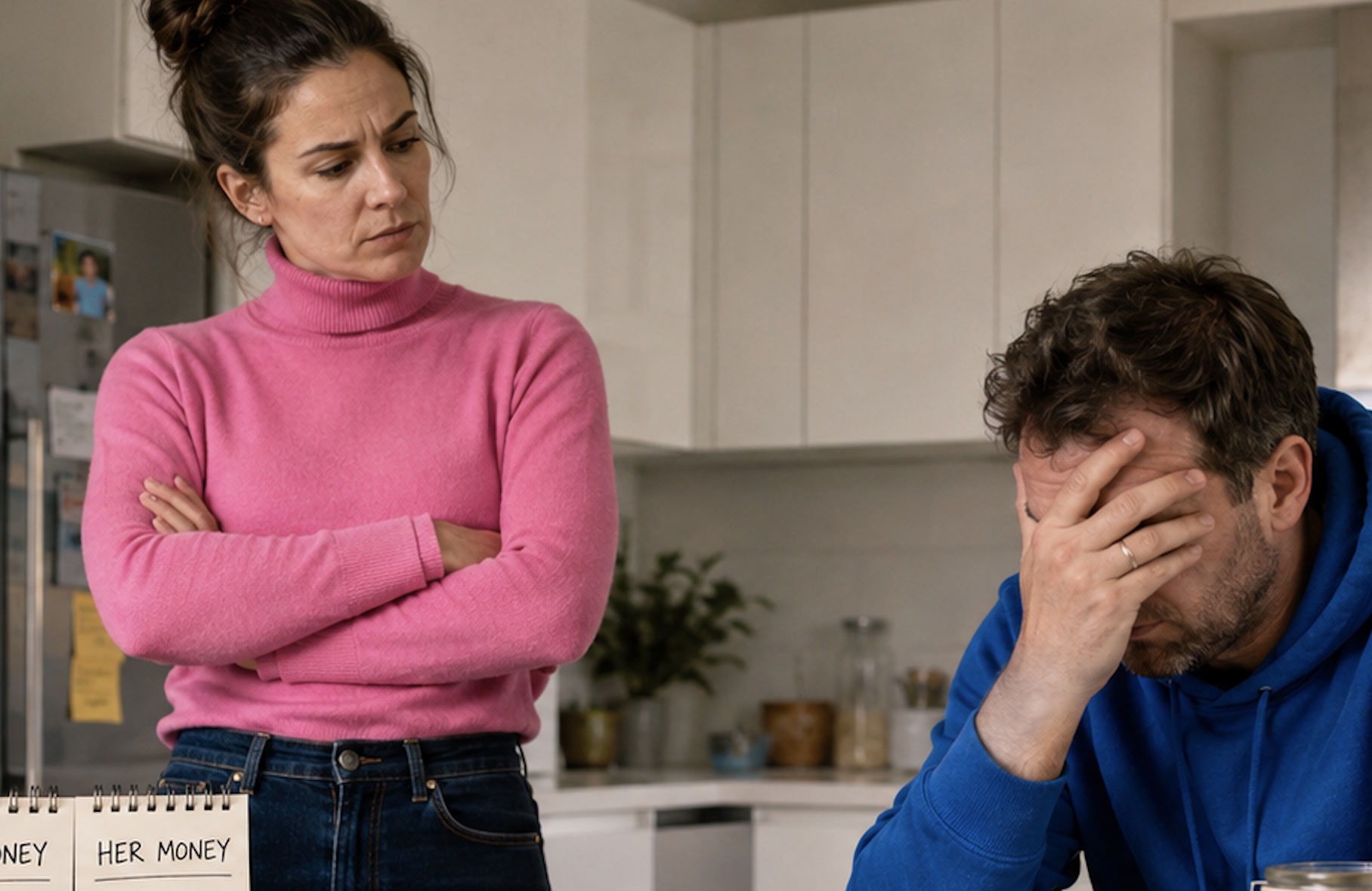
“From this evening on, we’re running separate finances,” Pavel said, placing his fork on the edge of his plate with such solemnity that it looked as if he were signing a peace treaty after a long and exhausting war. “Every adult is responsible for their own money.”
Oksana looked up from the pot of buckwheat.
“Are you saying that to me or to the refrigerator? Because the refrigerator has been asking for a responsible adult to take care of filling it for quite some time.”
“Don’t be sarcastic,” Pavel said, straightening on his stool. “I’m serious. My salary is for my expenses. Your salary is for yours. Rent, groceries, internet, Mishka’s school expenses—we split those in half. Everything else, each person decides for themselves. I’m tired of getting paid and then, three days later, having no idea where the money went.”
“And before, did you know?”
“Before, I didn’t even have a chance to know. I transferred the money to you, you managed everything, and then you’d say, ‘Pash, we need another five thousand. Mishka’s sneakers have fallen apart.’ And I’d say, ‘Of course, we need it.’ But I have wishes too, you know.”
“I know,” Oksana said, turning off the gas and sitting down opposite him. “A fishing rod, a screwdriver, a set of bits you bought last year and still haven’t opened, and a jacket ‘like normal men wear,’ even though your old one doesn’t need replacing, it just needs washing.”
“There, you see! You think my wishes are ridiculous.”
“Pash, I don’t think the wish itself is ridiculous. I think it’s ridiculous that you call it financial freedom. Freedom is when you know how much laundry detergent costs—not when you buy a fishing lure for one thousand nine hundred rubles and call it an ‘investment in relaxation.’”
“Here we go,” he leaned back in his chair. “I knew it. Now I’m going to hear a lecture about how we’ll all die of hunger and dirty socks without you.”
“No, we won’t die. At worst, we’ll start smelling like self-confidence.”
Mishka, their lanky sixteen-year-old son, poked his head out of the room with headphones hanging around his neck.
“Mom, are you two talking about money again? Can I just pass by? My mental health is expensive.”
“Come through, heir,” Pavel said. “We’ll start with you too. From now on, you get pocket money separately from me and separately from your mother. If you ask for money for the cinema, you specify who you’re asking. For transparency.”
“Dad, are we a family or a cookie supply tender?” Mishka scratched the back of his head. “Should I submit my application in duplicate?”
“Don’t be smart.”
“I’m not being smart. I’m adapting to the market.”
Oksana smirked.
“All right, Pavel. Let’s do it separately. But honestly. Shared expenses strictly by receipts. Food, household chemicals, Mishka’s transport to practice, medicine, gifts for relatives, small repairs, cat food, replacing the water filter, light bulbs, batteries, garbage bags. We split everything.”
“We split it,” he said confidently. “I’m not a child. I’ll figure it out.”
“And do we split the refrigerator too?”
“What do you mean?”
“Exactly what I said. You buy your own food, you eat your own food. I buy mine, I eat mine. Shared groceries are bought from a shared list and paid for fifty-fifty. And afterward, don’t open containers with my cutlets at night like an archaeologist discovering a tomb.”
“Oh, come on, what containers… I’m not five.”
“We’ll see.”
Pavel worked as a foreman at a plastic window factory and earned decent money, especially when there were orders from cottage communities. Oksana worked at the reception desk in a private dental clinic. Her salary was more modest, but her mind worked like an accounting spreadsheet. She knew when chicken was cheaper, where household products cost less, which doctor wouldn’t prescribe unnecessary tests, and why you should never buy potatoes in a mesh bag if the bottom always hides two rotten ones like secret agents of decay.
Pavel, on the other hand, believed money disappeared because his wife “fussed over little things.” It seemed to him that if they stopped buying yogurt, napkins, sanitary pads, sponges, hand cream, dill, lemons, and those “unnecessary” freezer bags, life would immediately become spacious, free, and most importantly, masculine.
The next day, he came home from the store with a huge piece of smoked brisket, a jar of pickled cucumbers, and seeded bread.
“This is mine,” he said, placing the food on the middle shelf of the refrigerator. “I bought it for myself. With my own money.”
Oksana silently opened the fridge, took out a plastic container of borscht, a small pot of chicken meatballs, and moved them to the top shelf.
“And this is mine. Bought with my money. Don’t mix them up. The borscht isn’t labeled, of course, but it doesn’t look like you.”
“What’s that supposed to mean?”
“It’s rich and well thought out.”
Mishka peered into the refrigerator and whistled.
“Cool. Now it’s like a dormitory in here: this is mine, this is yours, don’t touch that, and touch this and you die.”
“This applies to you too,” Pavel said. “You need to understand the price of food now.”
“I understand. Mom’s borscht is priceless. Dad’s brisket is dangerous for the liver.”
“Mish!”
“Okay, I’m gone. The market is nervous.”
The first blow to Pavel’s reform came not from Oksana, but from Dusya the cat. She sat next to her empty bowl and began screaming as if bailiffs had come to evict her.
“Oksan, is there no cat food?” Pavel shouted from the kitchen.
“There is.”
“Where?”
“In my cabinet.”
“Why isn’t it in the shared one?”
“Because I bought a small bag with my own money. You said yesterday that everyone is responsible for their own expenses.”
“Dusya is shared.”
“Of course. So you owe me one hundred eighty rubles for half the bag. Or buy your own.”
“Are you seriously going to split cat food?”
“Me? No. You’re the one who started building a financial hierarchy. I’m just laying the bricks evenly.”
Pavel snorted, went to the store, and returned with “premium” cat food because the saleswoman had told him, “Sir, if you love your pet, take this one.” Dusya sniffed the premium food, looked at Pavel with contempt, and went off to sleep on the clean laundry.
“She won’t eat it,” he said half an hour later.
“She has character. Just like you. Only she has more fur and more honest complaints.”
“Maybe you could mix in some of your food?”
“I can sell you a portion. Market economy, Pash. Discounts for regular customers after the tenth purchase.”
By the end of the first week, strange zones of influence had appeared in the apartment. On the bathroom shelf stood Oksana’s shampoo, while beside it lay Pavel’s lonely “Pine Forest” soap, bought on a three-for-the-price-of-two deal. On top of the washing machine, Oksana placed her laundry detergent and stuck on a note: “For washing Oksana’s clothes and shared towels.” Pavel laughed at first, but then discovered that his work socks did not wash themselves and that detergent for colored clothes was different from detergent that was simply “whatever was cheapest.”
“Oksan, what setting do I use for jeans?” he asked one evening, standing in front of the washing machine like a bomb disposal expert.
“The one where they don’t shrink to the size of Mishka’s shorts.”
“I’m serious.”
“Thirty degrees, spin at eight hundred. And check the pockets. Last time you washed a receipt, two screws, and an unwrapped candy. The machine smelled like childhood on a construction site for a week.”
“How much detergent?”
“By eye.”
“Whose eye? Yours is an accountant’s. Mine is a builder’s.”
“Half a cap.”
“And fabric softener?”
“You said that was bourgeois nonsense.”
“I was talking about the ‘mountain lavender’ smell. Not about a T-shirt standing upright after washing.”
“You’re growing up.”
Pavel pretended everything was under control, but an hour later, he pulled a gray mass out of the machine. The white socks had turned the color of melancholy, and his work T-shirt had taken on a strange shape, as though it had been worn by someone whose torso had suddenly shortened while his soul had expanded.
“It’s fine,” he said, noticing Oksana’s look. “At least I did it myself.”
“Doing it yourself is wonderful. Independence is useful. Especially when you can later hang it out on the balcony and admire it.”
The second week began with a call from their daughter. Alyona studied in Nizhny Novgorod, lived in a dormitory, worked part-time at a coffee shop, and usually called home in one of two tones: “Everything is great” or “Mom, just don’t scold me.”
This time it was the second one.
“Mom, is Dad home?” she asked.
“He’s home. He’s sitting here studying the electricity bill like an ancient manuscript.”
“Put me on speaker, please.”
Pavel grew alert.
“What happened?”
“My laptop died. Not completely, but the screen has stripes all over it, like a fence at the dacha. I have to submit a term paper in four days. They said the repair would start at six thousand if it’s the screen matrix.”
Pavel immediately switched into the voice of a responsible father.
“Alyona, you should be more careful. It’s a computer, not a cutting board.”
“Dad, I didn’t hit it. It’s older than my sense of humor. It’s seven years old.”
“Seven years isn’t old.”
“Not for a person. For a laptop, it’s retirement with the right to a health resort.”
Oksana looked at her husband.
“Well? Family financial council?”
“Yes,” Pavel said. “The repair is shared. The daughter is shared. We split it in half.”
“Fine. Three thousand from you, three from me.”
“Now?”
“Is she submitting the paper next month?”
Pavel reached for his phone, opened his banking app, and darkened.
“My card is… not great right now.”
“What does that mean? Is ‘not great’ a diagnosis or an amount?”
“Oksan, don’t start. I just bought a few necessary things.”
“Brisket, cat food, detergent, two lunches from the deli because your soup ran away, and a new tape measure because the old one ‘lies by a centimeter’?”
“The tape measure really did lie.”
Alyona sighed through the phone.
“Mom, Dad, can you divorce each other over receipts later and pay for my screen now?”
“I’ll transfer it,” Oksana said. “Pasha will give me his half by Friday.”
“I’ll give it,” Pavel muttered. “Don’t make me look like a debtor in front of my own daughter.”
“Dad, don’t worry. If needed, I’ll send you a repayment schedule in Excel.”
“All like your mother,” he said.
“Thank God,” Oksana and Alyona replied at the same time.
By Friday, Pavel had given back only one thousand.
“The rest after my advance,” he said, not looking at his wife.
“You got your advance the day before yesterday.”
“They deducted something for the credit card.”
Oksana set down her spoon.
“What credit card?”
“Just a regular one.”
“Pavel, credit cards are never regular. Pots can be regular, and even then, only if they’re not nonstick. What credit card?”
“Well, I opened one a while ago. Just in case.”
“In case of what?”
“A man’s case.”
“So, in case you really want something but are too ashamed to tell your wife?”
He turned red.
“It’s not much.”
“How much?”
“Oksan, don’t interrogate me. We agreed: personal money means personal space.”
“Of course. Only your personal space is somehow stopping you from paying for your daughter’s laptop repair.”
“I said I’ll pay it back!”
“Pasha, you’re not paying it back. You’re promising. Those are different genres.”
He got up from the table.
“You know what? This is exactly why I suggested separate finances. So you wouldn’t dig through my spending. I’m a grown man.”
“A grown man doesn’t hide a credit card like a teenager hiding a bad grade.”
“And a grown wife doesn’t order her husband around like he’s an intern at her dental clinic!”
“At least the interns there know where the shoe covers are.”
Mishka, sitting in the hallway with his backpack, said quietly:
“I think I’ll go to Vitalik’s. Their parents just silently ignore each other. The atmosphere is more stable.”
“Stay home,” both parents said at once.
He raised his hands.
“See? On critical issues, you two have complete budget unity.”
Pavel slammed the cabinet door and went out to the balcony to smoke, even though he had been quitting for four years. Oksana remained in the kitchen. On the table lay the receipt for the “premium” cat food, the payment slip for Mishka’s sports section, the grocery list written in her small handwriting, and her phone with a message from Alyona: “Mom, don’t fight there. I can borrow from the girls, really.”
Oksana replied, “Don’t borrow. Study.” And she felt a dry anger rising inside her. Not the loud kind, with broken plates. Worse. The kind of anger that calmly buttons up its coat, washes cups, checks a son’s homework, and then lies awake at night counting other people’s offenses instead of sheep.
On Saturday, Pavel decided to prove that he was capable of household independence and volunteered to cook dinner.
“Without your hints,” he warned. “I can do it myself.”
“If you can, then cook. Just clean the stove afterward. Grease on the tile is not a decorative element.”
He bought pork, a frozen vegetable mix, and “Georgian-style” sauce. Twenty minutes later, the kitchen smelled of burnt garlic and mild panic.
“Oksan!” he called. “Do you salt meat before or after?”
“When do you want to ruin it?”
“Very funny.”
“Pash, you said no hints.”
“I’m not asking for a recipe. I’m clarifying a technical point.”
“Technically, you’ve already turned the pork into a shoe sole. At this point, you don’t need to fear the salt.”
He silently closed the kitchen door. Ten minutes later, Mishka came out, sniffed the air, and asked:
“Dad, is that dinner or a fire drill?”
“You’ll eat what you’re given.”
“I just want to understand whether I’m supposed to chew it or present it as evidence.”
In the end, they ate the pork with ketchup, stayed mostly silent, and crunched on undercooked carrots. Oksana ate two forkfuls, thanked him, and poured herself some kefir.
“You’re doing that on purpose, aren’t you?” Pavel asked.
“Doing what?”
“Pretending it’s impossible to eat.”
“Pash, I’m not pretending. I’m protecting my teeth. I do get a discount at the dental clinic, but not for this kind of stupidity.”
“At least I tried.”
“Trying is good. But dinner isn’t a fifth-grade essay. Your stomach doesn’t give marks for effort.”
He wanted to snap back, but he didn’t. He looked at the frying pan, at the greasy droplets on the tile, at the sink clogged with dishes, and suddenly said tiredly:
“Do you do this every day?”
“Do what?”
“Think about what to buy, how to cook it, how to make it last, how not to throw anything away, how to make sure everyone eats, and still have something left for tomorrow.”
“Of course not. Sometimes I think about running away to the forest and living with squirrels. At least they gather their own nuts.”
He almost smiled, but then his phone rang. Pavel looked at the screen and quickly rejected the call.
Oksana noticed.
“Who was that?”
“Work.”
“On a Saturday evening?”
“Our installers are idiots. They always have questions.”
The phone vibrated again. Pavel grabbed it and stepped out into the stairwell.
Oksana didn’t follow him. She was not the kind of woman who pressed her ear to the door. His face was enough. That was not how men looked when installers called them. That was how men looked when someone reminded them of a debt, a lie, or a woman whose name was better left unspoken at home.
Five minutes later, he returned.
“Everything all right?” she asked.
“Yes.”
“The installers figured it out?”
“They figured it out.”
“Your idiots get smart quickly.”
“Oksan, don’t pick at me.”
“I’m not picking. I’m remembering.”
He looked at her warily.
“What are you remembering?”
“Intonations.”
“You should have been an investigator.”
“No. Investigators get paid for it. Wives do it for free, out of love and hopelessness.”
After that call, something changed in Pavel. He became even more stubborn about maintaining the separate budget, but the cheerful bravado disappeared from him. He no longer displayed his brisket proudly, no longer lectured about fairness, no longer said “my money.” He started counting change, refusing coffee at gas stations, taking sandwiches to work—and making them himself: bread, cheese, cucumber, and sausage sliced thinly, like resentment.
Oksana watched and said nothing. Silence in a family is sometimes more frightening than a scandal. A scandal at least shows where the blow landed. Silence leaves the bruise inside.
On Monday, she found a pawnshop receipt in the pocket of his jacket. She hadn’t searched for it. She was simply emptying the pockets before doing laundry. The receipt read: “Collateral: gold signet ring. Amount: 18,000 rubles.”
The signet ring had been given to Pavel by his father when Pavel got his first proper job. It was tasteless, heavy, with a dark stone, but Pavel treasured it. He wore it rarely, only to weddings and funerals. Oksana stood by the washing machine, staring at the piece of paper, until Mishka shouted from behind the wall:
“Mom, where’s the laptop charger?”
“Look in the room.”
Her voice came out even. Too even.
That evening, she placed the receipt in front of Pavel.
“Explain.”
He turned pale.
“Were you digging through my pockets?”
“I was doing laundry. Those are different activities. Explain, Pavel.”
“It’s my ring.”
“I didn’t ask whose it was. I asked why.”
“I needed money.”
“For what?”
“For something personal.”
“You pawned something from your father for something personal?”
“Oksan, don’t pressure me.”
“I haven’t started yet. I’ve simply put a piece of paper on the table. I’ll start pressuring you when I understand that you’re lying.”
He sat down and rubbed his face with his hands.
“I can’t tell you.”
“Then I’ll offer some options. One: the credit card. Two: a woman. Three: you got yourself mixed up in some stupidity. Four: all of the above, because life likes to save time.”
“I don’t have a woman.”
“What a pity. A woman would at least explain the smell of someone else’s perfume. What we have here smells of a cheap pawnshop and your cowardice.”
“Watch your words.”
“And you watch your debts.”
He slammed his palm on the table.
“What do you know? You think I started all this for no reason? You think I enjoy counting toilet paper and buying my own soap separately? I’m not an idiot, Oksana!”
“Then stop acting like one and tell me the truth.”
He stayed silent.
“Pasha.”
“I can’t.”
“Can’t or won’t?”
“I don’t want to drag you into it.”
Oksana laughed shortly and bitterly.
“You’ve lived with me for twenty-two years. We have two children, a shared mortgage, a cat that eats better than some people, and a balcony full of your boards ‘just in case.’ How much more can you drag me in? I’m already inside. I’m standing there with a rag and receipts.”
“Oksan…”
“Who called you on Saturday?”
“It doesn’t matter.”
“It does.”
“My mother.”
Oksana froze.
“Your mother?”
“Yes.”
“Your mother, who three months ago told me that I was ‘cutting off her son’s oxygen’?”
“Yes, my mother. Don’t start about her.”
“I haven’t even started. Why did she call?”
“She needed tests. Paid ones. Then medicine. Then it turned out her neighbor recommended a doctor at a private clinic. She went there. They told her all kinds of things, she got scared. She needed money. I gave it to her.”
“How much?”
“Ten at first.”
“And then?”
“Then another fifteen.”
“And then you pawned the signet ring.”
“Yes.”
Oksana slowly sat down opposite him.
“And instead of telling me, ‘Oksan, my mother needs help,’ you staged a circus at home about sovereignty?”
“You would have started.”
“What?”
“You would have said she was manipulating me. That she was playing on pity again. That we have Alyona, Mishka, the mortgage. That paid doctors are a scam. That she should go to a public clinic first.”
“So I would have said reasonable things.”
“You would have said them as if I were a little boy carrying his last candy to his mother.”
“And what are you now? A man who pawned his father’s memory and lied to his wife because his mother might get offended?”
“She’s sick!”
“With what?”
“Her heart. Blood pressure. Dizziness.”
“What’s the diagnosis?”
“I’m not a doctor.”
“Did you see any documents?”
“She said…”
“Pasha, she’s seventy. She knows how to speak. Especially when she needs money.”
“Enough!”
“No, not enough. Because our daughter was sitting without a laptop, our son’s sports section needed paying, and you were feeding a private clinic where your mother may have simply been sold fear. And you covered it all with a separate budget so I wouldn’t see the hole.”
He clenched his fists.
“You hate her.”
“I don’t hate her. I’m tired of her calling you and crying, and then you coming home pretending to be the minister of finance. I’m tired of being the bad one just because I know how to count. I’m tired, Pasha. Really tired.”
He turned away toward the window.
“She’s alone.”
“She is not alone. She has a son. But for some reason, that son has decided his wife is not the person standing beside him, but an obstacle between him and his mother’s drama.”
The door creaked in the hallway. Mishka stood there barefoot, wearing a stretched-out T-shirt.
“Grandma again?” he asked quietly.
Pavel spun around.
“Why aren’t you asleep?”
“Because you’re shouting so loudly that Dusya hid under the bathtub. Dad, Grandma called me too.”
Oksana looked at her son.
“When?”
“On Thursday. She asked me not to tell you. She said she needed money for IV treatments, and that Dad was already drowning in debt. I sent her two thousand. The money I was saving for sneakers.”
Pavel seemed to sink where he stood.
“Mish…”
“I thought she was really sick. She was crying. She said, ‘You’re my grown-up grandson, you’ll understand.’ So I understood. And now I’m walking around in my old sneakers. They smell like a basement after rain.”
Oksana closed her eyes.
“Pasha, tomorrow we’re going to your mother’s place. All of us. And we’re checking the documents.”
“She doesn’t like it when people come at her like that.”
“And I don’t like it when my son is milked like an ATM with acne.”
“Mom, I barely have acne anymore.”
“This is not the time for dermatology.”
The next day, they drove to an old five-story apartment block on the outskirts of town. Pavel’s mother, Tamara Ivanovna, greeted them in a robe, speaking with the tone of a sick empress.
“Well, here come the auditors. Pavlusha, I asked you not to upset Oksana. Her face always looks as if she has arrived to shut down a shop for health-code violations.”
Oksana took off her boots.
“Tamara Ivanovna, show us the prescriptions.”
“What prescriptions? I have blood pressure problems. I feel ill. I don’t sleep at night.”
“The doctor’s papers.”
“Why are you acting like a prosecutor? I have a son. He believes me.”
“You also have a grandson. He sent you two thousand. Was that treatment too, or was it already a charity fund in honor of your anxiety?”
Her mother-in-law flushed.
“Misha wanted to help his grandmother himself!”
From behind Oksana, Mishka said:
“Grandma, you told me you might die before morning.”
“I said it figuratively!”
“I don’t understand figurative language very well at midnight.”
Pavel stood in the middle of the hallway like a man who had come to save a drowning person and suddenly discovered that the person was sitting safely on the shore, selling tickets to the rescue.
“Mom,” he said in a dull voice. “Where are the receipts? Where is the doctor?”
“Pavlusha, you don’t believe me?”
“I do. That’s why I’m asking.”
“Look what your wife has done. My own son is demanding a report.”
“Not my wife,” he said. “The pawnshop. I pawned Father’s signet ring.”
Tamara Ivanovna fell silent. For a moment, something real flickered across her face. Not illness. Not performance. Fear.
“Why?” she asked almost in a whisper.
“To give you money.”
“You fool, Pasha.”
Oksana said dryly:
“It’s nice when the family finally agrees on something.”
Tamara Ivanovna sat down on a stool.
“I didn’t give the money to a clinic.”
“Then where did it go?” Pavel asked.
She stayed silent, twisting the edge of her robe between her fingers.
“Mom.”
“To Valera.”
“What Valera?”
“The neighbor. From the third floor. His son got into trouble. Crashed a car. He needed money urgently. He promised to pay it back.”
Oksana slowly turned to Pavel.
“There it is. Our private cardiology center named after Valera.”
“Mom, are you serious?” Pavel’s voice was so quiet it became frightening. “You asked me for medicine money and gave it to a neighbor?”
“He’s a good man.”
“A good man takes money from a pensioner who has to ask her son for help?”
“He cried.”
“Half the men in this country cry when they need someone else’s money.”
“He’ll return it.”
“When?”
“After he sells his garage.”
Oksana narrowed her eyes.
“Does Valera’s garage exist in the same place as your medical examination?”
Tamara Ivanovna lifted her head.
“Don’t you dare speak to me like that.”
“And don’t you dare lie to my husband and my son. We are not rich. We are not an oil well wearing slippers. Every month for us is a quest: pay the mortgage, feed everyone, don’t lose our minds, buy the child sneakers, and pretend life is normal. And you staged a whole theater performance because Valera cried beautifully.”
Pavel went to the window.
“I’m going upstairs to see him.”
“No,” Tamara Ivanovna said quickly. “He’s at work.”
“On a weekend?”
“He works shifts.”
Oksana opened her phone.
“Mish, go ask the neighbors where Valera from the third floor is.”
“Oksana, don’t involve the child,” Pavel said.
“We have to. The child is already a participant in a financial pyramid. Let him see what it looks like without the presentation slides.”
Mishka came back five minutes later.
“Valera left. The neighbor said movers carried his sofa out yesterday, and this morning he got into a taxi with some woman. She also said, ‘Tell Tamara he owes everybody.’”
Tamara Ivanovna covered her face with her hands.
Pavel sat down on a chair. He stayed silent for a long time. Then he asked:
“How much did you give him?”
“I didn’t count.”
“How much, Mom?”
“Thirty-seven.”
“I gave you twenty-five. Mishka gave you two. Where did the rest come from?”
“From my pension. And I sold the earrings.”
“Dad’s earrings?”
“They were mine!”
“Dad gave them to you for your fortieth birthday.”
She began to cry, but this time the crying was ugly, old, and stripped of its usual theatrical softness. Oksana watched her and felt no victory. Victory is when you prove you were right. But this truth lay in the room like a shattered jar of jam: sticky, dirty, and no longer sweet for anyone.
“Tamara Ivanovna,” she said more quietly, “why didn’t you tell us right away?”
“Because you would have said I was an old fool.”
“I still think that. But if you had told us immediately, we would have gone to the police, filed a report, found witnesses. Instead, we got a pawnshop and a child’s savings.”
Her mother-in-law raised her eyes.
“The police? But he promised…”
“He moved out,” Pavel said. “His promises left with him in the taxi.”
They spent three hours at the police station. The officer on duty listened wearily, sighed, typed with one finger, and said:
“We get Valeras like this in every apartment block. We’ll take the statement, but you understand how it is.”
Oksana replied:
“We understand that if we do nothing, he’ll cheat three more pensioners.”
Pavel said nothing. Mishka sat beside his grandmother and handed her a bottle of water.
“Grandma, drink.”
She took it.
“Are you angry with me?”
“I am. But you’re still my grandma. I just won’t send you money anymore until Mom checks everything. Nothing personal. Financial security.”
Tamara Ivanovna sniffled.
“You’re becoming just like Oksana.”
“Well, at least someone in this family is evolving,” Oksana said.
That evening, when they returned home, the apartment greeted them with the smell of cat food and an unwashed frying pan. Dusya came out of the room, looked at everyone, and meowed loudly, like the chairwoman of a commission.
Pavel took off his jacket.
“I’ll redeem the ring tomorrow.”
“With what?” Oksana asked.
“I’ll sell the boat motor.”
“The one you’ve been planning to fix for three years?”
“Yes.”
“You bought it broken.”
“That’s why I’ll sell it cheap. But I’ll sell it.”
“Pasha.”
“What?”
“No heroic gestures made out of junk. First, we make a list of debts. Credit card, pawnshop, Alena’s laptop, Mishka’s sneakers. Then we decide.”
He looked at her almost guiltily.
“You’re going to fix everything again?”
“No. We are going to fix it. There is a huge difference, even if you used to think it was cosmetic.”
“I really thought you were controlling me.”
“I was controlling you. Because you behave like a man capable of buying premium cat food without asking the cat.”
“Fair.”
“But I don’t want to be your mother, Pasha. You already have one, and all of us have had enough.”
He sat down at the table.
“I was afraid you’d say, ‘It’s your own fault.’”
“I am saying it is your own fault. But that doesn’t mean I’ll go drink tea and watch you drown. From now on, you row with me instead of sitting at the stern giving speeches about freedom.”
Mishka placed his old sneakers on the table.
“Since this is confession night, here. The sole is coming off. I glued it with superglue, then stepped on a plastic bag, and now the right sneaker rustles when I turn.”
Pavel picked up the sneaker.
“We’ll buy new ones tomorrow.”
“From shared money?”
Oksana said:
“From parental money. It’s an ancient currency. It isn’t split in half. It simply has to exist.”
Pavel nodded.
“We’ll buy them. And we’ll finish paying for Alena’s repair. And Mom… Mom gets a limit.”
“What kind of limit?” Oksana asked, suddenly alert.
“Not a money limit. A human one. If she calls, we deal with it together. Any money only after documents. And no more ‘don’t tell Oksana.’”
“That should have been said ten years ago.”
“Better late than after a second Valera.”
Pavel’s phone rang again. The screen showed: “Mom.”
He looked at Oksana.
“Put it on speaker,” she said.
Pavel pressed the button.
“Pasha,” Tamara Ivanovna’s voice came through. “I’ve been thinking. I have a savings book. A small one. I was keeping it for my funeral.”
“Mom…”
“Don’t interrupt. I’ll save up for the funeral again. I’m not in a hurry. Tomorrow I’ll withdraw money and give Misha back his two thousand. And part of yours. And tell Oksana…”
Oksana leaned toward the phone.
“I’m listening.”
Her mother-in-law was silent for a moment.
“Thank you for not finishing me off.”
“I’m not that merciful. I just didn’t have the strength left to finish anyone off.”
“And thank you for the police report. I wouldn’t have gone myself. I was ashamed.”
“Shame is when you do nothing and keep lying.”
“I understand.”
Pavel looked at the phone as if he were hearing his mother without her commanding voice for the first time.
“Mom, I’ll come by tomorrow. But no performances, all right?”
“I’ll try.”
“And check your blood pressure.”
“I did. It’s normal.”
Oksana couldn’t resist.
“See? A police report is excellent for the blood vessels.”
Tamara Ivanovna unexpectedly snorted.
“You have a tongue like a grater, Oksana.”
“At least it shreds carrots for soup quickly.”
After the call, everything became quiet. Not peaceful. Peace was still far away. But at least it was honest. Oksana took out the notebook where she usually wrote things like “milk, eggs, buckwheat, light bulbs” and wrote at the top: “Rescue Plan for the Drowning.”
Pavel sat beside her.
“Write: credit card — forty-two.”
Oksana raised her head.
“You said it was ‘not much.’”
“I lied.”
“I see progress. Continue.”
“Pawnshop — eighteen with interest. Alena — five left. Mishka — sneakers. Mom… unknown for now.”
“Total?”
“A lot.”
“A lot is not a number. Numbers are scarier, but at least they’re honest.”
They counted almost until midnight. For the first time, Pavel saw the family budget not as some mysterious hole into which his wife poured his salary, but as a peeling boat where every month someone had to plug a new leak with a finger. Here, extracurricular classes. There, medicine. Here, transport became more expensive. There, the school asked for security fees. Here, the cat needed a vaccination. There, their daughter wrote, “Mom, I can wait,” and that made you want not to be proud of the child, but to smash your head against the wall, because children should not have to “wait” because of adult stupidity.
“Oksana,” he said at last. “I didn’t know.”
“You knew. You just didn’t look.”
“Is that worse?”
“It’s more honest.”
He stayed quiet for a long time, then took a card out of his pocket and placed it in front of her.
“Shared?”
“No,” Oksana said.
He looked surprised.
“Why?”
“Because the old system was wrong too. You handed over money and removed yourself from responsibility. I took it and turned into an angry control center. That ends now.”
“Then how will it be?”
“There will be a shared account for shared expenses. We both see it, both pay into it, both plan it. Personal money will exist too. No humiliation, no interrogations. But debts, help for parents, big purchases — we discuss them. Not ask permission. Discuss. Do you understand the difference?”
“I’m trying.”
“Try faster. The mortgage isn’t waiting for your personal growth.”
He smiled tiredly.
“You’re harsh.”
“I’m exhausted. People often confuse the two.”
The next day, Pavel sold the motor. For ridiculous money, but he sold it. Then they went to the pawnshop together. The signet ring returned to his palm, heavy, cold, and shameful.
“Put it on,” Oksana said.
“I don’t want to.”
“Put it on. Let it pinch. That’s a useful feeling.”
He put it on. The ring really did pinch. Maybe his finger was swollen. Maybe it was his conscience.
A week later, the police found Valera. Not because the police suddenly became cinematic, but because Valera was lazy and stupid. He had rented a room from an acquaintance in a nearby district and kept using the same phone number. It turned out he owed money not only to Tamara Ivanovna, but also to two other pensioners, an auto mechanic, and a woman at the market from whom he had taken a crate of persimmons “to sell later.”
They didn’t get all the money back. Only part of it. But even that felt like a miracle without sparkle: crumpled bills, a written statement, an irritated district officer, and Valera with the face of offended innocence.
“I was going to return it,” he said in the police station hallway. “Why did you make such a fuss?”
Tamara Ivanovna suddenly stepped toward him and said:
“Because I’m old, not dead. Remember the difference.”
Oksana looked at her mother-in-law with a new, unpleasantly warm feeling. Not love, of course. Love was as far from them as the sea in winter on foot. But a tiny, prickly spark of respect appeared.
That evening, they sat in the kitchen, all four of them. Alena had come home for the weekend with her repaired laptop and a bag of gingerbread.
“So,” she said after hearing the story, “Dad launched a financial reform to hide Grandma’s financial melodrama, Grandma sponsored the stairwell’s own Ostap Bender, Misha invested in emotional blackmail, and Mom saved everyone and now has the right to say ‘I told you so’ until the end of the year?”
“Until the end of my life,” Oksana said.
“With interest,” Mishka added.
Pavel raised his hands.
“I admit it. I was a donkey.”
“Don’t insult animals,” Alena said. “Donkeys at least carry loads instead of hiding credit cards.”
“Thank you, daughter. Very supportive.”
“I say it with love. In our family, love generally resembles a tax audit.”
Oksana put cutlets on the table. Ordinary ones, with onion, garlic, and grated potato. The kind Pavel called “with a secret,” though the secret was only this: do not spare time, and do not pretend to be a great reformer while standing next to a meat grinder.
Pavel picked up his fork.
“Oksan.”
“What?”
“Thank you.”
“For the cutlets?”
“For the cutlets too. But really… thank you for not throwing me out.”
“I thought about it.”
He froze.
“Seriously?”
“Pasha, when a wife finds a pawnshop receipt and learns about a credit card, she does not think, ‘Ah, what a complicated man.’ She thinks, ‘Where is the suitcase, and why didn’t I buy a new one earlier?’”
“What stopped you?”
Oksana looked at the children, at the cat under the table, at Pavel with the signet ring on his finger.
“I don’t know. Maybe anger. I decided I had invested too much in this family renovation to hand the house over to the cracks without a fight.”
Mishka raised his glass of compote.
“To renovation.”
“To the budget estimate,” Alena said.
“To the absence of Valeras in our lives,” Pavel added.
Oksana snorted.
“There will always be Valeras. The important thing is not to hand them the family budget just because they have honest eyes.”
Late that evening, after the children had gone to their rooms, Pavel brought an old shoebox into the kitchen and placed it in front of Oksana.
“What is this?”
“My secret fortune.”
“Pasha, I’m tired. If there is another credit card in that box, I’ll bury you in it. Cheap and eco-friendly.”
“Open it.”
Inside were fishing lures, a reel, some shiny fishing things, a receipt for a jacket he had never bought, and an envelope. Inside the envelope were twelve thousand.
Oksana slowly lifted her eyes.
“Where did this come from?”
“I was saving it. For a boat. A small inflatable one. I wanted to buy it in the summer and say I’d received a bonus.”
“So we have discovered another layer of lies.”
“Yes. But I brought it myself.”
“A real celebration of moral secondhand goods.”
“This money goes into the shared plan. Debts or Mishka’s sneakers, whatever you say.”
Oksana took the envelope and counted it.
“Do you know what’s most disgusting?”
“That I lied?”
“No. That you could have honestly said, ‘Oksana, I want a boat.’ I would have grumbled, called you the admiral of puddles, we would have counted, and maybe we would have saved up for it over a year. But you chose a hiding place, as if I were the enemy.”
Pavel sat beside her.
“I got used to thinking you’d say no.”
“And I got used to saying no because you came to me with an idea after everything had already been spent.”
He nodded.
“Will we learn?”
“It’s a bit late, of course. But in our education system, the main thing is that the student doesn’t run away.”
He laughed softly.
“I won’t run away.”
“See that you don’t. I now know every pawnshop in the district.”
A month later, little had changed on the surface of the apartment. The bathroom once again had shared laundry detergent. The refrigerator no longer had territorial borders. Dusya ate decent food and looked at Pavel with cautious trust. On the kitchen wall hung an expense chart written by Mishka: “Food,” “Utilities,” “Debts,” “Grandma Without Valeras,” and “Personal, But Not Stupid.”
In the evenings, Pavel entered receipts into the app himself and sometimes asked questions that exhausted Oksana, though they no longer made her angry.
“Why are we buying butter now if we still have some at home?”
“Because it’s on sale.”
“Why two packs?”
“Because you finally asked the right question. Write this down: ‘stocking up is not panic, it is strategy.’”
Tamara Ivanovna called less often and always began the same way:
“Is Oksana nearby? Put me on speaker. I want this to be official.”
One day, she came over herself, brought a cabbage pie, and said to Oksana in the hallway:
“I didn’t like you before.”
“I noticed.”
“I thought you were taking Pasha’s money away from him.”
“And it turned out?”
“It turned out you were storing his brains for him while he rarely used his own.”
“Not a bad beginning for an apology.”
“Don’t get arrogant. I’m still learning.”
Oksana took the pie.
“Come in. Will you have tea?”
“I will. And don’t ask for the cabbage receipt. I bought it myself.”
“See? Sovereignty has reached the people.”
At the end of May, Pavel received a bonus. Small, but real. He came home, placed the money on the table, and said:
“I suggest we distribute it.”
Oksana looked at him carefully.
“You’re suggesting that yourself?”
“Myself. Half toward the debts. Part for Alena’s ticket home in the summer. Something for Mishka’s camp fees. And… one thousand for me, for fishing. No boat. Just to sit with a fishing rod and think about life.”
“Is thinking easier with a fishing rod?”
“It’s easier without people.”
“All right. One thousand is possible.”
He had already started smiling, but she added:
“Only you clean the fish afterward.”
“Even if it’s small?”
“Especially if it’s small. Let it know the price of freedom.”
That night, Oksana woke up to a rustling sound in the kitchen. She went out and saw Pavel sitting at the table. In front of him lay his father’s signet ring and an old photograph: young Pavel, his father, a peeling boat by the river, both of them laughing.
“Can’t sleep?” she asked.
“Something like that.”
“Thinking about the boat?”
“About him. He would have smacked me for the pawnshop.”
“Definitely.”
“And then he would have gone and redeemed the ring.”
Oksana sat beside him.
“Possibly.”
“I always wanted to be like him. To decide things myself, earn money myself, keep my word myself. But it turned out I was just afraid to tell the truth at home.”
“Many people confuse independence with loneliness. Especially men. From childhood, you’re told: don’t whine, solve it yourself. Then you solve things in such a way that the whole family has to put out the fire.”
“And what are women told?”
“We’re told: endure. So we endure until we can kill someone with a look.”
He turned the photograph toward her.
“I want to take Mishka to the river this summer. Not by boat. Just with a tent. By commuter train. Cheap. Honestly.”
“Tell him.”
“And you?”
“I’ll think about whether I should let two financially unstable citizens into the wilderness.”
“We’ll take buckwheat.”
“That’s already growth.”
Pavel covered her hand with his.
“Oksana, I really understood a lot.”
“Don’t say it too loudly. Life might hear you and give you a test.”
He smirked, but in his eyes there was no longer the old self-satisfaction. There was something new. Not showy repentance. Not a masculine pose of “well, forgive me for being so complicated.” Just the simple exhaustion of a person who had finally seen how much work stood behind the word “home.”
In the morning, Oksana found a note on the refrigerator: “Bought bread, milk, food for Dusya. Receipts are in the jar. Your admiral of puddles.”
She smiled. Then she opened the bread box and saw a small paper bag from the bakery beside the loaf. Inside were two cinnamon buns, her favorites — impractical, a little expensive, completely unnecessary.
On the bag, he had written: “This is not a shared expense. This is so you don’t only count, but also eat something good.”
Oksana stood in the kitchen, listening to the water running in the bathroom, to Mishka grumbling in his room, to Dusya scratching near her bowl, and suddenly thought that sometimes the unexpected twist is not that a person suddenly becomes someone else. That doesn’t happen. People change slowly, with creaks, setbacks, and stupid questions about laundry detergent.
The surprise was something else: Pavel, for the first time, had not asked for forgiveness with words. He bought bread. Saved the receipt. Picked up cat food. Remembered the buns. Not a great heroic act, not a turn of fate, not the ending of a beautiful movie. Just a small piece of everyday honesty — and perhaps that is where a normal family life begins after twenty-two years of shared chaos.
From the bathroom, he shouted:
“Oksana! Where are the clean towels?”
She closed her eyes.
“In the closet, Pasha! Second shelf!”
“Mine or shared?”
Oksana looked at the buns, at the note, at the expense chart, and answered loudly:
“Ours!”
For a second, the bathroom went quiet. Then Pavel said:
“Got it. Thank you.”
And that “got it” sounded so unusually serious that Oksana didn’t even add anything sarcastic. Though she really wanted to. She simply poured tea, took out two plates, and cut one bun in half.
Justice, as it turned out, was not about everyone guarding their own wallet like a border officer guarding a warehouse of canned meat. Justice was about making sure no one carried the whole house alone in silence while the other person gave speeches about freedom. And it was also about sometimes buying buns not because they were on sale, not because they were necessary, but because the person beside you was tired of being strong.
And yes, Pavel placed the receipt in the jar. Straight, carefully, face up. Like a document of surrender. Or perhaps like the first real contribution to their shared world.