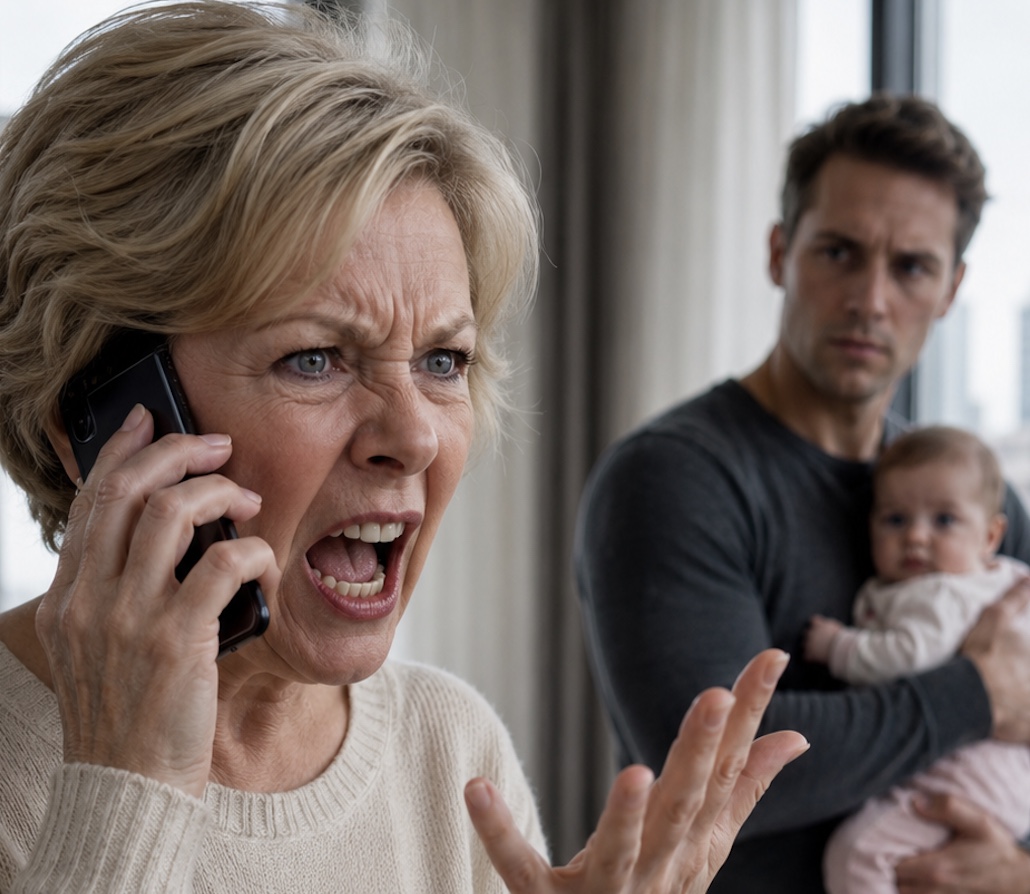
Elena was sitting in the kitchen with three-month-old Misha in her arms, watching as Andrey poured himself water from the pitcher. The baby smacked his lips softly in his sleep, pushing out his tiny lower lip in that helpless, childish way. The apartment was quiet and warm — one of those evening moments when it almost feels as if everything in life has finally fallen into place.
“Andrey, maybe we should call Galina Petrovna?” Elena suggested gently. “She still hasn’t seen Misha in person. Only in photos.”
Andrey set the glass down on the table and hesitated before answering. His face tightened, the way it always did whenever his mother was mentioned.
“Lena, not today. I’m tired after my shift.”
“I understand,” she nodded. “But he is her grandson. No matter what she’s like, sooner or later you’ll have to talk to her.”
Andrey sat down across from her and rubbed his palms over his knees. He was a large, broad-shouldered man with gentle features and pale blue eyes — the same eyes he had inherited from his father. Elena knew that behind his rough exterior lived a man who simply didn’t know how to say no to the people he loved.
“She hasn’t changed,” he said quietly. “Do you know what she wrote when I sent her Misha’s photo?”
“What?”
“She said, ‘The child has the wrong eyes.’ Those exact words. The wrong eyes.”
A cold shiver ran down Elena’s spine, but she forced herself to smile. Misha stirred in her arms, and she adjusted his little blanket.
“Well, people say strange things in the heat of the moment. Babies’ eye color can change during the first year. Maybe she just didn’t think before speaking.”
“No, she thought,” Andrey replied. “She always thinks. Just never about the right things.”
Elena remembered her first meeting with Galina Petrovna — that dinner at the restaurant where Andrey had brought her when they were still engaged. His mother was a tall woman with a straight back and sharp blue eyes. She had assessed Elena in thirty seconds with one long, slow look from the top of her head down to her shoes.
“So you are Elena,” Galina Petrovna had said then, without offering her hand. “Your eyes are dark.”
“Brown,” Elena had smiled. “Like my mother’s.”
“In our family, everyone has blue eyes,” Galina Petrovna had said in a tone that made it sound like a medical diagnosis. “Four generations. Without exception.”
Andrey had laughed then and put an arm around Elena’s shoulders, trying to turn it into a joke. But Elena had seen the way his mother’s eyes narrowed. That was how people looked at something they believed did not belong.
Their wedding took place without Galina Petrovna. She refused to come, citing “principles.” Andrey was hurt, but he said nothing. Elena didn’t push him. She believed time could heal things, that patience and kindness could melt even the hardest ice.
She was wrong.
The first real blow came a week after Misha was born. Elena was lying in the hospital room, still recovering from a difficult delivery, when messages began flooding Andrey’s phone.
“What is it?” she asked, noticing how sharply he straightened in the chair.
“Nothing,” he answered too quickly.
“Andrey.”
He handed her the phone. On the screen was a long message from Galina Petrovna, written in capital letters, without punctuation, furious and chaotic like a scream into emptiness. The message came down to one thing: “This child cannot be yours. He has dark eyes. She is deceiving you.”
Elena read it once. Then twice. Then a third time. The letters blurred before her eyes.
“Newborns often have dark eyes,” she said evenly. “They can become lighter by six months. This is basic physiology.”
“I know,” Andrey said, taking the phone back and shoving it into his pocket. “I wrote the same thing to her. She answered that I was ‘blinded.’”
“Blinded by what?”
“By you. By your charms. Her exact word was ‘charms.’”
Elena closed her eyes. The baby was sleeping in the transparent hospital crib beside her, his tiny fists clenched. She thought of her own parents — calm, reasonable people from the Moscow region who had accepted Andrey without a single interrogation. Her father had shaken his hand and said, “Take care of my daughter.” Her mother had hugged him and cried with happiness. No questions. No inspections of eye color.
“Andrey, maybe I should talk to her myself?”
“No,” he shook his head. “Not now. You just gave birth. You don’t need stress.”
But stress came anyway — and very soon.
Three days later, when Elena returned home with Misha, there were four voice messages waiting on the answering machine. Galina Petrovna had not called Andrey. She had called the home number Elena had left as an emergency contact.
The first message was fairly calm: “Elena, I want to talk. Call me back.”
The second was more insistent.
The third was irritated.
The fourth Elena listened to while standing in the hallway with the baby in her arms.
“…and I will not allow some brown-eyed outsider to destroy my family. You know I’m right. This child is not my son’s. I can see it. I can feel it. And I will prove it.”
Andrey came home an hour later. Elena was waiting for him at the kitchen table. Misha was already asleep in the bedroom.
“Sit down,” she said.
“What happened?”
“Your mother called. Four times. In the last message, she called me a whore.”
Andrey went pale. Slowly, he lowered himself onto a chair and covered his face with his hands.
“Lena, I’m sorry.”
“I don’t need apologies, Andrey. I need you to stop this.”
“I’ll talk to her.”
“You say that every time. And every time, she crosses another line.”
“What do you want me to do?” he asked, lifting his head. In his eyes was that same helpless confusion that once made Elena feel sorry for him — but now it only irritated her.
“I want you to choose. Not between me and her. Between truth and madness. Because what she is saying is madness. Complete, clinical madness.”
“I know Misha is mine,” Andrey said quietly.
“Then tell her in a way she understands. Once. Forever.”
He nodded. He took his phone and went into the other room. Elena heard his voice — first low, then loud, then low again. The conversation lasted forty minutes. When Andrey returned, his eyes were red.
“She doesn’t hear me,” he said. “She doesn’t hear anything. She says she has proof.”
“What proof?”
“She says she saw you with some man near our building. Two months before the birth.”
Elena froze. Then she slowly said:
“I’m near our building every day. With different people. Neighbors, couriers, colleagues. Was she following me?”
“Looks like it.”
“And who is this man, according to her?”
“She gave a name. Igor. An old acquaintance of mine. We trained together in the same sports club about ten years ago. I haven’t seen him in ages.”
Elena felt something thin and patient inside her — something stretched to its limit — begin to crack.
“I don’t know any Igor,” she said clearly. “I have never seen him in my life. Do you understand that?”
“Yes,” Andrey nodded. “I understand.”
“Then do something.”
Galina Petrovna did not stop. She accelerated.
Over the next two weeks, Andrey’s aunt in Saratov, his cousin in St. Petersburg, and three former classmates all learned about the “family disgrace.” Strangers began calling Elena — some sympathetic, some curious, some openly malicious. One woman, introducing herself as Galina Petrovna’s friend, called at three in the morning and asked, “Sweetheart, is it true the child isn’t your husband’s?”
Elena hung up and blocked unknown numbers.
Three days later, Igor himself called. His voice sounded both confused and furious.
“Elena? Hello. My name is Igor. You don’t know me, and I don’t know you, but apparently someone decided we should meet in the stupidest possible way.”
“I know what’s going on,” Elena replied. “I’m very sorry you’ve been dragged into this.”
“Sorry?” he laughed hoarsely. “My wife interrogated me for four hours yesterday. Her mother came all the way from Tula just to look me in the eye. Some woman I don’t know wrote to my parents saying I had fathered a child on the side. My parents! My father is sixty-eight and has a pacemaker!”
“I understand your anger.”
“No, you don’t. I have never seen you. I last saw Andrey at someone’s birthday party seven years ago. We aren’t friends. We aren’t even acquaintances anymore. I have no idea how his mother even remembered my name.”
“She remembered it because she needed a specific culprit,” Elena said tiredly. “A vague accusation doesn’t work. You need a name, a face, an address. Then gossip starts sounding convincing.”
Igor was silent for a moment. Then he spoke more calmly.
“Listen, I want this to end. My family is falling apart because of your husband’s mother’s fantasies. I’m ready to take a DNA test. Right now. Today. So there’s a result on paper and no one has any questions left.”
“I want this to end too,” Elena said. “I’ll talk to Andrey.”
That evening, she told her husband about the call. Andrey stood by the window for a long time without saying anything. Then he turned around.
“This is humiliating.”
“What exactly?”
“All of it. That my own son has to go through some kind of test. That my mother turned the birth of my child into a circus. That a stranger is calling my wife and asking for a DNA test just to save his family from my mother.”
“Andrey, listen to me carefully,” Elena said, stepping close to him. “It is humiliating for me too. It is humiliating that I am being called a whore. It is humiliating that my child — your child — has been declared someone else’s. But I am ready to swallow this humiliation for one thing: the truth in writing. Because written truth is the only thing that might shut her mouth.”
“And if it doesn’t?”
“Then we’ll act differently. But first — the test.”
Andrey nodded.
The next day, all three of them — Andrey, Igor, and little Misha — submitted biological samples at a laboratory on the other side of the city. Elena chose the facility herself: independent, accredited, impossible to accuse of falsifying anything.
The two weeks of waiting were the longest of her life. During that time, Galina Petrovna did not quiet down. She wrote a letter to Elena’s parents. A real letter, on paper, by hand. Four pages in cramped handwriting.
“Your daughter has deceived my son. The child is not his. I demand that you influence her and force her to admit the truth.”
Elena’s mother called her in tears.
“Lena, what is happening? What kind of horror is this? Who is this woman?”
“Andrey’s mother,” Elena answered. “Don’t read the letter again. Throw it away. I’ll handle everything.”
“Should we come?”
“No. I’ll manage.”
The result arrived on Thursday at half past eleven in the morning. Elena picked up the envelope, sat down on a bench outside the laboratory, and opened it without waiting for Andrey.
Probability of Andrey’s paternity: 99.99 percent.
Match with Igor: excluded. Completely, absolutely, without the slightest doubt.
She called Andrey.
“Read it.”
She read the result aloud. He breathed into the phone for a long time.
“Send a copy to Igor,” he said.
“I already did. And I’m sending a copy to your mother.”
“Lena…”
“No, Andrey. Not ‘Lena.’ Not ‘wait.’ Not ‘let’s be softer.’ I’m sending her the result. Today. By registered mail. With an inventory of contents. Let her read it. Let her see the numbers. Let her choke on her obsession.”
There was no anger in her voice — only coldness. The kind of coldness that appears when patience has not merely run out, but evaporated completely.
Galina Petrovna received the letter on Saturday and called on Sunday morning. Not Andrey. Elena. Directly.
“And what exactly did you send me?” her voice was poisonous and contemptuous. “A piece of paper? Do you think I don’t know how these things work? You sit in clinics, you have your people everywhere. They signed the result for you — and that’s it.”
Elena stood in the middle of the kitchen with Misha in her arms. The baby had woken up and was whining softly.
“Galina Petrovna, all the samples were taken with witnesses present and passports checked. The result is certified.”
“Certified!” the woman snorted. “Certified by whom? People like you? You’re all in it together.”
“Who are ‘all’?”
“You! Brown-eyed outsiders. You crawled into our family, wrapped my son around your finger, and now you’ve forged documents too.”
Elena placed Misha carefully in his cradle. She moved calmly, methodically, the way she always did in moments of crisis.
“I will come to you. Today. At two o’clock. We’ll speak in person.”
“Come,” Galina Petrovna snapped. “I’m not afraid of you.”
Andrey tried to talk her out of it. He failed.
“She’ll crush you,” he said. “You don’t know her when she’s like this.”
“I know myself,” Elena replied. “And that’s enough. Stay with Misha.”
She arrived forty minutes later. Galina Petrovna lived in an old brick building — a two-room apartment on the third floor, with heavy curtains and photographs on the walls. In every photo was Andrey: as a little boy, as a schoolchild, as a teenager, as an adult.
Elena was not in a single one.
Galina Petrovna opened the door and looked her daughter-in-law up and down. She was dressed as if she were going out — a dark dress with a collar, her hair neatly styled. She had prepared for battle.
“Come in,” she threw over her shoulder, turning away without waiting.
Elena entered, removed her shoes, and followed her into the living room. On the table lay the envelope with the DNA results, opened and crumpled.
“Sit,” Galina Petrovna said, pointing to a chair. She remained standing. “Well? What do you have to say?”
“I’ll say what I should have said long ago,” Elena said, sitting down. “I have never cheated on your son. Not once. I do not know a man named Igor. Misha is your grandson. He has brown eyes because that is how genetics works. Your son carries a recessive gene, and that is completely normal.”
“Don’t you dare lecture me!” Galina Petrovna raised her voice. “I’m not stupid. I know what I see. That child is not my son’s. I feel it.”
“You feel it?” Elena tilted her head. “You destroyed the life of a stranger based on a feeling? You wrote to my parents based on a feeling? You called me at night and called me a whore — based on a feeling?”
“Yes!” Galina Petrovna stepped forward. “Because a mother’s instinct does not lie. My son deserved a different woman. A blue-eyed woman. From a good family. Not you!”
Elena slowly stood up.
“Now you’ve finally told the truth,” she said quietly. “It was never about the eyes. Not about genetics. Not about Igor. You simply never wanted Andrey to marry me. And when he did, you decided to destroy our marriage by any means necessary. Isn’t that right?”
Galina Petrovna lifted her chin.
“You are not my equal.”
“Not your equal?” Elena took a step toward her. “Me? The woman who nursed your son back to health after his accident? The woman who endured your insults for half a year? The woman who gave birth to your grandson and received harassment instead of gratitude?”
“You did not give birth to my grandson,” Galina Petrovna said through clenched teeth, staring down at her. “You gave birth to a foundling.”
Elena slapped her.
It was quick and precise — an open palm across the cheek. The sound was dry and sharp. Galina Petrovna’s head jerked to the side, and she stepped back, clutching her face.
For several seconds, the two women stared at each other.
Galina Petrovna looked stunned, her eyes round with shock, her cheek reddening. Elena stood straight, her gaze burning, without the slightest trace of regret.
“Remember this moment,” Elena said. “Because this is the last time I explain anything to you. From this day forward, no calls, no letters, no messages. Not to me, not to my parents, not to Igor. You no longer exist for us.”
“You… you hit me in my own home,” Galina Petrovna whispered.
“And you spent a year destroying my family. We are not even. Not even close.”
Elena turned and walked to the door. At the threshold, she stopped.
“And one more thing. Igor is not going to let this go. His wife almost filed for divorce because of your lies. His father ended up in the hospital after an attack. He intends to seek compensation from you for moral damages — publicly. He will write to every person you wrote to. Every single one. With the DNA result and your name attached. And if it reaches court over false accusations, that will no longer be just malicious gossip. Think about that, Galina Petrovna.”
She left without looking back. On the stairwell, she took out her phone and called Andrey.
“It’s done. I spoke to her.”
“How did it go?”
“I slapped her.”
A pause. Long and heavy.
“Lena…”
“She called Misha a foundling. I’m not sorry.”
Another pause.
“Neither am I,” Andrey said quietly.
A month passed.
Galina Petrovna fell silent — not out of remorse, but out of fear. Igor kept his promise. He sent the DNA results to everyone she had contacted about the imaginary affair. Every recipient received a scanned copy of the laboratory report and a brief explanation:
“My name is Igor. I do not know Elena and I am not the father of her child. Everything Galina Petrovna told you was a lie.”
One by one, Andrey’s relatives stopped speaking to his mother.
Elena lived with Misha and Andrey, and for the first time in a year, their home was truly peaceful. The boy grew, smiled with his toothless little mouth, and wrapped his tiny hand around his father’s finger. His brown eyes shone like two chestnuts in autumn sunlight.
Then something happened that no one expected.
One evening, Andrey received a call from his uncle — his late father’s brother.
“Andryusha,” he said, his voice strange. “I need to tell you something. I have been silent for thirty-four years. I can’t keep silent anymore.”
“What is it, Uncle Sasha?”
“About your mother. About your father. About why she is so obsessed with blue eyes.”
Andrey put the call on speaker. Elena sat beside him and listened.
“Your father — Sergey — was my brother, and I loved him,” the uncle began. “But he was not your biological father. Andrey, do you hear me? Your mother, Galina, had an affair with a man a year before you were born. His name was Vadim. He had blue eyes, just like everyone in our family, so no one suspected anything. But Sergey knew. He found their correspondence. He told me before he died. He forgave her, but he knew the truth.”
Andrey did not move. Elena placed her hand over his.
“Uncle Sasha, are you sure?”
“Yes. Sergey made me swear I wouldn’t tell. But when I found out what she was doing to your wife, to your son… Andrey, she accused an innocent woman of the very thing she had done herself. Thirty-four years ago. Exactly the same.”
“Why did you stay silent for so long?”
“Because Sergey asked me to. Because he loved you, and he didn’t care whose blood you carried. You were his son — in life, in love, in every way that mattered. But what Galina is doing now is beyond the line. She is breaking people’s lives while accusing others of her own sin.”
Andrey ended the call and sat in silence for a long time. Elena did not rush him.
“Do you know what’s most monstrous?” he finally said. “She spent her whole life building a cult around purity of blood. Blue eyes, four generations, sacred tradition. And she was the first to break it. And my father — the man who knew the truth and raised me as his own anyway — didn’t exist to her. Only her version mattered. Only her obsession.”
“Will you call her?” Elena asked quietly.
“No,” he shook his head. “I’ll write. Briefly. Once. So she knows that I know. And then it ends.”
He wrote three lines:
“I know about Vadim. I know that Father knew. Do not call again — not me, not Lena, not anyone in our family. You no longer exist.”
The reply came four hours later. One word:
“Who?”
Andrey did not answer. He blocked the number and went to bed, holding his wife in his arms.
Galina Petrovna sat alone in her apartment, wearing her dark collared dress, surrounded by photographs of the son who was no longer her son. No one called. No one wrote. Neighbors looked away when they met her in the stairwell — apparently, one of the relatives had not been able to keep quiet. The whole town knew about the DNA results, about Vadim, and about the thirty-year lie.
She sorted through the photographs. In every one, there was a blue-eyed boy with a wide smile. Her boy. The one she had lost not because someone had taken him from her, but because she herself had pushed him away — cruelly, senselessly, irreversibly.
The obsession had faded.
And with it, her life seemed to fade as well.
Elena stood on the balcony, holding Misha as he reached his tiny hands toward the evening sky. Andrey stepped out beside her and wrapped his arms around them both — firmly, silently, reliably.
“You know,” Elena said, “Misha’s eyes will definitely stay brown.”
“I don’t care what color they are,” Andrey replied. “Only one thing matters to me.”
“What?”
“That they are happy.”