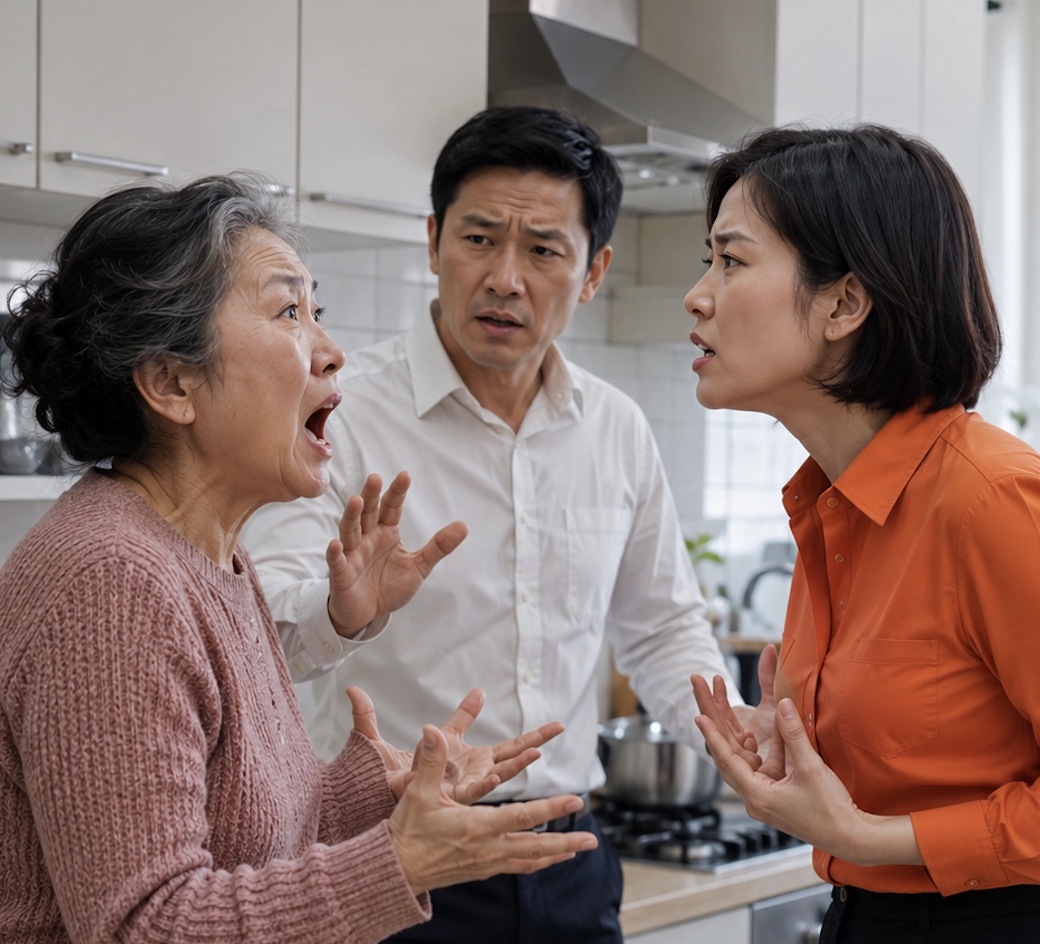
Kirill heard them before he even reached the apartment door.
Their voices seeped through the hallway — two voices, two pitches, one high, the other even higher. His mother’s voice was strained and trembling, with that wounded whine he had known since childhood and feared almost as much as he had once feared thunderstorms. Lyuba’s voice was sharp, dry, almost mechanical, which meant one thing: his wife had already crossed the line where words ended and something like ashes began.
Kirill stopped outside the door, key in hand, and listened for a few seconds. He could not make out the words, only the intonations. But the intonations were enough.
He went in.
The smell of valerian hit him the moment he entered the kitchen. His mother, Nina Vasilievna, was sitting at the table, clutching a paper napkin in her fist — a napkin already soaked through. Her eyes were red, her cheeks blotched. Lyuba stood by the window with her back to him, staring into the courtyard — or pretending to. Her shoulders were tense in that way people’s shoulders get when they are trying not to cry from anger.
“What’s going on?” Kirill asked.
No one answered. His mother sniffed. Lyuba did not turn around.
“What,” he repeated, setting his bag down on the floor, “is going on?”
Then his mother lifted her eyes to him, and there was so much mixed together in them that he involuntarily took a step back: hurt, fear, confusion — and, most inappropriate of all, some stubborn little spark that refused to go out.
“Your wife,” his mother began in the tone of someone reading out a sentence, “blocked my card. And I was going to use her bonus to buy myself a country house!”
Kirill opened his mouth. Closed it. Opened it again.
Outside the window, a car passed by. On the stove, the kettle began to whistle faintly, though no one seemed ready to turn it off.
“What?” he finally said.
They both started talking at once.
His mother jumped up from the chair — the paper napkin fell to the floor — and began explaining something about a neighbor, a dacha, an ATM that had swallowed the card and refused to give it back, what kind of outrage was this, no normal bank behaved like that, it was robbery in broad daylight, she had been standing there like a fool in front of the entire shop while people stared.
Lyuba turned away from the window and spoke over her — about a meeting, about her phone vibrating every thirty seconds, about a text message with a confirmation code for a huge amount of money, about how she had understood immediately that it must be scammers, some kind of fraud scheme, she had read about this a hundred times, she had done the only right thing anyone could possibly do in that situation, and if his mother thought—
“Quiet!” Kirill said.
They kept talking.
“QUIET!” he barked so loudly that the dishes rattled in the drying rack.
Both women fell silent. His mother clutched a fresh napkin to her chest, one she had managed to pull from the holder. Lyuba looked at him as if he had just slapped her — not painfully, but unexpectedly and offensively.
“I’m sorry,” he said more quietly. “Please. Just… one at a time. Lyuba, tell me what happened. Calmly.”
“I can’t do calmly,” Lyuba said.
It did not sound like a childish excuse. It sounded like an honest statement of fact. Her voice trembled on the final syllable, and Kirill realized she was holding herself together by the last thread — and had probably been doing so all day, since morning.
“All right,” he said. “Not calmly. Just tell me.”
Lyuba drew in a breath. Let it out. Sat down at the table — deliberately at the opposite end from her mother-in-law — and fixed her eyes on the tabletop.
“We had a meeting today,” she began. “A big one. Quarterly. With the director. You know I can’t just walk out of those — you can’t even take your phone out in there, Sergey Pavlovich loses his mind. So I’m sitting there, we’re discussing figures, I’m pretending to take notes, and suddenly my phone starts vibrating. Once. Twice. Three times. I glance down discreetly. A text. From the bank. A confirmation code for a transaction. Cash withdrawal. A huge amount, Kirill. I didn’t even understand the number at first. From the account.”
She ran her hand over her face.
“I’m sitting there thinking: I’m not withdrawing anything. I’m at the office. It isn’t me. So it must be scammers. I’ve read about schemes like that — they gain access, call pretending to be from the bank, ask for a code. No one had called me. I didn’t understand anything. I stood up in the middle of the meeting, Sergey Pavlovich looked at me like I was insane, and I said, ‘Excuse me, this is urgent, life-or-death,’ and went out into the hallway. I called the bank. Explained the situation. Asked them to block the card. They said, fine, done. I went back into the conference room. Ten minutes later she calls me…”
She nodded toward her mother-in-law. Nina Vasilievna tightened her lips.
“Your mother calls,” Lyuba continued, “and screams into the phone. Not talks — screams. Something about an ATM, that the card had been swallowed, that something had to be done, that this was outrageous. I don’t understand anything. I think she has also fallen into some scam. I tell her: Mom, stay there, don’t go anywhere, I’m coming. I ask Sergey Pavlovich to let me leave. He looks at me in a way that tells me there will be a conversation later. I take a taxi. I get there.”
She stopped. Then looked up at Kirill.
“She’s in tears. She can’t explain anything. She keeps talking about a dacha, some neighbor, how the house is good and there’s a vegetable garden. I understand nothing, Kirill. Nothing at all. I start asking questions — she gets offended and says I’m not listening. I tell her I am listening, just explain properly. Then she says I blocked her card. And I say, yes, because I thought it was scammers!”
“Because you didn’t warn me!” Nina Vasilievna could not hold back. “How was I supposed to know you can’t withdraw more than—”
“Mom,” Kirill interrupted. “Wait. Let me ask.”
He turned to his mother. Nina Vasilievna pressed her lips together even tighter, but fell silent — this time, it seemed, for good.
“Tell me,” Kirill said, sitting opposite her and covering her hand with his, “what happened today. From the very beginning. Slowly.”
Nina Vasilievna looked at him, and something trembled in her eyes again — either tears, or that same stubborn spark he had noticed earlier.
“I went to the pharmacy,” she began. “For my pills. You know I have to buy those blood pressure pills every month…”
“I know,” Kirill nodded.
“Well. I was on my way back. Near the shop, by the Pyaterochka on the corner, I met Zinaida Petrovna. You remember her — she lives through the wall from me. We’ve known each other for, oh, thirty years, probably. Even when your father was alive, she helped me. A good woman. We started talking, you know, about this and that — health, weather. And she tells me, Nina, my Alyoshka is in real trouble — that’s her son, you know him. He broke something at work, they gave him a big fine, he has to pay urgently or they’re threatening court. So she wants to help him.”
“Help him how?” Kirill asked carefully.
“By selling the dacha,” his mother said.
And her voice warmed so noticeably that Kirill understood at once: this was the part of the story where the whole mess had begun.
“She has a plot in the gardening settlement, in Zarechnoye. You know, I went there with her once, about seven years ago. The little house is small, but solid, not some falling-apart shack. Apple trees. Blackcurrants. There’s a bathhouse too — tiny, but still. The river is nearby, ten minutes on foot. She says she’s selling it urgently, the price is ridiculous, practically giving it away. And suddenly I wanted it so badly, Kirill.”
She looked at him — pleading and a little ashamed.
“I understand,” he said.
“No, you don’t,” she shook her head. “I’ve been thinking about something like that for a long time. I just… kept quiet. In summer I sit alone in the apartment. On the bench by the entrance. Everyone goes somewhere. My friends — some to their children, some to their dachas. And I have nowhere. Where am I supposed to go? Invite myself to you? That’s awkward. You’re young, you have your own life.”
“Mom…”
“Let me finish,” she asked.
He fell silent.
“Zinaida says: I’d gladly sell it to you, Nina, but Vera Semyonovna from our street also looked at the plot, said she wanted to buy it. Only she’s short on money right now, she’s trying to borrow somewhere. And if she borrows it, she’ll come and buy it. So I tell Zinaida: don’t wait for your Vera Semyonovna, I’ll take it. I can give you a deposit right now. Zinaida says: well, if it’s right now, then all right, I’ll tell Vera it’s too late, she missed her chance.”
Nina Vasilievna reached for the napkins again.
“The ATM was right there, next to Pyaterochka. And I remembered I had the card — the one Lyuba gave me. Remember, she said: Mom, take it, if you suddenly need expensive medicine or anything urgent, use it, don’t be shy. I hardly ever used it. Almost never. Only when I absolutely had to.”
“I remember,” Kirill said.
“Well. And Lyuba had said yesterday that she got a big bonus at work. So I thought: thank God, she has money on that account, and I’ll give the deposit, then I’ll pay it back, of course I’ll pay it back, my pension…”
“Mom,” Kirill said softly.
“I know,” she said even more quietly. “I know it wasn’t right. I know. But I thought — it’s urgent, I’ll explain afterward. I wanted to call you once I got home and say, Kirill, here’s what happened, I made an agreement, you and Lyuba can look at it and tell me if I did the right thing. I didn’t want to do it without you. Just the deposit — so Zinaida wouldn’t sell it to someone else.”
She paused.
“And the ATM took the card and wouldn’t give it back. Just stood there blinking. People were walking by, looking at me. Zinaida was standing next to me, didn’t know what to do. I took out my phone, called Lyuba, and she said, stay there, I’m coming. And then she came — and we argued.”
Kirill sat there looking at his mother. Then he slowly turned to Lyuba. She was staring at the table now — no longer from anger, but from that special state when anger slowly exhales and only exhaustion remains.
“It was an additional card,” he said at last. “Linked to your account.”
“Yes,” Lyuba said.
“With a limit.”
“Yes. A small one. She wouldn’t have been able to withdraw that much anyway — the limit wouldn’t allow it.”
Nina Vasilievna lifted her head.
“What do you mean, it wouldn’t allow it?”
“It means,” Kirill said gently, “that you can’t withdraw that amount with that card. We made it for small expenses. Medicine, taxis, anything urgent.”
His mother stared at him.
“So I wouldn’t have been able to do it at all?”
“No.”
“Even if the card hadn’t been blocked?”
“No.”
Nina Vasilievna slowly lowered her eyes to the crumpled napkin in her hands. Something in her face changed — the hurt disappeared, the stubbornness disappeared, and all that remained was something very simple and defenseless. Kirill recognized that expression. He had seen it on his mother’s face as a child, when she thought he was already asleep and no longer guarded herself.
“What an old fool I am,” she said to herself.
“Mom…”
“No, a fool,” she repeated, but without self-pity — more with a kind of sad irony. “Standing there at the ATM like… Zinaida probably still has no idea what happened. I should call her.”
“You will,” Kirill said. “Later.”
He looked at Lyuba. She was looking at her mother-in-law now, and the dry hardness that had been in her face when he had first found her by the window was gone. Lyuba always softened quickly when she did not meet anger in return. Kirill knew that about her for certain.
“Lyuba,” he said.
“What?” she replied quietly.
“You did the right thing. I would have called and blocked it too.”
She gave a slight nod. Then she looked at Nina Vasilievna for a long few seconds.
“Nina Vasilievna,” she said, “I didn’t know. If I had known it was you, I would have…”
“How could you have known?” his mother interrupted. “You weren’t supposed to know. I should have called first. Asked. But I… Zinaida described that plot so beautifully. The blackcurrants are big there, she said. And the river. You know, I immediately imagined it — sitting on the veranda in the morning with a cup of tea…”
Her voice trembled again, but differently this time.
Lyuba stood up. Walked to the table. Sat down beside her mother-in-law — not across from her, as before, but next to her, almost shoulder to shoulder.
“Tell me about this plot,” she said.
Nina Vasilievna looked up at her.
“Why?”
“I’m interested,” Lyuba answered simply.
His mother talked for a long time. About the bathhouse, which was small but built properly. About the apple trees — two varieties, one summer, one winter. About the river, shallow but clean, with a sandy bottom. About how she and Zinaida had gone there once in early June, and everything had been blooming, and it was warm, and the neighbor from the next plot had treated them to raspberries straight from the bush, handful after handful.
Kirill listened and watched Lyuba slowly relax — how her tense shoulders dropped, how she began to nod, how at one point she asked, “And how long is the train ride to Zarechnoye?”
“About two hours,” his mother said. “But trains run often.”
“Two hours,” Lyuba repeated thoughtfully.
And she looked at Kirill.
He looked back at her.
Between them passed that brief, wordless conversation that only people who have lived together long enough can have — when a glance, a slightly raised eyebrow, and the smallest tilt of the head are enough.
“Mom,” Kirill said, “has Zinaida Petrovna already sold it to someone else?”
Nina Vasilievna stopped mid-sentence.
“I don’t know. Probably not. It all happened today…”
“Call her.”
His mother stared at him.
“Call her,” he repeated. “Ask if she has sold it. Tell her there is a serious buyer.”
“Kirill…” she began, and her voice made him feel for a second like a little boy again, the one whose mother used to read to him before bed.
“Call her, Mom.”
She slowly took out her phone. Her hands would not obey her, and it took her a long time to find the number in her contacts. Without saying a word, Lyuba gently took the phone from her, found Zinaida Petrovna, and handed it back.
His mother looked at her daughter-in-law.
“Thank you,” she said.
And in that “thank you,” there seemed to be more than in any other word she had spoken that day.
Zinaida Petrovna had not sold it.
Vera Semyonovna still had not sorted out the money, and the dacha was still waiting for its buyer.
A week later, Kirill, Lyuba, and his mother were riding the train while suburban settlements, vegetable gardens, apple orchards, and muddy country roads after yesterday’s rain drifted past the window. His mother sat by the window and looked at all of it with such an expression that Kirill tried not to look at her too much — there was something too private in her gaze.
The plot turned out to be exactly as Nina Vasilievna had described it: small, a little neglected, but alive. There were apple trees — two varieties, just as she had said. The blackcurrants were large; Zinaida had not lied. The bathhouse leaned slightly to one side, but Kirill touched the logs and said it was nothing serious, it could be fixed.
Lyuba stood by the fence and looked toward the river, barely visible behind the trees.
“Do you like it?” Kirill asked, coming up beside her.
“I don’t know yet,” she said honestly.
They stood in silence. The last dry leaf from the previous year loosened from an apple tree and fell into the grass.
“You’ll add whatever we’re short?” Lyuba asked.
“I already calculated it.”
“Good.”
She leaned against his shoulder — just a little, almost imperceptibly. He did not move.
Nina Vasilievna stood by the apple tree, holding one of its branches, and smiled carefully, as if afraid to frighten the moment away.
Kirill thought that summer here would probably be good.