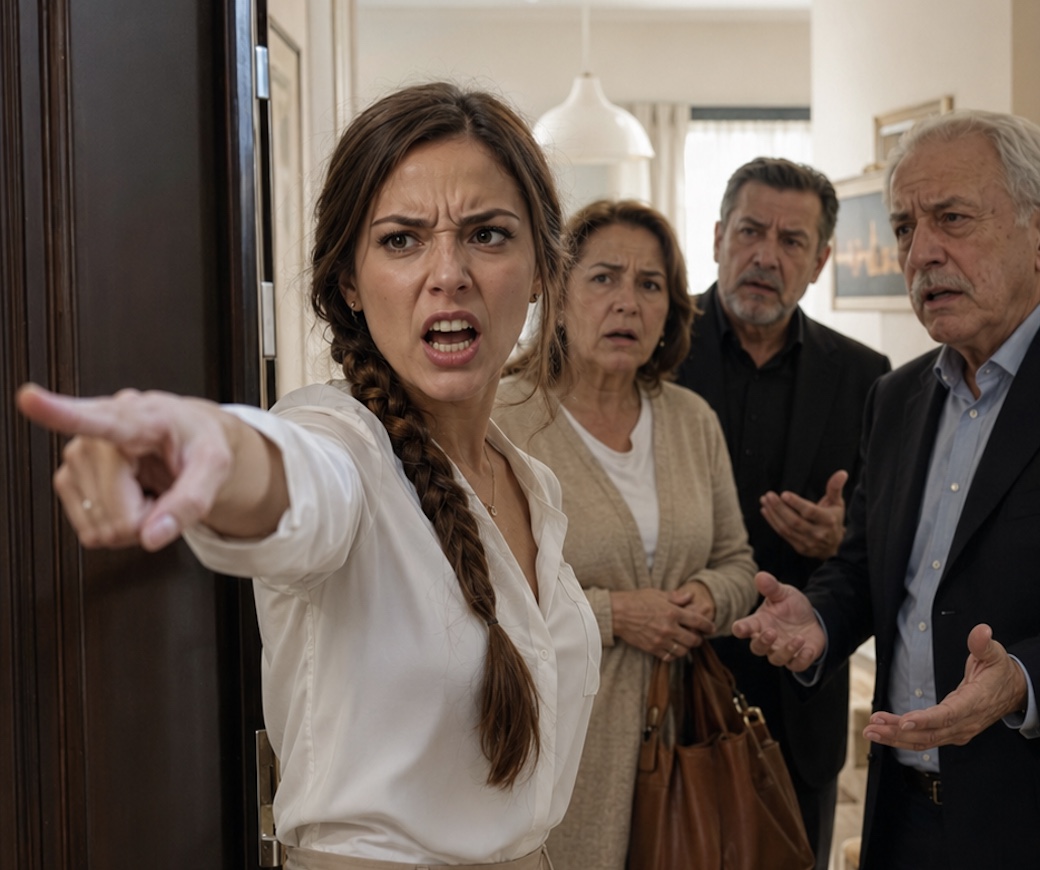
Neighbors later said that, that evening, voices could be heard coming from the apartment on the third floor. At first, it was the usual hum of a family gathering. Then one voice rose above the rest — a woman’s voice, so sharp and clear it seemed to make the windows tremble.
“Get out! I said get out! And I don’t care what any of you think of me!”
After that came silence.
Not the comfortable silence that follows a celebration, when the guests have left and the hostess is quietly clearing plates from the table. No. This was a different kind of silence — the kind that settles after a storm, when the air still feels charged and no one can tell whether everything is over or only just beginning.
It was Elena Rostova’s first evening in her new apartment.
Her first real home.
And the last time anyone dared to tell her how she was supposed to live.
Three years is a long time. Especially when, for three years, you live in someone else’s home — where every object is placed not where it suits you, where the refrigerator opens the wrong way, where even your habit of drinking tea in the evening feels almost like an act of rebellion.
Three years in a mother-in-law’s apartment is a sentence not everyone can serve with dignity.
Elena had endured it.
Though it had cost her far more than anyone knew.
Lyudmila Pavlovna, Sasha’s mother, was not an evil woman. Elena admitted that honestly, even on the hardest days. She was not cruel by nature. But she was the kind of person who believed that every favor deserved gratitude — not once, not twice, but every single day.
It usually began innocently enough, over breakfast, while Sasha was still asleep.
“Lena, did you buy milk?” Lyudmila Pavlovna would drift into the kitchen in her floral housecoat, wearing the expression of a woman kept awake by concern for others. “Sasha likes milk. I’ve always made sure there was some in the fridge.”
“I bought it, Lyudmila Pavlovna.”
“Well, good.” A pause. Just a little longer than necessary. “At least sometimes you think ahead. You live here, live here… grown adults, and still on Mother’s shoulders.”
That phrase — “on Mother’s shoulders” — was everywhere.
It appeared in every conversation, spoken aloud or left hanging unsaid but clearly implied. It was in the way Lyudmila Pavlovna looked at Sasha’s shoes in the hallway, as if they were standing there illegally. It was in the heavy sighs she let out whenever the young couple stayed too long in the kitchen at night. It was in the way she invited her friends over for tea and told them — just loudly enough for Elena to hear from the bedroom — that “young people these days are in no hurry to grow up.”
Sasha did not notice.
Or pretended not to.
Elena never figured out which was worse.
“Mom just talks like that,” he would brush it off when Elena carefully brought it up at night, lying beside him in the dark. “She doesn’t mean anything by it. You’re taking it the wrong way.”
Elena would fall silent.
Because explaining how one should “correctly” understand words that made something tighten inside her every morning was also work. Quiet work. Exhausting work. Invisible work.
So she endured.
She saved money. Calculated in her head how long it would take to gather enough for a down payment. Scrolled through apartment listings late at night while Sasha slept, saving places to her bookmarks.
Her own apartment.
Those two words were like a prayer.
They gave her the strength to keep going.
Her grandmother died in February, when the ground was still frozen and flowers for the cemetery had to be wrapped in paper.
Grandmother Valya — her mother’s mother — was someone Elena remembered from childhood as small and warm, with dry hands and the scent of cinnamon clinging to her clothes. She lived in Elena’s hometown, two hours away, and every summer she baked cherry pies that had once seemed to Elena like the greatest miracle in the world.
Elena had not expected an inheritance.
Not because she was unusually selfless, but because the thought simply had not occurred to her. Her grandmother was alive, and that had always been enough.
So when her mother called, crying, and said that Valentina Ivanovna had left her apartment and dacha to her granddaughter, Elena was sitting in her mother-in-law’s kitchen and, for a long time, could not say a word.
The apartment was old and needed repairs. The dacha was small, the land overgrown and neglected. It was hardly a fortune. But when Elena added everything up, she realized that if she sold both properties, there would be enough for a down payment — and even some left over.
Not just a down payment. A substantial part of the price of a new apartment.
Elena locked herself in the bathroom and cried for half an hour.
For her grandmother.
For the fact that, somehow, even after death, she had managed to reach out a hand at exactly the moment Elena needed it most.
Then Elena washed her face with cold water and began to think.
She thought for weeks.
Sasha was pleased. He was happy. He kept saying, “See? Everything is working out,” and started making plans.
Elena listened and nodded.
But her thoughts were elsewhere.
She loved Sasha. That was true. He was kind, gentle, and able to make her laugh even on the grayest days. He never raised his voice.
But he was his mother’s son.
And he had relatives — aunts, cousins, Uncle Grisha and his wife — people who, at every family gathering, spoke far too much and far too confidently about things that did not concern them.
Elena remembered one evening from long before the wedding, when Aunt Nina had said at Lyudmila Pavlovna’s table, as if casually, that “in a proper family, everything is shared. No secrets. Everything belongs to everyone.”
Everyone had nodded.
Sasha had nodded too.
A little guiltily, perhaps.
But he had nodded.
Back then, Elena had said nothing. She had taken a napkin, dabbed her lips, and changed the subject.
But she had remembered.
So when the time came to register the apartment, Elena called her mother.
“Mom, I want to put it in your name.”
There was a pause on the other end of the line.
“And Sasha?”
“I trust Sasha. But Sasha is not his relatives.”
Her mother was quiet for a moment.
Then she said, “All right. As you decide.”
That was it.
Simple as that.
The apartment was registered in the name of Elena’s mother, Irina Sergeyevna Gorshkova — a retired woman living in another city, quiet and dependable as stone.
They decided to have a modest housewarming. Only the closest relatives.
Sasha called his mother. She called Aunt Nina. Aunt Nina called Uncle Grisha and his wife.
By the time “only the closest people” were counted, there were enough guests to fill the entire table.
Elena prepared everything herself. She did not want anyone’s help. She sliced, arranged, set out glasses, and thought how wonderful it was to do all of this in her own kitchen — where every item was exactly where she wanted it, where the refrigerator opened the way she was used to, where the smell of the room belonged to her.
The guests arrived loudly, carrying flowers and advice.
Lyudmila Pavlovna came first — dressed up, holding a pie, wearing the expression of someone who considered herself partly responsible for the occasion. She kissed her son, patted Elena on the shoulder, and looked around.
“It’s a good apartment,” she said, as if granting approval. “A good one. Though I would have arranged the kitchen differently. But that’s a small thing.”
“I like it the way it is,” Elena replied evenly.
The evening moved along as such evenings do. Toasts were made, people laughed, Uncle Grisha told a story about his neighbors, Aunt Nina admired the parquet floor. Elena sat, smiled, and for a while everything was almost fine.
Almost.
Because somewhere around the third toast, Lyudmila Pavlovna, softened by wine, suddenly said loudly enough for the whole table to hear:
“It’s just a pity the apartment isn’t registered in Sashenka’s name. You’ll have to transfer it later. You never know what might happen. Property should stay in the family.”
The table went quiet for a second.
Then Aunt Nina immediately joined in.
“Well, yes. Lyuda is right. It is strange, really — the apartment being in the wife’s mother’s name. How does that even make sense?”
“Lena, what’s this about?” Uncle Grisha looked at her with a smile that was meant to seem good-natured. “You don’t trust your husband? That’s not how things are done. Hiding property behind parents. You’re family.”
Elena felt something inside her — something that had endured and stayed silent for three long years — begin to rise.
Slowly.
Inevitably.
Like water pressing against a dam.
“That is not how normal families behave,” Aunt Nina continued, now clearly inspired. “I understand Sasha is a soft man, and perhaps you think this is safer. But it’s insulting to your husband. Do you understand that? It’s as if you don’t trust him. What will people think?”
“Aunt Nina, don’t interfere,” Sasha said weakly.
“Oh, what did I say? I’m talking about family. Family means trust.”
“Lena, don’t take offense,” Lyudmila Pavlovna said, now speaking with the air of a person about to deliver something wise and final. “Just think about it. What if something happens to your mother? Then it won’t be clear whose apartment this is at all. Everything should be arranged properly before it’s too late. Of course, I understand that you tried, that the money came from your grandmother… but still. The apartment should belong to the family.”
And with one careless sweep of her hand, she gestured around the room.
As if the space had already been discussed.
As if it had already been divided.
Elena stared at that hand.
At that gesture.
At the people around the table, nodding — some confidently, others awkwardly, but nodding all the same.
At Sasha, who was looking down at his plate.
Then she stood up.
Slowly.
Very calmly.
“I need to say something,” she said.
The table fell silent.
“This apartment was bought with my grandmother’s money. My grandmother, who saved all her life, who left this to me when she died. Not to us. To me. I sold her apartment and her dacha. I traveled to my hometown, sorted through her belongings, cried over every plate because those plates remembered how she used to feed me cherry pies. That was her life. Her final wish. And what I chose to do with that inheritance is my business.”
Lyudmila Pavlovna opened her mouth.
“I’m not finished,” Elena said, her voice perfectly steady. “I put the apartment in my mother’s name because I decided to. Because I had the right to. Not you — me. I am not required to explain my reasons to you. I am not required to report to people who spent three years reminding us that we were living in someone else’s apartment — as if we didn’t pay, didn’t help, didn’t swallow your constant comments about grown adults sitting on Mother’s shoulders.”
Aunt Nina gasped.
“Lena, who do you think you are—”
“And one more thing.” Elena looked around the table. “This is my home. The first home that belongs to me. The first time in three years that I am standing inside my own apartment. And I will not allow — do you hear me? — I will not allow you to start dividing something you have absolutely nothing to do with on the very first evening I spend here.”
“How dare you?” Lyudmila Pavlovna snapped. “You’re still young enough to have milk on your lips, and already you talk like that? Whether we have a say in this or not is not for you to decide. Is that clear?”
“Lyuda, calm down,” Uncle Grisha tried, forcing a smile. Then he turned to Elena. “We mean well. We’re speaking for the family. Why are you taking it this way? What will people think?”
“Why should I calm down?” Lyudmila Pavlovna clearly had no intention of stopping.
And then something happened that no one at the table had expected.
“Get out!” Elena’s voice rose — clear, sharp, not hysterical, but so powerful that the glasses on the table seemed to tremble. “I said get out! And I don’t care what any of you think of me!”
One second of silence.
Then another.
Lyudmila Pavlovna stared at her with an expression Elena had never seen on her face before.
Something in it had cracked.
“Sasha,” Aunt Nina said, grabbing her handbag. “Sasha, say something to her.”
Sasha said nothing.
He sat there, looking at his wife.
As if he were truly seeing her for the first time that evening.
The guests left in silence.
Lyudmila Pavlovna was the last to stop at the door, her coat in her hands.
“Lena,” she began.
“Goodbye, Lyudmila Pavlovna.”
The door closed.
Elena and Sasha remained silent for a long time.
Elena cleared the table methodically, simply doing what had to be done. Sasha sat on the sofa, staring at the floor.
Then he stood and came closer.
“Lena.”
“Not now.”
“Lena, I…”
She stopped. Looked at him — at the face she loved, at the eyes that now held the expression of a person who had finally seen something important and did not know what to do with it.
“You saw it, didn’t you?” she said quietly. “You saw the way your mother waved her hand around. As if everything had already been decided.”
“I saw it.”
“And you said nothing.”
A long pause.
“I know,” he said.
Elena nodded, turned away, and continued clearing the table.
“Lena. Forgive me.”
“That doesn’t mean everything is suddenly fine,” she said at last.
“I know.”
“And it doesn’t mean I was wrong.”
“You were right.”
“I was silent for three years, Sasha. For three years I listened to comments about us being on your mother’s shoulders, and I pretended not to hear them. I smiled. I endured. Because I thought: once we save enough, once we move out, once we have our own place — everything will change. And now we have it. Our own place. And the very first thing that happens here…”
“It won’t happen again.”
She looked at him.
“Are you sure?”
“I’ll talk to Mom. Really talk to her. Not like before.”
“Sasha, I don’t need your mother to love me. I need her to respect me. Those are two different things.”
He said nothing.
Then he nodded slowly — as if he were agreeing not only with her, but with something inside himself.
Lyudmila Pavlovna called a week later.
Elena answered the phone calmly and without fear.
“Lena.” Her mother-in-law’s voice sounded unfamiliar. Elena did not hear the old certainty in it. “I… wanted to say that I lost my temper that day. We all did.”
Elena said nothing. She simply listened.
“You were right to… to stand up for yourself.” Each word seemed difficult for Lyudmila Pavlovna. “I suppose I didn’t always understand how hard it is to live in someone else’s home. I didn’t think about it.”
“I know you didn’t.”
“Lena. You are a good wife to Sasha. And a good homemaker. This is your home, and you were right…”
“Lyudmila Pavlovna,” Elena interrupted softly. “Let’s start over. Simply. You come to visit — when I invite you. We drink tea. We talk. About something neutral.”
A pause.
“Agreed,” her mother-in-law said.
Spring came.
One Sunday morning, Elena stood by the window of her apartment with a cup of coffee. Sasha was still asleep. Pigeons wandered in the courtyard below, and someone’s dog was dragging its owner toward a puddle.
She stood there, drinking her coffee.
And no one told her she was doing anything wrong.
She thought of Grandmother Valya. Of the fact that her grandmother would never know what kind of gift she had given her granddaughter — not just an apartment, but something far greater.
A turning point.
A line after which another life begins.
Elena was not someone who loved scandals. She was not proud of raising her voice.
She simply knew that, in that moment, there had been no other way.
Quiet words would not have been heard in that room.
She took another sip of coffee and smiled.