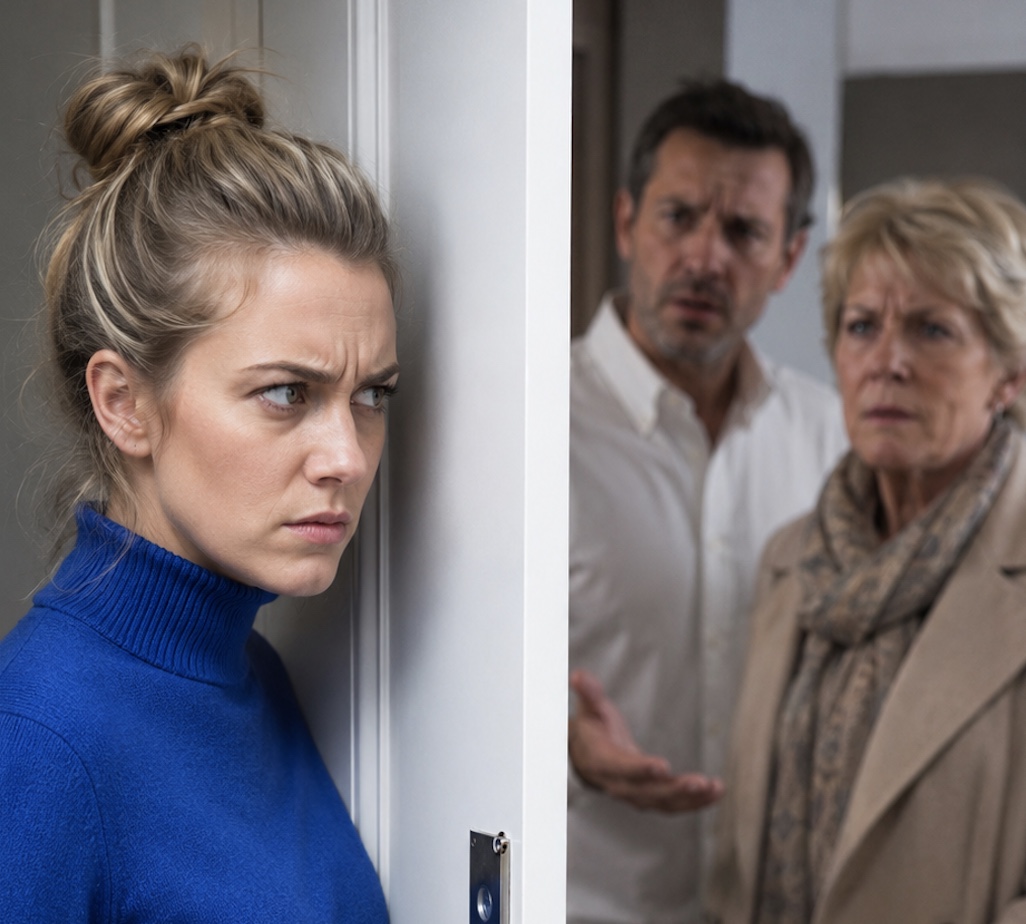
There are things that cannot be undone. Words once spoken. Broken dishes. The death of friends or loved ones. I used to think marriage belonged in the same category. But that morning, standing by the door with a new lock in my hand, I realized that sometimes you simply have to change the locks.
I will start at the end, because the end explains everything that came before it.
Lev called me at half past seven in the evening. I was sitting in the kitchen with a mug of cold tea, staring out the window at the streetlights that had only just begun to flicker on — uncertainly, as if they too were unsure whether it was worth the effort. My phone vibrated. I looked at the screen, saw his name, and didn’t answer. He called again. Then again. Then he sent one word:
“Olya.”
Just my name. No question mark. No explanation. And in that single word there was so much — confusion, anger, something almost like panic — that I felt something inside me begin to thaw. Just a little. A millimeter.
But I still did not open the door.
Our apartment had been our victory. Not a loud one, not the kind with fireworks and champagne, but real all the same. Lev and I had taken out the mortgage when we still barely understood what we were getting ourselves into. We signed the bank documents, and my hands trembled — not from fear, but from a sharp, almost painful happiness.
It was ours.
These walls. That uneven ceiling in the hallway. The kitchen window looking out onto other people’s balconies with laundry drying in the open air. All of it was ours.
We had put up the wallpaper ourselves, and I had been furious with Lev because he kept hanging it crookedly. We redid the same corner in the bedroom four times, maybe more. Then we laughed about it. Later, that corner became our private joke.
“Crooked like our wallpaper,” we would say whenever something didn’t go exactly as planned, but somehow still turned out all right.
The apartment had two rooms. A bedroom and what we simply called “the second room,” because we could never decide what it was supposed to be. At first, it held a sofa and boxes we kept promising to unpack. Then Lev dragged in his old armchair and a shelf full of books, and the room turned into his little den. After that, we argued about the armchair because it was terrible — sagging, stained in suspicious places, and far past its prime. I wanted to throw it away. Lev defended it with such passion that you would have thought the chair was a living creature.
In the end, the armchair stayed.
We did not have children yet. We were not in a hurry. Life was already full enough — work, the mortgage, plans that kept changing. Sometimes we talked about children calmly, without anxiety, and each time we pushed the decision into the future.
Later.
Such a convenient word. So vague, so comfortable. A word people use to cover every hole in the plans they make for their lives.
And that very “later” became the first argument in the war that ruined several weeks of our marriage.
Nelly, Lev’s sister, had found herself a fiancé. That alone was an event, because Nelly had always been a difficult person, to put it mildly. Sharp, like the corner of a table you keep bumping into. She and I had never been close, but we had never openly fought either. We maintained a polite distance, and both of us seemed to consider that the best arrangement.
Her fiancé’s name was Artyom. I had seen him only a couple of times and had formed no particular opinion of him — neither good nor bad. He was an ordinary man, slightly nervous, with a habit of tugging at the cuff of his shirt whenever he felt uneasy. Judging by how often he did it, he felt uneasy almost all the time.
Nelly lived with her mother, Galina Nikolaevna, in a two-room apartment. It was small, but perfectly decent, and somehow they managed there. Artyom rented a place somewhere on the other side of town.
Then Nelly decided that she and Artyom should live together. Logical. Normal. Understandable.
But after that, logic disappeared, and what I call family alchemy began: the strange ability to turn other people’s problems into your own, and your own into everyone else’s, without noticing the difference.
Nelly wanted her mother to vacate the apartment for her. Not forever — just until she and Artyom adjusted to each other, got used to living together, figured out what came next. Why rent somewhere, she argued, when there was already an apartment available?
Her mother could live somewhere else for a while.
Somewhere else.
That “somewhere else” had a very specific address.
Galina Nikolaevna began from a distance. I only understood that later, when I put all the pieces together. At first, there were ordinary phone calls to Lev — motherly calls about his health and work. Then little phrases started appearing.
“You two must have so much space in that apartment.”
“The second room is empty anyway, isn’t it?”
Then, finally, almost directly:
“I would never impose, you know that, but circumstances…”
Of course, Lev did not tell me any of this properly. Or he mentioned it in passing, without details, as if it were harmless small talk and not preparation for an attack.
The first serious conversation happened on a Sunday evening. We were having dinner when Lev suddenly said, without looking at me, trying to sound casual:
“Mom asked if we would mind if she stayed with us for a while.”
I put down my fork.
“For how long?”
“Well… until Nelly and Artyom figure things out. Maybe six months. Maybe less.”
“No,” I said.
Briefly. Simply. Without explanation, because it seemed to me that no explanation was necessary.
Lev looked up at me, and I saw something in his eyes that made me tense inside. Not anger. Worse. Prepared arguments.
“Olya, she’s my mother. And it wouldn’t be for long.”
“No,” I repeated.
The next few days felt like walking through a minefield. We talked about food, about the weather, about who needed to take out the trash — and did not talk about the main thing. But the main thing hung in the air, so thick and sharp it felt as if you could cut yourself on it.
Lev returned to the subject every day. In different ways. Softly at first, then offended, then with logical arguments he seemed to have rehearsed in advance.
“The room is empty anyway.”
“She’s my mother, not some stranger.”
“Nelly won’t manage on her own. You know what Nelly is like.”
“It won’t be for long, I promise.”
“You’re being selfish.”
He said that last sentence on Thursday evening, and I felt something begin to burn inside me — a quiet, steady, angry flame. Not the kind that flares up and dies quickly. The kind that keeps burning.
“Selfish?” I asked very calmly. “I’m the one being selfish?”
“Olya, it’s just…”
“Lev.” I turned toward him. “Nelly and Artyom are adults. They decided to live together. That is their decision and their responsibility. They should solve their housing problem themselves. Not at your mother’s expense. Not at our expense. I don’t understand why you and I are supposed to pay the price because Artyom rents an apartment on the other side of the city.”
“You don’t understand how family works.”
“I do understand how it works. I simply don’t agree with it.”
He fell silent. And that silence was angry, clenched like a fist.
We did not speak until the next morning.
A whole week passed like that. Conversations turning into arguments. Arguments sinking into silence. Silence breaking into conversations again. I felt tired — not physically, but somewhere much deeper, in the place where patience slowly runs out.
I did not like Galina Nikolaevna. I had never said that directly to Lev because it felt unfair. She had not done anything truly terrible to me. She was simply a person I knew would be very difficult to live beside. She had a way of filling a space — not physically, but in another sense. Her presence could be felt everywhere: in advice nobody had asked for, in sighs that meant more than words, in the way she looked around our apartment with a proprietary squint, as if she were already rearranging the furniture in her mind.
I imagined her living with us. Waking up earlier than everyone and clattering dishes in the kitchen. Commenting on the way I cooked. Calling Lev three times a day while he was at work, each time with something urgent, something important, something that could not possibly wait. I imagined how slowly, almost invisibly, our apartment would stop being ours.
Six months, Lev said.
Six months is a long time. Long enough to change everything.
On Friday, he came home later than usual. I was finishing dinner — cooking only for myself, because I had not known when he would return and did not want to call and ask. He took off his shoes in the hallway, came into the kitchen, and I immediately felt it.
Something had happened.
Something definite.
“Olya,” he said, sitting down at the table. “Mom is moving in tomorrow.”
I slowly turned around.
“What?”
“Mom is moving in with us tomorrow. I’ve already arranged it. Nelly and Artyom will move into her place on Saturday. Mom will take only the essentials and…”
“You already arranged it.”
He looked at me with a strange expression. Not guilty. No. More like a man who had made a decision and was waiting for everyone else to accept it.
“You understand there was no other way. Nelly already told Artyom the apartment…”
“Lev.”
“Olya, listen…”
“Leave the kitchen,” I said very quietly.
He left.
I stood by the stove, staring at the flame under the pot. My hands were not shaking. Inside, everything was strangely silent — that special silence that comes immediately after a blow, before the pain arrives.
He had already arranged it.
Without me.
He had simply presented it as a fact.
He had decided that I would argue for a week, make some noise, then eventually give in — because where else would I go, because she was his mother, because that was how family worked.
I turned off the stove.
And I began to think.
The next morning, Lev left for work early. We barely spoke. He asked something about coffee; I answered with a single word. Then he left. The door closed. I sat in the kitchen for about ten minutes, looking out at the morning courtyard.
Then I got up, got dressed, and went to the hardware store.
I chose the locks slowly. I stood in that aisle, looking at all the metal parts and mechanisms with a calm that was almost meditative. A salesman came over and asked something. I said I needed a good lock, a reliable one, something that could not be opened from the outside. He looked at me a little strangely, but helped me choose.
The locksmith arrived two hours later. He was a young man with a bag of tools, businesslike and not very talkative. He changed both locks on the front door in forty minutes.
“The keys,” he said, handing me the new set.
I took them. They were heavy and pleasantly cold in my hand.
After he left, I locked the door from the inside and leaned my back against it.
The apartment was quiet.
Our apartment.
The one we had bought with a mortgage together. The one where we had hung wallpaper badly. The one where that horrible sagging armchair still stood.
Ours.
They arrived at half past six in the evening.
I heard them through the door. First the elevator, then voices in the corridor, then the sound of a key entering the lock.
Once.
Again.
Then silence.
Then Lev’s confused voice:
“What the…”
“Levochka, what happened?” Galina Nikolaevna asked.
I stood on the other side of the door and said nothing.
“Olya!” Lev knocked, then rang the bell. “Olya, open the door.”
I did not answer.
“Olya, I know you’re home. Open the door, please.”
“I can hear you,” I finally said.
“Then open it!”
“No.”
A pause.
A long one.
“Olya, Mom is standing in the corridor with a suitcase.”
“I know,” I said. “Lev, I want you to understand something. You made a decision without me. You presented it to me as a fact. You decided that our home was a place where you could invite anyone without asking me. So here is my decision. Mine. Without you.”
“Are you out of your mind?”
“No,” I said evenly, almost calmly. “I am speaking perfectly normally. If you want, go to Nelly and Artyom with your mother. All four of you can live in that two-room apartment since that is apparently the solution. But you will come in here only after you and I have a real conversation. And after you decide where your priorities are.”
“Olya…”
“Priorities, Lev,” I repeated. “Are you a husband or a son? Because you cannot play both roles by ignoring me.”
There was a long silence behind the door. Then I heard Galina Nikolaevna’s quiet voice — not the words, only the tone. Then footsteps. Then the sound of the elevator leaving.
I slid down the door to the floor and sat there with my arms around my knees, staring into our hallway.
The crooked wallpaper in the corner.
Lev’s boots by the threshold.
Our worn doormat with the frayed edge.
I was scared. I felt ashamed too — a little. Ashamed that Galina Nikolaevna had been standing in the corridor with a suitcase. Ashamed that Lev was probably furious enough to tremble. Ashamed that I had not found another way.
But there was something else as well.
Something quiet and steady.
Something that felt like being right.
He did not call for several hours. I stayed home, tried to read and could not, stared out the window, walked from one room to another. Without Lev, our home felt strangely empty, wrong, like a word missing one letter.
At half past seven, that message arrived.
“Olya.”
I looked at the screen.
Then I typed:
“I’m here.”
He wrote:
“Can I come?”
I replied:
“Yes.”
Twenty minutes later, he rang the doorbell. I did not open immediately. I stood there for a second with my hand on the lock.
Then I turned the key.
Lev stood in the doorway without his jacket — he must have left it in the car. He looked like someone who had spent the whole day carrying something unbearably heavy. Not physically heavy. Something else.
“I talked to them,” he said.
I stepped aside and let him in. He entered the hallway and took off his shoes. We went into the kitchen — the place where all the important things in our life had always been decided.
I put the kettle on. He sat at the table and said nothing for a while.
“Artyom’s parents,” he finally said, “had offered the young couple their country house a long time ago. It’s fine there. Big house, not some ruin. Nelly just didn’t want to live outside the city. She thought it was… I don’t know. Not romantic, maybe. Not convenient.”
“And now she wants to?” I asked.
“Now she has been told there aren’t many other options.” He looked up at me. “I was angry with you. All day.”
“I know.”
“You could have just talked to me.”
“Lev.” I poured boiling water into the mugs. “I did talk to you. For a week. Every day. You didn’t hear me. You had already decided everything.”
He stayed silent.
“You said, ‘Mom is moving in with us tomorrow,’” I reminded him. “You said it as if I was simply supposed to nod. As if my opinion was a formality you could skip.”
“I didn’t think of it that way.”
“Maybe not. But that is how you acted.”
The kettle whistled. I turned off the stove. Outside the window, the evening had grown completely dark, and the streetlights burned steadily now.
“Mom is offended,” Lev said. “At you. Very.”
“I understand,” I answered. “And I’m sorry she ended up in that situation. Truly. But Lev, I did not put her in that situation. Nelly did. And you did.”
He said nothing. He took his mug and held it in both hands, as if warming himself.
“You were right,” he said at last.
Quietly, as if the words cost him something.
I looked at him.
“You were right, and I acted like a complete idiot. I always do this with Mom and Nelly. I think I can arrange everything, make peace between everyone, solve every problem. And every time, I forget that I also have you. And that you are not just someone who lives beside me, but…” He stopped. “You know.”
“Say it,” I asked.
“You are what matters most,” he said. “You and this home. Everything else comes after.”
I looked at him across the table. At his tired face. At his hands around the mug. At the sagging armchair in the next room, visible through the open doorway.
“The key,” I said, and handed him a new key to our door.
He took it. Held it in his palm the same way I had held it that morning. Then he looked at me.
“Thank you,” he said.
And we sat there, in our kitchen, in our apartment with the crooked wallpaper and the terrible armchair I would never throw away now, drinking tea while the streetlights outside burned with a steady glow.
Sometimes love means changing the locks to prove that there is a door, and there are people who belong inside.
And that matters.