“Vika, listen… do you really think that shade of indigo will work in our north-facing living room?” Artyom asked quietly, his voice carrying the soft, enveloping warmth of a man who had finally allowed himself to relax. He turned a small ceramic sample in his hands, the one they had brought back from their trip, as if it were a precious stone.
“Of course, darling. It will remind us of that sunset, when the sky looked as if it had spilled straight into the water,” Vika said with a smile, adjusting the blanket on her lap as the taxi glided along the night highway. “We’ve lived in gray tones for too long. It’s time to add some depth.”
“Then indigo it is,” he agreed, covering her hand with his palm. “The important thing is that we’ve come back with new energy. Tomorrow, those drawings won’t draft themselves, and clients don’t like waiting.”
The taxi passed through the barrier of their residential complex, and the couple, tired but filled with quiet happiness, headed toward the parking elevators. They needed to pick up their car, which had been left there during their two-week absence, and take it to the car wash before the next workday. Artyom walked confidently toward the familiar spot in the corner of the parking garage, where he had parked his SUV for years.
But parking spot number forty-two was empty.
Only an oil stain on the concrete hinted that a vehicle had once stood there. Artyom stopped and blinked, as if hoping his eyes were deceiving him because of jet lag.
“Maybe you moved it before we left?” Vika asked carefully, still hoping there was some simple explanation.
“No. I remember perfectly well locking the door and setting the alarm,” Artyom said, frowning as he pulled out his phone to call security.
But the shift supervisor was already hurrying toward them. He was an older man with a badge that read “Valery.” He looked guilty, yet strangely calm.
“Artyom Sergeevich, you’re back already?” he began, not even giving Artyom the chance to ask anything. “Your mother, Galina Nikolaevna, took the car three days ago.”
“Took it?” Artyom felt a cold, prickling anxiety begin to rise inside him. “She doesn’t have the keys. And the alarm tag is with me.”
“She came with a mechanic. Showed the documents—the vehicle title, the registration certificate—everything was in her name,” the guard said, spreading his hands helplessly, as if bowing before the law itself. “She said she had lost the keys. The mechanic opened it and reprogrammed everything. I couldn’t stop the legal owner. You know the rules.”
Artyom froze.
He remembered.
That loan from the beginning of his career, when banks had refused to trust a young entrepreneur with unconventional ideas. His mother had agreed to register the car in her name back then. He had paid off the loan in two years, but somehow never got around to transferring ownership—one difficult project after another, one urgent order after another.
“She sold it, Artyom Sergeevich,” the guard added quietly. “Right here. The buyer was waiting in the garage. They left together.”
Galina Nikolaevna’s apartment door was unlocked, as if she had been expecting them. The entryway smelled of something sweet and stale, a scent that Artyom had always associated with childhood. Now it only made him feel sick.
His mother was sitting in an armchair, her head thrown back with queenly importance, watching television. She did not even turn when they entered.
“Where is the money?” Artyom asked without wasting time on greetings. His patience had snapped like an over-tightened string.
“Hello to you too, son,” she replied, slowly turning her head and sliding a contemptuous glance over Vika. “And the money is where it is needed more. Oleg got into a paid university program. He needs somewhere to live, clothes to wear, tuition to pay. He shouldn’t have to count every penny.”
“You sold my car to pay for the education of a grown man who has never lifted a finger for anything?” Artyom’s voice trembled, not from weakness, but from the realization of the abyss opening between them.
“It was my car,” Galina Nikolaevna said sharply, rising from her chair. “On paper, it belonged to me. I had every right to do whatever I wanted with my property. You pushed me to this, Artyom.”
“I pushed you?” He gave a bitter laugh. “By supporting you completely for the last five years? By paying your utilities, buying your groceries, covering your medicine?”
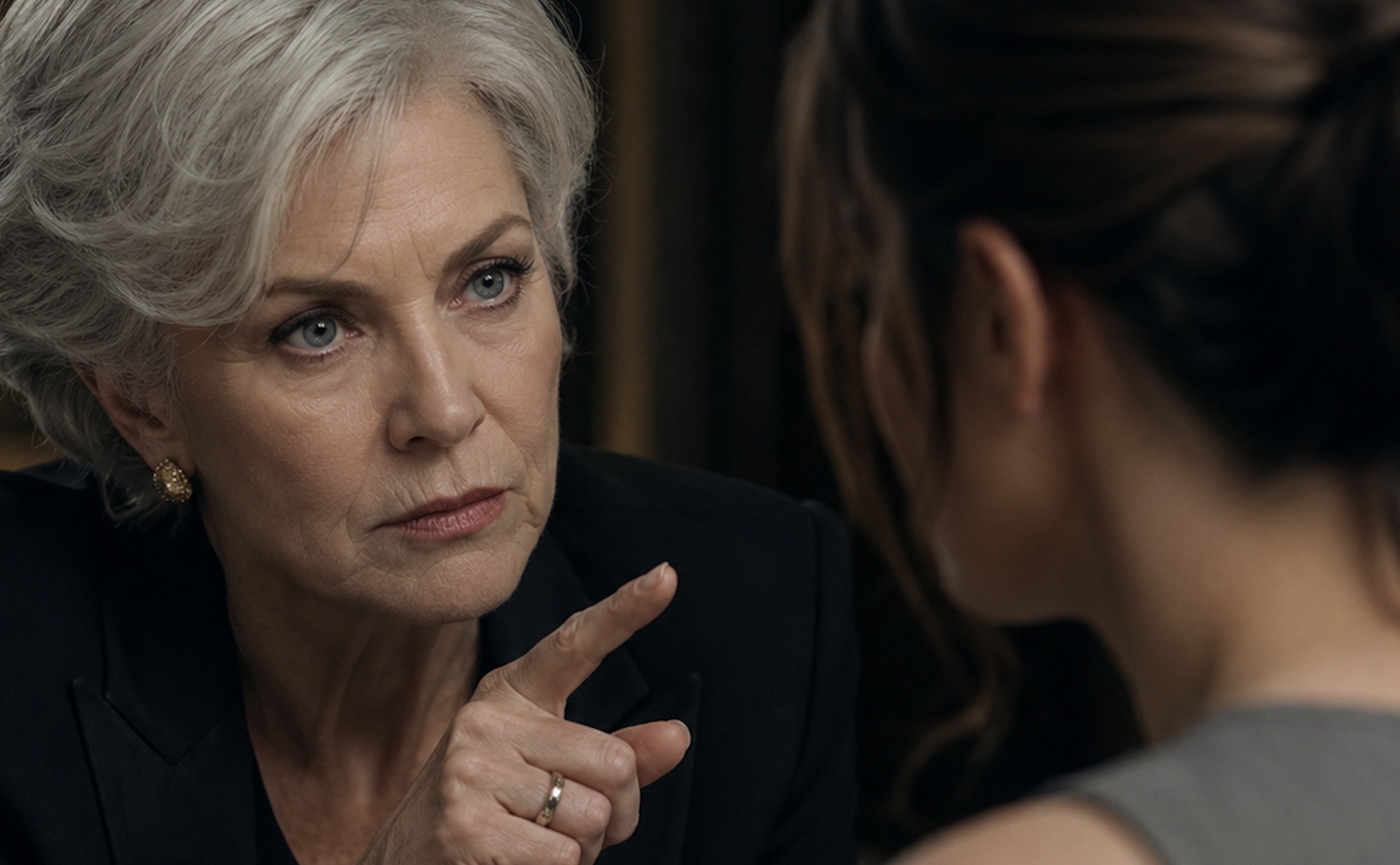
“You became greedy!” she shouted, her face twisting. “As soon as this one appeared”—she jabbed a finger toward Vika—“the money stopped flowing. Before, you never counted how much you gave your mother. And now? ‘Mom, why do you need so much?’ ‘Mom, where did you spend it?’ It’s humiliating! I don’t owe you a report for every kopeck while you’re taking your wife to resorts!”
Vika stood silently, feeling disappointment rise inside her like a slow wave. She had seen this woman in many moods, but never with such open hatred.
“She turned you against me,” Galina Nikolaevna continued, stepping toward her son. “She whispers to you at night so you’ll forget your family. But now justice has been restored.”
“Justice?” Artyom looked at his mother. “You stole one and a half million from me. You didn’t just take what was yours. You betrayed me.”
“Don’t you dare speak to your mother like that!” she shrieked. “I gave you life!”
“And today you priced that life at the value of a used SUV,” Artyom said coldly. “Fine. If you believe you acted legally, then I will act legally too.”
He took Vika’s hand and felt her fingers trembling.
“The money will run out, Mom. Oleg will waste it in six months, just like he wasted everything else you ever gave him. And when you come to me—and you will—remember this day.”
“Don’t threaten me!” she shouted after them. “We’ll live just fine without you!”
The capital greeted them with its frantic rhythm, but it was there that their unusual, rare specialty—designing complex stage machinery and lighting scores for theaters—finally found real demand. Three years passed. Business grew steadily. They bought a spacious apartment in an old building with high ceilings, full of air and light.
Vika was seven months pregnant.
Her pregnancy was going smoothly, and they were preparing the nursery, choosing the safest, most eco-friendly materials. They tried not to think about the past, as if they had cut off a rotten branch so the tree could continue to grow.
The phone rang on a Saturday morning. Artyom saw a number that was no longer saved in his contacts, but memory immediately supplied the name. He stared at the screen for a long time until Vika raised her eyebrows questioningly.
“Yes?” he answered dryly, switching on speakerphone so there would be no secrets.
“Artyom, I need money,” Galina Nikolaevna said in a demanding voice, without greeting or explanation, as though they had spoken only yesterday. “Oleg is about to be expelled. He needs to settle his exams. There are some bribes, I don’t understand the details, but it’s a large amount.”
“You have the wrong number,” Artyom said, already wanting to end the call.
But his mother spoke faster.
“Don’t you dare hang up! You are obliged to help your brother! He has talent. The professors are just targeting him. And I need a medical examination too. My heart has been acting up because of your behavior.”
“Galina Nikolaevna,” Artyom said, his mind suddenly becoming clear. Anger gave way to icy calm. “I don’t have a brother. I know an irresponsible person named Oleg. And I don’t have a mother who steals from her own son.”
“You ungrateful animal!” she screamed so loudly that her voice echoed through the room. “You’ve grown fat and arrogant in your Moscow apartment! I’ll come there. I’ll find a way to deal with you. You owe me until the day you die!”
Artyom pressed the red button.
“She won’t stop,” Vika said quietly, stroking her belly.
“Let her try,” Artyom said, embracing his wife. “We’re far away now. And I’m no longer that little boy who was afraid of her shouting.”
But he was wrong.
Distance was no obstacle to malice and greed. Galina Nikolaevna did not merely threaten—she acted. Through old acquaintances, she found out her son’s address and boarded a train. A plan had formed in her mind: if her son had become so cold-hearted, then his wife was to blame. She needed to pressure Vika, frighten her, force her to pay. Female sympathy or fear for the baby—something had to work.
That day, Artyom was supposed to leave for the installation of a complicated stage set. He packed his tool bag, kissed Vika, and went out. Vika stayed home, planning to sort through sketches for a new project.
An hour later, the doorbell rang.
Vika looked through the peephole. A courier stood on the landing—or at least it looked that way because of the cap and the large box in his hands. She opened the door, expecting nothing unusual.
The box flew to the floor, and Galina Nikolaevna appeared in front of her.
She had changed dramatically. Her facial features had become sharper, and her eyes were prickly and restless.
“Well, hello, homewrecker,” her mother-in-law said, rudely pushing past pregnant Vika and stepping into the apartment. She looked around at the expensive renovation with undisguised envy. “You’ve settled in nicely. Crystal chandeliers, oak floors. Meanwhile, his own mother counts coins?”
“Leave,” Vika said firmly, stepping back into the hallway. “Artyom isn’t home.”
“I don’t need him. I came to see you.” Galina Nikolaevna threw her bag onto the dresser, leaving a scratch on the polished surface. “Here’s how it’s going to be, sweetheart. You will transfer fifty thousand to me right now. And you will do it every month. That is compensation for stealing my son from me.”
“Are you out of your mind?” Vika felt her fear turning into disbelief. “I’m not transferring anything to you. You sold our car and took all the money. Wasn’t that enough?”
“That was my money!” her mother-in-law barked. “And now you will pay. If you don’t, I’ll make your life hell. I’ll write to Artyom’s workplace. I’ll come here every day. I’ll file a report with child services saying you’re drug addicts!”
Vika could not hold back.
The absurdity of the situation was so enormous that she laughed. It was not hysterical laughter, but genuine astonishment at the woman’s shamelessness.
“You think this is funny?” Galina Nikolaevna’s face flushed with red patches. “You’re laughing at a mother? At an elderly woman?”
She lunged forward.
Vika had no time to react.
A sharp slap burned across her cheek. Her head jerked to the side, and her shoulder struck the doorframe. The smile disappeared from her face, but a cold shine appeared in her eyes. Now she no longer saw a relative. She saw an enemy.
“You…” her mother-in-law hissed, and in a blind fit of rage, she grabbed Vika by the collar of her house shirt. The fabric tore with a loud rip, exposing her shoulder. “I’ll teach you some respect!”
At that moment, slow, heavy clapping sounded behind her.
Once.
Twice.
Three times.
Galina Nikolaevna froze, her fingers still clenched around the torn fabric.
Slowly, she turned around.
In the doorway of his office, which she had failed to notice in her fury, stood Artyom.
He had not gone anywhere.
The installation had been postponed, and he had been working from home in soundproof headphones until the vibration from the slamming door caught his attention. He had come out a minute earlier—and had seen everything.
Artyom’s gaze was terrifying.
He did not shout. He did not wave his arms. But his figure radiated such heavy, primal menace that Galina Nikolaevna instinctively loosened her grip and stepped back.
“It tore by itself,” she blurted out quickly, swallowing her words. “She threw herself at me. She’s hysterical! You saw it, didn’t you? She provoked me!”
Artyom walked past her without a word.
He went to Vika and, as carefully as if touching crystal, ran his fingers over the reddening mark on her cheek. He examined the torn shirt. He made sure his wife and child were all right.
Then he slowly turned to his mother.
“Artyomka, she was laughing at me,” Galina Nikolaevna whined, trying to slip back into her familiar role as the victim. “I only wanted to talk, and she…”
Artyom did not let her finish.
He stepped toward her, and there was so much resolve in that movement that she pressed herself against the wall. He did not hit her. He simply took her by the shoulders—roughly, the way one grabs a bag of trash. His fingers closed around her coat like steel clamps.
“Let me go! What are you doing?!” she shrieked, kicking her legs because her son, using his physical strength, had practically lifted her off the floor.
He dragged her toward the exit.
Galina Nikolaevna tried to resist, scratching at his hands, grabbing at the coat rack, which crashed to the floor. Artyom did not say a word. He picked up her bag from the floor and threw it out onto the stairwell.
“Artyom! I’m your mother! You have no right!” she screamed as he pushed her over the threshold.
He placed her on the cold concrete landing and stood in the doorway. His chest rose and fell heavily, but his face was absolutely calm. It was the cold expression of a surgeon amputating gangrene.
“If you close this door now,” Galina Nikolaevna hissed, fixing her disheveled hair, “you will no longer have a mother. Do you hear me? I will curse you!”
Artyom looked down at her.
“Excellent, Galina Nikolaevna,” he said clearly, each word cutting into her memory. “Then I have no mother. And all obligations are removed from me. Forget my name. Forget this address. If I see you again, I will not be this polite. I will file a report for trespassing and assault. We have cameras.”
He reached for the door handle.
“You’ll regret this!” she shouted in desperation.
The door slammed shut.
The lock clicked.
Then the second one.
Galina Nikolaevna was left alone in the empty stairwell. After all her screaming, the silence pressed painfully against her ears. She stood there for a minute, expecting the door to open again, expecting her son to come to his senses and run after her with apologies.
But the door remained silent and closed.
Slowly, shuffling her feet, she walked toward the elevator. Angry thoughts churned in her head: “Fine. He’ll cool down. He won’t go anywhere. That Vika set him against me, that snake.” She still believed she controlled the situation. She still believed truth was on her side.
When she stepped outside, she took out her phone to call Oleg and complain about his cruel brother, to tell him how she had been humiliated.
But a new message from the bank was waiting on the screen.
She opened it.
The letters blurred before her eyes.
“We remind you that your loan payment is overdue. The amount owed, including penalties, is…”
Galina Nikolaevna went cold.
To come to the capital and rent a hotel room for a while—“until her son started paying”—she had taken out a quick loan. She had been absolutely certain that she would squeeze money out of Vika or Artyom that very day. She had no return ticket. She had almost no cash left.
She dialed her younger son’s number.
“Hello, Oleg? Son, something happened… Artyom threw me out. I need money for a ticket back, and…”
“Mom, seriously?” Oleg’s voice sounded irritated, loud music playing in the background. “I thought you were going to get money out of Artyom. I don’t have anything either. I’m taking a girl to the movies, actually. Handle it yourself. You’re an adult.”
The line went dead.
Galina Nikolaevna lowered the phone.
She stood in the middle of a huge, unfamiliar city, outside the building where her son and daughter-in-law sat in warmth and light—the two people she had just lost forever. The autumn wind pierced through her thin coat and chilled her to the bone.
She looked up at the windows on the third floor.
A warm golden light glowed behind the curtains. She knew that inside, Artyom was now holding Vika, comforting her, making her tea. And in that cozy world, there was no place left for her.
The realization of her complete and total defeat struck her all at once. She could not believe that her plan, which had seemed so flawless, had turned against her. She had wanted to punish them.
Instead, she had punished herself.
People walked past her, paying no attention to the confused woman clutching a useless phone in her hand, finally understanding that she had nowhere to go.