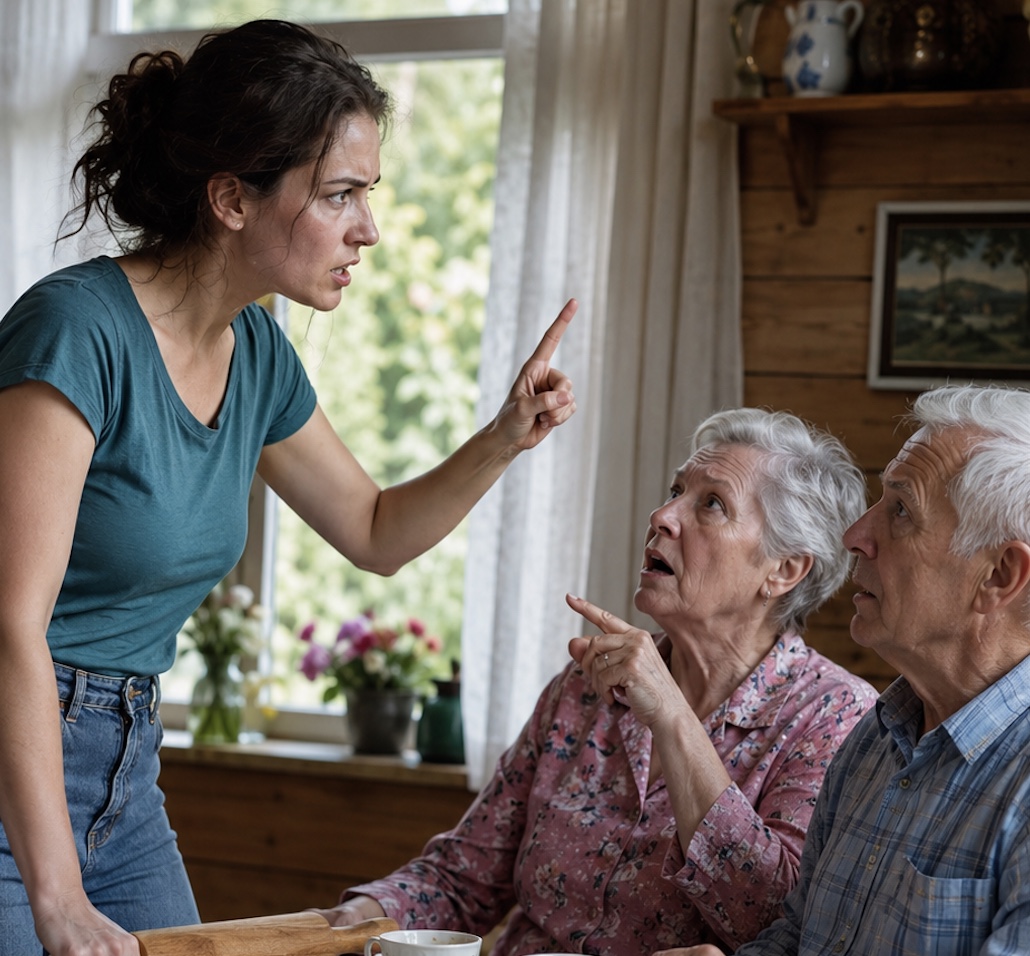
The gate creaked at half past ten. A car stopped by the porch, and the first one to step out was Maria Petrovna, dressed in a white blouse as if she had come to a banquet, not to the countryside.
“Well then, Olenka, welcome your guests! We came to see what kind of mess you’ve made out here in the wilderness.”
I was standing on the porch with Pavlik’s wet T-shirt in my hands. Viktor had left two days earlier on a three-day business trip, and I had deliberately not told his parents that we were staying at the dacha.
“We weren’t expecting you. All I have in the fridge is cottage cheese and sausages.”
Maria Petrovna walked past me into the house as if she hadn’t heard a word. She opened the refrigerator, looked through the cupboards, and said,
“There’s flour. I see eggs. That’s enough. Go make pancakes. We’re hungry from the road. We’ll watch Pavlik for now.”
Pavlik pressed himself against my leg and said nothing. He was afraid of his grandmother.
“Pavlik is tired. He needs to…”
“Fine, stay here then. Grigory, let’s go outside.”
They went out into the yard, and a minute later they were already stretched out on wooden loungers beneath the apple tree, as if they were at a resort. Pavlik stood by the porch, poking the ground with a stick. They paid no attention to him at all.
I turned on the stove. I cracked the eggs. Pavlik whined, “Mom, I’m bored.” And I stood there frying pancakes for people who had arrived without calling and ordered me to set the table as if I were a servant.
I had just placed the first batch on a plate when my mother-in-law shouted from the garden,
“Olya, have you fallen asleep in there? We’re starving!”
I set the table in silence. Grigory Semyonovich pushed an empty cup toward me.
“Daughter-in-law, pour me some tea. Three spoons of sugar, and stir it right away. A hostess should serve her guests. We’re tired.”
I stared at that cup and felt something tear inside me. I poured the tea. Added the sugar. Stirred it. Then I sat on the edge of a chair like a guest, even though this was my own home.
Maria Petrovna tried one pancake and frowned.
“A bit tough. Undercooked. Well, we’ll eat them anyway.”
Then she began the conversation I had been dreading.
“Grigory and I have been thinking… Viktor’s Uncle Petya has heart problems. The doctors told him he needs fresh country air. So he’ll be staying with you all summer. We’ve already told him. He’ll arrive the day after tomorrow.”
I put my fork down.
“We don’t even know him.”
“So what? He’s family! This dacha is part of the family now. Everyone should help each other.”
“So you decided this for us? Without even asking?”
“What is there to ask? Viktor is our son, so our opinion matters here.”
Pavlik sat on the small sofa, staring out the window as if he wanted to disappear. Maria Petrovna went on.
“And honestly, the hospital is too far from here. Why did you buy a place in such a backwater? And that store nearby is pathetic. They don’t even have decent soda.”
When it began to get dark, I stood up.
“Pavlik goes to bed early. We need to sleep. And it’s dangerous for you to drive through the forest in the dark.”
Maria Petrovna jumped up.
“Are you throwing us out?”
“We came to you with kindness, and this is how you treat us! Your pancakes were half-raw, and you’re a wicked daughter-in-law! Completely inhospitable!”
She grabbed her handbag. Grigory Semyonovich got up reluctantly, finishing his tea. The door slammed so hard the windows shook. Headlights swept across the glass, and a minute later, everything was quiet.
Pavlik wrapped his arms around my leg.
“Mom, is Grandma angry?”
“Don’t be afraid, sweetheart. Everything is fine.”
But my hands were shaking as I cleared the table. I waited for Viktor to call and scold me. The phone stayed silent until morning.
The next day, I was weeding the garden beds when the gate creaked again. A jeep. Three men climbed out. Anatoly, Viktor’s younger brother, walked in front, carrying fishing gear and a bag with bottles sticking out of it.
“Hey, sister-in-law! Mom said you’ve got a holiday base here! We’re here for the weekend — barbecue, fishing, overnight stay. I brought the guys along.”
The two men behind him smirked. Anatoly held out a bag of raw meat.
“While we go find the river, cut up a little salad. Cucumbers, tomatoes, that kind of thing. You’re the hostess. It’s no trouble for you.”
I looked at him and barely recognized the young man I had once celebrated New Year’s with. Back then, he had been polite. Now he stood there giving orders, as if I were a waitress.
“Anatoly, I wasn’t expecting you. Or your friends.”
“Mom said you were kind people! That you’d welcome us!”
“Your mother was wrong.”
Anatoly stopped smiling.
“What’s that supposed to mean?”
“It means exactly that. The river is over there,” I pointed toward the forest. “You can cook there. There’s nowhere for you to stay overnight. I’m here resting with my child. I am not your cook. Leave.”
One of his friends whistled. Anatoly turned red.
“Have you lost your mind? We’re family!”
“Family calls in advance. Family asks permission. You showed up as if this were an inn.”
I took Pavlik by the hand and went into the house. I closed the door. Locked the latch. My heart was pounding so hard it rang in my ears. Outside, I heard voices — first angry, then confused. The jeep doors slammed, the engine started. I leaned back against the door and closed my eyes.
That evening, I called Viktor. I told him everything. He listened in silence, and I was terrified he would say, “You could have at least offered them tea.”
“Olya, I know,” he said at last. “My mother already called me for half an hour, saying you were rude and that you threw my brother out.”
“And what did you say?”
“I told her: Mom, no one comes to the dacha anymore without calling and being invited. This is Olya’s and my home. If you want to visit, call first and ask whether it’s convenient.”
I said nothing. A lump rose in my throat.
“She screamed that I was a traitor, that my wife had turned me against my family. I told her: respect our plans, or we’ll stop coming altogether. End of discussion.”
“Viktor…”
“Enough, Olya. I should have said this two years ago. This is our life.”
I sank into a chair. Pavlik was asleep in the room, the pines rustled outside the window, and for the first time I felt that this dacha truly belonged to us.
Three quiet weeks passed. No calls. No messages. Then, on Saturday morning, the phone rang. It was my mother-in-law.
“Olenka, it’s me. Grigory and I would like to come by. On Saturday. If it’s convenient for you.”
Maria Petrovna’s voice was quiet, almost cautious. I stayed silent for one second. Two. Three.
“Saturday works for us. Come for lunch.”
“All right. Thank you. We won’t stay long. We just want to see Pavlik.”
On Saturday, they arrived exactly at noon. They got out of the car quietly, almost guiltily. Maria Petrovna was holding a bag of gingerbread cookies for Pavlik. Grigory Semyonovich gave me a silent nod.
We drank tea. We spoke carefully — about the weather, about their grandson, about repairs. No one mentioned that day. No one said the word “sorry.” But when they were leaving, Maria Petrovna hugged me — quickly, stiffly, but she hugged me.
“Olenka, forgive us, if we were out of line. We’re just old fools.”
I didn’t answer. I only nodded.
Viktor closed the gate behind them and put his arm around my shoulders.
“So? Can you breathe now?”
“Not yet.”
Pavlik was playing on the swing Viktor had built from old boards. The sun was sinking toward the horizon, and the light fell across the yard so beautifully that everything looked golden.
A month later, Maria Petrovna called again — this time asking permission to come for the weekend. She even asked if she should bring anything. I answered, “Come. We’ll be glad to see you.” And it was true — but it was a truth with boundaries.
Uncle Petya never came. Viktor called him himself and explained that the dacha was small, we had a child, and there simply wasn’t enough room. Uncle Petya wasn’t offended.
“I understand, son.”
Anatoly came the following year — alone, without friends, and he stayed overnight. But he warned us a week in advance. He brought meat for barbecue and cooked it himself. At the table, he was quiet. When he was leaving, he said,
“Sorry, Olya. I was wrong.”
I looked at the gate that Viktor and I had painted together. At the lock that was now always closed. At the little sign he had jokingly nailed to it: “Call before visiting.”
The last time Maria Petrovna saw it, she pressed her lips together but said nothing. Grigory Semyonovich only snorted and said,
“That’s right. You never know who might show up.”
They understood. Not immediately, not the first time. But they understood.
And I learned the most important thing — not to be afraid to say no. Not guiltily. Not apologetically. Just no. Because my kindness is not weakness. And my family is not a public waiting room.
Pavlik came running over, covered in dirt.
“Mom, can I invite Mishka to sleep over tomorrow?”
“You can. Just tell his mom in advance.”
“Okay!”
He rushed off again. Viktor took my hand, and we sat there quietly, listening to the pines rustle.
I felt that this dacha was exactly the place where I belonged. Not because it was beautiful or quiet. But because here, I was the mistress of my home. Of my life. Of my decisions. Of my boundaries.