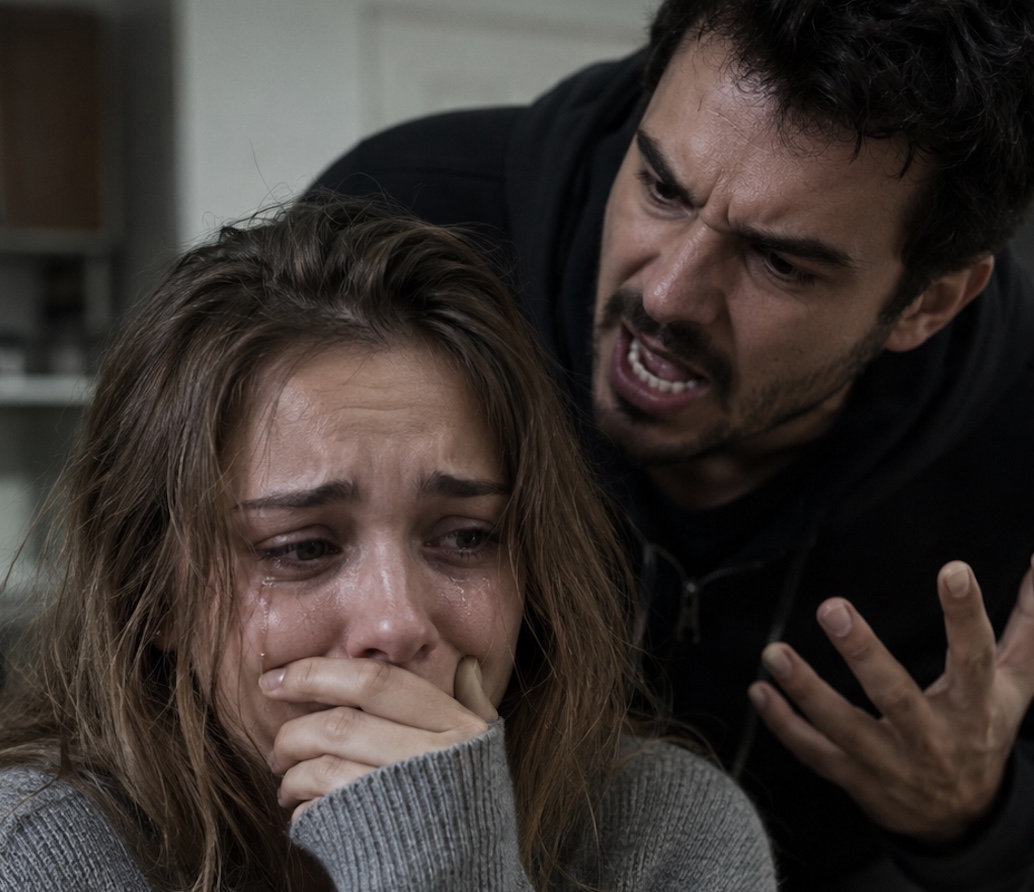
“Do you even understand what you’re doing?”
The frying pan didn’t fly across the kitchen.
The salad bowl did.
A heavy glass bowl filled with Olivier salad — the one I had chopped after work while his socks thumped around in the washing machine and the kettle cooled on the windowsill. It slammed into the wall beside the refrigerator, shattered, and boiled potatoes mixed with mayonnaise slowly slid down the pale wallpaper.
I stood by the sink with wet hands, watching a shard of glass roll across the tiles.
“Kirill, have you lost your mind?”
“I’ve lost my mind?” He stepped toward me, yanking his jacket open so sharply it was as if the fabric was stopping him from breathing. “I’m the crazy one? My card is blocked, people from work keep calling, there’s nothing to eat at home, and this is what you serve me?”
“First of all, there is food at home. Second, your card wasn’t blocked because of me. And your job isn’t calling because of me either.”
“Oh, here we go. Here we go, Alyona. Now you’re going to lecture me?”
“I’m not lecturing you. I’m speaking normally. Don’t shout.”
“Normally? You haven’t spoken to me normally in a long time.”
“And when was the last time you spoke to me like I was a human being?”
He smirked, not because anything was funny, but because something inside him had already snapped loose.
“Like a human being? Do you even act like one? Where did half your salary go?”
“I paid the utilities. And your overdue internet bill, by the way.”
“Don’t lie to me.”
“I’m not lying.”
“Don’t lie to me in my house!”
That was the moment I simply exhaled with exhaustion.
At first, I wasn’t even scared. I wasn’t hurt. I was just tired.
Because I had been listening to that same old chorus about “my house” for three years. Even though the apartment wasn’t his, but his mother’s. Even though we had renovated it together. Even though I had bought the sofa with my bonus. Even though the pots, curtains, dishes, iron, and half the furniture had been brought here by me.
“This isn’t your house, Kirill. Enough already. Aren’t you tired of saying that yourself?”
He came right up to me. I could smell wet pavement, cigarettes, cheap vending-machine coffee, and anger.
Anger has a smell, as it turns out. Something metallic.
“Say that again.”
“This isn’t your house.”
He slapped me with an open hand.
Not very hard, but enough to snap my head sideways and make my ears ring.
I stared at him.
“What did you just do?”
“What did you just say?”
“You hit me.”
“Don’t start getting hysterical.”
“Me? Hysterical—”
The second blow landed on my cheekbone.
Then he shoved me in the shoulder. I slammed my hip into the table, caught the stool with my leg, and barely stayed on my feet.
“Kirill, step back.”
“Or what?”
“Step back, I said.”
“Or what? You’ll call your mommy? You’ve got nothing except that mouth of yours.”
I reached for my phone on the windowsill.
He grabbed my wrist.
“Don’t touch it.”
“Let go.”
“I said don’t touch it!”
He yanked me so hard that my elbow hit the radiator. Pain shot all the way down to my fingers. I hissed and tried to pull free.
Then he punched me in the shoulder. Then again — somewhere near my collarbone. I couldn’t even tell anymore. I just curled inward, covering my head. He hit quickly, viciously, as if he wasn’t trying to punish me so much as beat something out of himself.
Then, just as suddenly, he stopped.
He stood there, breathing heavily, looking down at me.
I was sitting on the floor, pressing my palm to my lip. When I pulled my hand away, there was blood on my fingers.
“Pack your things,” he said quietly.
And somehow, that was worse than the shouting.
“I want you gone within the hour.”
“I have nowhere to go.”
“That’s not my problem.”
“Was it ever?”
“That’s enough. I’m going to my mother’s. And don’t even think about complaining to her. I’ll tell her you put on another performance.”
He grabbed his keys, slammed the door so hard the coat rack shook in the hallway, and left.
I sat on the kitchen floor, listening to the faucet drip in the bathroom, and thought about something strange: when glass breaks from an impact, at least you can see the pieces.
But a person, apparently, can be broken almost silently.
From the outside, only the breathing changes.
I got up, walked to the mirror, and winced.
My lip had already swollen. A bruise was forming under my eye. Dark marks were appearing on my neck.
A normal family life, wasn’t it?
A refrigerator, a car loan, water delivery, and beatings squeezed in between dinner and laundry.
I didn’t pick up the phone right away.
Honestly, the last person in the world I wanted to call was Zoya Ivanovna. My mother-in-law. A woman who could make you feel wrong with one glance: the soup was too salty, the curtains were too dark, you spoke out of turn, you greeted her in the wrong tone.
But there was no one else to call.
She answered after the third ring.
“Yes?”
“Zoya Ivanovna, it’s me.”
“I can hear that. What is it this time?”
“Come get your son.”
A pause.
“Are you drunk?”
“No.”
“Then speak properly. I’m not here to solve riddles. Kirill just called. He said you’re putting on another show.”
I sat down on the edge of the bathtub and stared at the floor.
“I’m not putting on a show. Your son beat me.”
The line went quiet.
Even the background noise disappeared, as if she had stepped out of the room.
“What did you say?”
“You heard me. He beat me. If you think I’m exaggerating, come and see for yourself. If you don’t come, I’m calling the police and going to document the injuries.”
“Alyona, don’t you dare threaten me.”
“I’m not threatening you. I’m warning you.”
“Are you sure you didn’t provoke him?” Her voice was no longer sharp. It sounded confused. But the question still struck like a slap.
I almost laughed, and pain immediately burned through my swollen lip.
“Of course. I probably smeared the salad across the wall myself too. And threw myself against the radiator. And gave myself a black eye. Very convenient. Come if you want. Or don’t. Just don’t say later that you didn’t know.”
I ended the call.
And for the first time that evening, I didn’t feel fear.
I felt anger.
Cold, clear anger — like winter water from the tap.
She arrived forty minutes later.
Not alone. With a driver.
And not in a robe like someone dragged from home in a panic, but in a coat, with a handbag, her back perfectly straight. As if she were arriving for an important meeting, not coming to see the daughter-in-law she had barely tolerated for half her life.
She opened the door with her own key.
Stepped inside.
Saw the kitchen.
“My God.”
Then she saw me.
And in that moment, it was as if someone switched her off.
Her face emptied.
Not kind. Not sympathetic.
Just very quiet.
“Was this him?”
“No, the plumber.”
She ignored my tone.
“Step into the light.”
“I’m not in the army.”
“And I’m not joking. Come here.”
I moved closer.
She silently examined my face, my neck, my arm. Then she touched my shoulder, and I flinched.
“Does it hurt?”
“What do you think?”
“Badly?”
“Enough for you to stop asking whether I provoked him.”
She turned away, walked into the kitchen, saw the shards on the floor, sighed, and said with unexpected calm:
“The driver is in the car. I told him not to leave. If necessary, we’ll go to the emergency clinic.”
“It’s necessary.”
“Good.”
I had not expected that word.
Not “we’ll see.”
Not “we’ll sort it out.”
Not “let’s not involve the police.”
Just one simple human word.
Good.
She sat down at the table, removed her gloves, and asked:
“What happened before today?”
“What do you mean?”
“Before this. Don’t lie to me now. I’m too old for pretty fairy tales.”
I leaned against the doorframe.
“Before, he shouted. Then he pushed me. Then he grabbed my arms. Today he finally hit properly. Evolution, I suppose.”
“How long?”
“Six months.”
“Why did you keep silent?”
“And who was I supposed to tell? You? You could barely stand me as it was.”
“Don’t change the subject.”
“I’m not changing it. It’s just a fact. You would have taken his side.”
“I don’t know,” she said after a pause. “Before, maybe I would have.”
“And now?”
She looked straight at me.
“Now I’m looking at you and seeing myself at thirty-two.”
I said nothing.
She stood up, went to the window, and stood there looking out into the courtyard, where someone in a hood was smoking under the streetlamp. When she began speaking, it sounded as if she was talking not to me, but to the glass.
“My husband beat me for seven years. Not every day. Not even every week. That made it especially easy to lie to myself. One day he threw a stool, the next he brought a cake. One day he called me filth, two days later he drove me to the country house. One day he nearly strangled me, the next he came with roses. And you walk around thinking: well, it’s not that bad. Other people have it worse. We’re a family. We have a child. He has a difficult personality. His job is stressful. I talk too much. I have a temper too. Round and round it goes until one day you realize you’re forty, you have an ulcer, a habit of speaking in whispers, and a son who saw far more than you thought.”
I swallowed.
“Does Kirill know?”
“No. I told him his father died of a heart condition. A beautiful lie. I wanted the boy to live without that dirt.”
“It didn’t work.”
“It didn’t,” she said dryly. “He grew up, and the dirt found its way into him anyway. Or maybe it was always there. I don’t know.”
She sat back down and suddenly asked in a completely different tone:
“Have you ever seen the apartment documents?”
“What documents?”
“For the apartment.”
“No. He said it was his. That you had transferred everything to him years ago.”
She gave a crooked smile.
“He said many things. The apartment is registered to me. Completely. He is only registered here as a resident.”
My breath caught.
“Wait… So all this time…”
“He lied. Yes. To you, to me, and probably to himself too. It suited him to feel like the master. Especially at someone else’s expense.”
“And you stayed quiet?”
“I thought maybe it would make him feel responsible. What kind of brilliant strategist does that make me? I raised myself a boss out of thin air.”
I looked at her and, for the first time, did not see a mother-in-law.
I saw a tired woman with dry hands, perfectly styled hair, and such rage toward herself that my resentment beside it felt almost childish.
“What happens now?”
“Now?” She took out her phone. “Now I call a locksmith and a lawyer. First we change the lock. Then we go document your injuries. Then I remove my son’s registration through court. After that, he will be very surprised how quickly male arrogance ends when there is no apartment, no money, and no mother eternally spreading cushions under him.”
“You’re serious?”
“Alyona,” she said, looking up at me, “I was a fool for far too long. I have reached my limit for today.”
For the next hour and a half, we packed his things.
It was probably the strangest evening of my life.
I held the bags. She opened the closets. She pulled out shirts, sweaters, belts, sweatpants, chargers, a razor, boxes full of junk he called “important.”
At the bottom of the dresser, we found a stack of receipts, old payment slips, and some papers for microloans.
“What is this?” I asked.
She picked them up, skimmed through them, and turned pale.
“The little bastard.”
“What is it?”
“Loans. Several of them. One paid off, two still active. And this—” she pulled out another paper, “a power of attorney to access your credit history. Where did this come from?”
I snatched the sheet from her.
“That’s not my signature.”
“I can see that.”
“Did he take loans in my name?”
“Looks like it. Photographed your passport, forged a few things. Excellent. The full set. A beaten wife and debts in her name, just so she doesn’t get too comfortable.”
I sat down right on the hallway floor.
“I’m going to kill him.”
“No,” Zoya Ivanovna said. “There’s no need to kill him. You ruin his life properly. It’s more useful and legal.”
“Are you joking right now?”
“Not at all. I’ll joke later. When he realizes the free buffet called ‘mother and wife’ has closed.”
We placed three large bags outside the door and had just started finishing the fourth when a key scraped in the lock.
Kirill came in cheerful.
Apparently, he had managed to drink somewhere on the way.
Then he saw the bags, me, and his mother.
The cheer vanished instantly.
“What kind of circus is this?”
“This is not a circus,” Zoya Ivanovna said. “This is a move.”
“Whose?”
“Yours.”
He laughed.
“Mom, are you serious? She complained to you, and you rushed here to save her? Come on, don’t make me laugh. You know what she’s like. She provokes. I say one word, she answers with ten.”
“And for that, you hit her?” his mother asked calmly.
“Nobody hit her. I gave her a couple of slaps because she was talking nonsense.”
“A couple?” I was surprised by how steady my own voice sounded. “Do you want me to take off my shirt so you can count the bruises and see how many ‘a couple’ really means?”
“Don’t dramatize.”
“Don’t dramatize?” I stepped toward him. “You grabbed me by the throat a month ago. Should I not dramatize that either? You twisted my arm in winter when I tried to go into another room. Was that also a joke? You photographed my passport to hang debts on me. Was that out of great love too?”
He froze.
“What debts?”
Zoya Ivanovna silently threw the stack of papers at him. The pages scattered across the floor.
“These. Pick them up. Read them while you’re at it.”
Kirill looked at his mother, then at me. Then he irritably kicked the papers with the toe of his shoe.
“You’ve both lost your minds. Mom, whose side are you even on?”
“On the side of the person who does not get beaten in my house.”
“In your house?” He jerked back. “Here we go again. You told me for twenty years this was all mine! That everything was for me!”
“I told you to live decently. Not to act like a beast in charge. You confused the words.”
“So she’s an angel now? She’s probably already sung you a whole song about how I ruined her life.”
“Don’t, Kirill,” I said. “Don’t try to turn yourself into the victim again.”
“And what am I, in your opinion?”
“A thirty-five-year-old man living off swagger, someone else’s apartment, and his mother’s habit of solving everything for him.”
He lunged toward me.
“Shut your mouth!”
But Zoya Ivanovna was already standing between us.
Small, thin, wearing a dark dress — and somehow even harder because of it.
“Just try.”
“Mom, move.”
“No. You are the one leaving.”
“You’re throwing me out of my home because of this—”
“Finish that sentence,” she said quietly. “Go on. Finish it so I can fully understand what I raised.”
He lowered his tone and tried to take her by the elbow.
“Mom, come on. You know me. It was just nerves. Work is a mess, money’s tight, she’s always nagging me. I snapped. It happens.”
“It happens to people who think a woman is a punching bag for their rage.”
“You put up with my father!” he shouted. “So what are you preaching to me for?”
I saw her face tremble.
Only for a second.
“Exactly why I will not put up with you.”
He went still.
“What?”
“You heard me. I kept silent once in my life. I won’t do it a second time. Your bags are outside. Put the keys on the cabinet. Tomorrow your things will be taken to a rented room near Shchyolkovskaya. I’ve paid for one month. After that, you’re on your own.”
“You won’t even let me live normally?”
“Normally? Do you even understand that word? Normal is when a person works and doesn’t scream at home. Normal is when a wife doesn’t flinch at the sound of keys in the door. Normal is when a mother isn’t ashamed of her own son.”
“You’re cutting me off because of some woman?”
“No, Kirill. Because of you. You worked very hard for this. Well done.”
He looked at me.
The anger in his eyes had been replaced by panic.
That particular male panic that appears when a man suddenly realizes the usual levers no longer work.
“Alyona, are you seriously going to make this into such a big deal? So what, we fought. Everyone fights. Are you really going to destroy the family?”
I laughed.
It came out ugly.
“Family? You’re calling this a family now? When I could tell from the sound of your steps at the door whether you were drunk or just angry? When I stood in the grocery store counting whether I had enough money for food and your next ‘temporary crisis’? When you told me I was nothing without you because I lived in ‘your’ house? That isn’t a family, Kirill. That was free service you arranged for yourself.”
“Who will want you after this?”
“That, actually, is the funniest question of the evening,” Zoya Ivanovna said. “Son, when a man says to a woman, ‘Who will want you?’ it usually means he is afraid of becoming unwanted himself.”
He said nothing.
Then he ripped his jacket from the hook.
“Fine. Wonderful. You want war? You’ll get war. Mom, you’ll crawl back to me later. And you, Alyona, you’ll regret this. You think you’ll live well without me? In a month, you’ll call me yourself.”
“No,” I said. “I won’t.”
“We’ll see.”
“No, we won’t,” his mother cut in. “Go.”
And he left.
No slammed door.
No grand final gesture.
He simply dragged the bags away, swearing under his breath, leaving like someone who had hoped until the last second that somebody would call him back.
Nobody called.
We went to the emergency clinic at one in the morning.
While the doctor filled out the paperwork, Zoya Ivanovna sat in the corridor with my handbag on her lap and stared straight ahead.
Then she said:
“Do you know what the most disgusting part is?”
“What?”
“I saw long ago that something in him was rotting. I saw how he spoke. How he belittled you. How he lied. But until I saw blood, I kept thinking: they’re adults, they’ll sort it out. Such a convenient position. A cowardly one.”
“You weren’t obligated…”
“I was. I’m his mother. That isn’t an excuse. It’s exactly the responsibility.”
“I was afraid of you.”
“You were right to be. I’m not a pleasant person.”
“Not now.”
She looked at me with a crooked smile.
“Now I’m just a very angry old woman.”
The next day, the part began that movies usually show quickly under music.
In real life, it is endless paperwork, phone calls, queues, passport copies, statements, consultations, notaries, the local police officer, the bank, the lawyer, and a locksmith changing the lock while glancing around as if embarrassed to witness someone else’s shame.
At first Kirill called.
Then he texted.
Then he came and stood under the windows.
“Open up. Let’s talk.”
“What are you trying to achieve?”
“Mom, come out. I’m talking to you.”
“Alyona, enough already. You’re going too far.”
Then the messages got nastier.
“You’re ruining my life.”
“I spent so much money on you.”
“You’ll die without me.”
Zoya Ivanovna read them with her glasses on and commented dryly:
“See how convenient? First he beats you, then he considers himself an investor.”
Two weeks later, it turned out that he really had taken out a small online loan in my name.
The amount wasn’t fatal, but it was enough for me to understand once again: a person can live beside you for years and still be a stranger down to the bone.
“I don’t understand how someone can…” I said one day while we were drinking tea in the kitchen.
“Very easily,” Zoya Ivanovna replied. “When a person gets used to thinking everyone owes him something, he stops recognizing boundaries. Someone else’s wallet, someone else’s body, someone else’s life — it all starts feeling like an extension of his own hand.”
“And what if he really changes?”
“That is no longer your job — waiting for his changes.”
A month later, when the bruises had faded, she brought over a folder.
“You’re coming with me tomorrow.”
“Where?”
“To the notary.”
“Why?”
“You’ll find out.”
I went because I no longer had the energy to argue.
At the notary’s office, she spoke shortly and to the point. At first, I didn’t even understand what was happening.
Then it hit me.
“Wait… What are you doing?”
“What should have been done long ago.”
“No. No, that’s impossible. I won’t take it.”
“You will.”
“Zoya Ivanovna…”
“Alyona, don’t start. I’m not giving you a palace. I’m simply transferring the apartment to someone who, at the very least, doesn’t frighten the walls.”
“But why me?”
“Because if I leave it in my name, he will circle around me forever. Begging, pressing, bargaining, acting remorseful. I don’t want that anymore. I want to live the rest of my life in peace. And because, unlike him, you know how to live — not feed off others.”
“It’s too much.”
“No. Too much was me pretending for years that my son could be loved into becoming better. He can’t. Sometimes the only thing you can do is put a person out the door and stop confusing pity with motherhood.”
I signed the papers with a trembling hand.
That evening, we sat in that same kitchen.
The wall had already been re-papered. Instead of the stain, there was now a small calendar with Lake Baikal on it — something she had bought at a kiosk and brought over with the words, “Let at least one beautiful thing hang here.”
Outside, a light April rain was falling.
Soup bubbled on the stove.
Ordinary chicken soup.
The kind people eat, not the kind served beside arguments.
My phone vibrated.
Unknown number.
I looked at the screen.
“Answer,” Zoya Ivanovna said.
I did.
“Yes?”
At first, there was only breathing.
Then Kirill’s voice. Dull, worn out.
“It’s me.”
“I know.”
“Is my mother there?”
“She is.”
“Give her the phone.”
“No.”
“Alyona, stop playing games.”
“I’m not playing games. Say what you wanted.”
He was silent for a moment.
Then he said, unexpectedly quietly:
“They fired me today. For good.”
I said nothing.
“I thought she would help me. My mother, I mean. I thought she’d yell, get offended, and then help. Like always.”
Zoya Ivanovna sat across from me, watching calmly, not even trying to guide me.
“And?”
“And nothing. I’m sitting in this rented room that smells like cats and fried onions, and for the first time I realized nobody owes me anything.”
It sounded so unlike him that I didn’t immediately know what to say.
“Congratulations. Useful discovery.”
He gave a bitter little laugh.
“Mocking me?”
“No. Not anymore. Before, maybe I would have tried to explain something. Not now.”
“I didn’t become like this all at once.”
“I don’t care when exactly you started.”
“Well, I do,” he said after a pause. “I spent my whole life despising my father. I thought I wasn’t like him. Then today I kept remembering how you covered yourself with your shoulders in the kitchen, and I realized I’m exactly like him. One to one.”
I looked out the window.
Rain trails were gathering on the glass.
“So what do you want from me now? Forgiveness?”
“I don’t know.”
“Then figure that out first.”
“Are you happy now?”
It was a stupid question.
And terribly human.
I set my cup down on the table.
“No. I’m not happy. I’ve simply stopped being afraid of evenings. For now, that’s enough.”
There was silence on the line again.
Then he said:
“Tell my mother… No. Don’t tell her anything.”
And he hung up.
I placed the phone face down on the table.
“What did he say?” Zoya Ivanovna asked.
“That for the first time, he understood nobody owes him anything.”
She nodded.
“Late. But better that than never.”
“Do you think he really understood?”
“I don’t know. And you know what? That is no longer our concern.”
I stood up, walked to the window, and suddenly caught sight of my reflection.
No bruise.
No hunted look.
Just the tired face of a woman who had survived a filthy winter and lived long enough to breathe normal air again.
Before, I used to think the world was divided into loved ones and strangers.
It turned out to be more complicated.
A stranger can step in front of you and shield you.
A person close to you can strike you.
And if something changes after that, it isn’t the world.
It is you.
You finally start believing not words, but the way people treat you.
“Alyona,” Zoya Ivanovna called from the kitchen, “are you having soup, or is it going to get cold again?”
I turned around and, for the first time in a very long while, smiled for real.
“I’ll have some. And you know what?”
“What?”
“Thank you for not coming that night as a mother. Thank you for coming as a decent human being.”
She snorted, adjusted the cup on its saucer, and replied in her usual dry tone:
“Don’t get used to it. I’m still an unpleasant woman.”
“But an honest one.”
“Well, look at that. We’ve lived to see the day. I’m being praised in my own house.”
I laughed.
Only afterward did I realize it was the first peaceful laugh this apartment had ever heard from me.
No tension.
No waiting for footsteps in the hallway.
No inner readiness to cover my head with my hands.
Outside, the rain kept falling.
On the stove, the soup simmered quietly.
On the table lay the keys.
My keys.
And the world did not suddenly become kind.
No.
It simply became clear at last.