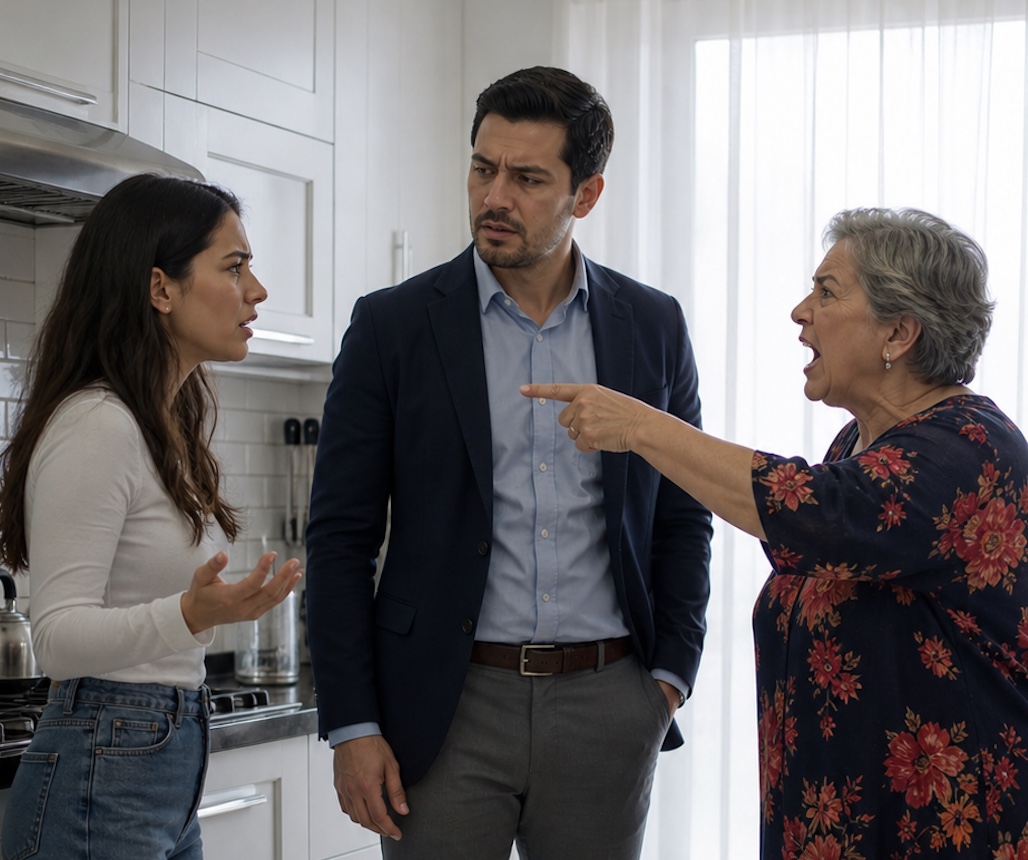
“What is this mess in your kitchen?! Pans belong in the cupboard, not on the stove! Who even stores cookware like this?”
Tanya stood in the kitchen doorway, watching Galina Petrovna — her mother-in-law, whom she and Andrey had taken in six months earlier “temporarily, until things got better” — rearrange their belongings.
Silently.
With the expression of a woman doing all of humanity a favor.
This was not the first reorganization.
First, she had moved the towels. Then she had rehung the curtains. Then, somehow, it turned out that Tanya folded the bed linen “incorrectly,” and the coffee machine “stank and only took up space.”
But the pans — that felt personal.
“Galina Petrovna,” Tanya said, trying to keep her voice as even as possible, “I’m used to keeping them there. It’s convenient for me.”
“Convenient for her!” the older woman snorted without even turning around. “Grease splatters everywhere, everything gets covered in oil — but it’s convenient for her. Do I live in this house or not?”
Exactly.
She lived there.
That was the problem.
Galina Petrovna was a monumental woman — both in appearance and in character. Broad-shouldered, with a heavy gray-eyed stare and a way of speaking as though every word she uttered was the final ruling of a court. She had raised Andrey alone after her husband left when their son was seven, and ever since then she considered herself a person who had endured everything and therefore knew everything.
Perhaps she did.
But she applied that knowledge with the force of a road roller.
Tanya had met Andrey four years earlier at a company party hosted by a mutual acquaintance. Back then, he had been laughing at something silly, so alive, so genuine, completely free of arrogance. She fell in love quickly. Their wedding had been modest. They traded their one-room apartment for a two-room place in a new district and took out a mortgage. They lived simply — not richly, but in a home that was theirs. Cozy. Built piece by piece.
Then Galina Petrovna’s “heart began acting up,” and Andrey said, “Mom can’t be alone.”
Tanya had not objected. She had been raised to believe that objecting was impolite. Especially to a sick mother-in-law.
Except Galina Petrovna’s heart, judging by everything, seemed to hurt strictly according to schedule. She avoided medical tests, took her pills only when she felt like it, but somehow always had the energy to wash all the dishes “properly,” move the hallway furniture, and explain to Tanya that she “cooked without love.”
“Cook without love,” Tanya repeated to herself that evening as she lay beside Andrey. “What is that even supposed to mean?”
Andrey said nothing. He was scrolling through something on his phone.
“Andrey.”
“What?”
“Your mother said I cook without love.”
“Well, Mom just says things as they are. You know what she’s like.”
“I do. That’s why I’m asking.”
He turned toward her and looked at her the way people look at someone who has created a problem out of thin air.
“Tanya, she’s old. It’s easier for her this way — ordering people around, controlling things. Just be patient a little longer.”
“A little longer” had become Andrey’s favorite phrase over the past six months.
Be patient a little longer.
Wait a little longer.
She’ll get used to things a little longer.
Tanya stared at the ceiling and thought that “a little longer” had ended a long time ago.
The next day, she went to the shopping mall — not to buy anything, just to get out. She needed to leave the apartment and spend time somewhere no one was moving her things or explaining how to live correctly.
She sat in a café on the third floor, drinking an Americano and looking down at the people below. Ordinary people. Walking somewhere, carrying shopping bags, laughing. They probably didn’t have anyone explaining to them how pans should be stored.
At the next table, a woman of about forty-five sat down — neat, wearing a light-colored blazer, with a laptop in front of her. Their eyes met by chance, and the woman smiled faintly.
“The coffee is good here,” she said. “I come here every Wednesday. Like a little ritual.”
“It’s my first time,” Tanya admitted.
“I can tell. You look like you escaped.”
Tanya laughed — unexpectedly, even to herself.
“Something like that.”
The woman’s name was Svetlana. She worked at a recruitment agency and lived alone — “and wonderfully,” as she added, without the slightest hint of regret.
They talked for nearly an hour. About nothing special — coffee, the neighborhood, the terrible parking at the new mall. But the conversation made Tanya feel lighter.
Strange. With a stranger, in a random café, she suddenly felt as if she had a voice. As if she existed. As if she was not just background scenery in someone else’s script.
That evening, Galina Petrovna announced that she wanted to “have a serious talk.”
The three of them sat in the kitchen — Tanya, Andrey, and his mother. Galina Petrovna folded her hands on the table and looked at Tanya the way a school principal looks at an irresponsible employee.
“I’ve been thinking,” she began, “and we need to come to an agreement. Peacefully. I’m a direct person, so I’ll say it plainly: you have no system. Not in the house, not in your head. You live however you feel like it — one way today, another way tomorrow. This isn’t a home. It’s a railway station.”
Tanya felt something inside her begin to boil.
Not a sudden explosion.
No.
Something else.
Cold. Very calm.
“Galina Petrovna,” she said, “this is our home. Mine and Andrey’s.”
“So what? I live here too!”
“Temporarily.”
Her mother-in-law narrowed her eyes. Andrey coughed.
“Temporarily,” Tanya repeated. “You moved in with us temporarily. We were happy to help. But that does not mean you now decide where the dishes go or how I should cook.”
“Well, look at her!” Galina Petrovna turned to her son. “Andryusha, do you hear how she’s talking to me?”
Andrey stared at the table.
“Mom, well…”
“What do you mean, well? I’m your mother! I raised you! And now she’s handing out rights here?”
Tanya stood up. She took her cup to the sink. Calmly. Without slamming anything. Without clutter in her voice.
“I’m not handing out rights,” she said. “I’m simply saying things as they are. The way you like to do.”
Then she left the kitchen.
Behind her, Galina Petrovna kept talking — loudly, forcefully. Andrey stayed silent. Tanya walked into the bedroom, closed the door, and sat on the bed.
That was it.
She had said it.
For the first time in six months, she had said it.
And the strangest thing was, she was not afraid.
She was curious to see what would happen next.
Galina Petrovna did not cause a scandal before morning.
That alone was suspicious.
Tanya woke earlier than everyone else — at half past six, when the world outside was still gray and quiet. She went into the kitchen, started the coffee, and only then noticed that something was wrong.
Not in the air.
Not in the room.
In Galina Petrovna herself.
The older woman was sitting at the table with a mug of tea and smiling.
Just like that.
Smiling.
In the morning.
Galina Petrovna, who usually greeted mornings with a silence that suggested the entire world owed her something.
“Good morning,” she said almost kindly.
Tanya answered and poured herself coffee. She felt the gaze on her back — attentive, studying. Like someone who had planned something and was checking whether the victim was ready.
“Don’t invent things,” Tanya told herself.
But the unpleasant feeling remained.
The day passed normally. Tanya worked from home — she managed social media pages for a few small companies, spoke with clients, edited texts. Galina Petrovna made a point of not interfering. She quietly watched television in the living room, went to the shop once for bread, came back, and put the kettle on.
Perfect, exemplary behavior.
Andrey came home from work at seven. Dinner was almost peaceful. His mother told some story about a neighbor from the first floor, Andrey nodded, and Tanya ate while thinking about a client call scheduled for the next day.
Then Andrey’s phone rang.
He went into the hallway and spoke for only about three minutes. When he returned, his face looked strange.
“Tanya, that was Aunt Raya. Mom’s sister.”
Tanya looked up.
“She says…” He hesitated. “She says Mom called her this afternoon. Crying. Said you insult her. Said she’s afraid to stay at home when I’m not here.”
Silence.
“That you shout at her.”
Tanya slowly placed her fork on the table. Then she looked at Galina Petrovna.
The older woman sat there with a perfectly calm face, examining her hands.
“I shout at her,” Tanya repeated.
“Well… that’s what Aunt Raya said. Mom, is that true?”
“Andryusha,” Galina Petrovna said quietly, almost wearily, “I don’t want to create problems. You know I’ve never complained.”
It was such a clean, polished lie that for a second Tanya almost forgot to breathe.
Not from pain.
From admiration at the scale of it.
Six months of daily remarks, moved belongings, comments about every dish — and now, “I’ve never complained.”
“Andrey,” Tanya said evenly, “I did not shout at your mother. Last night, I told her this is our home and that I don’t have to agree with every decision she makes. That’s all.”
“Well, there you go, you hear?” Galina Petrovna cut in. “She said it herself. ‘I don’t have to.’ That’s exactly what she said. In front of my son.”
“Mom, wait,” Andrey rubbed his forehead. “Tanya, I’m not saying you’re guilty. It’s just that Aunt Raya is worried. And now I am too…”
“You’re worried.”
“Well, what am I supposed to think?”
Tanya stood up from the table. She took her plate away. Washed her hands.
“What you should think,” she said without turning around, “is that you live with two adult women, and one of them has just called her sister and told her something that never happened. And now you have to decide who you believe. That’s your right.”
She went to the bedroom.
She did not slam the door.
She simply closed it.
That night, she did not sleep. She lay there, replaying it all: Aunt Raya, the tears, “afraid to stay at home.” This was no longer just a household conflict. This was an operation. Planned. Precise.
Her mother-in-law was not merely complaining.
She was building a version.
Her version.
A version in which Tanya was the aggressor and she was the victim.
Clever.
Truly clever.
Tanya stared at the ceiling and suddenly remembered Svetlana from the café.
“You look like you escaped.”
Back then, Tanya had laughed.
Now she thought: I should have escaped earlier.
Not from the apartment.
From the situation.
Before it reached the point where she had already been declared guilty — and she had not even noticed when it happened.
Andrey came into the bedroom late. He lay down. Stayed quiet for a while.
“Tanya. Are you asleep?”
“No.”
“I’m not on your side or Mom’s. I just don’t know what to do.”
“That’s honest,” she said.
“You’re not angry?”
“I am. But not at you.”
He was silent again. Then he said:
“I think she’s planning something. Mom. I know her — when she gets this quiet, it’s never good.”
Tanya turned her head and looked at him in the dark.
“Finally,” she said softly. “Finally, you see it.”
The next morning, Tanya went to the public services office to pick up some documents she had filed back in February. It was supposed to be a simple matter, half an hour at most. But while she stood in line, her phone vibrated.
An unknown number.
“Hello?”
“Tatyana?” The voice belonged to an older woman, unfamiliar. “This is Raisa Petrovna. Galina’s sister.”
Tanya stepped into the corridor.
“I’m listening.”
“I wanted to talk. Without Andrey. Galya calls me every day, do you understand? Every day — tears, complaints. But I have known her for fifty-eight years. And I know when she is telling the truth and when…” A pause. “When she is putting on a performance.”
Tanya stood silently.
“She asked me to come,” Raisa Petrovna continued. “She wants me to ‘see everything with my own eyes.’ I think you understand why.”
“I understand,” Tanya said. “A witness.”
“Exactly. I don’t know what is happening in your home. But if you want, let’s meet. Before I come to see her. Just to talk.”
Tanya was quiet for a second.
“All right,” she said. “Let’s meet.”
She put the phone back in her pocket and looked out the window. The line moved forward. Her documents were waiting.
And somewhere in the apartment, Galina Petrovna was most likely preparing her next move.
Only now, Tanya was ready to play.
They met in a small café near the metro — Tanya and Raisa Petrovna.
Her mother-in-law’s sister turned out to be nothing like Galina. She was small, thin, with quick dark eyes and a habit of speaking shortly, without unnecessary words.
She had arrived early. She was already sitting with tea when Tanya walked in.
“Sit down,” she said without preamble. “I’m listening.”
Tanya told her everything.
Calmly.
Without tears, without drama — just facts.
The moved belongings. The daily criticism. The call to the aunt. The nighttime conversation with Andrey. Raisa Petrovna listened without interrupting, only occasionally closing her eyes slightly, like someone for whom all of this was painfully familiar.
“She has always done this,” she said at last. “She did it with her husband too. That’s why he left. Not for another woman. He simply left. I love Galya. She’s my sister. But I’m not blind.”
“Why are you telling me this?” Tanya asked directly.
“Because I’m coming to see her tomorrow. And I want to know the truth before she starts explaining her version of it to me.”
They sat for another forty minutes. At the end, Raisa Petrovna stood up, buttoned her coat, and said:
“I will not support her. That is all I can promise you.”
Tanya nodded.
That was enough.
Raisa arrived the next day at three in the afternoon. Tanya was home, working on her laptop in the bedroom, the door left slightly open. She heard the sisters greet each other in the hallway, heard Galina Petrovna say something about “finally,” heard the kettle rattle.
About twenty minutes later, voices began coming from the kitchen — quiet at first, then louder. Tanya was not deliberately eavesdropping. The walls in the apartment were simply not that thick.
“Raya, do you see how I live here?”
“I see. You live well, Galya. The apartment is clean and warm.”
“That’s not what I mean! She doesn’t respect me! I can’t say a word!”
“What word are you not allowed to say?”
A pause.
“Well… I tell her how things should be done, and she…”
“And she what?”
“She doesn’t listen.”
“Galya.” Raisa’s voice grew quieter, but clearer. “This is her home. Hers and Andrey’s. You are a guest here. A guest does not rearrange the hostess’s dishes.”
“What guest? I’m his mother!”
“Andrey’s mother. Not the owner of the apartment.”
Tanya closed her laptop.
She sat and listened as the version Galina Petrovna had spent six months building collapsed behind the wall.
Slowly.
Without theatrics.
Simply collapsing under the weight of ordinary words spoken by an ordinary person who had known her all her life.
That evening, after Raisa left and Andrey came home from work, Galina Petrovna was unusually quiet. She sat in the living room watching television and did not come out for dinner, saying she was not hungry.
Andrey ate, then went to his mother’s room. Tanya could hear them talking for a long time. She did not listen closely. She kept herself busy.
But when her husband came out, he looked as though he had just finished a long, exhausting race.
“Tanya,” he said, sitting beside her, “Aunt Raya really talked to her today. Properly. Mom… admitted she called her on purpose. So that she would come and ‘put you in your place.’”
“I know.”
“You knew?”
“I guessed.”
He was silent.
“I talked to Mom. Honestly, without yelling. I told her we love her, that she isn’t a stranger to us. But that this cannot continue. She cannot complain to relatives about a wife who has done nothing wrong. She cannot build a coalition against you right here, in our home.”
Tanya looked at him.
For the first time in a long while, she really looked at him.
“And what did she say?”
“She was quiet. Then she said that maybe she had stayed too long.”
Galina Petrovna left four days later.
Without a scandal — that was the most unexpected part.
She packed her things methodically, placed them into two large bags, and asked Andrey to call her a taxi to the train station. She was returning to her own apartment in another city, where she had her neighbor Klavdia, her favorite balcony, and the familiar rhythm of her own life.
Before leaving, she stopped in the hallway.
She looked at Tanya for a long time — without a smile, but also without malice.
There was something tired in that look. Like a person who had been fighting all her life and only now realized she no longer remembered why.
“Tanya,” she said, “I’m not going to ask forgiveness. I don’t know how.”
“I know,” Tanya replied.
“But you…” She faltered. “You hold yourself well. I don’t like women like that. But I respect them.”
That was the most Galina Petrovna was capable of.
Tanya understood that.
“Have a safe trip,” she said.
The door closed.
Andrey returned from the stairwell, leaned against the wall, and exhaled as if he had been holding something unbearably heavy for months and had finally set it down.
That evening, they moved the furniture back. They returned the pans to the stove. They hung the old curtains again — the ones Tanya had taken down from the cupboard, never throwing them away, as if some part of her had known they would be needed. The coffee machine returned to its place by the window.
Andrey made coffee and watched Tanya arrange her things on the shelves — calmly, without hurry, like someone coming home after a long absence.
“Tanya,” he said, “forgive me. For taking so long to see it.”
“You saw it,” she replied. “That’s what matters.”
They sat by the window with their mugs. Outside the glass, the city lived its own life — lights, cars, voices drifting up from below. An ordinary evening.
The most ordinary kind.
And for the first time in six months, the apartment was quiet.
Not the anxious silence of waiting.
Just silence.
Their silence.
Home.
Tanya took a sip of coffee and thought that tomorrow she would call Svetlana from the café. Just because. To thank her for that random conversation which, without knowing it, had helped Tanya remember something important:
She had a voice.
She had a home.
And she had the right to remain in it.
Three months passed.
Galina Petrovna called rarely — once a week, on Sundays, around noon. She mostly spoke with Andrey, sometimes sending Tanya a restrained “hello.” Tanya replied the same way. Neither warmly nor coldly. Calmly. Like sensible adults who had understood everything they needed to understand about one another.
One day, her mother-in-law called unexpectedly — on a Wednesday evening. Tanya answered because Andrey was in the shower.
“Tanya,” Galina Petrovna said after a brief pause, “I wanted to say something. Raya explained a few things to me. About how I behaved. I thought about it for a long time.”
Tanya stayed silent. She did not interrupt.
“I don’t know how to be different. But I will try,” her mother-in-law said, each word sounding heavy, as if it cost her effort. “That is all I can do.”
“That is enough,” Tanya replied.
She did not say anything more. She did not generously forgive her aloud or deliver beautiful speeches about new beginnings. She simply ended the call and returned to her work.
That evening, she and Andrey sat in the kitchen. The pans were on the stove. The coffee machine hummed by the window. Outside the glass, the city lived its own life.
“She called,” Tanya said.
“I know. She messaged me afterward.” Andrey looked at his wife. “How are you?”
“I’m fine,” Tanya answered.
And it was the pure truth.
Not victory.
Not defeat.
Just life returning to its proper place.
To where it belonged: quiet, familiar, without someone else’s rules and someone else’s voice in every room.
Andrey covered her hand with his.
“You know,” he said, “I’m proud of you. You never once lost control.”
Tanya smiled faintly.
“I did. Just on the inside.”
He laughed.
So did she.
Outside, the city murmured. The coffee machine finished its work. And at last, the apartment felt the way a home should feel — peaceful, warm, and free of unnecessary people.