The phone vibrated for the third time in the last ten minutes. Nastya stared at the screen — “Tolya” — and didn’t answer. She simply watched his name flash, disappear, flash again, and disappear again, until the phone finally went silent.
She was standing by the window of her office on the twelfth floor. Far below, cars crawled along the road, tiny as toys. Rain smeared the glow of the streetlights across the wet asphalt. It was early November — that time of year when darkness falls too soon and you feel, more sharply than usual, that something in your life has gone terribly wrong.
He would call again.
She knew it.
Because when Tolya needed something, he always called again.
But three weeks ago, he was the one who had told her, “You’re not capable of anything except making money. Nobody loves you, Nastya. Nobody.”
And three weeks ago, he was the one who had filed for divorce.
It had all begun on an ordinary day, the kind that gives no warning before everything falls apart.
Nastya came home around ten in the evening. Late, yes, but she had been submitting the quarterly report and couldn’t leave any earlier. She took off her shoes in the hallway, pressed her tired toes into the carpet, and went into the kitchen, hoping to find something — anything — to eat.
The refrigerator greeted her with cold emptiness.
Tolya was sitting in the living room.
The television was off.
That alone made her uneasy. He never just sat in silence like that — no phone, no remote control in his hand.
“Is there anything to eat?” she asked, peeking into the room.
“No,” he said.
“Should we order something?”
“Nastya, sit down.”
She looked at him more carefully. Something about his posture — his straight back, his hands folded on his knees as if he were waiting in a doctor’s office — made her heart stop for a second.
“What happened?”
“Please, sit down.”
She sat.
On the edge of the armchair across from him, without taking off her jacket, her bag still on her lap — as if she hadn’t yet decided whether she was staying or leaving.
Tolya was silent for a long time.
Then he said, “I met another woman.”
The room became very quiet.
Nastya could hear the neighbors’ television through the wall. She could hear the distant noise of the street. She could hear her own breathing — steady, almost mechanical, as if her body had not yet understood what had just happened.
“How long?” she asked at last.
“A few months.”
“I see.”
She did not cry.
That seemed to surprise him. He had expected tears, had prepared himself for them, but she simply sat there, staring somewhere past him, at the wall.
“Nastya…”
“Who is she?”
“That doesn’t matter.”
“It matters to me.”
“Her name is Lena. She’s…” He hesitated, searching for the right words, and from that pause Nastya understood the words would not be kind. “She’s completely different. She’s gentle. Domestic. With her, it feels… calm. Warm.”
That word — warm — struck her unexpectedly. Not in the chest, but somewhere under the ribs, in the place where you never expect a blow.
“So I’m not warm,” she said.
“You’re different.”
“That’s not an answer.”
Tolya lifted his eyes to her.
There was no anger in them — and somehow that was the worst part. Anger would have made sense. Anger would have meant passion, accumulated resentment, something still alive. But in his gaze there was only tired, almost indifferent regret, the look of a man who had made his decision long ago and was now simply carrying out an unpleasant but necessary procedure.
“You’re always at work,” he said. “You think about work during dinner. You talk about work in bed. When was the last time we went somewhere just because we wanted to? Not to a corporate event, not to a business dinner — just somewhere?”
“I make money, Tolya. Good money. We have enough for everything.”
“I don’t need your money!”
“Really?” She finally looked straight at him. “What about the apartment we bought with my money? The car? Last year’s vacation?”
He stood up so abruptly he almost knocked over the coffee table.
“There it is! That’s exactly what I mean! You always do this — straight to the accounting. Straight to counting things. We can’t just talk, we can’t just be human beings. You always have to start calculating who owes whom and how much.”
“I’m simply stating the facts.”
“You don’t know how to live, Nastya!” His voice cracked, and now the anger she had been waiting for finally appeared — but it did not comfort her. “You don’t know how to cook, you don’t know how to rest, you don’t know how to simply sit beside someone in silence. You’re always rushing somewhere, solving something, controlling everything, organizing everything. You’re like a machine, not a person!”
“A machine, then.”
“I didn’t mean it like that.”
“But you said it.”
She stood up.
She was strangely calm — or perhaps what looked like calm from the outside was only numbness, an anesthesia the body creates at the moment of real pain.
“Tolya, I want to understand one thing. You say she’s gentle and warm. That it feels good with her. And I’m a machine. Fine. But we lived together for seven years. Seven. And all that time, you kept silent?”
“I did talk!” he shouted again. “I told you a hundred times that you’re never home, that we should go somewhere, that—”
“You said, ‘It would be nice.’ You said, ‘Maybe sometime.’ You never once said, ‘Nastya, I’m unhappy. Nastya, I feel bad. Nastya, we need to change something or everything will collapse.’ Not once.”
“You wouldn’t have heard me anyway!”
“You never tried!”
They stood facing each other in the living room of their shared apartment, beneath the light of their shared floor lamp, saying things that could never be forgotten afterward. Words that live under the skin and ache whenever the weather changes.
“You know what?” Tolya said quietly, and that quiet was more frightening than shouting. “Your mother called you three times last week. Did you call her back?”
“What does my mother have to do with this?”
“Everything. You transferred money to her for repairs, didn’t you? But did you talk to her? Did you visit her? And your sister — when was the last time you saw her?”
“Don’t you dare touch my family.”
“I’m not touching them. I’m telling you the truth you don’t want to hear. People don’t love you, Nastya. They tolerate you. They communicate with you because you help them with money, because you’re useful, because they can get something from you. You built those relationships yourself — where you’re not a person, you’re an ATM. So don’t be surprised.”
That was when his words finally cut deep.
“Leave,” she said.
“Nastya…”
“Leave this room. Please.”
He left.
She heard the bedroom door slam.
Then silence.
Nastya stood in the middle of the living room and thought: Was he right? About anything at all?
She found no answer.
Or maybe she simply didn’t want to look for one.
A week later, Tolya told her he had filed for divorce.
She did not cry.
She called her friend Irishka, who worked as a lawyer, and asked about property division. Irishka was silent for a moment on the phone, then said carefully, “Nastya, how are you doing, really?”
And Nastya replied, “I’m fine. Just tell me about the property.”
She worked.
She submitted reports, held meetings, negotiated deals. She did not allow herself to fall apart during working hours, and outside of work, there was almost no time left. She taught herself not to think about his words.
Almost.
Nobody loves you. People talk to you because of money.
She replayed it at night, lying on her side of the bed — except now he slept somewhere else, and the whole bed belonged to her, huge and empty. She replayed it and felt angry: at him, at herself, at the fact that she was angry, and at the fact that she was not angry enough.
Two more weeks passed.
The phone vibrated again.
This time, Nastya answered.
“Yes?”
“Nastya.” His voice was tense, pleading. She remembered that voice. It appeared whenever he wanted something and didn’t know how to ask. “We need to talk.”
“We communicate through lawyers now, Tolya. That was your decision.”
“This isn’t about the divorce. It’s about something else. Can we meet?”
She agreed — and later she could not explain to herself why.
Maybe because seven years were still seven years.
Maybe because she had not stopped loving him yet, though admitting that was frightening.
Or maybe simply because she wanted to look him in the eyes and see what she would feel now.
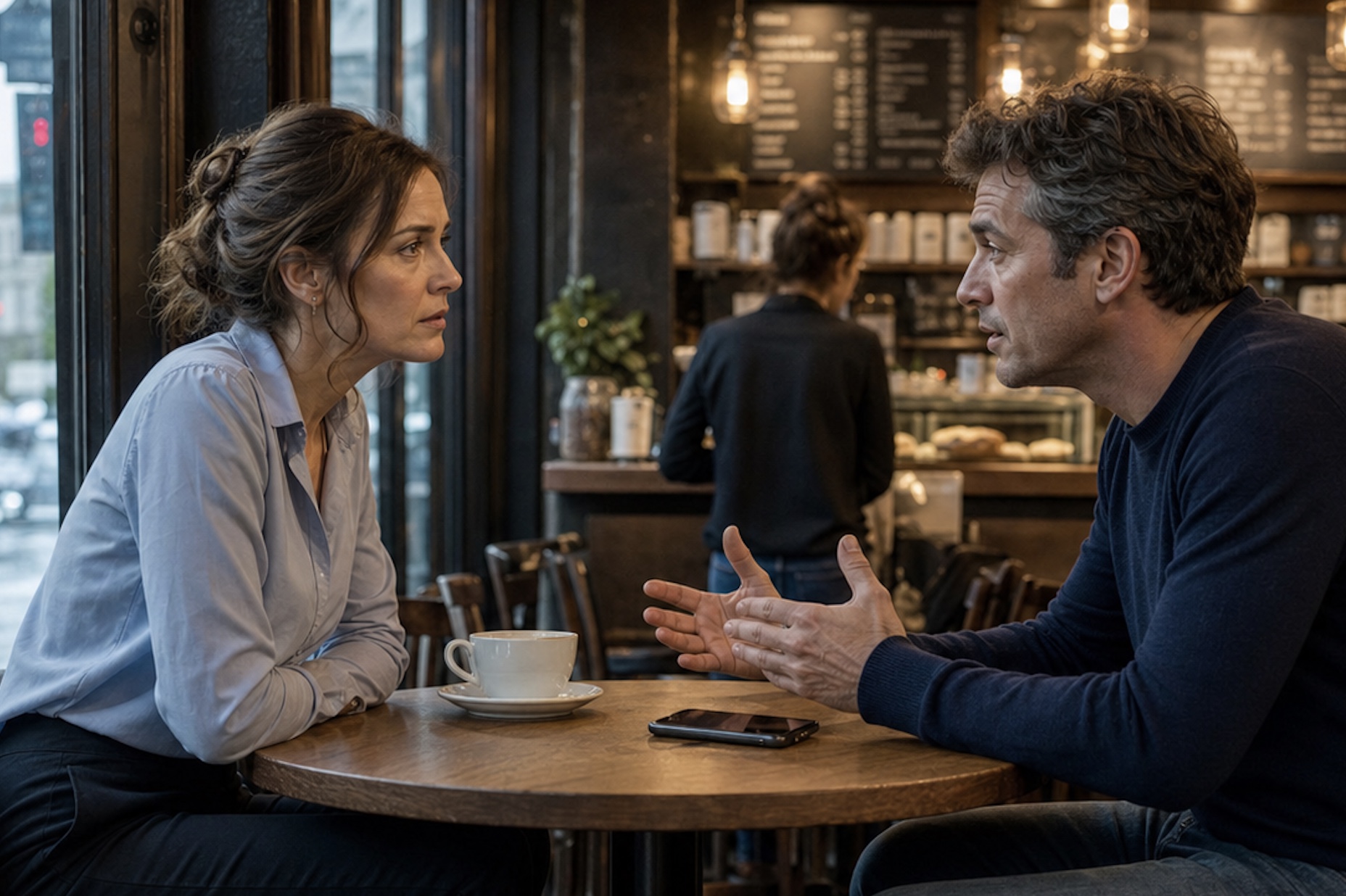
They met in a café not far from her office. He was already sitting at a table when she walked in. What surprised her was that he looked worse. He was supposed to be happy now. But she saw no happiness.
“Hi,” he said.
“Hi.”
She ordered coffee.
He ordered nothing.
“How are you?” he asked.
“Fine. You wanted to talk, so talk.”
He folded his hands on the table again.
The same posture — as if he were in a doctor’s office.
“Svetka had a pipe burst in her apartment,” he began. “Inside the walls. They need to open everything up and replace the riser. It’s urgent and expensive. She can’t handle it alone.”
Sveta was his sister.
Nastya was silent for a moment.
“And?”
“And I thought… you two always got along well. She loves you. Maybe you could…”
“What?”
“Help. Lend her the money. She’ll pay it back. She’s just in a really hard place right now.”
Nastya looked at him.
Soft music played in the café. At the next table, a couple was laughing. The air smelled of coffee and cinnamon.
“Tolya,” she said slowly, “you filed for divorce. Why on earth should I help your relatives?” she asked, more bewildered than angry, almost with childlike disbelief.
He winced.
“We’re not divorced yet. Officially, we’re still husband and wife.”
“And in reality?”
“In reality…” He hesitated. “Nastya, Sveta has nothing to do with this. She isn’t to blame for our divorce. She never hurt you.”
“Sveta didn’t hurt me,” Nastya agreed. “But Sveta is your sister. Your responsibility. Not mine.”
“I can’t right now! I have my own—”
“Your own what?” She leaned forward slightly. “You work, don’t you? Does your Lena work?”
He said nothing.
That was an answer.
“I see,” Nastya said. “So she’s gentle and warm, but there isn’t enough money for your sister’s pipes.”
“Don’t do that.”
“Do what? Tell the truth?”
He took a napkin and crushed it in his fist.
“Nastya, I understand you have reasons to be angry with me. You do. I’m not denying that. But I’m asking you not to take it out on Sveta. She really is in a difficult situation.”
“Am I taking it out on Sveta? I’m talking to you. And I’m telling you: no.”
Silence.
“Is that all?” she asked. “Or is there something else?”
He hesitated.
Then he said it anyway.
“Dima’s roof is leaking at the dacha. It needs to be patched before winter, or everything will rot.”
“Dima. Your brother.”
“Yes.”
“Anything else?”
“Mom. She needs to undergo some tests. The doctor referred her, but it’s paid, and she… she doesn’t want to ask you, but I thought…”
“Stop.” Nastya raised her hand. “Wait. So: Sveta’s pipes, Dima’s roof, your mother’s medical tests. All of this is happening right now, all at once, within a month of you filing for divorce.”
“That’s just how it happened.”
“That’s just how it happened,” she repeated slowly, letting the words settle. “Tolya, do you hear yourself?”
“I understand how it sounds.”
“Really?” She leaned back in her chair. “Then explain it to me, because I want to make sure I understand correctly. You told me I was a machine. That you no longer felt drawn to me. That you had found someone better. You filed for divorce. And three weeks later, you came to ask me for money for your family.”
“Not money. Help.”
“It’s the same thing.”
“They’re not strangers to you!”
“They will become strangers the moment the court stamps the papers. You chose that yourself.”
He looked at her — and she could see he was angry.
Not because she was wrong, but because she was right.
It was the anger of a cornered man who had nothing meaningful left to say.
“Mom always loved you,” he said quietly.
“Really?” Nastya thought for a moment. “Maybe. Or maybe she simply liked that Tolya had a wife who earned good money. It’s hard to tell now.”
“That’s cruel.”
“You were the one who told me people communicate with me because of money. Literally. With that mouth. Three weeks ago. Did you really think I would forget?”
He lowered his eyes.
“I said too much.”
“A lot too much,” she agreed. “But some things, Tolya, are said precisely when people stop holding themselves back. When there’s nothing left to lose. Maybe that was the truth — your truth, the way you see me. And in that case, I have one question: why should I help the family of a man who believes nobody loves me and that I’m only needed as a source of money?”
The silence between them grew heavy and dense.
“Nastya,” he said at last, “you’re not that kind of person. You can’t just turn away and leave.”
She finished her coffee.
Set the cup down.
“Tolya, three weeks ago, I thought the same thing about you.”
She left the café and stepped into the November evening. The streetlights were already glowing. The wet asphalt shone. She walked toward her car and thought about what he had said.
“You’re not that kind of person.”
What kind of person was she, then?
She had helped all her life.
Her parents. Her sister. Colleagues. The neighbor from the third floor who needed someone to take her cat to the vet. She helped quietly, without expecting gratitude — simply because she could, because she had money, time, strength. Because it seemed to her that this was how the world worked, how connections between people were built.
But now, standing beside her car, she thought that perhaps he had been right about one thing.
Not that nobody loved her.
But that she herself had allowed her relationships to become that way.
She had allowed money to become the language of closeness.
She transferred money instead of calling.
Solved problems instead of asking questions.
Earned instead of simply being present.
But that was her story with her own people.
With her mother. With her sister.
That was hers to figure out, hers to rethink, hers to change — if she wanted to.
But Sveta with her leaking pipes, Dima with his rotting roof, and her mother-in-law with her paid medical tests — that was not her story.
It would have been her story if they were still a family.
But family is not a stamp in a passport that simply hasn’t been canceled yet.
She got into the car.
Started the engine.
Her phone vibrated again.
This time it wasn’t Tolya.
It was Svetlana.
Nastya looked at the screen.
Held the phone in her hand for a moment.
Then placed it on the passenger seat, face down.
Maybe Sveta really did love her.
In her own way, as best she knew how.
Maybe she really was struggling now — with the pipes, and with everything else. Her brother was getting divorced, after all. That was always painful. It broke the familiar order of things. It was frightening.
But.
There are things a person must understand on their own.
And one of them is this: you cannot push someone away and then expect her to keep feeding you.
Nastya drove out of the parking lot.
Turned on the radio.
Outside the window, the November city drifted past — wet and dark.
She thought that once everything was over, she would call her mother.
Just like that.
She would ask how she was feeling, what she had made for dinner, whether she had watched the series she had mentioned last time.
She would simply talk to her.
Like one person to another.
That, perhaps, was what needed to change.
Not because Tolya had said it.
But because she herself had finally understood.
The divorce was finalized in February.
The judge asked whether the parties wished to reconcile.
Both parties said no.
Nastya stepped out of the courthouse, lifted her face to the February sun, and thought:
Well, there it is.
That’s it.
She took out her phone and called her mother.
“Mom, hi. How are you? No, everything’s fine. I just missed you. Tell me something.”
And her mother — surprised, delighted, a little flustered by such an unusual call — began to talk.
About the neighbor.
About the cat.
About the TV series.
About how she had found old photos from the dacha, where Nastya was little, with braids in her hair.
Nastya listened as she walked down the February street, her face turned toward the sun.