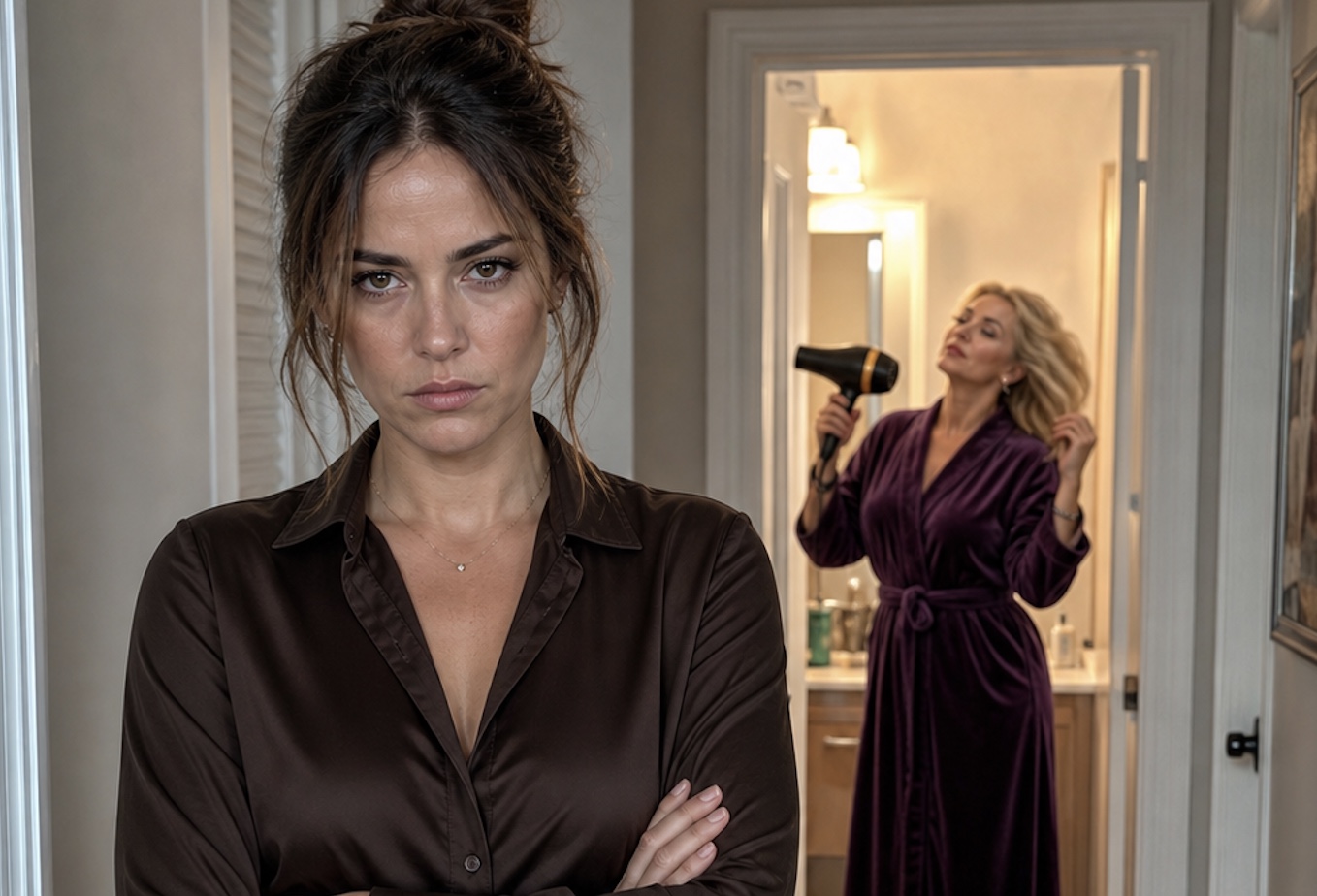
“I’m in my son’s home, so that makes me the mistress of the house!” Rimma Markovna announced loudly, dropping her enormous plaid bag onto our hallway floor with a heavy thud.
She had far too much faith in that key.
More precisely, in Misha’s spare key — the one my husband had naively given her a year earlier “just in case of an emergency.” No emergency ever happened. Instead, my mother-in-law arrived from Saratov on a Tuesday evening, right when Misha and I had finally sat down to dinner after a twelve-hour workday.
To be honest, I didn’t even put my fork down. I just sat there and watched as this woman, who had spent thirty years working as a cashier in a factory canteen, pushed my shoes aside with the air of an owner and sailed into the kitchen of our rented two-room Moscow apartment as if she had come to inspect her private estate.
Misha, a window installer with golden hands and angelic patience — at least up to a certain point — choked on his pasta. We were saving every possible ruble for a mortgage down payment. I was taking extra shifts at Sberbank, working with loan applications, while Misha rushed from one job site to another without weekends. We had no energy for guests. And we definitely had no energy for Rimma Markovna, whom we had tearfully begged just a month earlier to postpone her visit until winter.
“Mom, why didn’t you call first?” Misha asked carefully, pushing his plate away.
“What, am I visiting strangers now, that I need to ask permission?” my mother-in-law shot back, running her finger along the edge of the refrigerator with disgust. “Olya, you have dust here. And what kind of miserable dinner is this? Pasta? My son works with his hands. He needs meat, rich borscht!”
I took a deep breath. The secret to surviving Rimma Markovna was to treat her like a natural disaster. You can’t outshout hail; you just have to wait it out under a roof.
“There’s borscht in the fridge, Rimma Markovna,” I answered calmly. “From yesterday. It’s had time to sit. Shall I warm it up?”
“I can warm it myself. I’m not some fine lady,” she snorted, immediately beginning to rattle the pots and rearrange everything in a way that suited her.
And so began a week of absurdity.
Rimma Markovna methodically turned our life into a branch of her old canteen. She rearranged my clothes in the wardrobe because “blouses aren’t supposed to hang like that,” threw away my favorite blue cheese after calling it “rotten filth,” and delivered daily lectures about how I mismanaged the family budget.
“You need to save in gold!” she declared one evening, stirring tea with my favorite spoon as if she owned it. “Your bank papers will burn, but gold will remain. Back in my day, I bought a ring…”
“Rimma Markovna, physical gold currently comes with a huge banking spread, and our deposit earns twelve percent with capitalization,” I replied evenly while slicing apples. “Besides, you can’t pay for cement at a hardware store with gold rings.”
“Oh, look at her, so painfully clever! Little accountant! Ugh, it makes me sick to listen to you. No respect for your elders!” she shrieked, then swept out of the room with her chin raised, like an offended empress who had been served proletarian barley instead of roasted game.
But the real surprise was waiting for us on Friday.
At breakfast, while spreading butter on her bread in a layer as thick as a finger, Rimma Markovna casually announced:
“Anzhelka is coming tomorrow. My school friend.”
Misha and I froze at the same time.
“What Anzhelka?” my husband asked, stopping with his cup halfway to his mouth.
“Borisovna. We sat at the same desk in school. Can you imagine, all her life she dreamed of seeing Mikhail Shufutinsky at the Kremlin Palace! He gives a concert once a year, on his birthday. She got a ticket! She’ll stay with us for a week. Only her back is bad, so she’ll sleep in your bed. You have that orthopedic mattress. And you two can make do on the folding bed in the kitchen. You’re young.”
A thick, heavy silence fell over the kitchen.
Misha looked at me in confusion. I carefully placed the knife on the table.
That was the line. The one that could not be crossed.
“Rimma Markovna,” I said quietly, but in such a tone that my husband instinctively drew his head into his shoulders. “Angela Borisovna may come. She may sleep on the sofa in the living room. But no one will sleep in our bedroom, in our bed. Ever. That is private territory.”
“How dare you?!” my mother-in-law turned so red she looked like an overripe tomato. “This is my son’s apartment! I make the decisions here!”
“This is a rented apartment, which Misha and I pay for equally,” I cut her off. “The sofa in the living room or a hotel. The choice is yours.”
All the next day, my mother-in-law wandered around the apartment with the face of a martyr, preparing to welcome “an intelligent person, unlike some people.” I mentally prepared for battle, imagining Angela Borisovna as another loud, shameless woman just like her.
But that evening, a short, slender woman in an elegant coat appeared at the door, with intelligent, slightly tired eyes. A literature teacher.
“Olenka, Mikhail, please forgive me for intruding,” she said first thing as she took off her shoes. “Rimma assured me you were eager to host me. If I am inconveniencing you, I’ll rent a hotel room. I have money.”
“Don’t be silly, Anzhelochka, come in!” my mother-in-law fussed, trying to push me aside with her shoulder. “I’ll show you their bedroom now. Royal bedding!”
“Rimma, stop,” Angela Borisovna suddenly said sternly.
Her voice was not loud, but it had that teacherly steel that can silence a classroom of thirty troublemakers.
“I will sleep wherever the hosts tell me to sleep. End of discussion.”
During dinner, it turned out that Angela Borisovna was a wonderful conversationalist. We talked for two hours.
“By the way, Olenka,” she smiled as I poured her tea, “do you know why so many people get irritated when the Russian word for ‘coffee’ is used in the neuter gender? Historically, it comes from the word ‘kofiy,’ which was masculine. But language is alive. If you’re in a hurry and say something like ‘one black coffee’ in the neuter form, the sky won’t fall. Dictionaries already allow it in colloquial speech. Still, good, quality coffee is always masculine. Just like a good husband — strong and dependable.”
Hearing this, Misha proudly straightened his back, while Rimma Markovna sat there blacker than a storm cloud.
She had brought her friend to demonstrate her power over her daughter-in-law, but in the end, she was the one pushed to the edge of the celebration. Angela and I discussed books, mortgage rates, and different types of window profiles — which, as it turned out, the teacher understood very well after her recent renovation.
My mother-in-law was furious.
Her plan for triumph had collapsed with a crash.
The Shufutinsky concert went wonderfully. Angela Borisovna left happy, leaving us a basket of Saratov delicacies. And the next morning, Rimma Markovna began packing her own bags.
I was getting ready for work. When I went into the bathroom, I reached for my favorite expensive hair dryer, the one I had saved for over several months. I picked it up and immediately realized the nozzle was loose. The plastic attachment had been snapped off at the base. On the sink beside it lay a stranger’s gray hair.
I stepped into the hallway.
Rimma Markovna was already standing there in her coat, clutching her plaid bag. A small, spiteful smirk played across her face.
“What, did that Chinese junk break?” she asked innocently. “I only wanted to curl my bangs a little, and it fell apart in my hands. You should buy proper things instead of wasting money.”
I didn’t scream.
I didn’t cry.
I simply turned to Misha, who was just zipping up his jacket before leaving for a job site. He smelled of mounting foam and cold morning air — the smell of hard, honest work.
“Misha, come here, please,” I said.
He came over.
I handed him the broken hair dryer.
“This hair dryer costs twenty-five thousand rubles, Misha. That is almost half a square meter of our future balcony. Rimma Markovna broke the attachment by force because she couldn’t remove the nozzle.”
Misha looked at the hair dryer.
Then he looked at his mother.
Something clicked in his eyes. That blind son’s veil, the one that had justified his mother’s “difficult character” for years, suddenly fell away. He no longer saw a caring mother. He saw a woman who had ruined his wife’s possession out of petty spite while she was at work.
“Mom,” Misha said, his voice quiet like the air before a storm. “Take out the keys.”
“What?” my mother-in-law froze, and all her arrogance vanished at once.
“The keys to our apartment. Take them out and put them on the hallway table.”
“Mishenka, son, what are you saying? You don’t believe your own mother because of some piece of plastic? She was the one trying to drive me out!”
“The keys, Mom.”
With trembling hands, Rimma Markovna dug into her bag and pulled out her keychain. She removed the duplicate key and threw it onto the hallway table with a sharp metallic clink.
The door closed behind her.
Silence settled over the apartment. But it was not an empty, ringing silence. It was the peace of a fortress reclaimed.
Misha silently wrapped his arm around my shoulders and buried his nose in the top of my head. And in that moment, I understood that a ruined hair dryer was the cheapest price we could have paid to make sure there would never again be any outsider calling herself the mistress of our home.