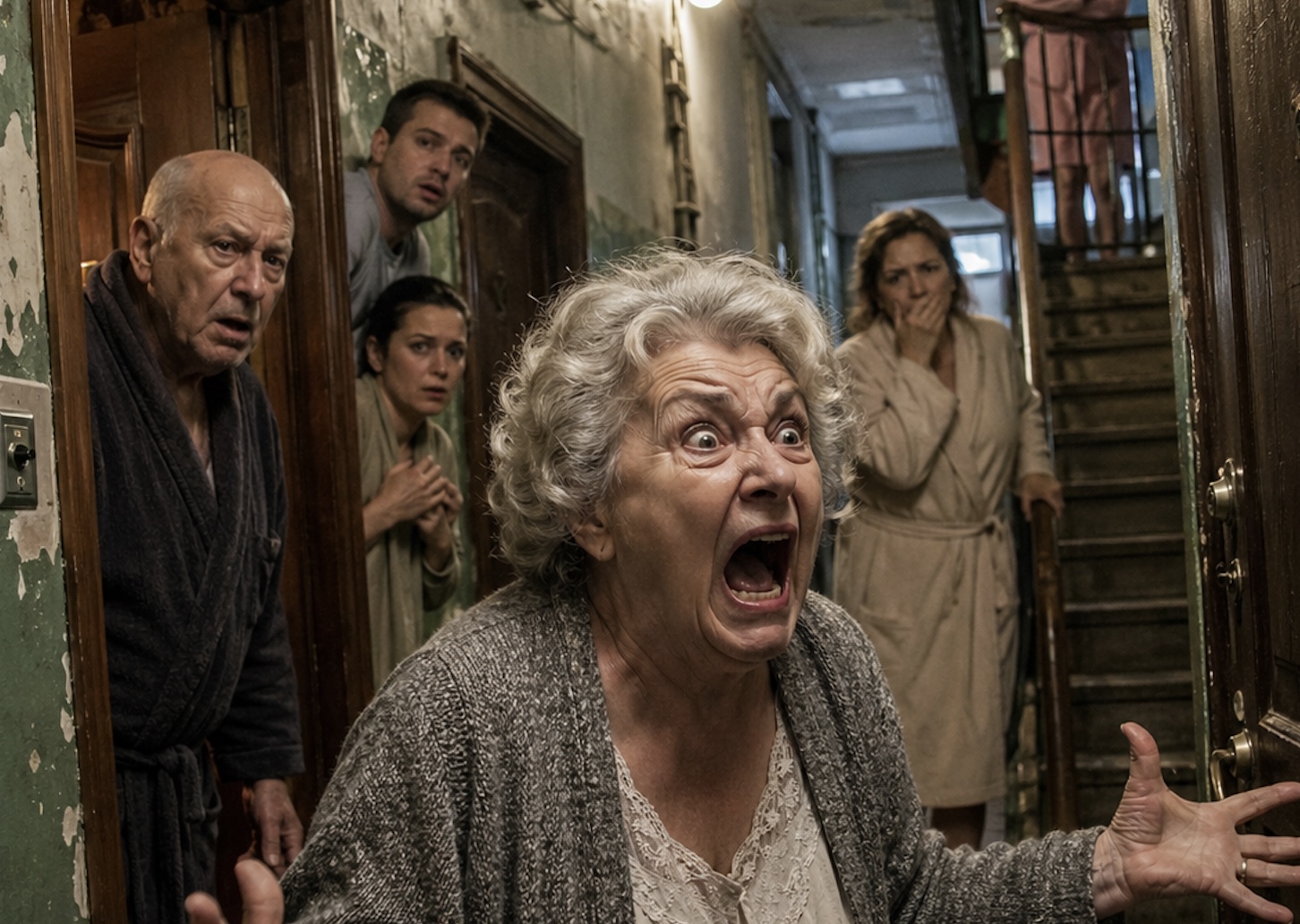
My mother-in-law’s scream — shrill, drawn-out, like an air-raid siren — jolted not only me awake, but probably everyone in the building, from the ground floor all the way up to the attic.
It was five in the morning.
I stood on the other side of the metal door, my back pressed against the cool hallway wall, listening to the performance. In my hand I held a key on a long metal keychain — the old key my mother-in-law, Lyudmila Petrovna, could no longer force into the lock that morning.
“How dare you?!” my husband Sergey shouted, his voice joining hers in a horrible duet. He pounded on the door so hard that flakes of whitewash drifted from the ceiling into my entryway. “Open this door right now, you idiot! Have you completely lost your mind?!”
I said nothing. I was smiling. In the darkness of the hallway, with its smell of old carpet and last night’s dinner, that smile probably looked more like a snarl.
I was tired. No — that word was too gentle. I had burned out completely, like a match used to set every bridge on fire.
Lyudmila Petrovna had entered our lives on the day of the wedding and never truly left. More precisely, she never left my apartment. The apartment I had inherited from my grandmother. The apartment where Sergey and I lived. At first she came “just to check in” once a week. Then every other day. Then every single day. She had her own keys — keys Sergey had made behind my back without even asking me — and he had handed them to her with the words, “Mom, this is your home too now.”
That was when my home became a branch of hell.
She checked the temperature in my refrigerator, rearranged my pots and pans the way she liked them, and criticized me if I bought the “wrong” brand of butter. My life turned into one endless exam. “Why is the soup bland?” “Why is the ironing board standing in the corner?” “Why do you look so tired?”
At first Sergey kept quiet. Then he started agreeing with her. And then, about six months ago, he started putting his hands on me.
The first time happened after I asked his mother not to move my cosmetics around in the bathroom. I said it calmly, without raising my voice. Lyudmila Petrovna called her son and told him I had thrown her out and called her an old fool. When Sergey came home, he didn’t even try to hear my side. He hit me for the first time — a sharp slap across the face that left a hot red mark on my cheek.
I believed him when he said, “I’m sorry, I lost my temper, Mom wound me up.” I always believed him. Until yesterday.
Yesterday I walked into the bedroom and found Lyudmila Petrovna going through my personal things in the wardrobe. When I protested, she looked at me with the cold superiority people reserve for an annoying piece of furniture. “I’m putting things in order,” she said.
I looked at Sergey. He was in the living room, drinking beer and pretending to watch television. He said nothing. And when I tried to tell his mother to leave, he jumped up. The second time in six months. But this time he didn’t stop at a slap. First he struck my shoulder, then grabbed my arm so hard I felt my bones grind, and hissed, “Don’t you dare open your mouth against my mother.”
That was the moment I stopped crying. Something inside me simply snapped and went still, like a mechanism that had run out of spring.
I waited until they fell asleep. Sergey was snoring on the couch, and Lyudmila Petrovna had proudly retired to “her room” — because she believed she could stay overnight whenever she pleased. I dressed quietly, took my documents and my laptop, and left. I didn’t sleep all night. I sat in a 24-hour coffee shop, drinking bitter espresso and waiting for locksmiths to open in the morning. I didn’t have much money, but I had enough for a new, secure cylinder lock.
When I came back in the morning, the apartment was empty. Sergey had left for his night shift, and his mother had gone home, leaving behind a mountain of dirty dishes and the television blaring at full volume. I called a locksmith. In an hour and a half, he replaced the lock on the front door.
I wanted nothing connecting me to them anymore.
I took the day off work, stuffed Sergey’s clothes into two large trash bags — not suitcases, trash bags, because he did not deserve that kind of respect for his belongings — and put them out on the landing. Lyudmila Petrovna’s things I packed neatly into a box and placed on top.
So when they came back at five in the morning after the early train, they found a surprise waiting for them.
“Open up!” Sergey and my mother-in-law screamed, kicking the door. “Who do you think you are, throwing my things out? This is my apartment too! I’m registered here!”
I took a deep breath. My voice did not shake. For the first time in two years, I spoke calmly, loudly, and clearly, knowing that every neighbor was awake by now, pressed to their peepholes.
“Sergey,” I said through the door, “the apartment is legally mine. I got it two years before I ever met you. You may be registered here, but that does not give you the right to raise a hand against me.”
“I never hit you!” he shouted instantly. “You provoked me!”
“I’m filing for divorce this morning,” I cut in, feeling a strange, almost painful lightness spreading through me. “The paperwork is already prepared. From now on, you can live with your mother. Let her take care of you. Let her cook your favorite soup, iron your shirts, and make excuses for your fists.”
Silence fell outside the door — thick enough that I could hear the rustle of the trash bag Sergey was probably trying to pick up from the floor.
“You…” my mother-in-law’s voice shot upward into a shrill falsetto. “How dare you speak to your husband like that?! Who gave you permission? He’s the provider! He took pity on you and let you live with him! And you — who do you think you are? Without him, you—”
“Lyudmila Petrovna,” I interrupted again, and for the first time there was steel in my voice — the very steel everyone had always said I lacked. “Shut up.”
She choked on her own words. Sergey made a sound like an enraged bull.
“Your son beat me,” I continued, still without shouting, but pronouncing every word like a verdict. “I have bruises on my shoulder and arm. Today I’m going to have them officially documented. And if either of you comes anywhere near this door again, I will go to the police and file a harassment report. You have your own apartment, Lyudmila Petrovna. And I sincerely wish Sergey luck finding a woman willing to tolerate his temper and his mommy.”
“You’ll regret this!” he spat at last, no longer kicking the door. Apparently it was finally sinking in that concrete is stronger than fists, and iron does not yield to shouting.
“I already do,” I whispered so quietly they couldn’t hear. I regret not doing this sooner.
I stepped away from the door. I could hear my mother-in-law sniffling and lamenting, “My poor boy, what is she doing, that snake,” while Sergey tried to calm her down. But the rage had drained from his voice. What remained was confusion.
They lingered on the landing for another ten minutes. I heard Lyudmila Petrovna frantically trying to force her old key into the new lock, as if sheer desperation could somehow change reality. Then came the sound of the box falling, the rustle of the bags, and finally the slam of the elevator doors.
Then it was quiet.
Truly quiet.
I walked into the kitchen. Yesterday’s cup was still on the table, untouched. I switched on the kettle and looked out the window. The dawn over the city was cold and gray, but unbelievably beautiful. My mother-in-law and Sergey came out of the building. She was carrying the box, and he was dragging the two black bags. They walked slowly, glancing up at the windows as though they still hoped I would come running after them, fall to my knees, and beg them to return.
I watched them from above. I watched them get into Sergey’s old car, and all I felt was emptiness.
But it was a good emptiness.
The kind that remains after a poisoned tooth finally has its nerve removed.
At nine o’clock I was sitting in a lawyer’s office. At ten, I was at the emergency clinic, where a tired elderly doctor sighed when he saw the dark finger-shaped bruises on my arm and silently filled out the paperwork.
That evening Lyudmila Petrovna called me from someone else’s number. I answered because I was expecting a call from a courier.
“Marina,” she said, her voice sweet as spun sugar, “what is all this? Sergey is so upset. Come over, let’s talk calmly. People argue, it happens. But why change the locks? Are we strangers now?”
I listened to her, and for the first time, I wasn’t shaking. I wasn’t trembling. I felt like a tree with deep, powerful roots.
“Lyudmila Petrovna,” I said, “you really are strangers to me now. Please don’t call me again.”
I ended the call and blocked the number.
Inside that apartment — the apartment that no longer smelled of чужой criticism and fear, but of peace — a new life was beginning.
Quiet. Free. Mine.