The wall clock in the kitchen ticked steadily, measuring out the minutes. Outside, the spring dusk was slowly thickening. Her father had left for the night shift at the rail depot over an hour ago, and her younger brother was still at practice.
A special kind of silence hung over the apartment — the heavy, concentrated silence that only appears when two people who love each other are about to have a very serious conversation.
Daria sat at the table, both hands wrapped around a hot mug of tea. She was not drinking it. She only watched the steam curl up from the dark surface and kept tracing the chipped edge of the cup with her thumb.
Across from her, her mother, Elena Viktorovna, sat down after setting aside a kitchen towel. She knew her daughter well. Dasha was not the kind of woman who created drama for no reason or talked endlessly about nonsense.
If Dasha had come over on a weekday evening without warning and asked to speak privately, then something truly important had happened.
“Pasha proposed to me,” Daria said quietly, placing her left hand on the table.
A gold ring with a neat little stone glimmered faintly on her ring finger.
Elena Viktorovna gasped and instinctively pressed both hands to her mouth. Her face lit up with a warm, heartfelt smile.
“Dasha! My God, finally! Then why are you sitting there looking like you’ve just been approved for a mortgage at thirty percent interest?”
Daria gave a small laugh, but there was bitterness in it. She took her hand back, as if the ring had suddenly grown heavy.
“I asked him for a week to think, Mom. I told him it was unexpected and that I needed time to weigh everything carefully.”
The smile slowly faded from Elena Viktorovna’s face. She frowned.
“I don’t understand. You’ve been together for a year. Pavel is a perfect catch. He’s a department head, earns great money, doesn’t drink, doesn’t even swear, brings you flowers every week. He always helps you with your coat, always opens the door for you. Isn’t that exactly the kind of man you always wanted?”
“It is,” Daria nodded. “I have no complaints about Pasha himself. He really is good. Caring. Reliable. I felt safe with him, like I was behind a stone wall. Up until last weekend, when he took me to meet his family.”
Elena Viktorovna pulled her cup closer.
“And what was wrong with the family? They didn’t like you? Thought you were too ordinary for them?”
“If only,” Dasha sighed heavily. “It would have been easier if they had simply disliked me. It’s much worse than that, Mom.”
And Daria began to tell her everything. With every word, Elena Viktorovna’s eyebrows rose higher.
Pavel’s family consisted of his mother, Olga Petrovna, and his younger sister, Kristina. His father had died five years earlier of heart trouble.
Olga Petrovna was only fifty-two — well-kept, attractive, always perfectly styled, with a fresh manicure. But she had never worked a day in her life.
When her husband was alive, she had devoted herself to “creating a warm home.” After his death, she smoothly transferred the role of family provider onto her eldest son’s shoulders. Kristina was twenty, studying at an expensive prestigious university, and she too saw no reason to burden herself with even part-time work.
“Do you understand, Mom? They live in this huge four-room apartment,” Daria explained. “The utilities alone must be enormous. Then there’s Kristina’s tuition. Food. Clothes. Olga Petrovna’s beauty appointments. Her yearly trips to the seaside. Pasha pays for all of it. Every last bit. He fully supports two healthy adult women.”
Elena Viktorovna shook her head in disbelief.
“Fifty-two… Women that age at our factory take double shifts just to help their grandchildren. And she just stays home? She never even tried to get a job?”
“Pasha says his mother has delicate health and a sensitive soul,” Daria said with a grimace. “And little Kristina ‘needs to focus on her studies and not spread herself too thin.’”
“And that scares you?” her mother asked directly.
“It terrifies me,” Daria admitted honestly. “Mom, I’m twenty-eight. I want a family. I want two children, preferably close in age. If I go on maternity leave, my income drops to almost nothing. Will Pasha be able to support five people? Me, the baby, himself, his mother, and his adult sister? What if someone gets sick? What if there’s a financial crisis?”
Elena Viktorovna was quiet for a long time, staring out the window. She understood her daughter’s fears. Dasha had been working hard since she was eighteen: first juggling school and shifts as a waitress, then climbing her way up from the bottom in a logistics company.
She had bought her cozy two-bedroom apartment on her own, taking on a mortgage she was paying off ahead of schedule by skipping vacations and denying herself luxuries. She knew the value of every ruble she earned.
“You know what, sweetheart,” Elena Viktorovna said at last, “don’t work yourself into a panic before you have all the facts. Men often don’t understand how a household budget works until someone spells it out for them. Maybe he has a plan. Savings. Investments. Maybe he intends to make his sister get a job once she graduates.”
“You think so?”
“I think these things need to be discussed before the wedding march starts playing,” her mother said firmly. “Meet with him. Start simple: ask where the two of you would live. Then move gently into money and maternity leave. Watch how he reacts, and you’ll understand everything.”
They met on Friday evening at their favorite little Italian restaurant in the city center.
It was a cozy place with dim lighting, the smell of basil and baked garlic floating in the air.
Pavel arrived carrying a huge bouquet of cream-colored peonies. He looked wonderful: a crisp shirt, a perfectly fitted blazer, and genuine tenderness in his eyes. He ordered their favorite pizza, poured wine into their glasses, covered Dasha’s hand with his warm palm, and asked:
“So, my love? The week is over. Is my poor, suffering fiancé finally going to get an answer?”
Daria gently slipped her fingers free and picked up her glass. Her heart was pounding somewhere in her throat, but her voice came out calm.
“Pasha, I love you very much. And I do want to say yes. But we’re adults. Let’s talk things through in advance, so there won’t be unpleasant surprises later. We need to discuss practical life.”
Pavel smiled indulgently and leaned back against the booth.
“Practical life? Dasha, what practical life? I earn enough so that you’ll never have to worry about money. You won’t have to count every penny from paycheck to paycheck.”
“I understand that. But let’s start with something simple. Where would we live? My apartment is almost fully paid off, it has a nice renovation, a bedroom and a living room. If we have a child, there’s enough room. The only downside is that it’s about forty minutes from your office in traffic.”
The smile on Pavel’s face tightened slightly.
“In your little two-room place? Dasha, why would we squeeze ourselves into two rooms on the outskirts when we have a beautiful four-room Stalin-era apartment? My room alone is twenty square meters. We’ll do a bit of redecorating to match your taste.”
Daria went still.
“Wait. You’re suggesting I move in with your mother and sister?”
“Well, of course. Where else? It’s my family home.”
“Pasha,” Daria said carefully, keeping her voice as gentle as she could, “but your mother is already the mistress of that home. Two women trying to run one kitchen never ends well. I want to be the true homemaker in my own house. I want to decide where the mugs go, when the floors get cleaned, what I wear in the morning.”
Pavel laughed — lightheartedly, even with relief.
“Oh, darling, don’t be silly. Why would that be a problem? Two homemakers? Mom only goes into the kitchen to make coffee. She hates cooking. Back when Dad was alive, the housekeeper handled all of that. And Kristina either orders food or lives on yogurt. You’d be the unquestioned queen of the pots and pans! Nobody would interfere with your rules. On the contrary, Mom would be thrilled if you took over the cooking and cleaning. To be honest, things have gotten a bit messy since Dad died. It’s hard for her to manage everything.”
Daria stared at him, unable to believe what she was hearing. He said it all with such innocent sincerity, with such genuine pride in his plan.
He was not offering her the role of a wife.
He was offering her the position of unpaid help — a replacement housekeeper for two grown women who did not work.
“So after work I’m supposed to come to your family apartment and cook dinner for four? And clean a four-room place?”
“Well, why ‘supposed to’?” Pavel frowned slightly. “Just as a woman does for her family. You cook well. What, are you really going to begrudge my mother a bowl of soup?”
Daria set down her napkin. Tension tightened across her shoulders.
“Pasha, it isn’t about one bowl of soup. It’s about time and energy. But fine, let’s leave the cleaning aside for a moment. Let’s talk about money. How do you see our finances working if we get married?”
Pavel relaxed a little, finally on familiar ground.
“It’s simple. My salary is our shared budget. Your salary is yours for shoes and little things — or for the household too, if you want. I provide for the family completely.”
“By ‘family,’ you mean me, you, your mother, and Kristina?” Daria asked.
“Well, yes. Mom won’t be able to find work at her age, and besides, she’s never worked before. Her blood pressure goes up and down. Kristina still has a year and a half of school left. Obviously I’m not going to abandon them.”
Under the table, Daria clasped her hands together tightly.
“All right. And what happens if I get pregnant? I go on maternity leave. My salary disappears. We’ll have expenses for a stroller, diapers, formula, doctors. Will your salary cover the three of us, plus the utilities on the big apartment, Kristina’s tuition, and your mother’s beauty appointments?”
Something changed in Pavel’s face. The warm smile vanished, replaced by businesslike focus. He leaned forward.
“Dasha, let’s be realistic. Children are a massive expense. And a huge responsibility. Why rush? I’m thirty-two, you’re twenty-eight. We’re still young. Let’s live for ourselves for a while. In five years Kristina will finish university, get married, move out. Mom might finally start getting a pension that helps a little. Then we can think about children. Calmly. Without stress.”
Five years.
She would be thirty-three by then.
And what if they could not conceive right away? What if Kristina never got married? What if Olga Petrovna suddenly needed an expensive private clinic?
Her mother’s advice flashed through her mind: test him, and you’ll know.
Daria took a slow breath.
“Pasha, I forgot to tell you. Last week my boss called me into his office. The head of our department is retiring, and they’re offering the position to me. My salary would almost double. I wasn’t sure whether I should accept that kind of workload if we’re planning a wedding and children…”
Pavel’s eyes practically lit up. He grabbed her hand again, this time tightly, with excitement.
“Seriously? Dasha, that’s incredible! Of course you should take it! Why are you even hesitating? This changes everything! Look — you move in with us. We rent out your apartment — it’s in a good area, so it should bring in a solid monthly income. Then add your new salary. We could finally send Mom to Kislovodsk! Her joints have been bothering her, she needs a proper health resort. She hasn’t been to the seaside in two years. And I could finally replace my car, because Kristina’s tuition loans eat up all the extra money.”
He was speaking quickly, enthusiastically, already making plans for her money. Her apartment. Her promotion.
Daria looked at him, and the veil of love slipped from her eyes, revealing a reality so sharp and sobering it almost hurt. He was not a bad man. He simply and sincerely believed that the entire world should revolve around his mother’s and sister’s comfort.
And in that system, a wife had only one purpose: an extra set of hands to care for the family apartment, and another source of money to finance holidays and conveniences.
“So let me get this straight,” Daria said quietly, every word precise and cold. “We rent out my apartment. My salary goes into the family budget. We postpone having children for five years so your mother can go to a spa?”
Pavel stopped short. The enthusiasm drained from his face and hardened into irritation.
“Dasha, what is this tone? Why are you splitting everything into ‘yours’ and ‘mine’? We’re supposed to be a family!”
“We are not a family, Pasha. And under those conditions, we never will be.” Daria drew her hands back and sat up straighter. “I am not renting out my apartment so your mother can go on health vacations. I am not coming home after work to serve in your four-room apartment and clean up after a healthy twenty-year-old girl. And I am not postponing having my own children for five years.”
“So you begrudge a sick woman some money?” Pavel’s voice trembled with outrage, and now he made no effort to hide his anger. “My mother gave me everything! I promised my father I would take care of them!”
“Exactly, Pasha. You made that promise. I didn’t,” Daria shot back. “Your mother is fifty-two. A woman that age works as the receptionist in my office and does just fine. She could work in a library, a museum, a kindergarten, anywhere at all if she needs money. And Kristina could absolutely get a part-time job as a courier or a barista, just like thousands of other students do.”
Pavel stared at her as if he were seeing her for the first time. Red blotches crept across his face.
The mask of the caring, intelligent gentleman cracked, revealing a spoiled, rigidly self-centered man underneath.
“My mother is not going to scrub floors or sit behind some front desk!” he hissed, leaning across the table. “I won’t allow it. And you… My mother was right. The minute she heard you had a mortgage, she said, ‘Son, find a girl from our circle. That one just wants to latch onto you, move into our apartment, and drain your money.’”
For a second, Daria could not even answer. She? Drain his money? He had just spent the last few minutes assigning her salary and her apartment income to his mother’s resort trips and his own new car.
“You know, Pasha… your mother really is a wise woman. Listen to her. Find someone from your circle. A woman who will be delighted to become your family’s unpaid maid.”
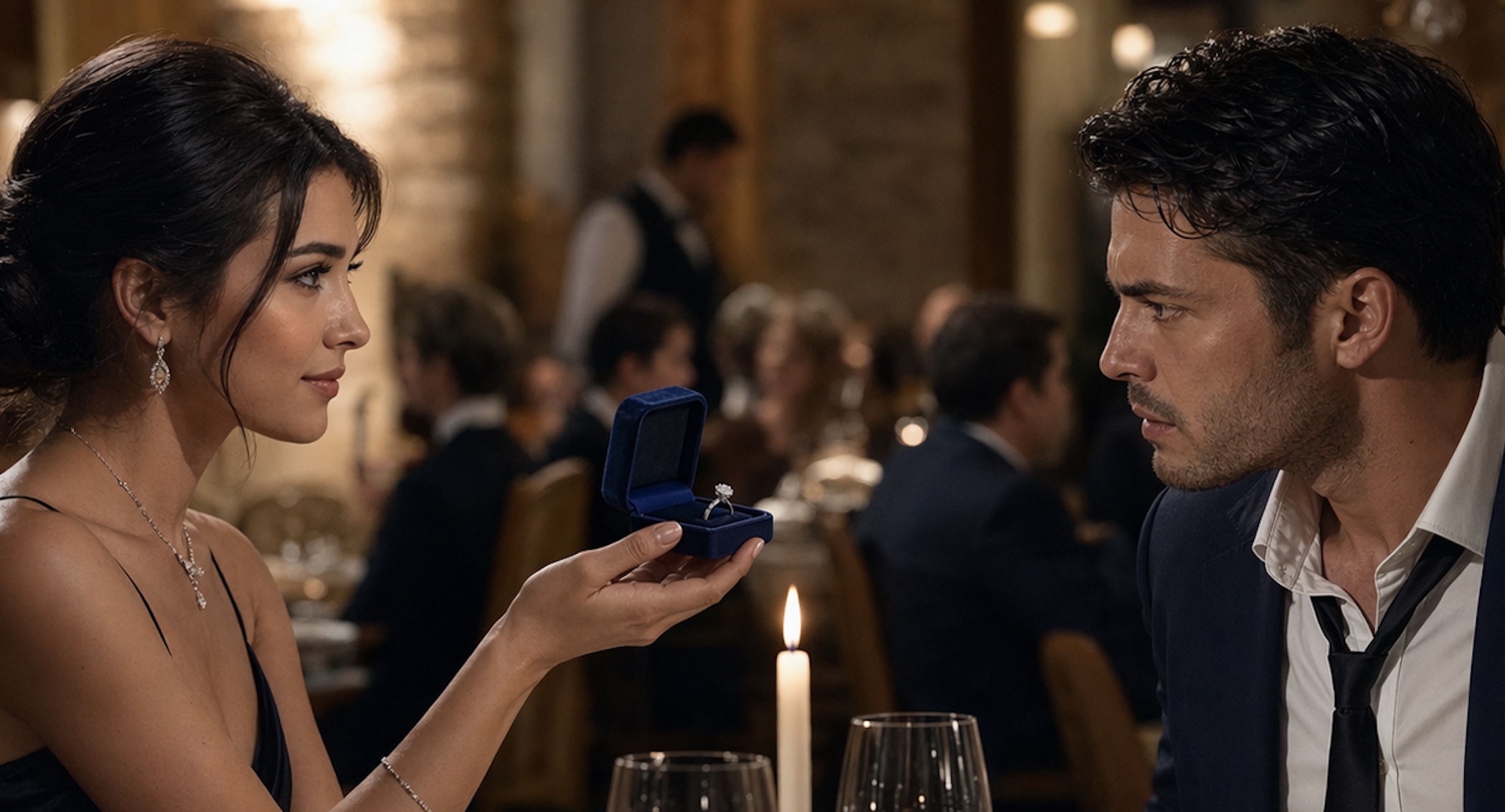
She opened her handbag, took out the velvet ring box where she had already placed the ring, and gently set it beside Pavel’s plate.
He looked down at the box. His jaw muscles twitched. Without a word, he pulled several bills from his wallet and tossed them onto the table without even looking at the check.
“Goodbye, Dasha. Enjoy your perfect, selfish little life.”
He turned sharply and walked toward the exit. He did not look back. He did not offer to drive her home.
Daria remained at the table. The waiter came over discreetly to collect the money and gave her a sympathetic glance. She only nodded, asked for the bill for her coffee, paid it, and called a taxi.
She did not get home until an hour and a half later. Even late on a Friday evening, Moscow traffic was still as brutal as ever.
When she stepped into her apartment — that same two-room apartment, lovingly furnished, the one that would never be rented out for someone else’s whims — she kicked off her shoes. She turned on the hallway light. Silence wrapped around her shoulders, but it was not the frightening silence of loneliness. It was the peace of a fortress.
She washed her face, rinsing away her makeup and the last traces of that exhausting evening. She poured herself a glass of water. Then the phone on the kitchen table vibrated. It was her mother.
“Well?” Elena Viktorovna’s voice was tense with worry.
Daria sat down on a chair and looked at her reflection in the dark window.
“We exchanged our views and agreed to remain on opposite sides,” she said with bitter irony.
“You broke up?”
“Yes, Mom. You were right. It was exactly as you expected. Worse, actually. My future promotion and the rent from my apartment had already been mentally spent on a health resort for Olga Petrovna and a new car for Pasha. And our children were postponed until his sister got married.”
There was a heavy silence on the line. Then Elena Viktorovna exhaled loudly, with unmistakable relief.
“Thank God, Dasha. Thank God you had enough sense not to run to the registry office with your eyes closed. Can you imagine what your life would have been? You’d be washing their laundry, cooking for four, pouring your salary into a shared budget, and listening to them complain that you still weren’t doing enough. Ten years of that, and you’d have no health left.”
“I know, Mom. It’s just… it hurts a little. I really did love him. And he accused me of being selfish and money-hungry so sincerely that for a second I almost believed him.”
“That’s their favorite defense, sweetheart,” her mother said softly. “When people like that realize you won’t carry them on your back, they start shouting the loudest about your selfishness.”
“Do you want me to come over?”
“No, Mom. Don’t. I’m surprised myself, but I haven’t cried at all. I just feel angry. And… lighter.”
They talked for another ten minutes. Elena Viktorovna told her to drink some chamomile tea and go to bed.
Daria ended the call. She went into the bedroom and made the bed. As she lay down, she thought about the fact that tomorrow was Saturday. She did not have to drive to a Stalin-era apartment to help “set up the household.”
On Monday, she would go to her boss and tell him she was accepting the department head position. And her money would remain her money.
As she drifted off to sleep, she felt an astonishing peace. As if she had been standing at the edge of a deep, dark pit — and had stepped back just in time.
The next morning began with bright sunlight slipping through the blinds.
Daria opened her eyes. Her head felt clear. No heaviness, no bitterness left over from the fight the night before. She stretched, got out of bed, and padded barefoot to the kitchen.
She switched on the coffee machine. It hummed to life, filling the room with the rich, slightly bitter aroma of Arabica. Dasha let her eyes travel around her bright kitchen. The spotless countertop. Her favorite yellow curtains. A place where she alone was the mistress of the house.
She poured coffee into a large mug, went to the window, and looked down at the city waking up below. Cars were already honking. People were hurrying somewhere. Life was moving forward.
She would build her real family one day. With a man who saw in her a beloved woman and the future mother of his children — not a convenient tool for solving other people’s problems.
Daria took a sip of the scalding coffee.
Everything was right.
Everything was exactly as it should be.