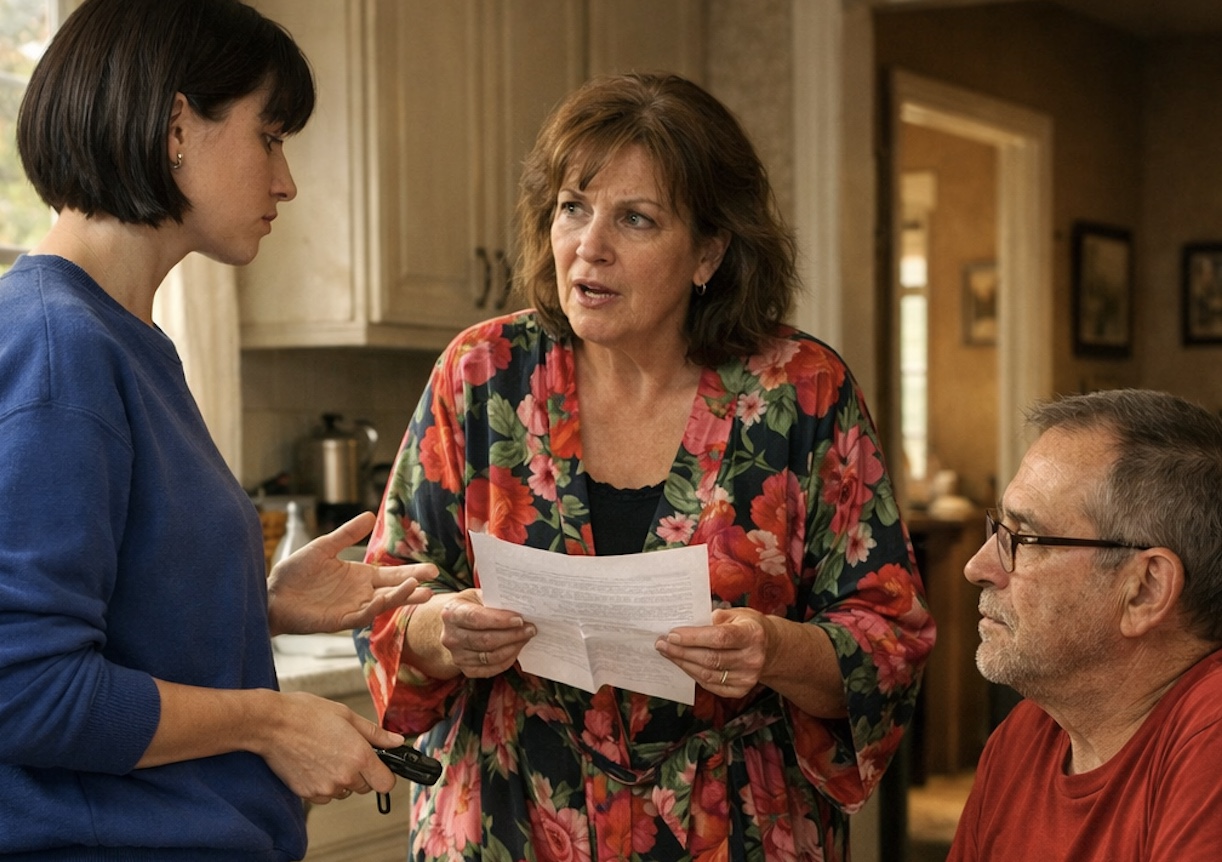
I Found Out My Parents Left Everything to My Sister, So I Stopped Paying Their Bills — A Month Later My Mother Called: “Sweetheart, the utility bill came, and we have no money”
Nadya was standing on a step stool, stretching to reach the top shelf of the hallway storage cabinet. The apartment where her parents lived smelled of dust and old newspapers — that stale, lingering odor that never disappeared, even when the windows were wide open.
“Nadyush, are you almost done in there?” her mother, Irina Petrovna, called from the living room. “Yulechka phoned — she and her husband are coming by tonight. We should set the table. Will you have time to stop by the store?”
Nadya wiped the sweat from her forehead. She was forty years old. At the factory, she headed the planning department and managed a staff of thirty people. But inside her parents’ three-room apartment, she instantly turned into the family errand girl.
“I’ll make it, Mom.”
She tugged an old shoebox toward herself, packed so tightly with documents that the cardboard split open. Papers spilled onto the floor — appliance manuals, warranty cards for the refrigerator Nadya herself had bought three years earlier, and a thick A4 envelope.
She climbed down and knelt to gather everything up. The envelope wasn’t sealed. The corner of an official stamped document was visible inside.
She knew she had no right to read something that wasn’t hers. But then her eyes caught her sister’s фамилия — surname.
Nadya pulled the paper out.
A will. Recent. Dated February.
“…the apartment located at the address… as well as the country plot… I bequeath to my daughter, Yulia Viktorovna Smirnova…”
She read it twice.
Inside her, everything went hollow. Not pain. Not even hurt. Just emptiness — like an unplugged refrigerator.
Only a month earlier, she had paid for her father’s dental treatment. The amount had been so large that she had postponed buying winter tires. Two years ago, she had financed the full renovation of this apartment — everything from the wiring to the laminate flooring. Back then, Yulia had sighed and said, “Oh, I’m having a creative crisis right now, I’m completely broke,” and then gone off to Sochi on vacation.
Carefully, Nadya slipped the paper back into the envelope, set it at the bottom of the box, and covered it with old iron manuals.
“Nadya!” her mother shouted again. “Should I dictate the grocery list, or do you already know it? Don’t forget the red caviar — Yulechka loves it.”
Nadya stood up. Her knees cracked. She looked down at her hands — at the manicure she hadn’t touched up in three weeks because she had been “helping her parents at the dacha.”
“I know, Mom,” she said quietly.
That evening, after dinner — during which Yulia cheerfully talked about her plans to open a yoga studio (“I just need to find a place; Dad said he’d help with the rent”) — Nadya drove home.
She sat down at her kitchen table and opened her banking app.
In the favorites list was a long row of saved payments:
Mom — utilities
Dad — internet
Dacha — electricity
Parents — groceries
Dad — medication
Nadya tapped Edit.
Delete.
Delete.
Delete.
Her finger hovered over Medication.
Her father really was ill.
But then she remembered her sister’s satisfied face, devouring caviar sandwiches, and those words: Dad said he’d help with the rent.
So there was money. It just wasn’t meant for treatment. It was meant for the beloved younger daughter.
Delete.
She laid the phone face down on the table. For a second, she expected alarms to start blaring. But her apartment stayed quiet. The refrigerator hummed. Cars hissed past outside the window.
The first two weeks passed in a strange silence. Her parents didn’t call. Nadya didn’t call either.
She knew this script well: they assumed she was “sulking over nonsense” and would soon come running back on her own, carrying grocery bags and apologies.
That was how it had always gone before.
Nadya had always felt guilty for being “dry” and “boring,” while Yulia was “the joy of the family.”
The call came in the second week of the month. Nadya was in a meeting, saw Mom on the screen, and declined it. She only called back that evening.
“Why weren’t you answering?” her mother demanded, her voice shaking with outrage. “We’ve been going out of our minds here!”
“I was working, Mom. What happened?”
“What happened?! Nadya, they cut off our internet! Your father can’t even watch football! And the bills came — I checked the mailbox, and there are red warning numbers everywhere! Why didn’t you pay them? Did you forget?”
Nadya walked over to the window.
“I didn’t forget, Mom. I’m just not paying anymore.”
The silence on the other end was almost physical. Nadya could hear her mother breathing heavily.
“What do you mean… not paying?” Irina Petrovna asked, bewildered. “Our pension is tiny… you know we’re always trying to save…”
“I know. To help Yulia.”
“What does Yulia have to do with any of this?” Her mother’s voice jumped into a shrill pitch. “Are you counting our money now?”
“No, Mom. I’m counting mine. The apartment is Yulia’s now. The dacha is Yulia’s. The whole inheritance is hers. I saw the papers.”
“You… you were snooping through our things?” her mother snapped, instantly switching to offense. Attack was always her best defense.
“I was cleaning, Mom. Like I always do. So now, if Yulia is inheriting the assets, she can take care of the costs that come with them. Taxes, utilities, repairs — those are her investments now.”
“But she can’t do that yet!” her mother burst into tears. “Her income is unstable! We wanted to protect her! You’re strong, you know how to make your way, you have a profession, your own apartment! But she would fall apart without support!”
“Then maybe it’s time she learned how to survive.”
“My dear, the utility bill came, and we have no money…” Her mother’s tone shifted from anger to pleading. “There’ll be penalties. Nadya, you can’t do this to your own family…”
“Ask Yulia. Or take it from the money Dad set aside for her studio rent.”
Nadya ended the call.
Her hands were trembling so badly she couldn’t get the spoon into her cup of tea. She was frightened. She felt sorry for them. But she knew one thing: if she paid even a single ruble now, everything would go right back to the way it had always been. She would become the family’s obedient workhorse again, hauling everyone toward the bright future of their favorite daughter.
The blockade lasted a month.
Through mutual acquaintances, Nadya learned that Yulia had tried to sell some of her designer handbags.
So things must have gotten tight.
At the end of November, Yulia called herself.
“Happy now?” she said instead of hello. Her voice was sharp, hard with anger. “Dad’s been taken to the hospital. His heart gave out.”
Nadya’s mouth went dry.
“Which hospital?”
“Cardiology. City Hospital No. 4. He needs a stent. The doctor said if we go through the public system, the wait is two months. If we pay, they can do it tomorrow. We need…” Yulia named an amount equal to three of Nadya’s monthly salaries. “We don’t have it. Mom is hysterical. If he dies, it’ll be on your conscience.”
“And where are your savings? Where’s the money for the studio?”
“We spent it all!” Yulia shouted. “On living, while you were busy making some ridiculous stand! Are you coming?”
“Yes. I’m coming.”
The hospital corridor smelled of chlorine and damp clothes. Her mother was sitting on a narrow bench, looking as though she had aged ten years. Yulia stood beside her, scrolling frantically through her phone.
When they saw Nadya, her mother lifted her head. There was no remorse in her eyes. Only expectation.
The expectation that the “older one” would show up and solve everything.
“Nadya… the doctor said…”
“I know,” Nadya cut in. “I already spoke to the department head.”
She pulled a folder from her bag.
“I will pay for the surgery. And the rehabilitation. And a caregiver for the first weeks afterward.”
Her mother let out a broken sob and clasped her hands together as if in prayer.
“Thank God! I knew it! Yulia, you see? Your sister didn’t abandon us!”
“But there’s one condition,” Nadya said quietly — so quietly that even Yulia stopped stabbing at her phone screen. “I’m paying now. This is my share of the inheritance you shut me out of. I am buying back our father’s health. But after this — not one more penny.”
“Nadya, how can you bargain at a time like this?” Yulia burst out.
“I’m not bargaining. I’m drawing a line. From today on, every bill, every grocery purchase, every medicine expense is on you, Yulia. You’re the heir. Take care of your parents — they’re your capital now.”
Nadya walked to the billing desk. She pressed her card to the terminal.
The beep of the payment sounded like a gunshot.
The money she had been saving for a new kitchen was gone.
She returned to her family.
“It’s paid. The operation is tomorrow at eight.”
“Will you stay?” her mother asked, searching her face. “When your father wakes up, he’ll want to see you…”
“No. I have work tomorrow. It’s reporting season.”
Nadya adjusted her scarf. She wanted to hug her father, to tell him she loved him. But she understood too well what that would mean in this moment: weakness. A signal that everything could go back to normal.
“Get well,” she said, and turned toward the elevator.
“Bitch,” Yulia muttered behind her back.
Pragmatist, Nadya corrected silently.
She stepped outside onto the hospital steps. Wet snow was falling. She drew in the cold air.
She was sad.
But for the first time in forty years, she felt that she owed nothing to anyone.
She took out her phone and blocked her sister’s number. She left her mother’s — just in case. But she muted it.
Now her own life would begin.
Without an inheritance. Without gratitude.
But without other people’s burdens on her shoulders, too.