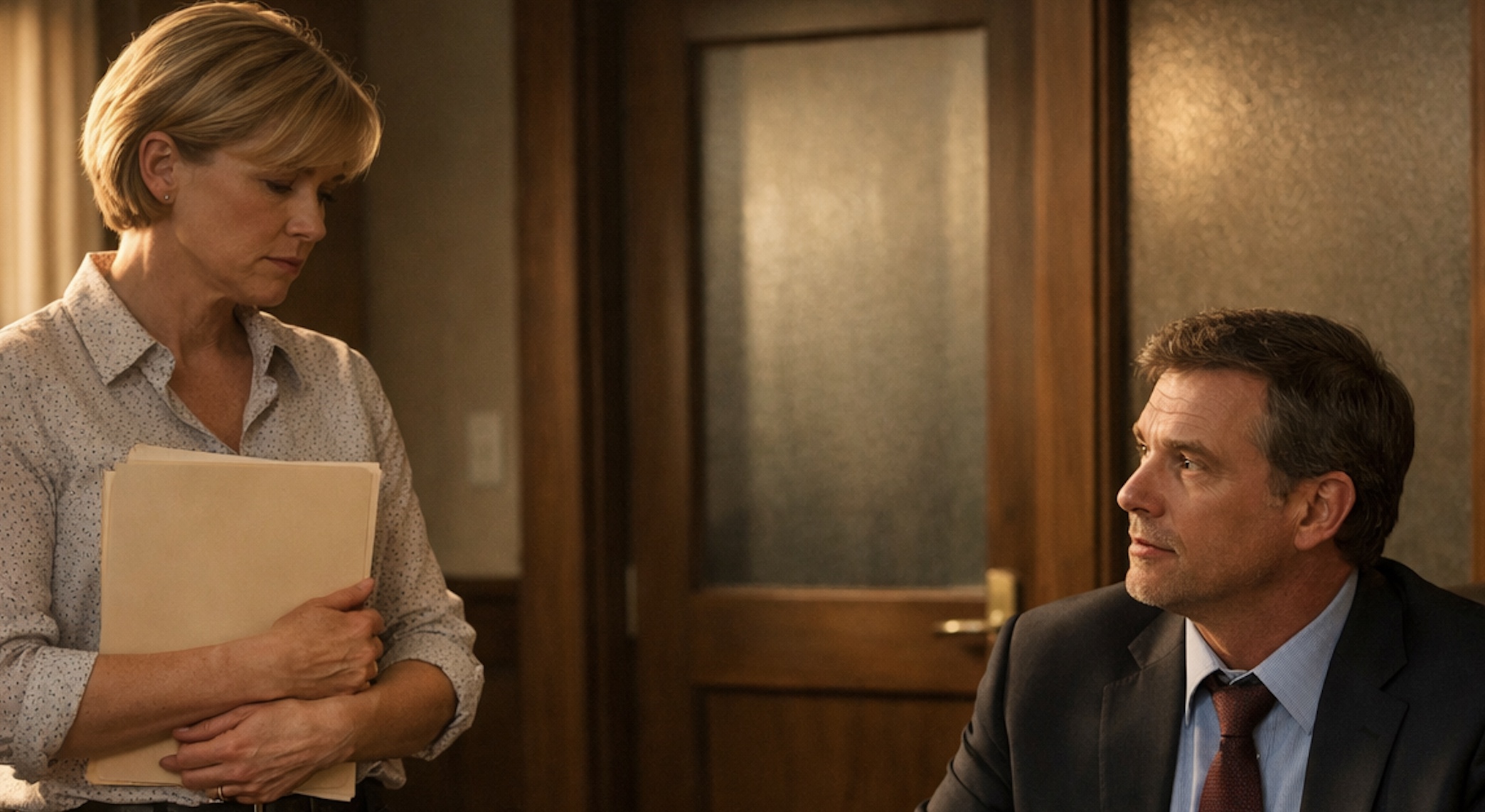
I froze in the doorway, unable to make sense of what I was seeing at first. I just stood there and watched him lift his head from the papers. Watched his hand stop halfway, the pencil still caught between his fingers. Watched him recognize me. And stop moving too.
We had both been in our early twenties when we met. Twenty-three when we got married. Twenty-seven when I left him for someone else. Now I was forty-six. He was forty-eight. And there I was, standing in the doorway of his office with a folder of documents for the division of property with my second husband.
“Marina,” he said.
Not “Marina Svetlova.” Just “Marina.” As if those nineteen years had never happened.
“Denis,” I replied. “Olga Pershina gave me your contact. She didn’t know that we—”
I didn’t finish. He stayed silent too. The pencil was still in his hand.
“Please, have a seat,” he said at last.
That please sounded strange. As if he himself wasn’t sure why he had said it. Or maybe he knew, but chose not to take it back.
I sat down. Put the folder on the desk. The fingers of my right hand automatically searched for the ring finger on my left—the place where a ring had been for so many years. The place where there was only bare skin now. I realized what I was doing and dropped my hand to my knee.
“Tell me about the case,” Denis said.
So I did.
Gennady had filed for divorce in January of last year. He had found someone else—I didn’t understand that right away, but eventually I did. Seventeen years of marriage, and then one day he walked into the kitchen and said we needed to talk. His voice had that careful tone, as if he had rehearsed every word in advance. He probably had.
I hadn’t worked for eight years. “Why would you? I provide for us.” That was always his line. Back then I agreed, because I was tired of office life, the metro, the endless meetings that led nowhere. It had seemed reasonable. Later I realized it had been a trap. Maybe not a deliberate one. But a trap all the same.
The apartment in Moscow was in Gennady’s name. The country house too. His construction business was split between several legal entities in such a way that from the outside all you could see was one small LLC with authorized capital of ten thousand rubles. Officially, we owned almost nothing together. Officially.
While I talked, Denis listened and made notes. He didn’t ask unnecessary questions—only clarified something briefly whenever it wasn’t clear. On his desk stood a tiny cactus in a white pot. For some reason, I kept looking at it while I spoke.
“You understand this is a difficult case,” he said. Not a question. A fact.
“I do,” I said. “That’s why I came to the best.”
He looked at me. I didn’t look away. I don’t know what exactly I meant by “the best” in that moment. A great lawyer, probably. Probably.
“I need time to review the documents.”
“All right.”
I stood up. He rose too—automatically, out of politeness. We stood on opposite sides of the desk, and suddenly I thought: here we are again. Again within arm’s reach. Again looking at each other and not knowing what to say.
Nineteen years ago, I had been the first one to lose the words. I had simply walked away.
“Thank you,” I said, and left.
In the elevator I stared at my reflection in the metal doors—blurred, almost unrecognizable. I thought I should have walked out immediately. Found another lawyer. Told Olga this wasn’t an option. But I hadn’t left. I couldn’t explain why. I just hadn’t.
Three days later, he called. His voice was professional, even. He set a meeting for Thursday and said he had started untangling the property structure and had questions.
I arrived at ten-thirty on Thursday. He was already behind the desk, a printed chart laid out in front of him. The pencil was spinning between his fingers on its own—he clearly didn’t even notice it.
He used to twirl the keys to our old car the same way whenever he was thinking. It usually meant he was working something out and would soon come up with a decision. Back then I was always afraid he’d drop them into the crack between the seats. Once, he actually did.
I pulled myself back. That had been another life.
“Did you find something?” I asked as I sat down.
“A few things. Through the property registry we traced three assets that weren’t listed in the inventory you brought. Two properties in the Moscow region and an apartment on Kotelnicheskaya Embankment. They’re registered to a private individual—a certain Irina Borisovna Svetlanova. Does that name mean anything to you?”
I thought for a moment. Svetlanova. No.
“Possibly a proxy,” he said. “We’ll keep pulling on the thread.”
Then he started explaining everything methodically, point by point. I listened and watched his hands. Broad fingers, short nails. I thought: in the details, he hasn’t changed. He had aged, of course. His shoulders slouched a little now—not from exhaustion, but like a tall man who had spent years learning to make himself take up less space. But something remained the same. The same steadiness. The same habit of pausing before answering.
“Marina?”
I looked up. He was watching me.
“Sorry. I drifted off.”
“I asked whether you have access to his personal email or messaging accounts.”
“No. He always kept his phone with him.”
“I see,” Denis said. “That’s not critical. Official requests will be enough.”
He made a note. Then, without lifting his eyes from the page, he added:
“How are you?”
It took me a second to realize he had switched to the informal you.
“I’m all right,” I said. “Managing.”
“Mm,” he replied. And that was all.
We didn’t speak of it again that day.
The next two weeks were all business. He sent requests, I answered them. We met in the office several times. He explained what he had found, I clarified details. Professional. Clean. Proper.
Every time, I told myself this was just work. That I came here for the case. That there was nothing strange about sitting across the same desk from him and sorting through documents. Nothing strange at all.
And yet sometimes, when he turned pages looking for the right paragraph, I would catch a glimpse of something tucked into the folder on his desk. A photograph, I thought. He would put it away quickly, without making anything of it. Maybe I imagined it. But later, at home, in the silence, I kept thinking about it.
Once, as I was about to leave, he said suddenly:
“You’ve changed.”
I turned back. He was looking down at the papers.
“In a good way,” he added quietly.
I didn’t know how to answer. So I left without saying anything.
Later, in the car, I sat for a long time wondering what he meant. Stronger? More confident? Or just older. Or maybe something else I hadn’t understood. I wanted to understand. But asking felt inappropriate. We were here for the case.
Weren’t we?
Gennady called in the middle of February. I saw his name on the screen and stared at it for several seconds before picking up.
“So you changed lawyers,” he said. He didn’t ask. He stated it.
“I hired a lawyer,” I replied. “I had no other choice.”
“Kraev Denis Igorevich. Your first husband.”
I said nothing.
“You think that’s wise?” Something entered his voice then, something I knew too well. Not anger. Worse. That calm contempt that says: you’re making a mistake, and we both know it.
“He’s my lawyer,” I said.
“Marina. I’m only advising you to think carefully. A good lawyer matters. But a good lawyer with unresolved history—that’s a risk. He may not act in your best interests.”
“You’re suggesting I should choose someone who’ll work against you instead?”
A pause.
“I’m suggesting you use common sense.”
“I am,” I said. “Which is why I’m keeping him.”
I hung up. My hands were perfectly steady. I was surprised by that. A year earlier, that voice—that same careful, condescending tone—would have made me doubt myself. Not because I was afraid of him. Because I had grown used to believing he always knew better. Over time, you get used to many things.
But now I ended the call and felt only one thing: I wasn’t going anywhere.
I told Denis the next day.
“Gennady knows who you are,” I said the moment I stepped into the office. “He called last night. Hinted that you might not be acting in my interest.”
Denis didn’t seem surprised. He lifted his head from the papers.
“I expected that,” he said. “It’s easy enough for him to pull basic information. Do you want to change lawyers?”
“No.”
He studied me for a second.
“All right,” he said simply.
“Will he try to pressure you?”
“He might. That’s his right. But none of that works unless I let it.”
He lowered his eyes back to the documents. I looked at him and thought that he hadn’t changed in the most important way—in that steadiness. In the way he never fussed. In the fact that when he said, “That’s his right,” there was real calm behind it, not some performance of confidence.
Gennady could be calm too. But his calmness had always been about power. This was different.
“Thank you,” I said.
“It’s nothing. It’s my job.”
But I understood he didn’t mean only the job. Otherwise he would have just nodded.
Gennady called again a week later. By then Denis had received an official letter from Gennady’s lawyer proposing a settlement before trial. Denis went through every point with me over the phone, slowly and clearly.
“This offer,” he said, “means you get the Moscow apartment and eight hundred thousand rubles. One payment. No further claims.”
I said nothing.
“The apartment is worth around twenty million,” he continued. “By our estimates, the portion of the marital property we can realistically prove and recover is about forty-five million. That’s without the Kotelnicheskaya apartment—we’re still working on that.”
“So he’s offering me about one-fiftieth of what’s real,” I said.
“Roughly.”
“What do you think?”
A brief pause. I realized he hadn’t expected me to ask for his opinion.
“I think you shouldn’t agree,” he said. “But the decision is yours.”
“I won’t agree.”
“Good.”
“Denis.”
“Yes.”
“Did you know from the start that this would be complicated?”
“I suspected it. Asset-hiding schemes aren’t exactly unusual in cases like this.”
“Is it hard for you?”
He was quiet for a moment.
“No. It’s my work. I like it when it’s done properly.”
I ended the call and sat by the window for a long time. Outside, February pressed against the glass—gray, not even a hint of spring yet. I thought about how I had left Denis back then because I was afraid. Not of him—of the money behind Gennady. Denis and I had loved each other for real, but we were twenty-seven, living in a tiny one-room apartment, and one day I added up our salaries, our expenses, our uncertain future and decided that love might be beautiful, but it wasn’t enough.
It was the stupidest thought of my life. I understood that much later. When there was no longer any point in understanding it.
And now I was sitting by the window in Gennady’s apartment—the apartment I still had to win back—and waiting for February to turn into something else.
At the next meeting Denis brought another printout. They had finally managed to connect the apartment on Kotelnicheskaya Embankment to Gennady through a chain of transactions. Irina Borisovna Svetlanova turned out to be a distant relative of his business partner. It was something they could prove.
I looked at the documents and couldn’t focus. I watched him trace lines of text with his finger while he explained. There was a small scratch on the back of his hand—fresh, reddish. I didn’t ask where it had come from.
“Marina, are you listening?”
“I am. Kotelnicheskaya. Eighteen million estimated value.”
“Approximately,” he said. “And we found another property in the Moscow region, registered to a company that has technically been bankrupt for three years, but is still functioning in practice. We’ll challenge that too.”
I nodded. Then, unexpectedly, I said:
“I didn’t realize how much he had hidden.”
Denis looked up.
“You lived with him for seventeen years,” he said. “I don’t think you were obligated to understand his business schemes.”
“I just didn’t want to see it. That’s different.”
He was silent for a moment. Then said:
“That happens.”
“Did it happen to you too?”
The question slipped out before I could stop it.
He didn’t answer right away. He picked up the pencil and laid it down on the desk. Very carefully.
“It did,” he said at last.
We looked at each other. For the first time in all those weeks, really looked. Not like lawyer and client. Just like two people who had once known each other deeply and had spent all this time pretending otherwise.
“Denis,” I said. “I want to ask your forgiveness.”
He stood up. Walked to the window. Stood with his back to me.
“You don’t have to,” he said.
“I do. I left, and I never even explained it properly. I just disappeared. It was cowardly.”
“Marina.”
“What?”
“Nineteen years have passed. You don’t owe me an explanation.”
“I know I don’t. But I want to.”
He turned around. Looked at me for a long time.
“All right,” he said. “I’m listening.”
And I told him. Not everything—some things still refuse to become words even after all this time. But I told him the important part. That I was scared. That I decided money mattered more. That afterward I spent a long time convincing myself I had done the right thing. And that one day I stopped trying to convince myself and simply went on living without thinking about it.
He listened. Didn’t interrupt. When I finished, he said:
“I understood, eventually. Not right away, but I did.”
“Were you angry?”
“For a long time. Then I wasn’t.”
“And after that?”
He paused for a moment.
“I just lived,” he said.
There was something very honest in that answer. Not hurtful. Just honest. I didn’t ask anything else.
We went back to the documents. But something in the office had changed. It was easier to breathe now, as if someone had cracked open a window.
“Denis,” I said before leaving.
“Yes.”
“You never asked why I stayed. I mean why I didn’t change lawyers.”
He looked up.
“I decided I wasn’t going to run anymore,” I said. “In the broadest sense. Not just in this.”
He looked at me and said nothing.
But I could see that he had heard me.
A few days later I called Olga, just to talk.
“So how’s your lawyer?” she asked.
“He’s doing a good job.”
“I told you. Best family attorney in the city.”
“How do you know him?” I asked.
“He handled Natalia Gromova’s aunt’s cousin’s divorce three years ago. Won her everything down to the last ruble, and her husband was a real snake. You’re lucky he took the case.”
I was quiet for a moment.
“Olga,” I said. “You don’t know who he is.”
“Kraev Denis? Attorney, Zamoskvoretsky district, high online rating—”
“He’s my first husband.”
Silence.
“What?!”
“Olga.”
“Marina, I swear I had no idea. I didn’t even remember his last name. You always just said ‘my first husband’ and never anything more—”
“I know. It’s not your fault.”
“But you’re still working with him?”
“Yes.”
She was quiet for a few seconds.
“All right,” she said at last. “All right. You know what you’re doing.”
“Exactly.”
I smiled without even knowing why. It just happened.
The court date was set for the end of March.
By then the case looked completely different than it had in January. In two months, Denis had dragged so much into the light that Gennady, through his lawyer, came back with another settlement offer—this time on very different terms. The amount had tripled. Denis laid out the figures for me, and once again I asked what he thought.
“You’re much closer to the real number now,” he said. “But the court will most likely award more.”
“How much more?”
“Hard to say precisely. There are always risks. But our position is strong.”
I thought for a moment.
“We go to court,” I said.
“All right.”
“You’re not afraid? He’ll try to pressure you there too.”
“Let him,” Denis said. And there was something in his voice that made me believe him.
A few days before the hearing, he called late in the evening. That surprised me—he usually texted.
“The Kotelnicheskaya documents. I found another contract, and it changes the picture. But I need one answer—do you remember what year Gennady re-registered the company?”
I strained my memory.
“2016, I think. Or 2017. Wait—I should have a copy.”
“Take your time.”
I searched through my phone. Found it.
“March 2017.”
“Perfect. That’s what I needed. Thank you.”
“Denis.”
“Yes.”
“Will everything be all right?”
A small pause.
“I’m glad you didn’t leave then. I mean the case. That you didn’t change lawyers.”
He said then, and I understood he could have meant different things. Maybe just the day Gennady called. Maybe something larger than that.
“I’m not running anymore,” I said.
He was quiet for a moment.
“Good,” he said softly. “Good night.”
“Good night.”
Afterward I lay in bed staring at the ceiling. I thought about how only a few months earlier, when Gennady had said, “We need to talk,” I had been a completely different person. Someone used to letting others know better. Used to yielding. Used to not asking too many questions.
Back then I had no idea what would come next. I certainly wasn’t thinking about Denis—how could I have known? I had gone to a lawyer because I wanted to defend what was mine.
But somewhere between January and March, something else happened too. I became interesting to myself again. It sounds strange, probably. But that’s exactly what it was. I began once more to think about what I wanted. Not what was possible, not what was reasonable—what I wanted.
It felt unfamiliar.
And wonderful.
On the day of the hearing I woke at six in the morning. Got dressed, drank coffee, rode the metro and stared into the black tunnel reflected in the train window. I thought about many things. About how in a few hours something would end—seventeen years of one life. About what I would say to myself at twenty-seven, to the woman I had been when I made those choices. Probably nothing dramatic. Just: wait. Don’t rush. Fear lies sometimes.
Denis was already in the courtroom when I arrived. He looked at me and nodded. I nodded back.
Gennady was there too—with two lawyers, in a dark suit, wearing that same expression I had known for ten years at least. Slightly condescending. The kind that says: I already know how this ends.
He was wrong.
It took four hours.
Denis spoke calmly, without wasting words. He knew the case inside and out—every document, every date, every number. When Gennady’s lawyers tried to challenge the apartment on Kotelnicheskaya, he answered in a way that left no room for objection. The judge listened carefully, occasionally asked for clarification. Denis clarified—briefly, precisely.
I sat there and thought: this is him working. This is what he does. Not putting on a show. Not pressuring anyone. Just doing well what he knows how to do. And it turns out that is far stronger than any display of force.
The ruling was in my favor.
When it was over and we stepped into the hallway, Gennady passed by without looking at me. His lawyers were murmuring something to him under their breath. I didn’t watch them go.
Denis stood beside me, putting papers back into his folder.
“Congratulations,” he said.
“It was you,” I replied.
“We,” he corrected.
I laughed—just from surprise. I hadn’t known he could reframe something so simply.
“I’m glad you didn’t back down,” he added quietly, without looking at me.
I didn’t answer. I simply stood there beside him, listening as the noise in the corridor slowly faded.
There was a café across the street from the courthouse. Small, with fogged-up windows and a coffee machine you could hear from outside.
“Coffee?” Denis asked.
“Yes,” I said.
We sat by the window. Two cups were set in front of us. Neither of us hurried to drink. Outside, a fine rain was falling—the first true rain of spring, the kind that smells not of snow anymore, but of earth.
“So what now?” he asked. He meant the apartment. The next legal steps. What came after.
“I’m not sure yet,” I said.
We both fell silent. He looked at his cup. I looked at the rain on the other side of the glass.
Then I noticed his eyes drifting to my left hand. To the place I myself had looked at first thing that morning—my ring finger. Just skin. I had stopped touching that spot a few weeks earlier without even realizing it. As if I had finally let go of something that had long since become nothing but habit.
He looked away. Said nothing.
“Denis,” I said.
“Yes.”
“You never married after me?”
He was quiet for a moment. Then he said:
“No.”
“Why not?”
He thought for a little while. Not like someone inventing an answer, but like someone choosing among several truthful ones.
“There was no reason to hurry,” he said at last.
I didn’t ask anything else. We both understood it wasn’t the whole answer. But it was what he was ready to say now. And it was enough for me.
The rain outside grew heavier. Trails of water slid down the glass. The coffee had cooled a little, but still neither of us rushed.
“They told me to go to the best,” I said suddenly.
He turned to me.
“What?”
“On the first day. I told you Olga had recommended the best. Remember?”
“I remember.”
“She was right.”
He looked at me. Something shifted in his face—not much, just a little.
“In what sense?” he asked.
“In both,” I said.
He didn’t answer right away. He picked up his cup. Took a sip. Set it back down. Then he did something I hadn’t expected at all—he simply placed his hand over mine. Just for a moment. Three seconds, maybe. Then he withdrew it.
“I don’t know yet,” he said.
I smiled. Because that—exactly that, that I don’t know yet instead of yes or no—was the answer I could live with. The door was open. Nothing had been promised. But nothing had been shut, either.
Outside, the rain kept falling. The first rain of spring. The kind that promises nothing yet—just falls, smells of wet earth, and leaves everything still ahead.